
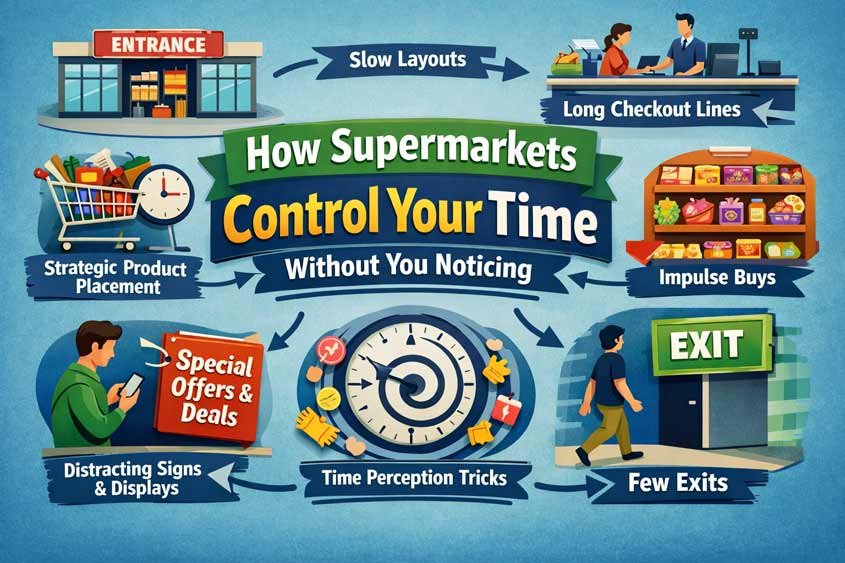
You Thought You Were Browsing. You Were Being Slowed Down.
You walk into a supermarket with a simple plan. Milk. Maybe bread. In and out in five minutes.
Ten minutes later, you’re still there. Not rushing. Not even thinking about rushing. You’ve slowed down, almost without noticing. You pick something up. Put it back. Glance at a nearby shelf. Then another. Somehow, your quick trip starts to stretch.
That shift right there? That’s not random.
It’s engineered.
The idea behind store spending time is simple: the longer you stay, the more you buy. But the way supermarkets make that happen isn’t obvious. They don’t tell you to slow down. They don’t block your path. They shape your movement so subtly that it feels like your own choice.
And your brain plays along.
When you’re in a retail environment, your attention is limited. You don’t analyze every decision. You rely on shortcuts. Familiar layouts. Visual cues. What feels easy. What feels natural. That’s where store design comes in. It doesn’t force behavior. It nudges it.
Think about it. Ever noticed how you rarely sprint through a supermarket, even when you’re in a hurry? Something about the space slows you. Wide paths. Open visibility. A sense that there’s no urgency. You unconsciously match your pace to the environment.
That’s not an accident.
Supermarkets borrow from multiple psychological triggers at once. There’s a bit of choice overload, where too many options make you pause. A touch of visual hierarchy, guiding your eyes where they want attention. Even default bias plays a role, where you stick to the path that feels easiest instead of questioning it.
And then there’s time itself. Or more precisely, your perception of it.
When your environment is calm, structured, and slightly stimulating, your sense of time stretches. Minutes don’t feel like minutes. You don’t feel rushed, so you don’t act rushed. And when you’re not rushing, you’re browsing.
That’s the real goal.
Not just to get you inside the store. But to keep you there just long enough for your intentions to soften. For your list to blur a little. For “I need this” to quietly turn into “I might as well grab that too.”
Once you see it, it’s hard to unsee.
Every aisle width. Every turn. Every small moment where you pause without realizing why. It all feeds into one outcome: increasing your store spending time without ever making you feel controlled.
And that’s where things get interesting.
Table of Contents
Wide Aisles in High Traffic Areas
Walk into almost any supermarket and pay attention to the first few aisles you hit. Fresh produce. Bakery. Maybe ready to eat meals. Notice anything?
Space.
You’re not squeezed. You’re not rushed. You’re given room to move, to drift, to pause without bumping into someone every two seconds. It feels comfortable. Easy. Almost… inviting.
That’s not generosity. That’s strategy.
Wide aisles in high traffic areas are one of the most effective ways to increase store spending time, because they quietly change how you behave. When you have more physical space, you naturally slow down. There’s no pressure to keep moving. No subtle stress telling you to get out of the way. So you linger.
And lingering is where buying happens.
Think about how you move in a crowded, narrow space. Your shoulders tighten a bit. Your focus narrows. You’re trying to get through, not explore. Your brain shifts into efficiency mode. Get what you need. Leave.
Now flip that.
In a wide aisle, your body relaxes. Your pace drops. Your field of vision expands. You start scanning instead of targeting. You notice things you didn’t plan to buy. A stack of strawberries that looks unusually fresh. Fresh bread placed just close enough for the smell to reach you. A promotion sign that catches your eye because you actually have the mental space to process it.
That’s the key. Space doesn’t just affect your movement. It affects your attention.
Retailers know that attention is a limited resource. If you feel rushed or constrained, you stop noticing. And if you stop noticing, you stop buying. So they design high margin, high impulse zones to feel open and low pressure. It gives your brain permission to wander a bit.
There’s also a subtle social effect at play. In wider aisles, you’re less aware of other people as obstacles. You don’t feel like you’re in someone’s way. That reduces friction. And when friction drops, browsing increases. You’re more likely to stop in the middle of the aisle, pick something up, compare options, maybe even double back.
That behavior is gold.
You’ll often see this paired with other psychological triggers. Bright colors in produce sections. Warm lighting near bakery items. Even gentle scent marketing drifting through the space. All of it works better when you’re moving slowly. Speed kills those effects. Slowness amplifies them.
Here’s something interesting. This principle isn’t limited to supermarkets.
Apple stores use wide, open layouts for the same reason. You don’t feel rushed, so you play with the products longer. Clothing retailers create spacious entry zones so you ease into browsing mode. Even car dealerships give you room to walk around vehicles freely, encouraging you to spend more time inspecting, imagining, considering.
More time equals more emotional attachment. More attachment increases the chance of buying.
Back in the supermarket, those wide aisles act like a soft landing. They transition you from “task mode” into “exploration mode” without you realizing it. Your original plan starts to loosen. You’re no longer just executing a list. You’re engaging with the environment.
And once that shift happens, your store spending time starts to stretch.
Not because you decided to stay longer.
Because the store made staying longer feel natural.
Narrow Aisles in Less Important Sections
Now here’s where things get a bit sneaky.
After you’ve slowed down in those wide, comfortable areas, the store quietly flips the script. You turn into another section, and suddenly… it feels tighter. Shelves are closer. People feel closer. You’re adjusting your path more often. You’re not lingering the same way.
That’s not poor design.
That’s control.
Narrow aisles are often placed in sections where the store doesn’t want you to spend too much time. Lower margin products. Everyday essentials. Items you came in for and would likely buy anyway. Think canned goods, cleaning supplies, basic household items.
In these zones, increasing store spending time doesn’t add much value for the retailer. You’re already committed to buying. The goal shifts from exploration to efficiency. So the environment nudges you to move faster.
And it works.
When space tightens, your behavior changes almost instantly. You become more aware of others. You don’t want to block the aisle. You don’t want to awkwardly stand there comparing five versions of the same product while someone waits behind you. So you speed up. You make quicker decisions. You grab what feels “good enough” and move on.
That’s cognitive pressure doing its job.
Your brain is wired to avoid friction. Narrow spaces create just enough discomfort to push you forward without making you consciously annoyed. It’s subtle. You don’t think, “This aisle is designed to rush me.” You just feel slightly less inclined to stay.
So you don’t.
There’s also a decision-making shortcut that kicks in here. When you’re in a constrained space, you’re less likely to engage in deep comparison. You rely more on habits, familiar brands, or whatever is easiest to reach. That ties directly into other psychological triggers like default bias and brand recognition.
You’re not evaluating. You’re selecting.
And that distinction matters.
Because the longer you evaluate, the more chances there are for upselling, cross-selling, or impulse decisions. In these narrow aisles, the store isn’t trying to inspire you. It’s trying to process you.
Move in. Pick. Move out.
You’ll often notice fewer attention-grabbing displays here. Less dramatic lighting. Fewer promotional signs competing for your focus. It’s a quieter environment, but not in a relaxing way. More like a functional corridor than a browsing space.
Even your body language shifts. You angle yourself slightly to pass others. You keep your cart tighter. You glance rather than scan. All small signals, but together they reduce your store spending time in that specific area.
And that’s the point.
If every aisle were wide and immersive, the store would lose control over pacing. You’d spend too long in low value zones and possibly feel fatigued before reaching the high margin sections. So they balance it. Expand where they want attention. Compress where they want flow.
It’s almost like editing a movie.
Some scenes linger. Others cut quickly. The rhythm shapes your experience without you thinking about it.
Same thing here.
You feel like you’re freely moving through the store, making your own decisions at your own pace. But the reality is, your pace is being guided step by step. Accelerated in some places. Slowed down in others.
All to optimize one thing.
How long you stay where it matters.
Strategic Bottlenecks
Just when you think you’ve found your rhythm inside the store, it breaks.
You slow down. Maybe even stop. Not because you planned to, but because something in front of you made that decision for you. A tighter passage. A display island. Two carts trying to pass each other. For a few seconds, you’re stuck.
That moment? That’s incredibly valuable.
Strategic bottlenecks are designed to interrupt your movement and create forced pauses. And those pauses do something wide aisles and narrow aisles alone can’t fully achieve. They make you look.
Not glance. Not skim.
Actually look.
When your movement stops, your attention has nowhere else to go. You’re already there, already waiting, already present. So your brain starts scanning the immediate environment. Products you would have walked past suddenly get a few seconds of real consideration.
And in retail, a few seconds is a lot.
This is where store spending time becomes very precise. It’s no longer about keeping you in the store longer overall. It’s about slowing you down at exact points where your attention is most valuable.
You’ll usually find these bottlenecks in transition zones. Between categories. Near promotional displays. Around high margin products. End of aisle areas are a classic example. You turn the corner and there’s a stack of discounted items, or something labeled as “best seller.” Right as your path narrows slightly and foot traffic converges.
You pause. Even if just for a moment.
And that’s enough.
Because during that pause, several psychological triggers stack on top of each other. There’s social proof if the area is busy. You see other people stopping, picking things up, adding them to their carts. That signals value without a single word being said.
There’s loss aversion if there’s a limited time offer or a bold discount sign. You don’t want to miss out, especially when the product is right there, within reach, and you’ve already stopped.
There’s even a bit of mere exposure effect happening. The longer you’re physically near a product, the more familiar it feels. And familiarity quietly increases preference.
All of this unfolds in seconds.
What’s interesting is that these bottlenecks rarely feel aggressive. You’re not being blocked in an obvious way. It’s just slightly inconvenient movement. Just enough friction to pause you, not enough to frustrate you.
That balance is critical.
Too much congestion and you get annoyed. You rush through or avoid the area entirely. Too little and the effect disappears. The store loses that moment of captured attention.
So they fine tune it.
A display placed just off center. A pallet positioned to narrow the path slightly. A popular product located where foot traffic naturally compresses. It all creates micro interruptions in your flow.
And those interruptions add up.
You might only stop for three or four seconds at each point. But across an entire store visit, those moments stack into minutes of additional store spending time. More importantly, they increase the number of products you actually notice.
Not just pass by.
Notice.
And once something is noticed, it has a chance to be considered. Once it’s considered, it has a chance to be added to your cart.
That’s the chain reaction.
Movement gets interrupted. Attention gets redirected. Decisions get influenced.
All without a single direct instruction.
From your perspective, you just paused because it felt natural. Maybe someone was in your way. Maybe you were adjusting your cart. Nothing unusual.
But from the store’s perspective, that pause was placed there.
Exactly where they wanted it.
You Didn’t Spend More Time by Accident
You probably didn’t walk into the store thinking, “I’ll spend 20 extra minutes here today.”
And yet… you did.
Not in one obvious chunk. Not in a way that felt deliberate. It happened in fragments. A slower step here. A quick توقف there. A moment of hesitation in front of something you didn’t plan to buy. Nothing dramatic on its own.
But together, those moments stretched your store spending time far beyond what you intended.
That’s the part most people miss.
Supermarkets don’t rely on one big trick. They stack small, almost invisible adjustments that shape how you move, how long you stay, and what you notice along the way. Wide aisles ease you into a slower pace. Narrow aisles push you forward when lingering isn’t valuable. Bottlenecks interrupt your flow just enough to capture your attention at the right moment.
It’s a rhythm.
Slow down. Speed up. Pause. Look. Move again.
And you follow it without realizing you’re being guided.
What makes this powerful is that none of it feels forced. You never feel controlled. You feel… comfortable. Natural. Like you’re just shopping the way you always do. That’s why it works so well. The less you question the environment, the more influence it has over your behavior.
By the time you reach the checkout, your basket tells the real story.
A few extra items. Maybe more than a few. Things you didn’t plan for, but somehow justified along the way. That’s not just impulse. That’s the result of extended exposure, repeated attention, and subtle psychological nudges working together.
Even your perception of time plays a role. Without clocks, without windows, with a steady flow that keeps you engaged but not overwhelmed, your internal timer drifts. You don’t feel how long you’ve been there. And if you don’t feel it, you don’t resist it.
That’s the game.
Once you see how store spending time is designed, you start noticing it everywhere. Not just in supermarkets. In malls. In showrooms. In any space where movement can be shaped and attention can be directed.
So next time you walk in “just for one thing,” pay attention to your pace. Notice where you slow down. Where you speed up. Where you stop without meaning to.
Because chances are, none of that happened by accident.
And once you see it, you get to decide how much of it you play along with.

Gabriel Comanoiu is a digital marketing expert who has run his own agency since 2016. He learned marketing by testing, analyzing, and refining campaigns across multiple channels. In his book series Impulse Buying Psychology, he shares the psychological triggers behind every purchase, showing how to create marketing that connects, persuades, and converts.