
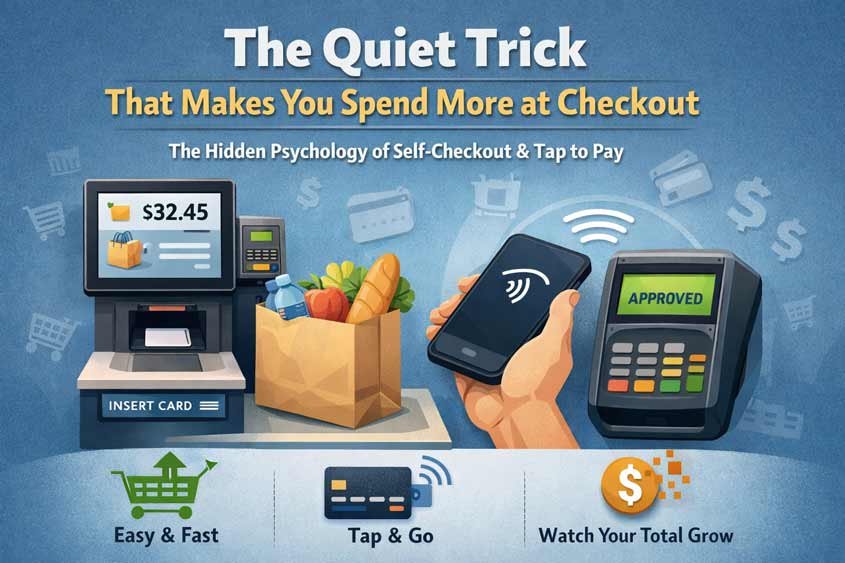
Why Paying Feels Easier Than It Should
You ever walk out of a supermarket, look at the receipt, and think… wait, how did it get this high?
Not because you bought something crazy. Just… more than expected. A few extras. A snack. Maybe two. Nothing dramatic. And yet, the total feels slightly off, like it climbed without asking for permission.
That moment isn’t random. It’s engineered.
Supermarkets don’t just focus on what you buy. They care just as much about how you pay. Because the way you pay changes how you feel. And how you feel changes how much you spend. That’s where payment friction reduction comes in. It’s not some abstract concept. It’s a quiet system designed to make spending feel easier, smoother, almost invisible.
Here’s the core idea. Paying hurts. Literally. Studies in consumer psychology show that parting with money triggers a mild emotional discomfort, often called the pain of paying. Cash makes it obvious. You see it leave your hand. You feel the loss. Your brain registers it clearly.
So what do retailers do?
They remove that friction.
They shorten the time between decision and payment. They strip away the physical cues of money. They reduce the small pauses where doubt could sneak in. Because doubt is dangerous. Doubt is where you start asking questions like “Do I really need this?” or “Is this worth it?”
And if you ask those questions, you buy less.
Payment friction reduction works by keeping you from asking.
Think about the full journey. You’ve already been influenced before you even reach the checkout. Store layout nudges your path. End-of-aisle displays catch your eye. Scarcity signs whisper “last chance.” Familiar brands feel safer because you’ve seen them a hundred times. By the time you’re ready to pay, your basket is already shaped by dozens of small psychological pushes.
Now comes the final step. The most sensitive one.
The payment.
This is where the supermarket either reinforces your decisions… or risks losing them. If paying feels slow, effortful, or too real, your brain gets a second chance to reconsider everything. That’s a problem for the store.
So they make sure it doesn’t happen.
They make paying fast. Frictionless. Almost forgettable.
And once you start noticing it, you can’t unsee it.
Ready to look at how they actually do it?
Table of Contents
Speed Kills Doubt: The Power of Fast Payment
You reach the checkout. Basket full. Brain slightly tired. You’ve already made dozens of small decisions. What brand. What size. What feels “worth it.” At this point, you’re not in a highly analytical mood. You’re running on momentum.
And that’s exactly when payment friction reduction does its best work.
Self-checkout looks like a convenience feature. And sure, on the surface, it is. Fewer queues. More control. Faster exits. But underneath that, there’s a very specific psychological function: it compresses time between wanting something and paying for it.
That compression matters more than most people realize.
Because the longer the gap between decision and payment, the more likely you are to rethink. Even a few extra seconds can trigger a different mental process. You go from “I’ll take it” to “Do I actually need this?” That shift is dangerous for retailers. It introduces doubt. And doubt reduces spending.
So what do self-checkout systems do?
They remove that gap almost entirely.
You scan. You bag. You tap. Done.
No small talk. No waiting for a cashier. No idle time staring at your items, mentally reviewing them one by one. The whole process becomes fluid, almost automatic. Payment friction reduction turns the checkout into a continuation of shopping, not a separate moment where decisions get evaluated.
It’s subtle, but powerful.
Now think about traditional checkouts for a second. You place your items on the belt. They move slowly toward the cashier. There’s a rhythm. A pause between each scan. You watch the total climb, item by item. That pace creates awareness. It gives your brain space to react.
You notice things.
“Wait, that’s more expensive than I thought.”
“Do I really need two of these?”
Even if you don’t act on it, that awareness is there. It creates friction.
Self-checkout removes that rhythm.
You’re in control of the scanning speed, and most people go faster than a cashier would. Not because they’re in a rush, necessarily. It just feels natural. Tap, swipe, beep, bag. Repeat. There’s a certain flow to it. Almost like a game. And once you’re in that flow, you’re not stopping to reflect. You’re completing a task.
That’s a key shift.
You’re no longer evaluating purchases. You’re executing them.
Payment friction reduction thrives in that shift from thinking to doing.
There’s another layer here too. Responsibility.
At a traditional checkout, the cashier is the one scanning your items. There’s a tiny psychological distance between you and the act of paying. At self-checkout, you’re doing everything yourself. You might think that would increase awareness, maybe even restraint.
In reality, it often does the opposite.
Because the process becomes mechanical.
When actions are repetitive and predictable, your brain uses less energy. It goes on autopilot. Scan. Bag. Pay. There’s no emotional spike tied to each item. No moment that says “this is costing you something.” The pain of paying gets diluted across the process.
And when pain is reduced, spending goes up.
You see the same principle in other industries. Fast food chains push mobile ordering. One click, no queue. Streaming platforms let you subscribe in seconds. Ride apps remove the need to physically hand over money. In each case, payment friction reduction shortens the path between desire and transaction.
Less friction, more action.
Supermarkets just happen to apply it in a very physical environment.
Now add one more detail that often goes unnoticed. The absence of interruption.
At a staffed checkout, interruptions are built in. The cashier pauses. Maybe there’s a price check. Maybe the card machine takes a second longer. Maybe someone in front of you has an issue. All of these micro delays break momentum. They give your brain time to drift back into evaluation mode.
Self-checkout systems are designed to avoid that.
Everything is optimized for continuity. Even the interface. Big buttons. Clear instructions. Minimal steps. It’s not just about speed. It’s about maintaining flow from start to finish. Because once the flow is broken, friction returns. And once friction returns, spending becomes more conscious.
That’s not what the system wants.
There’s also something slightly uncomfortable here, if you think about it long enough. You’re doing the work. Scanning, bagging, and processing your own purchase. Tasks that used to belong to the store. And yet, the experience feels easier, not harder.
That’s not an accident either.
When you feel in control, you perceive the process as smoother. Even if you’re technically putting in more effort. That perceived ease reinforces the whole system. You leave faster. You feel efficient. You don’t dwell on what you spent.
And that’s the end goal of payment friction reduction.
Not just to make payment faster. But to make it forgettable.
The less you remember the act of paying, the less it influences your future decisions.
Next time you’re at a self-checkout, try something simple. Slow down. Scan one item. Pause. Look at it. Ask yourself if you’d still buy it if you had to hand over cash for it, physically.
Feels different, right?
That difference is the friction that’s been quietly removed.
When Money Stops Feeling Real
Tap. Done.
No counting. No change. No moment where your wallet gets lighter in a way you can actually feel. Just a quick vibration, maybe a soft beep, and you’re already walking away.
That’s payment friction reduction at its cleanest.
Contactless payments don’t just make transactions faster. They change what money feels like. Or more precisely, they strip away most of the feeling altogether.
Cash is physical. It has weight. Texture. You see it leave your hand. You watch it disappear. Your brain registers that loss in a very concrete way. That’s why paying with cash tends to hurt more. The transaction is visible, tangible, hard to ignore.
Contactless removes all of that.
Your card stays in your hand. Or doesn’t even leave your pocket if you’re using your phone. There’s no visual subtraction. No physical exchange. The money doesn’t feel like it’s going anywhere, even though it is. And because your brain relies heavily on sensory cues to evaluate situations, that missing feedback matters.
Less feedback means less emotional reaction.
Less emotional reaction means less resistance to spending.
That’s the mechanism behind payment friction reduction in contactless systems. It abstracts money. Turns it into something closer to a number than a resource. And numbers, on their own, don’t trigger the same instinctive caution.
You can see this effect clearly when people switch payment methods.
Ask someone how much they spent after a cash shopping trip. They’ll usually give you a fairly accurate estimate. They remember the notes they handed over. The sequence of payments. It sticks.
Now ask the same person after a contactless-heavy trip.
The answer gets fuzzy.
“I don’t know… around this much, I think.”
That gap isn’t carelessness. It’s design.
When spending becomes less memorable, it becomes easier to repeat.
There’s another layer to this, and it’s about timing. With cash, the cost is immediate and undeniable. You give something up in the exact moment you receive the product. That tight connection reinforces the idea of exchange.
With contactless, especially when tied to bank accounts or credit, that connection loosens.
You tap now. The actual impact registers later. Maybe hours later. Maybe when you check your balance. Maybe when the monthly statement comes in. That delay creates psychological distance. And distance reduces the pain of paying.
Payment friction reduction isn’t just about speed. It’s about shifting when the cost feels real.
Push it far enough, and the transaction starts to feel almost consequence-free in the moment.
That’s why small, frequent purchases become so easy to justify. A snack here. A drink there. Something you didn’t plan, but it’s “just a few lei.” Each decision feels minor in isolation. And because contactless removes friction, there’s nothing slowing down that chain of small yeses.
Stack enough of those, and the total quietly grows.
Supermarkets lean into this environment in subtle ways. Products near the checkout are often low-cost, impulse-driven. Gum, chocolate, drinks. Items that don’t require much deliberation. Pair that with a payment method that doesn’t trigger spending pain, and you’ve got a near-perfect setup for impulse buying.
You see it. You grab it. You tap. Done.
No internal negotiation.
And this doesn’t exist in isolation. It connects with other psychological triggers already at play. Scarcity cues make you feel like you might miss out. Familiar brands lower your guard because they feel safe. Price anchoring makes certain items seem like good deals, even when they’re not. By the time you reach payment, your decisions have already been shaped.
Contactless just makes sure nothing interrupts them.
There’s also something interesting about how contactless changes your perception of value. When you don’t physically part with money, the mental link between price and sacrifice weakens. Ten lei doesn’t feel like ten lei in cash. It feels lighter. Less significant.
That shift might seem small, but across dozens of purchases, it adds up.
And retailers know it.
That’s why contactless adoption has been pushed so aggressively across industries. Not just in supermarkets. Cafés, taxis, vending machines, online platforms. Anywhere a transaction can be simplified, it usually is. Because simpler payments lead to more frequent payments.
It’s a direct line.
Less friction → less pain → more spending.
There’s no mystery there.
If you want to test this on yourself, try a simple experiment. For one week, pay in cash for everything at a supermarket. Same habits. Same types of purchases. Just switch the payment method.
You’ll notice two things almost immediately.
First, you hesitate more. Even on small items.
Second, you remember your spending more clearly.
That’s the friction coming back.
And once you feel it again, it’s hard to ignore how different contactless really is.
Payment friction reduction doesn’t force you to spend. It doesn’t need to. It just removes the small psychological barriers that normally keep your behavior in check.
And when those barriers disappear, your decisions change.
Quietly. Consistently. Predictably.
You Didn’t Pay Faster by Accident
By the time you finish a shopping trip, the most important moment has already happened without you really noticing it. Not the decision to buy. Not even what went into the basket. It’s the moment you paid.
Because that’s where everything either slows you down or quietly pushes you forward.
Payment friction reduction isn’t a single trick. It’s a system built from small design choices that all aim in the same direction. Faster checkout. Fewer interruptions. Less visible money. Less time to think. Each piece removes a little resistance from the act of spending.
And when resistance disappears, behavior changes.
Self-checkout shortens the space between action and payment. Contactless payments remove the physical reality of money leaving your hand. Together, they compress the entire experience into something smooth enough that your brain barely pauses to evaluate it.
You don’t get the same natural checkpoints where you would normally reconsider a purchase.
That matters more than it looks like on the surface.
Because most spending decisions are not made in one big conscious moment. They are shaped through a sequence of small approvals. “Sure.” “Why not?” “It’s just this once.” When payment friction reduction speeds everything up, those micro-decisions stack without interruption. You move from desire to completion before doubt has time to form properly.
There’s also a quieter shift happening in how you remember the experience. Fast payment systems reduce the emotional imprint of spending. You don’t recall handing over cash. You don’t remember the pause where you hesitated. You mostly remember the outcome: you got your items and left quickly.
That weak memory matters.
When spending doesn’t feel emotionally significant, it becomes easier to repeat. Not because you’re careless, but because the feedback loop is softer. Less friction in the moment leads to less reflection afterward. And less reflection means fewer internal checks the next time you shop.
This is where supermarkets are most effective. Not in persuading you to buy something specific, but in shaping the conditions where buying feels normal, automatic, and expected. Payment friction reduction doesn’t change your goals. It changes how much attention you give to your decisions.
And attention is the real currency here.
Once you start noticing this pattern, it becomes hard to ignore. The speed of the checkout line. The simplicity of tapping instead of paying. The way a full basket suddenly turns into a finished transaction with almost no emotional weight attached to it.
It’s not that you lost control. It’s that control was never taken away dramatically. It was softened, step by step, until it stopped feeling necessary in the moment.
So next time you leave a store and your purchase feels slightly bigger than you expected, don’t just think about what you bought.
Think about how you paid.
Because that part wasn’t accidental.

Gabriel Comanoiu is a digital marketing expert who has run his own agency since 2016. He learned marketing by testing, analyzing, and refining campaigns across multiple channels. In his book series Impulse Buying Psychology, he shares the psychological triggers behind every purchase, showing how to create marketing that connects, persuades, and converts.