
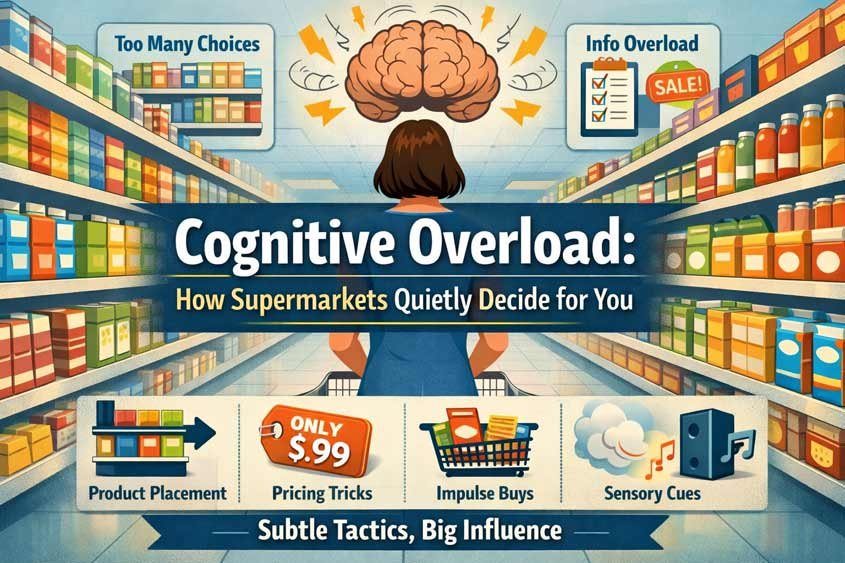
When Your Brain Gets Tired, Your Wallet Opens
Walk into a supermarket and you feel like you’re in control. You’ve got a list. Maybe a budget. A rough plan. In your head, it’s simple. Get in, grab what you need, get out.
But within a few minutes, something shifts.
You slow down. You hesitate. You start comparing. Prices, brands, sizes, flavors, discounts. Suddenly, you’re not just buying pasta, you’re choosing between twelve versions of it. Whole grain, organic, gluten free, premium, store brand, discounted, family pack. Each one asking for a tiny decision.
This is where cognitive load in decision making quietly takes over.
Your brain has a limited capacity for processing information. Every choice you make consumes a bit of that capacity. Psychologists have studied this for decades. When the number of decisions increases, the quality of those decisions tends to drop. Not because you’re careless, but because your mental energy gets depleted.
Supermarkets are designed around this reality.
They don’t reduce complexity. They increase it. More options. More signs. More “deals.” More comparisons. It feels like freedom, but it’s actually pressure. And under pressure, your brain looks for shortcuts.
You stop analyzing deeply. You simplify.
You reach for what feels familiar. Or what’s easiest to grab. Or what stands out the most. Maybe it’s a product at eye level. Maybe it’s something labeled “best seller.” Maybe it’s part of a bundle that feels like a deal, even if you didn’t plan to buy it.
That’s not random. That’s strategy.
Retailers understand cognitive load in decision making at a very practical level. The longer you stay in a high-choice environment, the more likely you are to rely on mental shortcuts. And those shortcuts can be guided.
This is where other psychological triggers quietly blend in.
Loss aversion nudges you toward discounts you don’t want to miss.
Scarcity signals create urgency when stock looks low.
Social proof reassures you that others already made the choice.
All of these work better when your brain is tired.
Think about the last time you went shopping for something simple and left with more than you planned. It probably didn’t feel like a mistake. It felt justified. Reasonable, even.
That’s the effect.
Cognitive load in decision-making doesn’t force you to buy. It changes how you decide. It shifts you from deliberate thinking to automatic behavior. From “What do I actually need?” to “This seems fine.”
And supermarkets don’t need you to notice it. In fact, it works best when you don’t.
Once you start paying attention, though, it’s hard to unsee.
Because the moment your brain gets tired, it doesn’t just want to decide. It wants to be decided.
And that’s exactly the moment when influence becomes easiest.
Table of Contents
Too Many Choices, So You Stop Choosing Carefully
You stand in front of a shelf, looking for something simple. Let’s say yogurt. Should take ten seconds, right?
Instead, you’re hit with rows of options. Different brands. Different fat percentages. Protein added. No sugar. Fruit flavors. Greek, regular, drinkable. Large tubs, small packs, multipacks. And then the labels start talking to you. “High protein.” “Natural.” “Limited edition.” “-20% today.”
At some point, you stop comparing.
That moment matters more than you think.
This is choice overload, one of the clearest examples of cognitive load in decision making. When the number of options crosses a certain threshold, your brain shifts gears. It stops trying to find the best option and starts trying to reduce effort.
You simplify.
And simplifying sounds smart. Efficient. Even rational. But in this context, it usually means one thing. You’re no longer choosing based on what fits you best. You’re choosing based on what’s easiest to process.
Familiar brands suddenly feel safer. You’ve seen them before, maybe bought them once, maybe just recognize the logo. That recognition acts like a shortcut. Your brain goes, “We know this. Good enough.”
That’s the mere exposure effect creeping in, but we’ll get deeper into that later.
Promoted items work the same way, just faster. Bright labels. Discount tags. “Best seller” signs. They grab attention and reduce the need to think. Instead of scanning ten options, your brain locks onto one and moves on. Decision done.
Supermarkets don’t reduce options because more choice increases perceived value. It creates the feeling that you’re in control, that you’re selecting exactly what you want. But behind that feeling, cognitive load in decision-making is doing quiet work.
There’s a well-known study often cited in consumer psychology. Shoppers faced with 24 types of jam were less likely to buy than those shown only 6. More options attracted attention, but fewer options drove action. Why? Because too many choices slow you down and drain your mental energy.
Retailers take that insight and tweak it, not by reducing options entirely, but by structuring them.
They cluster products in ways that look abundant but guide your attention to a few key items. Eye-level placement. End caps. Slightly better lighting. Subtle differences, but they matter when your brain is overloaded.
And here’s where it gets interesting. Choice overload doesn’t just make you pick faster. It changes what you pick.
You become more risk averse. You avoid unfamiliar products. You skip trying something new, even if it might be better or cheaper. Exploration requires effort, and under high cognitive load, effort is exactly what you’re trying to avoid.
So you default to safe options.
Big brands win here. Not always because they’re better, but because they’re easier. Easier to recognize, easier to justify, easier to grab without second-guessing.
Promotions ride that same wave. A “2 for 1” deal or a bold discount tag doesn’t need to be perfect. It just needs to stand out at the right moment, when your brain is already tired of deciding.
You’ll see the same pattern outside supermarkets too. Streaming platforms showing endless content. Online stores with hundreds of similar products. Restaurant menus that go on forever. The environment changes, but cognitive load in decision-making behaves the same way.
Too many options don’t set you free. They push you toward shortcuts.
And once you start relying on shortcuts, your choices become easier to influence.
Not by force. Not even consciously.
Just by design.
The First Thing You See Feels Like the Right Choice
You reach a shelf. You scan left to right. Or maybe right to left, depending on the layout. Either way, something subtle happens. Your attention lands somewhere first, and that starting point shapes everything that follows.
It doesn’t feel important. But it is.
This is default positioning, a quiet but powerful extension of cognitive load in decision making. When your brain is already dealing with too many options, it looks for an anchor. Something to start from. And whatever appears first often becomes that anchor.
From there, your judgment shifts.
You compare everything else against that first option. Prices feel higher or lower depending on it. Quality seems better or worse relative to it. Even if you don’t choose it, it frames the decision.
And a lot of the time, you do choose it.
Because starting is the hardest part.
When cognitive load in decision-making is high, your brain wants to reduce effort. Evaluating ten products from scratch takes work. But if one option is already in front of you, already processed, already “understood,” sticking with it feels easier than exploring further.
So you stop early.
Supermarkets are very intentional about this.
They don’t place products randomly. The first items you encounter in a category are often high margin products, private labels, or promoted brands. Not always the cheapest. Not always the best. Just the ones the store wants you to notice first.
Eye level plays a role, but sequence matters just as much.
Think about how shelves are structured. Products are grouped, but within those groups, there’s a clear flow. Your eyes follow patterns. Top to bottom. Center outward. Left to right. Retailers study these patterns and place key products right at those entry points.
That’s default positioning.
And once your brain latches onto a starting point, it tends to stay there longer than you’d expect.
You might glance at a few alternatives. Compare a price or two. But rarely do you reset and evaluate the entire shelf objectively. That would require more mental effort, and under cognitive load in decision making, effort is exactly what you’re avoiding.
So the first option gains an advantage.
There’s also a subtle trust factor at play.
If something is placed first, prominently, cleanly displayed, your brain can interpret that as a signal. Not consciously, but it feels curated. Almost like someone already filtered the options for you. That feeling reduces uncertainty.
It’s similar to how people interact with menus. Items at the top sell more. Not necessarily because they’re better, but because they’re easier to choose. The same logic applies here.
Default positioning also works together with other triggers.
Pair it with scarcity, like a slightly emptier shelf, and the first item feels in demand.
Add social proof, like a “popular choice” tag, and hesitation drops even more.
Layer in pricing cues, like a crossed-out higher price, and the decision starts to feel obvious.
All of this hits at the same time your brain is trying to conserve energy.
And here’s the part most people miss.
Default positioning doesn’t force a decision. It narrows the path. It reduces how far you explore before deciding. And in a high-choice environment, that’s enough.
Because the longer you search, the more effort it takes. The more effort it takes, the more likely you are to stop early.
Right where the store wants you.
Cognitive load in decision-making creates the conditions. Default positioning takes advantage of them.
You don’t need to be pushed. You just need to be guided, a little, at the right moment.
And usually, that moment is the very first thing you see.
The More You See It, The More You Like It
You’ve probably had this happen without noticing.
You walk into a store with no intention of buying a specific brand. A few minutes later, you pick one. It feels like your choice. Maybe even a preference. But if you stop and think about it… where did that preference come from?
Chances are, you’ve seen that product before. More than once.
This is where cognitive load in decision making blends with one of the most reliable psychological effects in marketing. Repetition builds familiarity. Familiarity builds comfort. And comfort quietly turns into preference.
It’s called the mere exposure effect.
The idea is simple. The more often you see something, the more you tend to like it. Not because you analyzed it. Not because you compared it carefully. Just because it feels known.
And when your brain is under pressure, “known” becomes a powerful shortcut.
In a supermarket, exposure happens everywhere.
You see the same brand at the entrance in a promotional display. Then again on an end cap. Then again in its actual category. Maybe even near the checkout. Each time, your brain registers it, even if you’re not paying full attention.
By the time you reach the shelf to make a decision, that product doesn’t feel new. It feels familiar. And under cognitive load in decision making, familiar often wins.
Because familiar is easy.
It requires less effort to process. Less risk to justify. Less thinking overall. Your brain doesn’t need to ask as many questions. It already “knows” it, or at least feels like it does.
That feeling matters more than most people realize.
You might believe you’re choosing based on quality or price. And sometimes you are. But when options pile up and your mental energy drops, familiarity starts to tip the scale.
This is why large brands invest so heavily in visibility.
Not just advertising, but placement. Repetition inside the store is deliberate. Seeing the same packaging multiple times increases the chance you’ll pick it, even if you never consciously decided to trust it.
And here’s the interesting part. The effect works even when you don’t remember the exposure.
You don’t need to recall seeing the product before. The brain still registers it. It still feels easier to process. That ease translates into a subtle preference.
Less friction, more likelihood to choose.
Repetition also reduces perceived risk.
When something feels familiar, it feels safer. You assume others have chosen it. You assume it’s been around long enough to be reliable. That overlaps with social proof, even when no explicit signal is present.
And when you combine repetition with default positioning or choice overload, the effect gets stronger.
You see a product multiple times. Then you find it placed early in the category. Then you face too many options. At that point, your brain isn’t trying to optimize anymore. It’s trying to finish the task.
So it goes with what feels easiest.
Familiarity permits it to stop searching.
This pattern shows up everywhere, not just in supermarkets. Apps you open daily. Brands you scroll past online. Songs you didn’t like at first but suddenly don’t skip anymore. Exposure builds comfort, slowly, almost invisibly.
And once comfort is there, preference follows.
Cognitive load in decision-making doesn’t create that preference on its own. It amplifies it. It makes you rely on it when you’re tired of deciding.
You don’t need to be convinced.
You just need to recognize something.
And in that moment, that’s enough.
You Didn’t Choose as Clearly as You Think
You walked in with a plan. Maybe a short list, maybe just a few things in mind. It felt simple at the start.
But somewhere between the entrance and the checkout, your decisions changed.
Not in a dramatic way. Nothing felt forced. You didn’t feel manipulated. That’s kind of the point. Cognitive load in decision-making doesn’t override your choices. It reshapes how those choices happen.
Too many options pushed you to simplify.
Default positioning gave you a starting point you didn’t question.
Repetition made certain products feel familiar, almost safe.
Layer on top of that a few well-placed nudges. A discount that taps into loss aversion. A “popular” label that leans on social proof. A slightly empty shelf that hints at scarcity. None of these need to be aggressive. They just need to show up at the right moment, when your mental energy is already running low.
And that moment comes faster than you think.
Your brain isn’t built to analyze dozens of decisions in a row with perfect consistency. It adapts. It looks for shortcuts. It tries to conserve effort. That’s efficient in everyday life, but in a supermarket, it makes it easier to guide.
Not because you’re careless. Because you’re human.
The tricky part is how natural it all feels.
You don’t walk out thinking, “I was influenced.” You think, “That made sense.” The choices feel justified. Reasonable. Even intentional. And sometimes they are. But often, they’re shaped by an environment designed to reduce friction in very specific directions.
Cognitive load in decision-making doesn’t eliminate your control. It narrows it.
You still choose, but within a path that’s been quietly structured. You explore less. You compare less. You stop earlier. And where you stop often determines what you buy.
Once you notice this, shopping starts to feel different.
You catch yourself reaching for the first option.
You notice how often you default to what you’ve seen before.
You start questioning whether something feels right because it is right, or just because it’s easy.
That awareness doesn’t mean you’ll suddenly optimize every decision. That would be exhausting. But it gives you a bit of distance. A pause, sometimes, before the automatic choice kicks in.
And that pause is where clearer decisions can happen.
Because you were never completely in control to begin with.
But you were never completely without control either.

Gabriel Comanoiu is a digital marketing expert who has run his own agency since 2016. He learned marketing by testing, analyzing, and refining campaigns across multiple channels. In his book series Impulse Buying Psychology, he shares the psychological triggers behind every purchase, showing how to create marketing that connects, persuades, and converts.