
The Last 60 Seconds That Decide Everything
You’ve probably felt it without noticing it. You walk through a supermarket with a plan. You pick what you need. You stay disciplined. And then… checkout happens.
Suddenly, your basket changes.
A chocolate bar appears. A drink you didn’t plan for. Maybe gum, maybe batteries, maybe something small that feels harmless. It’s never random. It’s engineered. Checkout psychology is where all the quiet influence tactics converge into one final push. And it works because of timing, not force.
At this point in your shopping journey, something important has already happened. Your mental energy is lower. You’ve made dozens of decisions. Big ones, small ones, fast ones. This is decision fatigue at work. Your brain starts looking for shortcuts. It stops questioning. It accepts.
And that’s exactly where retailers lean in.
Checkout zones are not just “the end.” They’re a controlled environment designed to capture what your earlier decisions missed. Think about the layout. Narrow space. Limited movement. You’re waiting. You’re looking around. There’s no escape from the products placed right in front of you, at hand level, at eye level, sometimes even below your line of sight for kids. That’s not convenience. That’s precision.
But the real trick is emotional.
By the time you reach checkout, you’ve already justified your trip. You bought essentials. Maybe even something “good” like fresh food. That creates a subtle permission structure. You start thinking, “I’ve been reasonable… this small thing doesn’t matter.” That’s the same reward loop you see in other areas of retail. One good decision quietly licenses a less rational one.
And here’s where checkout psychology gets more sophisticated than it looks.
It doesn’t rely on a single tactic. It layers multiple triggers at once. Scarcity cues like limited quantities. Price anchoring through small, round numbers. Familiar brands that reduce thinking. Even color psychology, with bright packaging designed to interrupt your passive gaze. Every element reduces friction between seeing and buying.
You’re also in a micro-moment of pause. You’re not walking anymore. You’re not comparing products. You’re just… there. Waiting. That pause is valuable. In most of the store, attention is divided. At checkout, attention is captive.
Retailers understand something simple but powerful. You don’t need to convince someone to spend a lot more. You just need to make it easy to spend a little more. And if that happens consistently, across thousands of customers every day, it compounds fast.
This is why checkout psychology is not an afterthought. It’s the closing argument.
And like any good closing argument, it doesn’t try to introduce new ideas. It works with what’s already in your head. Your fatigue. Your justifications. Your habits. Your impulses.
The rest of the article breaks down exactly how that final moment is shaped, and why it has more influence over your behavior than most of the store combined.
Table of Contents
Why the Ending Rewrites the Whole Experience
There’s a strange thing your brain does after you leave a store. It doesn’t replay the entire trip. It compresses it.
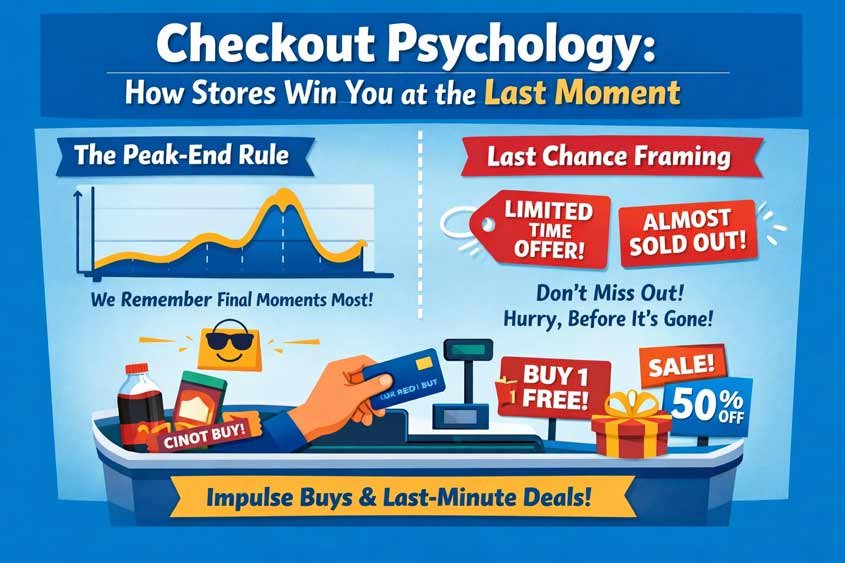
You don’t remember every aisle. You don’t remember every comparison you made. Most of it fades almost instantly. What sticks are two points. The emotional high. And the ending.
That’s the peak end rule in action. And in retail, checkout is the ending that quietly decides how you feel about everything that came before it.
You could have had a slightly annoying experience in the store. Maybe it was crowded. Maybe you couldn’t find something right away. Maybe you spent more time than you wanted. But if checkout feels smooth, quick, even slightly pleasant, your brain does something interesting. It softens the negatives. It rounds off the rough edges. It tells you, “That wasn’t so bad.”
Now flip it.
Imagine a perfect shopping trip ruined by a frustrating checkout. Long lines. Confusion. Slow payment. Suddenly the entire experience feels worse than it actually was. Same store. Same products. Different ending. Completely different memory.
That’s not a coincidence. It’s how your memory system is wired. You don’t store experiences like a recording. You store them like a summary.
And checkout psychology is built around controlling that summary.
Retailers invest heavily in this final stage because they know something most people overlook. You’re not just influencing a purchase. You’re influencing whether the customer comes back. That last interaction becomes the emotional signature of the visit.
Think about the small details that shape that moment.
Speed is the obvious one. Faster checkout reduces friction. But it’s not just about being fast. It’s about feeling fast. A line that moves consistently feels shorter than one that stops and starts. Self checkout options create a sense of control, even if they’re not objectively quicker. That perception matters more than the clock.
Then there’s human interaction.
A simple, natural “hello” or a brief moment of eye contact can shift the tone of the entire ending. Not exaggerated friendliness. Not scripted enthusiasm. Just something that feels real. That tiny social signal tells your brain the experience is complete. Clean. Resolved.
And resolution is important.
Your brain likes closure. When checkout feels clear and predictable, it reduces cognitive tension. You know what’s happening. You know what comes next. There’s no ambiguity. That sense of completion makes the experience feel finished in a satisfying way.
Retailers also layer in subtle comfort cues.
Lighting tends to be brighter. Spaces are more open. The visual noise is reduced compared to the aisles. It creates a transition zone. You’re moving from decision making to completion. That shift matters because it signals relief. The hard part is over.
But here’s where things get more strategic.
Checkout is not just about ending well. It’s about ending slightly better than expected.
This is where small positive surprises come in. Maybe the cashier is quicker than you anticipated. Maybe the total is slightly lower than your rough estimate. Maybe you find a small item you actually needed. These micro wins create a gentle upward spike right at the end.
And that spike becomes the “peak” your brain remembers.
It doesn’t have to be dramatic. It just has to exist.
You see this pattern outside supermarkets too. Think about ride sharing apps. The trip itself might be average, but a smooth drop off and a polite driver can shape your overall rating. Hotels do the same thing with easy checkout processes. E commerce platforms focus heavily on frictionless payment flows. Different industries, same psychological principle.
Now layer this with something else happening at checkout.
Justification.
By the time you reach the end, you’ve already committed to your purchases. There’s no more internal debate. That creates a subtle sense of relief. You’re done deciding. And when your brain feels relief, it becomes more receptive to positive reinforcement.
That’s why even small pleasures at checkout feel amplified.
A familiar snack. A neatly organized display. A quick, seamless payment. These aren’t big experiences on their own. But combined with relief, they carry more emotional weight than they normally would.
Retailers don’t need to impress you throughout the entire store. They need to leave you with a clean, slightly positive ending.
That’s enough to influence your future behavior.
Because when you decide where to shop next time, you won’t run a detailed analysis. You’ll rely on a feeling. “That place is easy.” “That place is fine.” “I don’t mind going there.”
Those vague impressions are built here. At checkout.
And there’s one more layer that often goes unnoticed.
If checkout is reliably smooth every time, it builds trust. Not conscious trust. Behavioral trust. You stop worrying about the end of the experience. It becomes predictable. And predictability reduces friction in future decisions.
You don’t think, “Will this be annoying?” You already know the answer.
So you go back.
This is where checkout psychology connects with other triggers you’ve probably seen across retail. Habit formation. Familiarity bias. Even the default effect. A good ending reinforces the loop. You shop, you finish, it feels fine, you repeat.
No dramatic persuasion needed.
Just a well controlled final moment.
And that’s the quiet power of the peak end rule in supermarkets. It doesn’t try to change everything. It just rewrites how everything is remembered.
The Subtle Push You Didn’t Plan For
Right before you pay, something shifts again.
Not in the environment this time. In your attention.
You’re done shopping, at least consciously. Your brain has already moved on to what comes next. Leaving the store. Getting home. Maybe even what you’ll eat. And that mental shift creates a small gap. A moment where you’re no longer actively deciding… but you’re still exposed to options.
That gap is where last chance framing does its best work.
You’ve seen it a hundred times. Small signs. Quiet prompts. “Don’t forget batteries.” “Grab a drink for the road.” “Any last minute essentials?” None of these feel aggressive. They feel helpful. Almost like the store is doing you a favor.
But they’re not random reminders.
They’re carefully chosen triggers designed to activate something specific in your mind. Not desire. Not curiosity. Memory.
Because at checkout, the game is no longer about introducing new products. It’s about recovering missed ones.
Think about how you shop. You walk in with a rough list. Maybe it’s written, maybe it’s just in your head. You pick up most of what you need, but rarely all of it. Something always slips. Small items, usually. Low attention products. Things you don’t think about until you need them.
That’s the gap last chance framing targets.
Instead of asking, “Do you want this?”, it quietly asks, “Did you forget this?”
That question lands differently.
It bypasses the usual resistance you have to buying something new. You’re not evaluating. You’re checking. Scanning your memory. Running a quick mental inventory. And if there’s even a slight signal that you might need that item later, the decision becomes easy.
You add it.
Because now it doesn’t feel like an extra purchase. It feels like a correction.
That distinction matters more than it looks.
When something feels like a correction, it carries less psychological weight. You’re not spending more. You’re fixing a potential problem. That’s a much easier decision to justify, especially when you’re already at checkout and your decision energy is low.
Retailers amplify this effect by choosing products with a certain profile.
They’re usually low cost. Familiar. Frequently forgotten. Batteries are a classic example. So are lighters, gum, wipes, small drinks, or everyday personal care items. You don’t plan them carefully. But you recognize them instantly.
Recognition is key here.
At this stage, your brain relies heavily on familiarity bias. You’re not looking for new brands or comparing features. You’re responding to what feels known and safe. That’s why big, recognizable packaging dominates checkout displays. It reduces thinking even further.
There’s also a time pressure element, even if it’s subtle.
You’re in line. People are behind you. The process is moving. You don’t want to hold things up. That creates a quiet urgency. Not enough to feel stressful, but enough to push you toward quicker decisions.
So when a “don’t forget” message appears, you don’t pause and analyze it. You react.
And reaction is exactly what this tactic is designed to produce.
But there’s another layer that makes last chance framing more powerful than it seems.
If you ignore a product in the middle of the store, it doesn’t feel like a loss. You can always come back. You’re still shopping. But at checkout, the context changes. This is the end. If you don’t take it now, you might have to make a separate trip later.
That possibility creates a small sense of potential loss.
Not dramatic. Just enough to nudge you.
Your brain starts calculating in the background. “If I don’t get this now, I’ll have to come back.” That future inconvenience, even if it’s minor, suddenly makes the present purchase feel more reasonable.
So you add the item.
Not because you strongly want it, but because you want to avoid a future problem.
This is where last chance framing connects with other psychological triggers you’ve probably noticed in stores. Scarcity plays a role. Limited quantities or compact displays make items feel like they’re about to run out. The default effect shows up too. When something is placed directly in your path, it becomes the easiest option. No effort required.
Even anchoring sneaks in.
Prices at checkout are often rounded and simple. No complex comparisons. No mental math. Just small, easy numbers that feel insignificant compared to your total basket. That reduces friction even further.
And all of this happens in seconds.
You’re not standing there analyzing tactics. You’re just… adding one more thing.
Now zoom out for a second.
If one customer adds one small item, it doesn’t seem like much. But multiply that across hundreds or thousands of transactions a day, and the impact becomes massive. This is why checkout zones are some of the highest revenue per square meter areas in any store.
Not because they sell big products.
Because they capture missed intent.
And here’s the part that makes this tactic even more effective over time.
Learning.
The more you experience these reminders, the more your brain starts expecting them. You begin to rely on checkout as a safety net. A place where you’ll be reminded of anything you forgot. That shifts your behavior earlier in the store. You become slightly less careful with your list, whether you realize it or not.
You trust that the system will catch your mistakes.
And in a way, it does.
But it also monetizes them.
You walk in thinking you’re in control of your purchases. And for most of the trip, you are. But at checkout, control becomes a bit more fluid. Your decisions are faster, lighter, more reactive.
That’s not an accident.
It’s the final layer of checkout psychology. Not pushing you to buy something new. Just reminding you, at exactly the right moment, that you might already need it.
The Quiet Moment That Shapes Your Next Visit
Checkout doesn’t look like much on the surface. A line, a counter, a few small products, a quick payment. It feels like a formality. Something you pass through on your way out.
But it’s doing more work than most of the store combined.
By the time you reach this point, the heavy lifting is done. You’ve made your choices. You’ve justified your basket. You’re mentally already leaving. And that’s exactly why this moment matters so much. Your guard is lower. Your decisions are lighter. Your memory is about to lock in how the whole experience felt.
That’s what checkout psychology is really about. Not forcing big decisions, but shaping small ones that carry disproportionate weight.
The peak end rule wraps your entire visit into a simple feeling. Smooth ending, good memory. Friction at the end, everything feels worse. It doesn’t matter how rational you think you are. Your brain compresses the experience anyway. It keeps the ending and lets the rest blur.
At the same time, last chance framing quietly fills the gaps. It catches the things you forgot, or think you forgot. It turns missed items into easy wins. It reframes extra purchases as smart corrections. And because these decisions happen when your mental energy is low, they slide through with almost no resistance.
Put these together and you get a system that feels natural, even helpful, while being highly structured underneath.
And it doesn’t work in isolation.
Checkout psychology builds on everything that came before. Familiarity bias makes you trust what you see without thinking. The default effect makes the closest option the easiest one. Scarcity nudges you to act now instead of later. Even subtle reward loops play a role, where earlier “good” choices give you permission for small indulgences at the end.
None of these triggers are loud on their own.
But layered together, in the final minute of your visit, they become hard to ignore.
From a business perspective, this is where marginal gains turn into real revenue. A few extra items per basket. A slightly better memory of the visit. A smoother path to repeat behavior. No dramatic persuasion, just consistent, well placed nudges.
From your perspective, it’s worth noticing how little it takes to shift your behavior at this stage.
You don’t need a big discount to spend more. You don’t need a strong desire to add something. You just need the right reminder, at the right time, in the right mental state.
That’s the part most people underestimate.
If you’re thinking as a marketer, this is the closing move you can’t afford to ignore. The end of the journey is not a passive step. It’s where perception is finalized and future decisions are quietly shaped.
If you’re thinking as a consumer, it’s one of the few moments where awareness actually gives you an edge. Once you recognize the patterns, you start to see them everywhere. The prompts. The placement. The timing. And that alone can change how you respond.
Not completely. These tactics are effective for a reason.
But enough to make your choices feel more deliberate.
And that’s the interesting tension at the heart of checkout psychology. It works best when you don’t notice it. Yet the moment you do, the entire experience starts to look different.

Gabriel Comanoiu is a digital marketing expert who has run his own agency since 2016. He learned marketing by testing, analyzing, and refining campaigns across multiple channels. In his book series Impulse Buying Psychology, he shares the psychological triggers behind every purchase, showing how to create marketing that connects, persuades, and converts.