
The Label Is the Message (And You Rarely Question It)
Walk into a supermarket and try something simple. Pick up a product and look at it like you’ve never seen packaging before. Not the brand. Not the price. Just the words. “Low fat.” “High protein.” “Natural.” “No added sugar.”
Feels informative, right? Like you’re being helped.
You’re not.
You’re being guided. Quietly. Efficiently. And most of the time, without even noticing it.
This is where information framing in marketing does its best work. It doesn’t change the product. It changes how you interpret the product. And that difference? That’s where decisions happen.
Here’s the uncomfortable part. You don’t evaluate every detail when you shop. You can’t. There are too many choices, too little time, and honestly… you don’t want to. Your brain looks for shortcuts. Fast signals. Something that says “this is good enough” so you can move on.
That’s exactly what labeling is designed to provide.
A single phrase can outweigh a full ingredient list. A bold claim on the front can override the fine print on the back. And once your brain locks onto that first impression, everything else gets filtered through it. That’s not a flaw. That’s how human decision-making works.
Think about it. You see “organic” and instantly feel safer. You see “low calorie” and assume weight-friendly. You see “premium” and expect higher quality. None of those claims give you the full picture, but they don’t need to. They just need to anchor your perception early.
And once that anchor is set, something interesting happens. You stop questioning as much.
This is closely tied to other psychological triggers you’ve probably felt before. Anchoring bias sets the starting point. Authority cues make claims feel credible. Social proof labels like “customer favorite” reinforce the choice. Even scarcity messaging can sneak in through phrases like “limited batch” or “seasonal recipe.”
It all stacks.
But information framing in marketing is the layer that ties everything together. It decides what gets seen first. What feels important. What gets ignored.
And supermarkets? They’ve refined this to a science.
Because they don’t need to lie to you. They just need to present the truth in a way that leads you somewhere specific.
The product stays the same. Your perception doesn’t.
And once you start noticing that shift, it’s hard to unsee.
Table of Contents
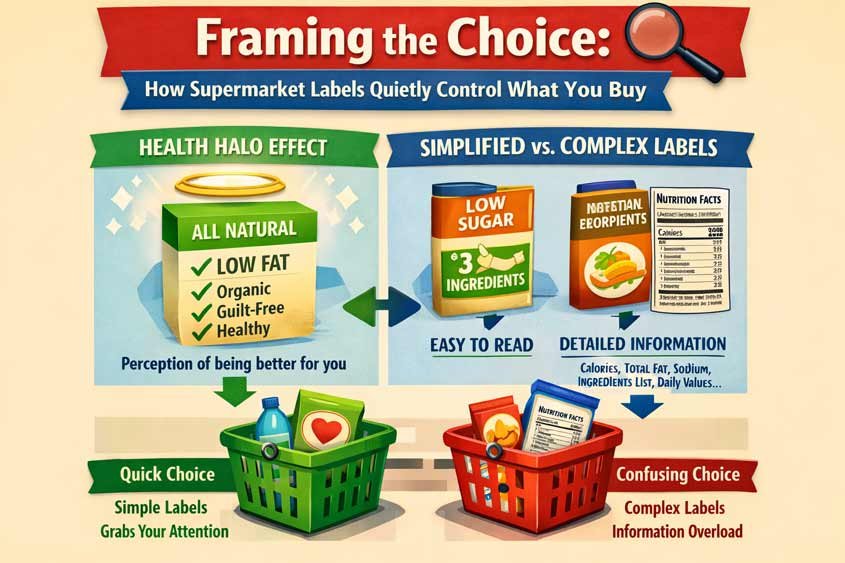
The Health Halo Effect: One Claim, Total Control
You’ve seen it a hundred times. Probably bought it too.
A snack labeled “low fat.” A cereal box shouting “high in fiber.” A yogurt proudly stamped “protein rich.” And just like that, your brain relaxes a little. Feels like a safe choice. Maybe even a smart one.
That’s the health halo effect in action. And inside information framing in marketing, it’s one of the most efficient tools ever created.
Here’s how it works.
Your brain takes one positive attribute and uses it to fill in the blanks. You don’t consciously decide to do this. It just happens. One good signal spreads across the entire product, like ink in water.
“Low fat” becomes “healthy overall.”
“Organic” becomes “clean and better for you.”
“Gluten free” becomes “lighter” or “less processed,” even when it’s not.
The label gives you a shortcut. And you take it, because evaluating every product from scratch would be exhausting.
Now here’s where things get messy.
That single positive trait often tells you very little about the full nutritional picture. A “low fat” product might be packed with sugar to compensate for taste. A “high protein” bar might be ultra processed and calorie dense. An “organic” cookie is still… a cookie.
But the frame is already set.
And once that frame is in place, your brain starts protecting it.
You’re less likely to check the ingredient list. Less likely to compare alternatives. Less likely to question whether the product actually fits your goal. The initial label does the heavy lifting, and everything else becomes background noise.
This isn’t random. It connects directly to how cognitive biases stack on top of each other.
Anchoring bias sets the first impression. The health claim becomes the anchor. Then confirmation bias kicks in. You start noticing details that support the idea that this is a “good” choice, while ignoring anything that contradicts it. Add a bit of authority bias, maybe a clean design or a subtle “nutritionist approved” vibe, and the perception feels even more solid.
All of this happens in seconds.
Let’s make it concrete.
Picture two snack bars.
The first says “low fat” in big, bold text. The second says nothing but has a shorter ingredient list and less sugar. Which one feels healthier at a glance?
Most people lean toward the first. Not because they’ve analyzed it, but because the label framed the decision before analysis even started.
That’s the power of information framing in marketing. It doesn’t wait for you to think. It moves before that.
And supermarkets know exactly where to place these triggers.
Health halo products often sit at eye level. They use lighter colors. Clean typography. Words that feel clinical but friendly. “Balanced.” “Light.” “Wholesome.” Nothing too technical, just enough to signal control and intention.
You see it, you trust it, you move on.
There’s also a subtle emotional layer here that doesn’t get talked about enough.
Buying something framed as “healthy” gives you a small sense of progress. Like you’ve done something right. That feeling matters. It reduces guilt. It creates a kind of internal permission structure.
And once you’ve made one “good” choice, something interesting can happen next.
You loosen up.
Maybe you add a dessert to your basket. Maybe you grab a drink you didn’t plan on. There’s a quiet justification running in the background. “I already chose something healthy, so this is fine.”
That’s not just the health halo effect anymore. That’s a reward loop starting to form. One decision influencing the next, all rooted in that initial frame.
You can see how this scales.
Multiply that effect across dozens of products, across an entire store layout, across repeated shopping trips. Over time, these small framed decisions shape habits. Preferences. Even identity.
You start to see yourself as someone who buys “better” products. Even if the underlying choices haven’t changed much at all.
And here’s the key point.
Information framing in marketing doesn’t need to mislead you outright. It just needs to highlight one truth loudly enough that you don’t go looking for the rest.
That’s it.
One claim. One angle. One carefully chosen piece of information that becomes the lens for everything else.
So what can you actually do with this?
Next time you’re shopping, pause for a second when you see a strong health claim. Ask yourself a simple question. “What am I not being told here?”
You don’t need to become obsessive or read every label in detail. Just interrupt the automatic response. Even briefly. That alone weakens the effect.
Because once you start seeing the health halo for what it is, it loses some of its grip.
Not completely. These systems are too well designed for that.
But enough that your choices start to feel like yours again, not just the result of how something was framed.
Simple Wins: Why Less Information Sells More
Pick up two similar products. One has a clean front label. Three words. Maybe a number. “High protein.” “0% sugar.” “Only 99 calories.”
The other? Covered in detail. Full breakdowns. Percentages. Claims stacked on claims. Technical language trying to sound precise.
Which one do you process faster?
You already know the answer. And that’s exactly why information framing in marketing leans so heavily on simplicity.
More information does not mean better decisions. In most real shopping situations, it means slower decisions or no decision at all.
Your brain is not trying to find the perfect product. It’s trying to reduce effort.
This is where things get interesting.
When labels become complex, your cognitive load increases. You have to read, interpret, compare, maybe even do a bit of mental math. That’s friction. And friction kills momentum.
So what do you do?
You either skip the product entirely or default to something easier to understand.
That’s why simple labels outperform detailed ones in fast moving environments like supermarkets. They remove friction. They compress meaning into something instantly recognizable.
“High protein” is easier than scanning grams per serving.
“No added sugar” is faster than checking ingredient lists.
“Low calorie” beats calculating total intake.
It’s not that the detailed information is useless. It’s that it arrives too late in the decision process.
Information framing in marketing prioritizes what gets seen first, not what is most complete.
And simple claims dominate that first glance.
There’s also a timing element here that most people miss.
Decisions in supermarkets are often made in seconds. You’re walking, scanning shelves, half thinking about something else. Maybe you’re tired. Maybe you’re hungry. Decision fatigue is already creeping in.
In that state, your brain shifts even more toward shortcuts.
Simple labels act like visual triggers. They don’t ask for attention. They grab it.
A bold “20g protein” callout works because it removes ambiguity. It tells you exactly what to think, immediately. No interpretation required.
Compare that to a dense nutrition panel. Same information, technically. But it demands effort. And effort is something your brain is actively trying to avoid.
So simplicity wins again.
This connects directly to other psychological triggers you’ve probably noticed.
Processing fluency plays a big role here. The easier something is to understand, the more you trust it. Even if the underlying information is identical. A simple claim feels more true than a complex explanation.
Then there’s the mere exposure effect. Short, repeatable phrases stick. You see “high protein” across multiple products, across multiple shopping trips. It becomes familiar. Familiar becomes safe.
And once something feels safe, you stop questioning it.
There’s also an interesting contrast effect happening.
When a product uses a clean, minimal label, it often feels more premium. More intentional. Like nothing unnecessary was added. Even if the product itself is no different.
On the other hand, a crowded label can feel defensive. Like it’s trying too hard to convince you.
Again, same category. Same function. Completely different perception.
Let’s step outside supermarkets for a second.
Look at tech products. A phone advertised as “All day battery” versus one listing exact milliamp hours, voltage efficiency, and usage metrics. Which one sticks?
Or fitness apps. “Burn fat faster” versus a breakdown of metabolic pathways and energy expenditure.
Or even financial services. “Zero fees” versus a detailed pricing structure with conditions and exceptions.
Different industries. Same principle.
Simple framing wins attention. Complex framing requires commitment.
And in environments where attention is scarce, that difference is everything.
Back in the supermarket, this plays out at scale.
Brands design packaging to communicate one core idea. Not five. Not ten. One.
Because they know something crucial.
If you remember one thing, you’re likely to buy.
If you have to process five things, you’re likely to hesitate.
And hesitation is dangerous in retail. It opens the door to comparison. To doubt. To walking away.
So labels are engineered to close that gap quickly.
Now, here’s where it ties back to the bigger system.
Information framing in marketing doesn’t just simplify randomly. It simplifies strategically.
It chooses which detail becomes the headline.
And that choice shapes your entire perception.
A cereal brand could highlight sugar content. Or fiber. Or whole grains. Or calories. All true. All valid.
But whichever one they put front and center becomes the story you walk away with.
That’s framing at work.
And once that story is set, your brain fills in the rest, just like with the health halo effect.
You see “high fiber” and assume digestive benefits.
You see “low calorie” and assume weight friendly.
You see “natural” and assume less processed.
Even when those assumptions aren’t fully accurate.
So simplicity doesn’t just speed up decisions. It directs them.
That’s the part most people underestimate.
This is also why adding more information doesn’t “fix” manipulation. In fact, it often makes it easier to guide behavior.
Because the important information isn’t what’s available. It’s what’s visible.
And simple labels control visibility.
So what can you do with this?
Same idea as before. Slow down just enough to notice the frame.
When you see a bold, simple claim, treat it as an entry point, not a conclusion. It’s telling you where to look, not what the full truth is.
You don’t need to analyze everything. Just resist the urge to stop at the headline.
Because that’s exactly where information framing in marketing wants you to stop.
And once you push past that first layer, even occasionally, you start seeing the pattern.
Simple doesn’t mean wrong.
But it rarely means complete.
Seeing the Frame: What You Notice Changes What You Choose
After a while, supermarket shelves stop feeling random.
What once looked like a neutral display of products starts to look more like a conversation you’re being pulled into. Not loud. Not obvious. Just constant small suggestions about what matters, what is healthy, what is premium, what is safe.
That’s the long game of information framing in marketing. It doesn’t rely on one big persuasive moment. It relies on repetition, simplification, and selective emphasis until certain ideas feel like common sense.
You start to notice how often your attention is directed before your judgment even kicks in.
A label tells you what to care about. A claim tells you what to ignore. A design choice tells you what feels premium. And you move through it quickly, because that speed is built into the environment itself.
But once you see how this structure works, something shifts.
Not dramatically. Not in a “everything you know is wrong” kind of way. More like a quiet awareness that not all information is equally important, even when it’s presented as if it is.
Information framing in marketing works because it matches how you already think. You don’t evaluate every detail equally in real life. You rely on shortcuts. You trust signals. You simplify.
Supermarkets just organize those shortcuts for you.
And that’s the part worth sitting with for a second.
Because it means the goal is not to eliminate influence. That’s not realistic. The goal is to recognize when your attention is being guided toward one interpretation while others are left in the background.
You’ll still see “low sugar” and feel reassured. You’ll still see “high protein” and feel like it fits a goal. You’ll still respond to clean labels faster than complex ones.
That doesn’t disappear.
But you gain a bit of space between the label and your reaction.
And that space matters.
It’s where you can ask a simple question without overthinking it: what else could be true about this product that isn’t being highlighted right now?
Not as a rejection of the message. Just as a check against the completeness of it.
Because information framing in marketing is rarely about false information. It’s about partial information made to feel complete.
And supermarkets are very good at that balance. Too subtle to feel manipulative. Too effective to ignore.
You see it across categories. Health foods, snacks, drinks, and even everyday staples. The same structure repeats with different wording, different colors, and different claims. But the mechanism stays the same: highlight one attribute, let your brain extend it to the rest.
That’s why these patterns feel so natural. They match how perception already works. They don’t fight your thinking. They ride on top of it.
And that’s also why they’re hard to spot in the moment.
You don’t feel persuaded. You feel informed. That’s the trick.
So the real takeaway here isn’t about becoming skeptical of every label or second guessing every purchase. That would just replace one automatic behavior with another kind of friction.
It’s something simpler.
Notice when your decision feels too fast.
Notice when one word seems to carry the weight of an entire product.
Notice when complexity disappears and only a single idea remains.
That’s usually where information framing in marketing is doing its strongest work.
And once you get familiar with that feeling, you don’t need to fight it aggressively. You just start seeing your choices a bit more clearly as they happen.
Not perfectly. Not constantly.
But enough to make the process feel less automatic, and a bit more yours.

Gabriel Comanoiu is a digital marketing expert who has run his own agency since 2016. He learned marketing by testing, analyzing, and refining campaigns across multiple channels. In his book series Impulse Buying Psychology, he shares the psychological triggers behind every purchase, showing how to create marketing that connects, persuades, and converts.