
You Don’t Just Shop. You Perform Who You Are.
Walk into a supermarket and it feels simple. You grab what you need, compare a few prices, maybe check a label or two, and move on. That’s the story you tell yourself, anyway. But the reality underneath is a bit more… layered.
Supermarket marketing psychology is not just about pushing products. It’s about shaping decisions by quietly tapping into how you see yourself. Or more precisely, how you want to see yourself.
Because most of your choices in a store aren’t purely rational. They’re identity-driven.
You don’t just buy oat milk. You buy what it says about you.
You don’t just choose organic eggs. You choose the version of yourself that cares about quality, health, maybe even ethics.
You don’t just pick the premium brand. You align with a certain standard you believe you deserve.
And here’s the thing. You’re usually not fully aware of it.
Supermarkets are designed to make identity feel like instinct. Labels, colors, shelf placement, wording, even the way products are grouped. They all work together to send subtle signals. Signals about lifestyle. About status. About belonging.
It overlaps with other psychological triggers you’ve probably noticed before. The price quality heuristic nudges you toward higher priced items when you’re unsure. The halo effect makes one positive trait spill over into others. Even anchoring plays a role when premium products sit next to standard ones, quietly redefining what “normal” looks like.
But identity based triggers go deeper than all of these.
They don’t just influence what you think is good.
They influence what feels right.
And once something feels right, you stop questioning it.
That’s why supermarket marketing psychology leans so heavily on identity cues. Because if a product fits the story you have about yourself, the decision becomes effortless. Almost automatic.
You’ve probably experienced this without realizing it. Maybe you reached for a product and only later justified it with logic. Price. Ingredients. Convenience. But the decision was already made before the reasoning kicked in.
That’s not a flaw in how you think. It’s how you’re wired.
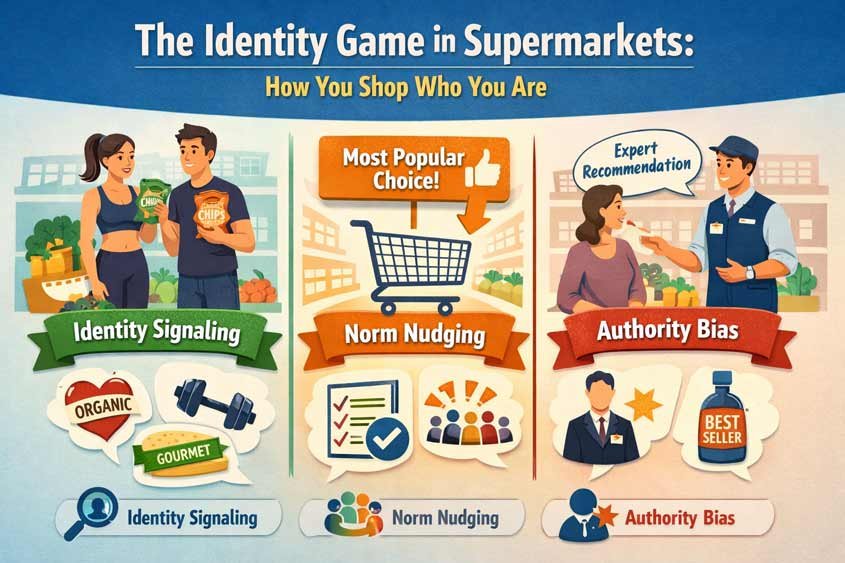
In this article, we’re going to break down three of the most powerful identity-driven mechanisms used in supermarkets. Identity signaling, norm nudging, and authority bias. Different tactics on the surface, but all aiming at the same core idea.
Influence who you think you are… and the purchase follows.
Table of Contents
You’re Not Buying Products. You’re Buying a Version of Yourself.
Pick up two nearly identical products. Same category. Similar ingredients. Close price. One says “organic, locally sourced, sustainable.” The other just… exists.
Which one feels better in your hand?
That feeling right there is supermarket marketing psychology doing its job.
Identity signaling works by attaching meaning to products far beyond their functional value. The item stops being just something you consume. It becomes something you express. A quiet statement about who you are, or maybe who you’re trying to become.
And supermarkets lean into this hard.
Look at how categories are framed. Organic sections are rarely mixed randomly with everything else. They’re grouped, curated, almost like a separate world. The lighting is softer. The colors lean green and earthy. Packaging uses textures that feel natural, sometimes even slightly imperfect on purpose.
It creates a micro-environment where a certain identity feels normal.
You step into that space and suddenly the question isn’t “Do I need this?”
It becomes “Is this the kind of person I am?”
That shift matters.
Because once a product aligns with your identity, price sensitivity drops. You’re no longer comparing purely on cost or utility. You’re protecting a self-image. And that’s much harder to negotiate with.
Think about labels like vegan, keto, gluten free, premium, artisan, locally produced. Each one carries a built-in story.
Vegan products signal discipline, ethics, environmental awareness.
Local products signal community support and authenticity.
Premium products signal taste, status, sometimes even self-reward.
None of these are just attributes. They’re identity shortcuts.
And here’s where it gets interesting. You don’t even need to fully live that identity for the trigger to work.
You just need to be close enough.
Someone who eats fast food during the week might still buy organic vegetables on the weekend. Not because it perfectly matches their behavior, but because it matches their aspiration. It’s a small correction toward the person they want to be.
Supermarket marketing psychology thrives in that gap between reality and aspiration.
It’s the same reason you’ll see premium private labels designed to look almost indistinguishable from high end brands. Matte finishes. minimalist typography. restrained color palettes. They don’t just signal quality. They signal a certain taste level.
You’re not just buying pasta.
You’re buying “I have standards.”
And once that association is in place, something subtle happens. The product starts benefiting from the halo effect. If it looks healthy, you assume it tastes better. If it looks premium, you assume it performs better. Even without evidence.
Now layer in a bit of anchoring.
Place a very expensive “luxury” version next to a slightly less expensive “premium” one. Suddenly the premium option feels reasonable. Sensible, even. But it still carries the identity signal you were drawn to in the first place.
So you walk away feeling smart and aligned with your self-image.
Win-win. At least from your perspective.
Another detail most people miss is how supermarkets use language to reinforce identity signaling. Words like “crafted,” “selected,” “pure,” “authentic.” They don’t add measurable value, but they shape perception. They create a narrative around the product that you step into the moment you pick it up.
It’s subtle. But powerful.
And it extends beyond food.
Think about cleaning products labeled as eco-friendly. Or baby products emphasizing safety and purity. Or even ready meals positioned as “chef inspired.” Different categories, same mechanism. Each one taps into a different identity you might hold or want to hold.
Responsible parent.
Environmentally conscious shopper.
Someone who appreciates quality.
The product becomes a shortcut to expressing that identity without much effort.
That’s why this tactic works so consistently. It reduces cognitive load. Instead of analyzing every detail, you rely on identity as a decision filter.
Does this fit me?
Yes?
Done.
Of course, this doesn’t mean the products are bad or misleading by default. Many do deliver on their promises. But the decision to buy them is rarely just about those promises.
It’s about alignment.
And once you start noticing it, you’ll see it everywhere. Entire shelves built around identities. Not needs. Not use cases. Identities.
That’s supermarket marketing psychology at its most effective. It stops selling products.
It sells you… to yourself.
You Follow the Crowd Even When You Think You Don’t
You’re standing in front of a shelf, scanning options. There’s no obvious winner. Prices are similar. Packaging looks decent across the board. Nothing really stands out.
Then you notice a small tag. “Customer favorite.”
It’s subtle. Easy to miss if you’re in a rush. But if you catch it, it does something immediate. It reduces uncertainty.
That’s norm nudging in action.
At its core, supermarket marketing psychology uses social proof to guide decisions when you’re unsure. Instead of asking “What should I choose?” your brain switches to “What are others choosing?”
And that shortcut is incredibly powerful.
Because in environments with too many options, following the crowd feels efficient. Safe. Even rational.
Supermarkets know this. That’s why they embed social cues directly into the shopping experience. You’ll see labels like “best seller,” “most popular,” “top choice,” or “trending.” None of these require detailed explanation. They work because they imply a collective decision has already been made.
And you’re just aligning with it.
The effect becomes even stronger when you’re mentally tired. After walking through multiple aisles, comparing products, making small decisions over and over, your cognitive resources drop. This is where decision fatigue kicks in.
At that point, norm nudging doesn’t just influence you. It almost decides for you.
You stop evaluating deeply. You start relying on shortcuts.
And social proof is one of the easiest shortcuts available.
But it goes beyond labels.
Shelf placement itself often reflects perceived popularity. Products at eye level are frequently assumed to be top choices. End caps highlight items that appear in high demand. Even partially empty shelves can signal that something is selling fast, which triggers a mild scarcity response.
You might not consciously think, “This is popular, so I should buy it.”
But you feel it.
And that feeling nudges your hand.
There’s also an interesting interaction between norm nudging and the bandwagon effect. When you believe many people are choosing something, your likelihood of choosing it increases. Not because you’ve validated the product independently, but because the collective choice acts as a form of validation.
It’s a form of borrowed confidence.
You see this clearly in categories where quality is hard to judge quickly. Wine is a classic example. Most shoppers don’t analyze regions, grapes, or production methods in detail. So a small “customer favorite” badge or a shelf talker highlighting popularity can tip the decision instantly.
Same with snacks, ready meals, even household items.
The less certain you are, the more you lean on others.
Supermarket marketing psychology doesn’t need to fake massive crowds. It just needs to suggest them.
A single phrase can do the job.
“Loved by families.”
“Our customers’ top pick.”
“A store favorite.”
These are lightweight signals. But they activate a deep instinct. Humans are social by default. You’re wired to look at others when making decisions, especially under uncertainty.
And supermarkets create that uncertainty on purpose.
Too many options. Slight variations. Minimal clear differences.
Then they offer a way out.
Follow the crowd.
There’s another layer to this. Norm nudging often works best when it feels local. Not global, not abstract. Specific enough to feel real.
For example, “popular in this store” feels more immediate than “popular nationwide.” It suggests people just like you, in your environment, are making this choice right now.
That proximity increases trust.
It’s the difference between hearing that something is generally liked and feeling that people like you are choosing it.
And once again, other psychological triggers quietly support this mechanism.
The halo effect can amplify perceived popularity. If a product looks premium or healthy, you’re more likely to believe others prefer it. Anchoring can also shape what “popular” means by placing certain products in more visible or prominent positions.
Even scarcity plays a role. If a product looks like it’s running low, you may assume it’s popular, which reinforces the norm signal.
All these elements blend together.
You don’t experience them as separate tactics. You experience them as a single, smooth decision.
“This seems like a good choice.”
That’s the end result supermarket marketing psychology is aiming for.
No friction. No overthinking. Just a quiet nudge in the direction most people appear to be going.
And the interesting part?
Even when you’re aware of it, it still works. Not always, not perfectly, but often enough. Because resisting social proof requires effort. And in a supermarket, effort is exactly what you’re trying to minimize.
So you go with the flow.
Not because you have to.
Because it feels right.
When Experts Speak, You Stop Questioning
There’s a certain tone that makes you pause in a supermarket.
“Clinically tested.”
“Recommended by nutritionists.”
“Developed with experts.”
You see phrases like these and something shifts. The decision feels… safer. More grounded. Like someone smarter has already done the thinking for you.
That’s authority bias at work, and supermarket marketing psychology uses it everywhere.
Because when a product appears backed by expertise, your need to evaluate it drops fast. You assume credibility. You assume quality. You assume it’s the right choice.
Even if you don’t verify any of it.
And most of the time, you don’t.
Authority signals come in many forms. Some are explicit. A label claiming professional endorsement. A badge that looks like a certification. A mention of specialists or testing processes.
Others are more visual.
Think about packaging that uses clean, clinical design. White backgrounds. Minimalist layouts. Subtle blue or green tones. Fonts that resemble medical or scientific documents. Even the structure of the text changes. Short statements. Technical sounding phrases. Measured claims.
It all creates the impression of expertise.
And your brain responds to that impression more than the actual content.
Because evaluating real expertise takes time. You’d need to check credentials, understand the criteria, compare alternatives. That’s not happening in the middle of a grocery run.
So supermarket marketing psychology offers a shortcut.
“If it looks authoritative, treat it as trustworthy.”
It’s efficient. And it usually feels rational.
This is especially powerful in categories tied to health, safety, or performance. Baby products, supplements, dairy alternatives, cleaning supplies. Areas where the perceived risk is higher.
You’re not just buying for preference. You’re buying for reassurance.
So when a product says “pediatrician approved” or “dermatologically tested,” it doesn’t just inform you. It reduces anxiety. It gives you permission to choose quickly.
Even if the claim is vague.
And that’s an important detail. Many authority based messages are technically true, but loosely defined.
“Tested” doesn’t always mean independently verified in a rigorous way.
“Approved” doesn’t always mean endorsed by a widely recognized authority.
“Expert formulated” doesn’t tell you who the expert is or what their standards were.
But the structure of the message is enough.
Because authority bias doesn’t require full proof. It relies on perceived credibility, not confirmed credibility.
You see the same pattern outside food.
Cleaning products often use lab imagery or reference “scientific formulas.”
Skincare leans heavily on dermatologist language.
Even bottled water sometimes includes mineral breakdowns that look technical enough to suggest superiority.
Different categories. Same mechanism.
And it often overlaps with other psychological triggers.
The halo effect plays a big role here. If a product looks clinical or professional, you assume it performs better overall. Anchoring can position “expert” products at a higher price point, reinforcing the idea that expertise costs more.
There’s also a subtle interaction with risk aversion. When you’re unsure, you prefer options that feel safer, even if they’re not objectively better. Authority cues create that sense of safety.
So you lean toward them.
Without much resistance.
Another interesting layer is how authority can be implied without being stated directly.
A product doesn’t need to say “expert approved” if everything about it suggests expertise. The layout, the wording, the structure, even the spacing. It all contributes.
You’ve probably seen products that look almost like they belong in a pharmacy rather than a supermarket. That’s not accidental. It’s positioning.
It tells you, “This is serious. This is precise. This is trustworthy.”
And in a crowded shelf, that perception stands out.
Because most products are competing on taste, price, or convenience. Authority based products compete on confidence.
They remove doubt.
Or at least, they make doubt feel unnecessary.
That’s why supermarket marketing psychology relies so heavily on this tactic. It doesn’t just push you toward a product. It lowers the mental effort required to say yes.
You don’t need to compare ten options.
You just need one that feels backed by expertise.
And once that feeling is there, the decision almost makes itself.
You move on. Basket a little fuller. Mind a little quieter.
All because someone, somewhere, seemed to know better.
You Thought You Were Choosing. You Were Aligning.
By the time you reach the checkout, it feels like a series of small, reasonable decisions. Nothing dramatic. Just a few preferences, a few habits, maybe a couple of treats.
But if you zoom out, a pattern shows up.
You didn’t just choose products.
You aligned with signals.
That’s the core of supermarket marketing psychology. It doesn’t push you aggressively. It guides you quietly. It shapes the environment so your decisions feel natural, even when they’re being influenced at multiple levels.
Identity signaling pulls you toward products that reflect who you are or who you want to be. Norm nudging reassures you that others are making the same choice. Authority bias steps in to remove doubt when something feels uncertain.
Three different paths. Same outcome.
Less friction. Faster decisions. Higher spending.
And the interesting part is how seamlessly these triggers blend together.
You might pick a premium organic product. That’s identity.
You notice it’s labeled as a customer favorite. That’s norm nudging.
The packaging mentions expert formulation. That’s authority bias.
At that point, the decision feels obvious.
But it wasn’t purely yours.
It was constructed.
Layered with cues that reduced your need to question anything. And once questioning disappears, spending becomes easier. More automatic.
Other triggers often slip in unnoticed too. Anchoring sets your expectations before you even compare options. The price quality heuristic makes higher prices feel justified. Scarcity nudges you when something looks limited. The halo effect fills in gaps with positive assumptions.
All working in the background.
Not forcing you.
Just guiding you.
So what do you do with this?
You don’t need to fight every tactic. That’s unrealistic. Supermarkets are designed to be efficient, and some of these cues actually help you move faster.
But awareness changes how you respond.
Next time you pick something up, pause for a second.
Ask yourself:
Did I choose this because I need it?
Or because it fits how I see myself?
Did the label influence me?
Did the idea of “others choosing it” make it easier?
Did it feel safer because it sounded expert backed?
You won’t always change your decision. And that’s fine.
But you’ll start seeing the pattern.
And once you see it, supermarket marketing psychology loses part of its edge. It stops being invisible. It becomes something you can recognize, question, and occasionally override.
Not perfectly. Not every time.
But enough to make your choices a bit more intentional.
A bit more yours.

Gabriel Comanoiu is a digital marketing expert who has run his own agency since 2016. He learned marketing by testing, analyzing, and refining campaigns across multiple channels. In his book series Impulse Buying Psychology, he shares the psychological triggers behind every purchase, showing how to create marketing that connects, persuades, and converts.