
You Think You’re Shopping Fast. You’re Not.
You walk into a supermarket with a plan. Maybe even a short list in your head. Bread, milk, a few basics. In and out. Ten minutes, tops.
That’s what you think.
But the moment you step inside, something subtle starts happening. Not loud. Not obvious. Just small shifts in how you experience time, how long you linger, how many decisions you make before you even realize you’re tired of making them.
This is where time perception and decision fatigue in supermarkets quietly take over.
Supermarkets don’t need to trap you physically. They slow you down psychologically. A few seconds here. A small pause there. A layout that nudges you to take just one more look. Individually, these moments feel insignificant. Stack them together, and suddenly your “quick trip” turns into twenty minutes… and a basket that’s heavier than you planned.
And here’s the part most people miss: it’s not just about time. It’s about what happens to your brain during that time.
Every product you consider, every price you compare, every choice you make chips away at your mental energy. This is decision fatigue. At the start of your trip, you’re sharp. You compare options. You think about price, quality, maybe even nutrition. But as the trip goes on, that sharpness fades. You stop analyzing. You start defaulting.
You pick what’s easy. What’s visible. What feels right in the moment.
That’s exactly where supermarkets want you.
They don’t front-load the most profitable decisions. They wait. They guide you through fresh produce, familiar staples, low-resistance choices first. They let you spend your cognitive energy early, when the stakes are lower. By the time you reach snacks, ready-to-eat meals, or high-margin items, your brain is done negotiating.
You’re still shopping. But you’re no longer deciding the same way.
This isn’t manipulation in the obvious sense. It’s design. It’s structure. It’s understanding how humans behave when time stretches and mental energy drops.
And it doesn’t just happen in supermarkets. You’ll see the same pattern in e-commerce scroll depth, in long restaurant menus, in streaming platforms that keep asking “what next?” until you stop thinking and just pick something.
But supermarkets? They’ve mastered it in the physical world.
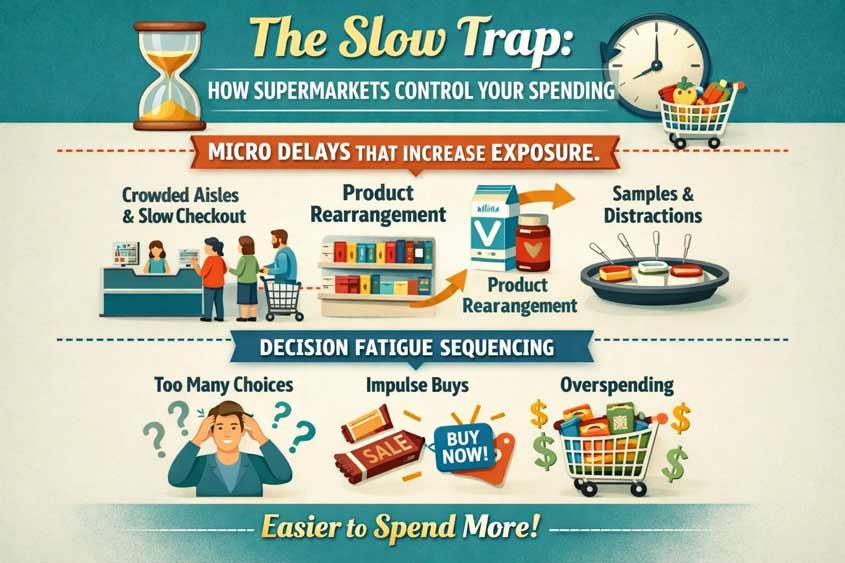
In this article, we’ll break down how time perception and decision fatigue in supermarkets are engineered step by step. You’ll see how tiny delays increase exposure without you noticing, and how store layouts are sequenced to catch you exactly when your decision-making is at its weakest.
Once you see it, it’s hard to unsee.
Table of Contents
The Hidden Pause: How Micro Delays Keep You Looking
You don’t notice the delay. That’s the whole point.
It’s not a long wait. Not enough to frustrate you. Just enough to slow your pace, hold your attention, and quietly increase how long you stay exposed to products.
This is one of the most overlooked layers of time perception and decision fatigue in supermarkets. Not the big, obvious time sinks. The tiny ones. The ones that feel like normal parts of shopping.
And yet, they add up fast.
Think about the produce section. You pick a few apples, maybe some tomatoes. Then you move to the weighing station. You place the bag down. You search for the right code. You tap the screen. It lags slightly. Maybe you redo it because the label didn’t print right.
Ten seconds. Fifteen, maybe.
Doesn’t sound like much. But during that time, what are you doing?
You’re standing still. Looking around. Surrounded by other products. Pre-cut fruit. Fresh juices. Premium organic items with clean packaging and higher margins. You didn’t come for those. But now you’re seeing them. Processing them. Letting them register.
That’s exposure.
And exposure changes behavior. Familiarity builds preference. Even a brief glance can make a product feel more “known,” more trustworthy, more likely to be chosen later. This ties directly into the mere exposure effect, one of the simplest but most reliable psychological triggers in marketing.
Now stretch that moment across an entire store.
A slow weighing station here. A narrow aisle where you wait for someone to pass. A checkout line that moves just slowly enough to keep you browsing the candy shelf. A refrigerated door that takes an extra second to open. A self-checkout interface that makes you pause between steps.
None of these are accidents.
They’re friction points. But not the kind that pushes you away. The kind that holds you in place.
And when you’re held in place, your attention doesn’t disappear. It redirects.
You start scanning. Not intentionally. Just… casually. Your brain fills the gap. It looks for something to process. A bright label. A discount sign. A “new product” badge. Something slightly different from the rest. That’s the isolation effect creeping in. One product stands out, so it gets your attention. Attention increases the chance of purchase. Simple chain reaction.
Here’s where time perception plays a quiet trick on you.
When delays are short and varied, your brain doesn’t register them as “waiting.” They blend into the experience. You don’t feel like time is being wasted. You feel like you’re just… shopping.
But the clock tells a different story.
Let’s say you encounter ten micro delays during your trip. Each one lasts around 10 seconds.
10 delays × 10 seconds = 100 seconds.
That’s over a minute and a half of extra exposure.
And that’s a conservative estimate.
Now consider that during those 100 seconds, you’re not walking with purpose. You’re stationary or moving slowly. Your visual field is narrower. Your attention is more focused. This increases the probability that you actually notice products, rather than just passing by them.
From a marketing perspective, this is incredibly efficient.
Supermarkets don’t need to increase store size or add more products to boost sales. They just need to increase how long you’re exposed to what’s already there. Micro delays do exactly that, without making the experience feel worse.
In fact, sometimes they even improve it.
A slightly slower pace can feel more relaxed. Less rushed. More “browsy.” That feeling reduces resistance. You’re not trying to get out as fast as possible. You’re open. Curious. Willing to look around.
And once you’re in that state, other psychological triggers start stacking.
Anchoring comes into play when you see a high-priced item first, making the next one feel like a better deal. Scarcity cues like “limited stock” or “today only” feel more urgent when you’ve already spent time in front of them. Even packaging design has more impact because you’re actually looking at it, not rushing past.
All of this starts with a few seconds of delay.
You’ll see the same pattern outside supermarkets too.
Airports use slow security lines that force you through duty-free zones. E-commerce sites introduce slight loading pauses before showing recommendations. Restaurants delay menu delivery just enough to make you look around and notice what others ordered.
Different environments. Same principle.
Slow the person down just a little. Increase exposure just enough. Let psychology do the rest.
And here’s the part that matters for you as a shopper or a marketer.
Micro delays don’t work because they force decisions. They work because they create opportunities for decisions that weren’t planned.
You didn’t walk in thinking about that smoothie bottle. Or that premium salad mix. Or that snack bar near checkout. But you saw them. Maybe more than once. Maybe while your brain was slightly bored, slightly tired, slightly more open to suggestion.
That’s all it takes.
Time perception and decision fatigue in supermarkets don’t rely on big, dramatic tactics. They rely on accumulation. Small moments. Repeated patterns. Subtle shifts in attention.
You don’t feel manipulated. You just end up with more in your basket.
And if you’re designing a retail experience, this is where you start paying attention. Not just to what people see, but when they’re forced to stop and actually look.
Because those pauses? That’s where the real selling happens.
When Your Brain Gets Tired, The Store Gets Smarter
At the start of your trip, you’re sharp.
You compare prices. You check labels. You pause and think, do I really need this? You might even do quick math in your head. Price per unit, brand differences, maybe a mental budget check. This is you at full decision capacity.
Supermarkets know this version of you very well.
And they don’t try to sell you their highest-margin products at this point.
Instead, they let you “warm up” on low-risk, familiar decisions. Produce. Bread. Milk. Basic staples. Categories where you already have preferences. Categories where you don’t need to think too hard.
This is where time perception and decision fatigue in supermarkets quietly begin their second phase. Not by slowing you down, but by letting you spend your mental energy early, where it doesn’t hurt them.
Because every decision you make has a cost.
Not financial. Cognitive.
Psychologists have studied this for years. The more decisions you make in a row, the worse your decision quality becomes. Not because you suddenly stop caring, but because your brain starts conserving effort. It shifts from careful analysis to shortcuts.
You stop asking what’s optimal.
You start asking what’s easy.
Now think about how a supermarket is structured.
You rarely walk in and immediately face the snack aisle, the ready-to-eat meals, or the premium convenience products. Those tend to appear later. After you’ve moved through multiple sections. After you’ve made dozens of small choices.
By then, something has changed.
You’re still functioning. But your standards have dropped.
You’re less likely to compare three brands. Less likely to calculate value. More likely to grab the one at eye level. The one with the clearer packaging. The one that “feels right.”
That’s not random. That’s decision fatigue doing its job.
Let’s break it down in a simple way.
Imagine you make 30 decisions during the first half of your trip. Small ones. Apples or bananas. Whole grain or white bread. Brand A or Brand B.
Each decision takes a bit of effort.
By the time you reach decision number 40, your brain starts cutting corners.
By decision 50, it’s actively looking for ways to avoid effort.
This is where high-margin categories are placed.
Snacks. Sweets. Ready meals. Premium drinks. Convenience foods.
Products that benefit from impulse rather than analysis.
Products where the difference between options isn’t always obvious, so you rely on cues. Packaging. placement. familiarity. maybe even mood.
And your mood matters more than you think.
Decision fatigue doesn’t just make you lazy. It makes you more emotional. More reactive. Less resistant to immediate rewards. That chocolate bar near checkout? It’s not just visible. It’s appealing in that exact moment because your brain is tired of saying no.
You’ve been “good” for most of the trip. You stuck to your list. You made sensible choices.
Now your brain wants relief.
That relief often looks like a small indulgence.
This connects directly with other psychological triggers. The reward effect, where you justify a treat after effort. The scarcity effect, where limited-time offers feel more urgent when your resistance is low. The center stage effect, where prominently placed items become default choices.
They don’t work in isolation. They stack on top of decision fatigue.
And supermarkets sequence them carefully.
You’ll often notice that impulse zones appear at transition points. End of aisles. Near checkouts. At the entrance of a new section. These are moments where your brain is already shifting context. That shift makes you even more vulnerable to suggestion.
You’re not fully focused. You’re in between decisions.
That’s when a well-placed product can slip in.
Now layer this with time perception.
If your trip feels longer than expected, even by a few minutes, your mental energy drops faster. Remember those micro delays? They weren’t just increasing exposure. They were also accelerating fatigue.
So by the time you reach the final third of the store, two things are happening at once.
You’ve seen more products than you planned.
And you’ve made more decisions than you realized.
That combination is powerful.
It increases the chance that you’ll default to easy choices. That you’ll rely on visual cues instead of logic. That you’ll respond to things like bright packaging, bold discounts, or “new” labels without much resistance.
From a business perspective, this is extremely efficient.
Instead of trying to convince a fully alert, analytical shopper to buy a high-margin product, supermarkets wait until that shopper becomes less analytical.
They don’t fight your resistance.
They outlast it.
You’ll see similar patterns in other environments too.
Streaming platforms show you endless options until you stop evaluating and just click something. Online stores present filters and comparisons early, then push “recommended for you” products later. Even fast-food menus are structured so that combos and add-ons appear after you’ve already committed to a main item.
The principle is the same.
Front-load decisions that feel necessary.
Back-load decisions that benefit from reduced scrutiny.
And once you recognize this, you start seeing how predictable your own behavior can be.
You go in for essentials. You leave with extras.
Not because you planned to. Not because you were convinced in a rational sense.
But because, at some point, your brain got tired of deciding.
Time perception and decision fatigue in supermarkets don’t just influence what you buy. They influence when you’re most likely to say yes.
And that “when” is engineered.
Carefully.
Quietly.
Very effectively.
You Didn’t Run Out of Self-Control. You Ran Out of Decision Capacity.
By the end of a shopping trip, most people don’t feel like they made hundreds of micro-choices. They remember a handful of decisions and a general sense of “it got a bit expensive.”
But the real story sits underneath that.
Time perception and decision fatigue in supermarkets work less like a single tactic and more like a gradual shift in how you think. At the start, you’re deliberate. You evaluate. You compare. You feel in control of each choice.
Later, something quieter happens. You still think you’re choosing, but the effort behind each choice drops. You stop running full comparisons. You lean on instinct, habit, visual cues. Not because you want to, but because mental energy is not infinite.
This is where the structure of the store matters more than most people realize.
A supermarket is not arranged randomly. It is paced. It is sequenced. It is designed so that early sections consume attention on low consequence decisions, while later sections contain higher margin, higher impulse products that benefit from reduced scrutiny.
That shift is subtle enough that you rarely notice it in real time.
You just feel it as fatigue.
And fatigue changes behavior in very predictable ways. You become more responsive to what is immediately in front of you. Less willing to walk back to compare. More likely to accept the first acceptable option instead of searching for the best one.
Time perception and decision fatigue in supermarkets intensify this effect because your sense of duration is distorted during the trip. Ten minutes can feel like five. Or the reverse. The inconsistency makes it harder to track how many decisions you’ve actually made, which removes one of your natural brakes.
You lose the sense of “I’ve done enough thinking for today.”
Other psychological triggers slide in at this point and become more effective than they would be at the start. Anchoring makes higher prices feel more normal after exposure to mid-range items. The scarcity effect feels more urgent when mental resistance is low. The center stage effect becomes stronger because attention is no longer actively filtering everything.
Even simple visibility becomes power.
If you see it clearly at the end of your trip, it has a better chance of entering your basket.
That’s the quiet mechanism behind so many “unexpected” purchases. Not persuasion in the obvious sense. Not aggressive marketing. Just timing. Just placement. Just catching you when your decision-making system is no longer running at full strength.
And this is not unique to supermarkets.
The same structure appears in digital environments, where scrolling replaces walking. In apps that front-load choices and push recommendations later. In menus, feeds, and interfaces that keep you engaged long enough for fatigue to build without you noticing.
Different environments. Same principle.
Extend attention. Increase exposure. Reduce decision quality over time. Then place the most profitable options where decision quality is lowest.
Once you see it clearly, the illusion of randomness disappears.
What feels like personal preference in the moment is often the result of timing and sequencing layered over your natural cognitive limits.
That doesn’t mean every choice is controlled. It doesn’t mean you’re not making real decisions. It just means the environment is doing more of the steering than it looks like on the surface.
And supermarkets are especially good at this because they operate in physical space. They can control your pace. They can structure your path. They can decide when you stop, when you pause, when you are forced to look.
Time perception and decision fatigue in supermarkets are not isolated tricks. They are part of a system that assumes one simple truth: you are not equally decisive at every moment of the trip.
Once that is accounted for, everything else becomes design.
And if you ever find yourself standing at a checkout with a few items you don’t remember planning to buy, it’s rarely about weakness or impulse in isolation.
It’s about timing.
It’s about how long you’ve been deciding.
And it’s about the fact that by the end, the store is still structured to sell… even when you’ve stopped actively trying to shop.
That’s the part most people miss.
Not what influenced the decision.
But when it was made.

Gabriel Comanoiu is a digital marketing expert who has run his own agency since 2016. He learned marketing by testing, analyzing, and refining campaigns across multiple channels. In his book series Impulse Buying Psychology, he shares the psychological triggers behind every purchase, showing how to create marketing that connects, persuades, and converts.