
The Illusion of Now: Why Scarcity and Urgency Quietly Control What You Buy
You walk into a supermarket for a few basic things. Bread, milk, maybe something quick for dinner. Nothing complicated. Then you notice it. A half-empty shelf where your usual product sits. A small sign nearby suggests there’s a limit per customer. Suddenly, your calm, rational plan shifts. You feel a subtle push. Maybe you should grab two. Just in case.
That moment isn’t random. It’s engineered.
Scarcity and urgency in marketing work at a deeper level than most people realize. It’s not just about flashing “limited time offer” banners or countdown timers. Those are the obvious plays. The real influence happens quietly, through physical cues, spatial design, and small signals that your brain picks up without asking for permission.
At its core, this tactic taps into a simple psychological principle. When something appears scarce, your brain assigns it more value. Not because the product changed, but because availability did. You instinctively treat it as something worth securing before it disappears. This is closely tied to loss aversion. You feel the potential loss of not having the item more strongly than the satisfaction of getting it.
Urgency adds another layer. It compresses your decision time. Instead of evaluating options, comparing prices, or even questioning whether you need the product at all, you move faster. And when you move faster, you rely on shortcuts. Heuristics kick in. You assume that if others are buying it, it must be good. That’s social proof sneaking in. You assume that if it’s almost gone, it must be worth having. That’s perceived value shifting in real time.
Here’s where it gets interesting. Supermarkets don’t just react to demand signals. They shape them.
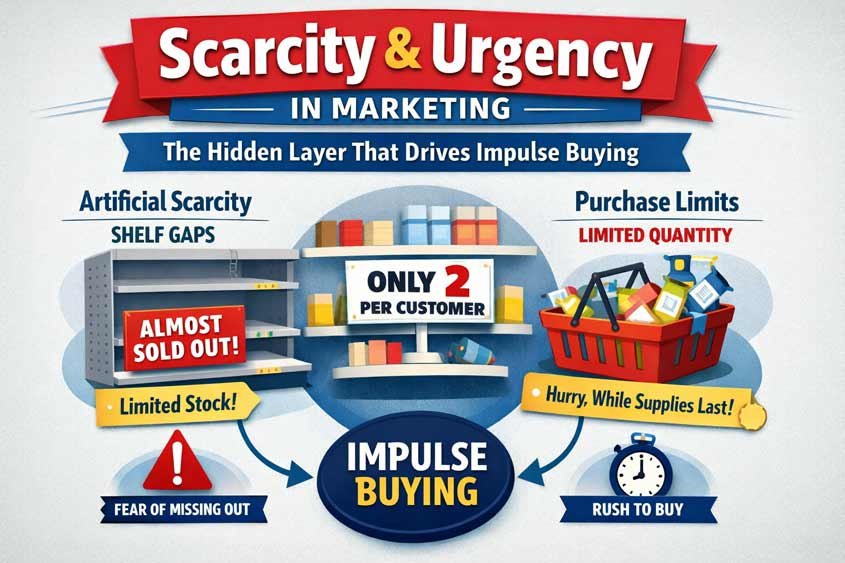
A shelf that looks slightly depleted can create the impression of popularity, even when stock is controlled behind the scenes. A purchase limit doesn’t just manage inventory. It signals that the product is in high demand. These are subtle nudges, but they stack. And once your brain starts interpreting these signals, your behavior follows.
You might think you’re making a rational choice. You’re not rushing. You’re just being practical. But zoom out for a second. Why did that item suddenly feel more important than the rest? Why did it move from “maybe later” to “I should get this now”?
That shift is the real target of scarcity and urgency in marketing. Not the product itself, but your perception of it.
And once you start noticing these patterns, you see them everywhere. Not just in supermarkets. Airlines, e-commerce platforms, streaming services, even restaurants use the same underlying mechanics. Different context, same psychological triggers.
The question isn’t whether these tactics work. They do. The better question is how often they’re guiding your decisions without you realizing it.
Ready to go deeper into how this plays out physically on the shelf?
Table of Contents
Artificial Scarcity Through Shelf Gaps
There’s a difference between something being low in stock and something looking low in stock. That gap matters more than most people think.
When you walk past a shelf and see a few scattered items with empty space around them, your brain doesn’t pause to question inventory logistics. It jumps straight to interpretation. This product is popular. Other people are buying it. I might miss out.
That reaction happens fast. Almost automatic.
Here’s the part most people miss. In many cases, those gaps are not a reflection of real demand. They are designed.
Retailers understand that a fully stocked shelf can actually reduce urgency. When everything looks abundant, your brain relaxes. There’s no pressure to act. You can always come back later. You can compare options. You can delay the decision.
But introduce a bit of emptiness, and the whole dynamic changes.
Spacing becomes a signal.
A product with intentional gaps around it stands out without needing bright colors or loud signage. It creates contrast. That ties directly into the isolation effect. Your attention is drawn to what looks different. And on a crowded shelf, “different” often means “less available.”
Now layer in perceived demand. If something is missing from the shelf, your brain fills in the story. Other shoppers chose this. They saw value here. That’s social proof, but in a physical, almost invisible form. No reviews. No ratings. Just absence doing the talking.
And here’s where it gets a bit sneaky.
Retailers don’t always restock shelves evenly. High margin or strategically important products may be given more visual breathing room. Instead of stacking items tightly, they’re spaced out. Fewer units are placed on the shelf at once, even if more are available in storage.
This creates controlled scarcity.
You’re not seeing the full inventory. You’re seeing a curated version of it. One that suggests demand without needing to explicitly say it.
Think about fresh bakery sections. Ever noticed how trays often look partially empty, even during peak hours? It gives the impression that items are selling quickly. That they’re fresh, constantly moving. In reality, batches are often timed and displayed in ways that maintain that “just bought” look.
Or take electronics stores. A popular accessory might have only a few units on display, spaced apart, while less important items are packed tightly. The message is subtle but clear. This one is in demand. The others… not so much.
This tactic also plays with your sense of timing.
When you see a nearly full shelf, you assume stability. When you see gaps, you assume volatility. Things are changing. Stock is moving. And when things are moving, you feel the need to move with them.
That’s urgency creeping in, without a single word being used.
There’s also an interesting interaction with price perception. Sparse displays can make products feel more premium. You’ve probably seen this in cosmetics or high end grocery sections. Fewer items, more space, cleaner presentation. It signals quality, exclusivity. But when that same sparsity appears in a regular supermarket aisle, your brain leans toward a different interpretation. Demand instead of luxury.
Same visual cue. Different context. Different meaning.
And then there’s the compounding effect.
Shelf gaps don’t work in isolation. They stack with other psychological triggers. A slightly empty shelf next to a “customer favorite” label amplifies the message. Add a rounded price just below a threshold, and the product feels both popular and reasonably priced. Place it at eye level, and now it’s unavoidable.
Each element reinforces the others.
You might think you’re just noticing what’s left. But what you’re really seeing is a carefully constructed narrative about what’s worth buying.
Let’s ground this in a simple scenario.
You’re choosing between two brands of pasta. One shelf is fully stocked, rows perfectly aligned. The other has visible gaps, only a few packs left, slightly disorganized. No price difference. No promotional tags.
Which one feels safer to choose?
Most people lean toward the one with fewer units. It feels validated. Pre selected by others. Even if that conclusion has no real data behind it.
That’s the power of artificial scarcity through shelf gaps. It doesn’t force your decision. It nudges your interpretation of reality.
And once your perception shifts, your behavior follows.
The important thing to understand is that your brain isn’t wrong for reacting this way. In most real world situations, scarcity does signal value. If something is consistently chosen by others, it often is worth considering. These mental shortcuts exist for a reason.
But in a retail environment, those signals can be manufactured.
So the next time you see a half empty shelf, it’s worth asking a simple question. Is this product actually in demand, or is it being made to look that way?
That pause, even if it’s just a second, is often enough to bring your decision back under your control.
Purchase Limits
There’s something oddly persuasive about a small sign that says “Max 3 per customer.” It looks practical. Responsible, even. Like the store is just trying to make things fair for everyone.
But your brain doesn’t read it that way.
It reads it as a signal.
The moment you see a purchase limit, the product changes in your mind. It’s no longer just another option on the shelf. It becomes something controlled. Something potentially scarce. Something other people want enough that the store had to step in.
That shift happens instantly.
And here’s the key point. The limit itself doesn’t reduce demand. It increases it.
This is one of the most reliable applications of scarcity and urgency in marketing. Not because it restricts access in a real sense, but because it reframes how you interpret the product. A simple constraint turns into a value amplifier.
Think about it from your own perspective.
If you see two identical products, and one has no restriction while the other is limited to three per person, which one feels more important to secure?
The limited one wins almost every time.
Why?
Because limits imply competition.
You start to imagine other shoppers reaching for the same item. You picture stock running out. Even if the shelf is currently full, the rule suggests that it won’t stay that way. That anticipation creates urgency before any actual shortage exists.
This taps directly into loss aversion. You’re not just thinking about buying the product anymore. You’re thinking about the possibility of not being able to buy it later. And that possibility carries more weight than it should.
There’s also a subtle authority effect at play.
When a store imposes a limit, it signals that someone made a decision behind the scenes. A system, a manager, a policy. It gives the impression that this product has been evaluated and flagged as important. That alone increases perceived value. You trust the constraint because it feels official.
It’s similar to how “expert approved” messaging works, but here the authority is operational rather than verbal.
Now layer in anchoring.
The number itself becomes a reference point. If the sign says “Max 3,” your brain starts to treat three as a reasonable quantity to buy. Even if you originally planned to get one, you might stretch to two. Maybe even three. Not because your need changed, but because the anchor did.
This is where things get interesting from a behavioral standpoint.
The limit doesn’t just create urgency. It shapes quantity decisions.
Retailers know that most people won’t question the number. They’ll adjust to it. A limit of three feels generous enough to avoid frustration, but restrictive enough to trigger action. It sits in that sweet spot where you feel both allowed and slightly constrained.
And that tension pushes you to buy more than you planned.
You can see this play out clearly during promotional periods. Discounted items often come with purchase limits. On the surface, it looks like inventory control. In reality, it’s a dual trigger. The discount activates price sensitivity. The limit activates scarcity and urgency in marketing.
Together, they create a powerful nudge.
You’re not just getting a deal. You’re getting a deal that might not last, on a product that others are likely grabbing right now.
Even outside discounts, limits work as standalone signals.
Consider everyday essentials. Bottled water, cooking oil, cleaning supplies. When these items carry limits, your brain flags them as critical. You don’t want to run out. So you adjust your behavior preemptively.
This is especially effective during periods of uncertainty. But the tactic doesn’t depend on real external pressure. The perception alone is enough.
And just like with shelf gaps, this doesn’t operate in isolation.
Place a purchase limit next to a slightly depleted shelf, and the effect multiplies. Now you have visual scarcity and rule-based scarcity reinforcing each other. Add a “popular choice” tag, and you bring in social proof. Each layer strengthens the narrative.
It starts to feel obvious. Of course this is worth buying. Of course you should act now.
But step back for a second.
Ask yourself this. Did your actual need change, or did the context around the product change?
Most of the time, it’s the context.
There’s also a psychological comfort in complying with limits.
It sounds counterintuitive, but constraints can reduce decision fatigue. Instead of debating how much to buy, you’re given a boundary. You operate within it. That makes the decision feel easier, faster, more justified.
“I’ll just take the maximum.” Done.
No overthinking. No second guessing.
This ties into another subtle mechanism. Effort reduction. When decisions are simplified, you’re more likely to act. The limit becomes a shortcut.
And once again, speed works in favor of the retailer.
Because faster decisions tend to rely on emotional cues rather than careful evaluation.
Here’s a scenario you’ve probably experienced.
You see a sign: “Max 3 per customer” on a product you didn’t plan to buy. You pause. Why is there a limit? Is it selling out? Should I get some? You pick up one. Then you hesitate. If others are buying it, maybe one isn’t enough. You add another.
Now you’re holding two units of something that wasn’t on your list.
That’s not an accident.
It’s a controlled shift from indifference to action, driven by a single line of text.
And the thing is, you don’t feel manipulated. It feels like a reasonable response to a reasonable rule.
That’s what makes this tactic so effective.
It doesn’t push. It reframes.
Scarcity and urgency in marketing don’t always shout. Sometimes they whisper through constraints, letting your own interpretation do the heavy lifting.
Once you start noticing purchase limits this way, they look very different. Less like protective policies, more like behavioral triggers designed to guide how much you buy and how fast you decide.
And just like before, awareness gives you a small edge.
Not to ignore the signal completely, but to question it. To separate real need from perceived urgency.
Because that’s the line these tactics are designed to blur.
When “Limited” Stops Meaning Limited
Scarcity and urgency in marketing work best when you don’t notice them. That’s the whole point. They slip into your decision process, reshape how you interpret a situation, and quietly push you toward action.
By now, you’ve seen the deeper layer. Not the loud countdown timers or the obvious “last chance” banners, but the subtle mechanics. Shelf gaps that suggest demand. Purchase limits that imply competition. Small cues that shift your perception without asking for permission.
And once your perception shifts, everything downstream changes.
You evaluate faster. You question less. You buy sooner. Sometimes you buy more.
It feels like your decision. Technically, it is. But it’s been guided.
Here’s the part that matters if you care about staying in control of your choices.
Scarcity and urgency in marketing are not inherently deceptive. In many cases, they reflect real conditions. Products do run out. Demand does spike. Limits can be necessary. The problem is not the tactic itself. It’s how easily your brain accepts the signal without verification.
Your brain is built to trust patterns.
Low availability usually means high demand. High demand usually means value. That shortcut works in most real world situations, so you rely on it. Retail environments simply recreate the signal, sometimes without the underlying reality.
That’s where things get distorted.
And it doesn’t stop at supermarkets.
Airlines show you “only 2 seats left” to accelerate booking decisions. E commerce platforms highlight “low stock” to reduce hesitation. Streaming services label content as “leaving soon” to trigger immediate viewing. Different industries, same psychological backbone.
Scarcity and urgency in marketing scale because they’re based on how you process risk and opportunity.
You avoid loss. You respond to time pressure. You look for signals from others. You simplify decisions when things feel uncertain. These are stable, predictable behaviors.
That’s why these tactics keep showing up.
So what do you actually do with this?
You don’t need to fight every signal. That would be exhausting and unnecessary. Instead, you build a small habit. A pause.
When something suddenly feels more important than it did a few seconds ago, that’s your cue. Ask a simple question. Did my need change, or did the presentation change?
If the answer is the presentation, you’ve just caught the mechanism in action.
That pause doesn’t mean you walk away. It means you decide with clarity instead of momentum.
There’s also a practical angle here if you’re on the other side, building campaigns or designing retail experiences.
Scarcity and urgency in marketing are powerful, but they’re also fragile. Overuse them, and people start to notice. If everything is “limited,” nothing feels limited. If every product has a constraint, the signal loses credibility.
The most effective use is selective. Controlled. Grounded enough in reality to feel believable.
Because once trust drops, the entire mechanism weakens.
And that’s the balance.
Used well, scarcity and urgency guide attention, simplify decisions, and increase conversion. Used poorly, they create noise and skepticism.
Either way, they’re shaping behavior every day.
You just see them differently now.

Gabriel Comanoiu is a digital marketing expert who has run his own agency since 2016. He learned marketing by testing, analyzing, and refining campaigns across multiple channels. In his book series Impulse Buying Psychology, he shares the psychological triggers behind every purchase, showing how to create marketing that connects, persuades, and converts.