
Why You Think You’re Buying Smart (But You’re Being Guided)
Walk into a supermarket and you feel in control. You compare prices. You scan labels. You pick what seems like the best deal. It feels rational. Almost calculated.
But here’s the uncomfortable part. Most of what feels like a smart decision is actually shaped before you even notice it.
The perception of value and quality doesn’t come from the product alone. It comes from how that product is presented to you. The price tag, the shelf position, the packaging, even the item sitting next to it. None of these are random. They’re carefully designed signals. And your brain is wired to read those signals fast, often without questioning them.
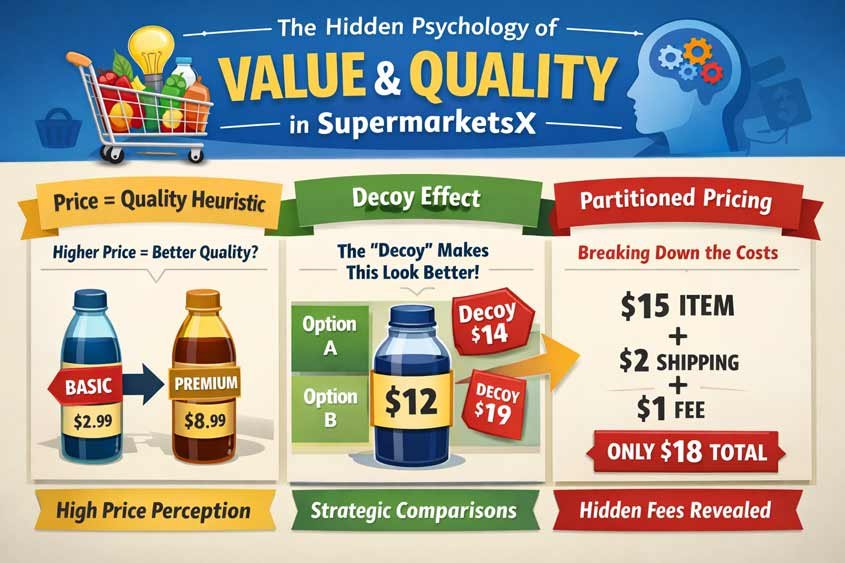
You see a higher price and instinctively assume better quality. That’s not you being irrational. That’s your brain using a shortcut. Psychologists call it a heuristic. You call it “this one just seems better.” Same thing.
Then there’s comparison. You rarely evaluate a product in isolation. You compare it to what’s around it. A 7 euro product feels expensive until it sits next to a 12 euro one. Suddenly it looks reasonable. Maybe even like a bargain. Nothing about the product changed. Only the context did.
Supermarkets lean heavily on this. They don’t just stock products. They stage decisions.
You’ll also notice how prices are broken down. Per kilogram. Per unit. Per serving. It sounds helpful, and sometimes it is. But it also shifts your focus away from the total cost. Your brain locks onto the smaller number. It feels lighter. Easier to accept. You don’t feel the full impact of what you’re spending.
And then there are those “almost good” options. The ones that seem slightly off. Not terrible, just… not quite right. They exist for a reason. They make another product look clearly superior. You feel like you’ve made a smart choice by avoiding the weaker option. In reality, the comparison was designed to lead you there.
This is where other psychological triggers quietly step in. Anchoring sets your expectations early. The decoy effect nudges you toward a specific choice. Cognitive ease makes familiar or simple options feel safer. Even the mere exposure effect can make you trust a product just because you’ve seen it before.
None of this means you’re being tricked in some dramatic way. It’s subtler than that. You’re being guided. Nudged. Framed.
And once you start noticing how the perception of value and quality is built, not just perceived, you can’t really unsee it.
Table of Contents
Why Expensive Feels Better (Even When It Isn’t)
You’ve done this before. Everyone has.
You pick up two bottles of olive oil. One is 6 euros. The other is 14. You don’t recognize either brand. No reviews, no clear difference in ingredients. Just a label and a price.
And yet… the 14 euro one feels better.
That feeling is the price quality heuristic in action. When information is limited, your brain uses price as a shortcut for quality. Higher price signals higher value. Not always true. But it’s fast. Efficient. Good enough for most decisions, especially in a supermarket where you’re making dozens of them in minutes.
This isn’t a random quirk. It’s a deeply studied pattern in consumer psychology. When you lack time, knowledge, or motivation to evaluate every detail, you lean on cues that feel reliable. Price is one of the strongest.
Think about wine. In blind tests, people often rate the same wine as tasting better when they believe it’s more expensive. Same liquid. Different perception. Your brain literally changes the experience based on expected quality. That’s how powerful this shortcut is.
Supermarkets know this. And they design shelves around it.
Look closely at how products are placed. Premium options are rarely isolated. They sit right next to cheaper ones. This is not about convenience. It’s about contrast.
A 10 euro product on its own might feel expensive. Place it next to a 3 euro alternative and suddenly it has a role. It becomes the “better” option. The upgrade. The safe choice if you don’t want to risk going too cheap.
Now push it further. Add a 18 euro version right next to it. Something slightly more luxurious, maybe organic, maybe imported, maybe just packaged better. What happens?
The 10 euro product now feels… reasonable.
That’s anchoring quietly doing its job. The highest price sets the reference point. Everything below it starts to feel more acceptable. You don’t evaluate the 10 euro item on its own. You evaluate it relative to the 18 euro one.
And here’s where it gets interesting. Supermarkets don’t need you to buy the most expensive item. They just need it there to shape how you see the others.
In many cases, the premium product is there to sell the mid tier.
You’ll see this pattern everywhere. Coffee. Chocolate. Cheese. Even bottled water. There’s usually a basic option, a premium one, and something in between that feels like the smartest pick. Not too cheap, not too expensive. Just right.
That “just right” feeling? It’s engineered.
Packaging reinforces it. Premium products tend to use darker colors, minimalist design, matte finishes. They look clean, serious, high end. Cheaper products often look louder, brighter, more crowded. None of this changes the actual quality in a meaningful way, but it changes how you interpret it.
And once your brain labels something as higher quality, you start justifying the price. You assume better ingredients. Better sourcing. Better results. Even if you don’t verify any of it.
This ties directly into another trigger you’ve probably felt. Loss aversion. You don’t just want a good product. You want to avoid a bad one. Choosing the cheapest option feels risky. What if it’s low quality? What if it disappoints?
So you move up a level. Not necessarily because you want premium, but because you want to reduce risk.
That’s why the perception of value and quality is rarely about finding the best product. It’s about finding the safest choice within a frame that someone else built.
And once you see how that frame works, you start noticing it everywhere. Electronics, restaurants, clothing, even digital subscriptions. The structure stays the same. Only the context changes.
Next time you’re in a supermarket, pause for a second. Look at the price ladder in any category. Ask yourself one simple question:
Would this product still feel like a good choice if the more expensive one next to it didn’t exist?
Most of the time, the answer is no.
The Option That Exists Just to Lose (And Make You Win)
There’s a strange product sitting on the shelf. You’ve seen it, even if you didn’t notice it.
It’s not the cheapest. Not the best. Not even particularly appealing. It just feels… off. Slightly worse for the price. Slightly overpriced for what it offers. You glance at it, dismiss it, and move on.
But here’s the thing. That product wasn’t placed there to be chosen.
It was placed there to make another product look like the obvious winner.
This is asymmetric dominance. A more structured, more deliberate version of the decoy effect. Instead of simply offering multiple options, supermarkets introduce a clearly inferior one that makes a specific alternative look superior by comparison.
And your brain loves that kind of clarity.
Let’s make it concrete.
Imagine you’re choosing between two packs of coffee:
Option A
250g for 5 euros
Option B
500g for 9 euros
At first glance, you pause. You might even do the math. Option B is slightly better per gram, but not dramatically so. The decision requires effort.
Now add a third option:
Option C
400g for 9 euros
Suddenly, something shifts.
Option C is objectively worse than Option B. Same price, less product. No real justification. It exists in the same price range but offers less value. And because of that, Option B now feels like a no brainer.
You don’t hesitate anymore. You don’t calculate as much. You just see it.
Option B dominates Option C. Clearly. Visibly. Effortlessly.
And that clarity spills over into your decision.
Without Option C, you might have debated between A and B. With Option C present, B feels like the smartest, safest, most rational choice. You feel confident. Even a bit proud of spotting the better deal.
But that confidence was engineered.
The key here is that the decoy isn’t random. It’s carefully designed to be worse in a very specific way. Close enough to the target option to invite comparison, but clearly inferior once you look. That’s what makes it asymmetric. It doesn’t just sit there as another choice. It points you toward a specific one.
Supermarkets apply this everywhere.
Think about yogurt packs. You’ll often see three sizes. A small one that feels too little. A large one that feels like a commitment. And a middle option that seems just right. But sometimes there’s a fourth one. Slightly awkward. Priced oddly. That one exists to push you toward the middle.
Or take ready meals. Two similar dishes priced closely, and then one that’s slightly more expensive but visibly smaller or less appealing. That weaker option makes the better one shine.
Even in non food categories like cleaning products or personal care, you’ll see this pattern. A bottle with fewer uses at nearly the same price as a larger one. A bundle that looks worse than a slightly more expensive alternative. These aren’t mistakes. They’re signals.
And here’s where it connects back to the perception of value and quality.
Asymmetric dominance doesn’t just make something look cheaper. It makes it look smarter. Higher quality. Better value for money. You’re not just saving. You’re choosing well.
That emotional payoff matters.
Because buying decisions aren’t just about cost. They’re about feeling competent. Feeling in control. Feeling like you made the right call.
The decoy strengthens that feeling.
It reduces cognitive load. Instead of weighing multiple factors, your brain locks onto a simple comparison. This is better than that. Done. Decision made.
It also works hand in hand with anchoring. The decoy helps establish a reference point, then reinforces the appeal of the target option. And once you’ve leaned in that direction, consistency bias kicks in. You stick with your choice because it already feels justified.
What’s interesting is that you rarely notice the decoy itself. You don’t remember it. You don’t talk about it. But it quietly shapes what you do remember. The option you picked. The one that felt right.
And that’s the whole point.
Next time you’re comparing products and one option suddenly feels like the obvious winner, pause for a second. Scan the shelf again. Look for the one that seems slightly out of place. Slightly worse.
That’s usually the one doing the real work.
The Smaller Number That Feels Easier to Say Yes To
You’re standing in front of a shelf, trying to decide between two packs of cheese.
One says 12 euros per kilogram.
The other says 2.40 euros per 200 grams.
Same product category. Similar quality. But one of those numbers feels lighter. Less serious. Easier to accept.
That feeling is not accidental.
This is partitioned pricing. Instead of presenting the full cost in one clear number, the price is broken into smaller components. Per unit. Per weight. Per serving. Sometimes even per use.
And the moment the price is split, your perception shifts.
Because your brain doesn’t process those numbers the same way.
A large, single number triggers caution. It feels like a commitment. Something to evaluate. Something that might hurt a bit when you pay.
But smaller numbers? They slip through more easily. They feel manageable. Almost negligible.
So instead of thinking “this costs 12 euros,” you think “it’s just 2.40.”
That’s a very different emotional reaction.
Even when you know, logically, that it adds up to the same thing.
Supermarkets rely heavily on this, especially in categories where direct price comparison would slow you down.
Look at meat, cheese, nuts, or produce. Prices are almost always framed per kilogram or per 100 grams. On paper, this helps you compare value. And sometimes it does.
But in practice, it does something else first.
It reduces the perceived total cost.
You’re not buying a kilogram of premium cheese in your head. You’re buying “a few slices.” You’re not spending 18 euros on salmon. You’re paying “around 3 euros per portion.”
The total fades into the background.
And once your focus shifts away from the full price, your resistance drops.
This works even better when combined with the perception of value and quality.
A premium product priced at 3.20 per 100 grams doesn’t feel dramatically more expensive than one at 2.60. The difference feels small. Almost trivial.
But scale that up to a full purchase, and the gap becomes significant.
Your brain just doesn’t instinctively make that multiplication.
And supermarkets don’t rush to help you do it.
You’ll also notice how partitioned pricing pairs with packaging.
Smaller packages with slightly higher per unit prices often feel more affordable because the absolute price is lower. A 2.50 euro snack feels harmless. A 7 euro family pack feels like a decision.
Even if the larger pack offers better value.
This is where mental accounting quietly steps in. You categorize small expenses differently from large ones. A few euros here and there don’t feel like real spending. They feel like exceptions. Like they don’t count.
Until they do.
Partitioned pricing also shows up in subtle ways across other industries.
Think about subscription services. 9.99 per month feels easier than 120 per year. Same cost. Different perception.
Or gyms advertising cost per visit instead of total membership fees. Or coffee chains framing loyalty rewards as “points per purchase” instead of total spend required.
The structure stays consistent. Break the price. Shrink the number. Lower the friction.
Back in the supermarket, this tactic often works alongside anchoring and the price quality heuristic.
You see a high price per kilogram and assume quality. Then you see the smaller per unit breakdown and feel reassured that it’s not “that expensive.” The two signals reinforce each other.
High quality. Reasonable cost. Easy decision.
But here’s the catch.
Partitioned pricing doesn’t lie to you. The numbers are there. Transparent. Technically helpful.
It just changes what you pay attention to.
And what you ignore.
Next time you pick up a product, take a second to reverse the frame. Look for the total price. Multiply the unit cost. Bring the full number back into focus.
Because once you do, the perception of value and quality can shift pretty quickly.
And sometimes, not in the direction the shelf intended.
You Were Never Just Buying the Product
By the time you reach the checkout, your basket feels like a series of smart decisions.
You picked the better olive oil. The reasonably priced coffee. The cheese that seemed like good value for the quality. Nothing extreme. Nothing careless. Just solid choices.
That’s the story you walk away with.
But if you zoom out for a second, something else becomes clear. Most of those decisions didn’t start with the product. They started with how the options were framed.
The perception of value and quality was built around you.
Price anchored your expectations before you even compared anything. A higher number quietly suggested better quality. A slightly lower one felt like a smart compromise. Then asymmetric dominance stepped in and removed the friction. One option clearly better than another, so you didn’t have to think too hard. It felt obvious.
And just when the total cost might have made you hesitate, partitioned pricing softened the impact. Smaller numbers. Easier to accept. Less emotional resistance.
Layer these together, and something interesting happens.
You don’t feel influenced.
You feel confident.
That’s what makes these tactics so effective. They don’t push you. They guide you while preserving the feeling that you’re in control. You’re not reacting. You’re choosing.
At least, that’s how it feels in the moment.
Other psychological triggers quietly reinforce the process. Anchoring sets the first impression. The decoy effect simplifies comparison. Loss aversion nudges you away from the cheapest option. Even cognitive ease plays a role. The option that’s easiest to evaluate often wins.
And all of this happens fast. In seconds. While you’re thinking about dinner, not decision theory.
So what do you actually do with this?
You don’t need to overanalyze every purchase. That’s not realistic. But you can interrupt the pattern at key moments.
When something feels like a “safe” choice, pause and ask why.
When a price feels reasonable, check what it’s being compared to.
When a number feels small, look for the total.
Simple shifts. But they break the frame.
Because once you see how the perception of value and quality is constructed, you stop taking it at face value.
You start questioning it.
And that’s where the dynamic changes.
You’re still making decisions. Still choosing between options. But now, you’re a little harder to guide. A little less predictable.
And in an environment designed to shape your behavior, that’s a real advantage.

Gabriel Comanoiu is a digital marketing expert who has run his own agency since 2016. He learned marketing by testing, analyzing, and refining campaigns across multiple channels. In his book series Impulse Buying Psychology, he shares the psychological triggers behind every purchase, showing how to create marketing that connects, persuades, and converts.