
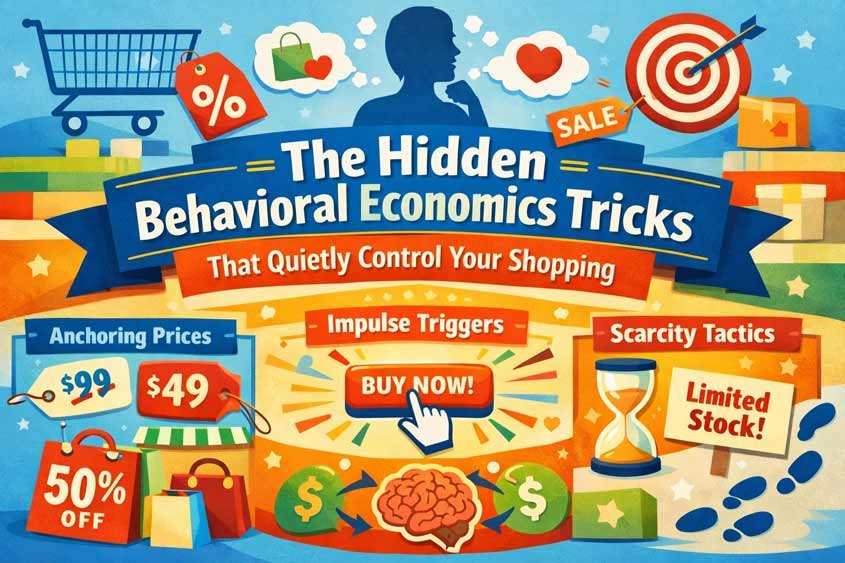
You Think You’re Choosing. You’re Not.
You walk into a supermarket with a plan. Maybe even a list. Milk, bread, something for dinner. Simple.
And yet somehow, you walk out with a basket that feels… heavier than expected. Not just physically, but financially. A few extras slipped in. Nothing dramatic. Just a snack you didn’t plan for. A “deal” that felt too good to pass. Maybe a product you picked up, examined, and then—without really deciding—kept.
This isn’t random. And it’s definitely not accidental.
Behavioral economics in supermarkets is built on a simple idea: your decisions aren’t as rational as you think. Not because you’re careless, but because your brain uses shortcuts. Fast judgments. Emotional cues. Subtle signals. Supermarkets are designed to meet you exactly in that space—right where logic fades and instinct takes over.
Most people assume supermarket tactics are obvious. Discounts. Bright packaging. Shelf placement. And yes, those matter. But the more powerful effects? They’re quieter. Harder to spot. They don’t push you. They guide you. Gently.
You don’t feel manipulated when you pick up a product just to “check it out.” You don’t question why a nearly-complete loyalty card makes you want to come back sooner. You don’t stop and think, “I’ve already spent 40 minutes here, I should probably buy more to justify it.”
But those moments? That’s where the real influence lives.
Supermarkets don’t just sell products. They shape behavior. They lean on psychological triggers like the mere exposure effect, loss aversion, and decision fatigue to tilt your choices. Not dramatically. Just enough. A small nudge here, a subtle push there. Over time, those tiny shifts add up to bigger baskets, more frequent visits, and higher spending.
And the interesting part? Even when you know these tactics exist, they still work.
Because they’re not trying to trick your conscious mind. They’re working underneath it.
In this article, you’ll see how some of the most overlooked behavioral economics effects show up inside supermarkets. Not the obvious ones. The subtle, almost invisible forces that quietly shape what you pick, how much you spend, and why you feel oddly satisfied doing it.
Let’s start with something deceptively simple.
The moment you touch a product.
Table of Contents
The Moment You Touch It, It’s Already Yours
You didn’t plan to buy it.
You just picked it up.
That’s how it starts.
A jar. A snack. A piece of fruit. Something small, something harmless. You grab it to check the label, maybe compare prices, maybe just out of curiosity. No commitment. No decision yet.
Except… there kind of is.
Because the second you touch a product, your brain quietly shifts how it sees it. Ownership, even temporary, changes perception. This is the endowment effect. And in behavioral economics in supermarkets, it’s one of the most underestimated drivers of buying behavior.
Once something is in your hand, it feels different. More valuable. More relevant. Slightly harder to put back.
You don’t notice it happening. But you feel it.
Supermarkets know this. So they design for it.
Think about loose produce sections. Apples, avocados, tomatoes sitting in open bins instead of sealed packaging. You’re expected to pick them up. Inspect them. Weigh them in your hand. That physical interaction isn’t just practical. It’s psychological.
Now compare that to pre packed produce. Clean, sealed, untouched. You look, maybe you grab one. But you don’t engage with it the same way. There’s less friction in walking away.
Touch creates connection. And connection increases perceived value.
Same idea shows up in bakery sections. Fresh bread laid out in open displays. Not hidden behind glass. You can get close. Sometimes even bag it yourself. That small act, putting it in a bag, feels like a step toward ownership. At that point, not buying it starts to feel like giving something up.
And people hate giving things up. That’s loss aversion quietly stepping in.
Tester packs work the same way, just more direct. Samples of cheese, small cups of yogurt, bite sized snacks. You try it, and suddenly it’s not just a product anymore. It’s an experience you’ve already had. Saying no now feels like rejecting something familiar.
There’s also a subtle escalation happening.
First, you touch it.
Then, you hold it.
Then, you carry it for a few seconds longer than necessary.
At each step, the mental barrier to buying gets lower.
By the time you’re thinking “Do I actually need this?”, your brain has already leaned toward yes.
This is why items that benefit from touch are rarely placed behind barriers. Think of clothing stores. Electronics displays. Even cars in showrooms. The same principle applies across industries. The more interaction, the stronger the sense of ownership.
And once ownership creeps in, rational evaluation weakens.
You stop asking, “Is this worth it?”
You start thinking, “Do I want to put this back?”
That’s a very different question.
Supermarkets don’t need to convince you aggressively. They just need to get the product into your hands. After that, your own psychology does the heavy lifting.
So next time you catch yourself holding something you didn’t plan to buy, pause for a second.
Ask yourself a simple question.
Did I choose this… or did I just touch it first?
The Closer You Get, The Faster You Spend
There’s something strangely motivating about being almost done.
Nine stamps out of ten on a loyalty card.
Eighty percent progress toward a reward.
Just two more purchases until you unlock something “free.”
Suddenly, what felt optional starts to feel urgent.
That’s the goal gradient effect. And in behavioral economics in supermarkets, it quietly speeds up how often you buy, how much you buy, and how quickly you come back.
Here’s how it works.
The closer you feel to a reward, the more effort you’re willing to put in to reach it. Not because the reward is huge. Sometimes it’s trivial. A free coffee. A small discount. A low value item.
But your brain doesn’t evaluate it purely based on value. It reacts to progress.
Progress feels good. Completion feels even better.
Supermarkets lean into this hard.
Loyalty cards are the obvious example. You’ve seen them everywhere. Buy nine coffees, get the tenth free. Collect points with every purchase. Spend a certain amount, unlock a reward tier.
At the start, motivation is low. One stamp on a card doesn’t mean much. But as the card fills up, something shifts. You start thinking about it more. You choose that store over another. You might even buy something you don’t really need just to “move closer.”
And once you’re near the end?
That’s where behavior accelerates.
You stop spacing out your visits. You compress them. You go out of your way. You add items to your basket that weren’t planned. All to close that small psychological gap.
Here’s the interesting part.
Even artificial progress works.
If a loyalty card starts with two stamps already filled in, people are more likely to complete it. The effort hasn’t changed. The reward hasn’t changed. But the perception of being closer makes the goal feel more achievable.
So you act faster.
This shows up beyond loyalty programs too.
Think about in store promotions like “Spend 50 more and get 10 off.” You’re already at 40. Now you’re scanning shelves, looking for something—anything—to bridge that gap. Not because you need it, but because stopping at 40 feels like leaving value on the table.
Or multi buy deals. “Buy 2, get 1 free.” You only needed one. But now you’re mentally calculating progress toward a better deal. One item doesn’t feel complete anymore. Three does.
The structure changes your behavior.
And it works because your brain hates unfinished progress. That tension sits there, quietly pushing you to resolve it.
There’s also a subtle emotional layer.
Finishing a goal feels like winning. It gives a small hit of satisfaction. A sense of closure. Supermarkets attach that feeling to spending. So the act of buying becomes tied to completion, not just consumption.
Over time, this shapes habits.
You don’t just shop when you need something. You shop when you’re “close” to something.
That’s a big shift.
And once that pattern sets in, supermarkets don’t have to push you anymore. You start pushing yourself.
So next time you notice you’re just a little short of a reward, pay attention to what happens next.
Are you buying because you need something…
Or because you’re almost there?
It’s Not Your Money Anymore. It’s “Saved” Money
You walk into a supermarket planning to spend 50.
You walk out spending 75… but somehow it doesn’t feel like 75.
Because in your head, you didn’t spend 75. You “saved” 20.
That gap between reality and perception? That’s mental accounting. And in behavioral economics in supermarkets, it’s one of the cleanest ways to get you to spend more while feeling like you’re doing the opposite.
Here’s the mechanism.
Your brain doesn’t treat all money the same. It creates separate mental buckets. Salary. Savings. Cash. Discounts. Rewards. Each one feels different, even though the value is identical.
A 10 euro discount is still 10 euros. But it doesn’t feel like money you already had. It feels like a gain. Like a bonus. Like something extra you can play with.
And once money feels like a gain, you spend it differently.
Supermarkets are built around triggering that exact shift.
Discount labels are everywhere. Bright colors. “Save 5.” “Special offer.” “Member price.” These aren’t just price signals. They’re reframing tools. They take your money and mentally convert part of it into “savings.”
Now you’re not just spending. You’re winning.
And winning changes behavior.
You become more flexible. More impulsive. More willing to add items to your basket because, in your mind, you’re still ahead. You might even justify a completely unrelated purchase using those “savings.”
“I saved 10 on groceries, so I can grab this dessert.”
That logic doesn’t hold up if you break it down. The dessert still costs money. But mental accounting doesn’t care about strict logic. It cares about how money is categorized.
There’s another layer here.
Once you accept a discount, you anchor to the idea that you’re getting value. That makes it easier to ignore the total bill increasing. You focus on individual wins instead of the overall outcome.
This is where supermarkets quietly combine mental accounting with other triggers like anchoring and price framing. A product marked down from a higher “original” price feels like a gain, even if the original price was rarely paid. Your reference point shifts, and the current price feels justified.
Now add multi buy offers into the mix.
“Buy 2, save 3.”
“3 for the price of 2.”
You start doing quick mental math. Not to minimize spending, but to maximize perceived value. You end up buying more units than planned because the “saving” feels like a missed opportunity if ignored.
Again, your total spend increases. But your perception? Still positive.
Even store credit and vouchers play into this. A 10 euro voucher doesn’t feel like your money. It feels separate. So when you use it, you’re more likely to overspend beyond it, because the initial amount didn’t feel like a real cost.
Different bucket. Different behavior.
This pattern shows up far beyond supermarkets. Casinos use chips instead of cash. Apps use credits. Airlines use miles. Same principle. Change the context, change how money feels.
And when money feels less like money, spending goes up.
So next time you see a discount and feel that small rush of “I’m saving here,” pause for a second.
Ask yourself one thing.
Would I still buy this… if there was no “saving” attached to it?
Because if the answer is no, then you’re not really saving anything.
You’re just spending differently.
You’ve Already Spent the Time. Now Make It Worth It
You’ve been in the store for 35 minutes.
You walked every aisle. Compared products. Waited in a short line. Maybe doubled back once or twice because you forgot something.
At this point, leaving with just a few basic items feels… off.
Almost like a waste.
That feeling? That’s the sunk cost fallacy. And in behavioral economics in supermarkets, it quietly pushes your basket size higher the longer you stay inside.
Here’s the core idea.
Once you’ve invested time, effort, or energy into something, your brain wants that investment to feel justified. Even if the original plan was simple. Even if you already got what you came for.
Because walking out with “just milk and bread” after 35 minutes doesn’t feel efficient. It feels like a bad trade.
So you compensate.
You add a few extra items. Something small. Something reasonable. Maybe a snack. Maybe a product you almost picked earlier. You’re not going overboard. You’re just… making the trip feel worth it.
That’s how it starts.
Supermarkets don’t create this feeling directly. They stretch the experience so the feeling has time to build.
Large store layouts. Long walking paths. Strategic product placement that forces you to pass through multiple sections. Even subtle friction like slightly confusing layouts or repositioned items.
You spend more time than you expected. Not dramatically more. Just enough.
And as time increases, so does the pressure to justify it.
There’s a quiet mental equation running in the background:
Time spent = value expected
If those two don’t match, your brain tries to fix it.
So you add value. Not by leaving faster next time, but by buying more now.
This effect gets stronger when combined with other psychological triggers.
Think about decision fatigue. After making dozens of small choices, your mental energy drops. At that point, adding one more item feels easier than carefully evaluating whether you actually need it.
Or anchoring. You’ve seen higher prices throughout the store, so a moderately priced item feels acceptable, even if it wasn’t planned.
Or even the endowment effect from earlier. You’ve already picked something up, carried it around for a bit… now putting it back feels like undoing part of your effort.
Everything stacks.
And then there’s the final moment. Checkout.
You’re standing there, waiting. You’ve already committed to the purchase. Time is fully spent. This is peak sunk cost territory.
So what’s right in front of you?
Small, easy to justify items. Snacks. Drinks. Gum. Low price, low التفكير, low resistance. Adding one more thing barely registers. But psychologically, it helps “round out” the trip.
It makes the whole experience feel complete.
Now multiply that by every visit.
You don’t just spend based on need. You spend based on how much time you’ve already invested.
That’s a subtle shift, but a powerful one.
Because supermarkets don’t need to convince you to spend more directly. They just need to keep you inside long enough for you to convince yourself.
So next time you’re about to head to checkout, pause for a second.
Look at your basket.
Ask yourself honestly.
Am I buying this because I need it…
Or because I’ve already spent too much time to leave with less?
You Didn’t Spend More by Accident
At this point, the pattern should feel clear.
You walk into a supermarket thinking in terms of needs. A list. A budget. A rough plan. Everything feels controlled, intentional.
But the moment you step inside, something shifts.
You start touching products you didn’t plan to buy.
You move a little faster when you’re close to a reward.
You treat discounts like extra money instead of reduced spending.
You add items just to make the trip feel worth the time.
None of these decisions feel forced. That’s the whole point.
Behavioral economics in supermarkets doesn’t rely on pressure. It works through small, almost invisible nudges. Each one seems harmless on its own. Easy to justify. Easy to ignore.
But stacked together, they shape your behavior in ways that are hard to notice in the moment.
And here’s the uncomfortable part.
Even when you understand these effects, they don’t suddenly stop working.
Because they don’t depend on you being unaware. They depend on how your brain naturally operates. Ownership bias. Progress motivation. Context driven spending. Loss avoidance. These aren’t flaws. They’re built in.
Supermarkets just design around them.
So what can you actually do with this?
You don’t need to fight every tactic. That’s unrealistic. And honestly, unnecessary.
But you can interrupt the pattern.
When you pick something up, pause before it goes into your basket.
When you’re close to a reward, ask if you’d still want it without the progress.
When you see a discount, look at the total, not the “saving.”
When your basket feels bigger than expected, check if you’re justifying time, not need.
These are small moments. But that’s where the decisions happen.
And once you start catching them, something interesting happens.
You don’t feel controlled anymore.
You feel aware.
That doesn’t mean you’ll always spend less. Sometimes you’ll still choose the extra item. Sometimes the convenience or enjoyment is worth it.
But now it’s your call.
Not a quiet chain reaction you didn’t even notice starting.
Because in the end, supermarkets don’t win by forcing you to spend.
They win by making it feel like you decided to.
And most of the time… you believe it.

Gabriel Comanoiu is a digital marketing expert who has run his own agency since 2016. He learned marketing by testing, analyzing, and refining campaigns across multiple channels. In his book series Impulse Buying Psychology, he shares the psychological triggers behind every purchase, showing how to create marketing that connects, persuades, and converts.