
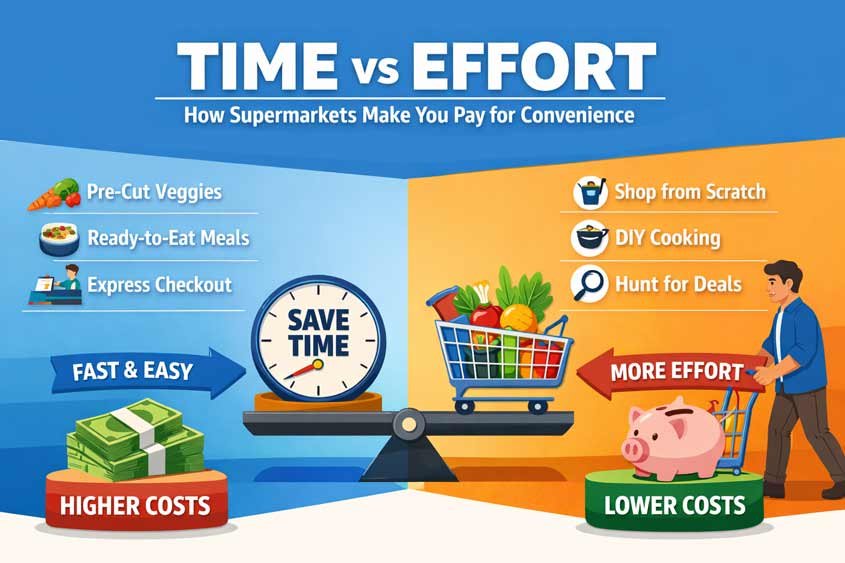
The Quiet Deal You Make Every Time You Shop
You don’t walk into a supermarket thinking about time. Or effort. Or trade offs.
You walk in thinking you’ll “grab a few things.”
That’s the story you tell yourself.
But the store is playing a different game entirely. One where every shelf, every product placement, every shortcut is designed around a simple equation: how much is your time worth right now?
Because here’s the uncomfortable truth. You don’t just pay with money. You pay with attention, energy, and patience. And supermarkets have become incredibly good at converting those into higher margins.
This is where supermarket convenience psychology quietly takes over.
You’ve felt it before, even if you didn’t notice it. You’re a bit tired. Maybe hungry. You don’t feel like cooking from scratch. Suddenly, that ready meal feels reasonable. That pre cut fruit feels justified. That packaged salad feels like a smart choice, even.
You tell yourself it’s about saving time. And it is. But it’s also about reducing friction.
And friction is the enemy of spending.
The less effort something requires, the less you question it. The less you question it, the easier it is to buy. That’s not accidental. That’s engineered.
Supermarkets know that when you’re mentally fatigued, you lean on shortcuts. This connects directly to other psychological triggers you’ve probably seen before. Decision fatigue pushes you toward easier options. Default positioning nudges your attention to what’s right in front of you. Even loss aversion plays a role when you feel like you’re “losing time” by doing things the slower way.
So instead of asking, “Do I need this?”, you start asking, “Is this easier?”
That shift changes everything.
And once you start noticing it, it’s hard to unsee. The store isn’t just selling products. It’s selling relief. Relief from effort. Relief from thinking. Relief from time pressure.
And you’re paying for that relief, often without realizing how much extra it costs.
Next time you walk through those aisles, pay attention to what feels easy. That’s where the real strategy lives.
Table of Contents
Ready to Eat Foods at Eye Level
Walk into any supermarket and stand still for a second. Don’t grab anything yet. Just look straight ahead.
What’s right in front of your eyes?
Not the raw ingredients. Not the things that require effort. You’ll usually see ready meals, sandwiches, wraps, maybe a neatly packaged pasta dish that promises dinner in five minutes. Clean packaging. Clear labels. No thinking required.
That’s not random placement. That’s supermarket convenience psychology doing exactly what it’s supposed to do.
Eye level is premium real estate. Products placed here get the most attention, the least resistance, and the highest chance of ending up in your basket. Now combine that with convenience driven products and you get a powerful combination. High visibility meets low effort.
You’re not just noticing these items more. You’re choosing them faster.
And speed matters.
Because the faster you decide, the less you analyze. The less you analyze, the less you question price, ingredients, or whether you could have made something similar for half the cost.
Think about how you shop when you’re tired. Or hungry. Or in a rush. You’re not browsing. You’re scanning. Your brain is looking for the easiest acceptable option, not the best possible one.
That’s when these products win.
Ready to eat foods at eye level reduce decision making to almost nothing. You don’t have to imagine a recipe. You don’t have to plan steps. You don’t even have to think about portions. It’s all done for you.
And that convenience comes at a price. Often a steep one.
Take a simple example. A basic pasta dish made from raw ingredients might cost you a few euros. The ready made version sitting at eye level can easily cost two or three times more. Same core ingredients. Completely different pricing.
Why?
Because you’re not paying for the food. You’re paying for saved time and reduced effort.
Supermarkets understand something very specific about human behavior. When effort goes down, willingness to pay goes up. Not always consciously, but consistently enough to build entire product categories around it.
This is where other psychological triggers start stacking on top.
Anchoring plays a role. When you see premium ready meals first, they set a mental price expectation. Suddenly, slightly cheaper convenience items feel like a good deal, even if they’re still overpriced compared to raw ingredients.
Then there’s the mere exposure effect. You see these ready to eat options every time you walk in. Same spot. Same height. Same packaging style. Over time, they start to feel familiar. And familiar feels safe.
And safe is easy to choose.
There’s also a subtle element of justification happening in your head. You might think, “I’ve had a long day, I deserve something easy.” That’s emotional reasoning, not rational comparison. But it’s powerful enough to override price sensitivity.
Supermarkets don’t create that feeling, but they position themselves perfectly to capture it.
Placement is doing most of the heavy lifting here.
Eye level isn’t just about visibility. It’s about reducing physical effort too. No bending. No reaching. No searching. You see it, you grab it, you move on.
That smooth sequence matters more than you’d expect.
Every small friction point removed increases the likelihood of a purchase. If you had to crouch down and scan a lower shelf for alternatives, you might reconsider. You might compare. You might even decide to cook something yourself.
But when the easiest option is also the most visible one, that extra step rarely happens.
This is the same logic used in other industries too.
Streaming platforms push “recommended for you” content front and center so you don’t spend time searching. Fast food menus highlight combo meals to remove decision making. Even apps use default settings so you don’t have to think.
Less effort, more action.
Supermarkets just apply it physically.
There’s another layer that often goes unnoticed. Packaging design. Ready to eat foods at eye level usually come in packaging that signals simplicity and speed. Clear windows, minimal text, strong visual cues of the final product.
You don’t have to imagine what it will look like. You see it. Instantly.
That visual clarity reduces uncertainty. And when uncertainty drops, hesitation drops with it.
So now you have a stack of advantages working together. Prime placement. Low effort. High visibility. Familiarity. Emotional justification. Reduced uncertainty.
At that point, the decision is almost made for you.
And here’s the part most people miss. These products don’t just increase what you spend. They also shape how you think about effort over time.
The more you rely on ready to eat options, the less appealing cooking from scratch feels. Your baseline shifts. Effort starts to feel like a cost you want to avoid, not something normal.
That’s a long term behavioral change. And it benefits the store every time you come back.
So next time you find yourself reaching for something at eye level, pause for a second. Ask yourself one simple question.
Am I choosing this because I want it, or because it’s easy?
That tiny pause breaks the automatic pattern. And once you break the pattern, you start seeing the system behind it.
Pre Cut or Packaged Produce
Now move a few steps away from the ready meals and look at the produce section again. Not the whole fruits and vegetables. Look closer.
You’ll see apple slices in plastic trays. Washed lettuce in bags. Peeled carrots. Diced onions. Even fruit salads cut into perfect cubes, sealed, ready to eat.
At first glance, it feels like a healthy upgrade. Fresh. Clean. Practical.
But this is where supermarket convenience psychology gets even more subtle.
Because unlike ready meals, these products still look like raw ingredients. They feel closer to “real food.” That makes them easier to justify.
You’re not buying junk. You’re buying fruit. Vegetables. Something good for you.
Just… easier.
And that one word changes everything.
Pre cut and packaged produce sits right at the intersection of health signaling and effort reduction. It tells you, “You’re making a smart choice,” while quietly charging you for the convenience.
Let’s break that down in a way you can verify.
Take whole carrots versus pre cut carrot sticks. A kilogram of whole carrots might cost, for example, 4 lei. A smaller pack of pre cut carrot sticks, maybe 300 grams, can easily cost the same.
Do the math.
4 lei for 1000 grams means 0.004 lei per gram.
4 lei for 300 grams means about 0.013 lei per gram.
That’s more than three times the price for the same vegetable.
No extra nutrients. No real transformation. Just washing, peeling, cutting, and packaging.
You are paying for reduced effort. Directly.
And most people accept that trade without hesitation.
Why?
Because effort feels more expensive than money in the moment.
After a long day, the idea of washing, peeling, and chopping feels like a task. A small one, objectively. But mentally, it carries weight. So when the store offers a version where that effort is already removed, the price difference feels justified.
You’re not thinking in cost per gram. You’re thinking in saved minutes and avoided annoyance.
Supermarkets rely on that exact mental shortcut.
And again, placement plays a big role. These items are often positioned at eye level or within easy reach, grouped together in clean, organized displays. Compare that to whole produce, which might require a bit more searching, selecting, sometimes even weighing.
One option feels effortless. The other feels like work.
Guess which one wins when you’re low on energy.
There’s also a strong layer of perceived quality here.
Packaged produce often looks more uniform. Cleaner. Brighter. The imperfections are removed before you ever see the product. No bruises. No odd shapes. No dirt.
That visual consistency creates an illusion of higher quality, even though the underlying product is the same.
This taps into another psychological trigger: the halo effect. When something looks better on the surface, you assume it is better overall.
So now the higher price doesn’t just feel justified by convenience. It feels justified by perceived quality too.
Even if that perception isn’t entirely accurate.
There’s also a subtle time pressure effect at play.
Pre cut produce signals immediacy. You can use it right now. No preparation needed. That reduces the mental barrier between intention and action.
You don’t have to think, “I’ll cook later.” You think, “I can eat this immediately.”
That shift increases the likelihood of purchase, especially for impulse decisions.
And supermarkets know that impulse buys are where margins grow.
You’ll often find these products placed near entrances, or along high traffic paths. Sometimes even near ready meals, creating a full convenience zone.
Everything in that zone answers the same unspoken question.
How can we make this easier for you?
But there’s another layer that rarely gets discussed. Shelf life.
Pre cut produce typically has a shorter shelf life than whole fruits and vegetables. Once something is cut, it starts degrading faster. That means you’re not just paying more per gram. You’re also taking on more risk of waste.
If you don’t use it quickly, you throw it away. And when you throw it away, the real cost goes even higher.
So the convenience comes with a hidden trade off.
Less effort now, more cost overall.
And yet, people keep buying it. Consistently.
Because the decision isn’t purely rational.
It’s shaped by context. By mood. By how much mental energy you have left at that moment. This ties back to decision fatigue again. The more choices you’ve made throughout the day, the more appealing simple options become.
A whole broccoli requires a decision. How to cut it. When to cook it. What to pair it with.
A bag of pre cut florets removes most of those decisions.
So your brain goes, “Good enough.”
And that’s all it needs.
This pattern shows up outside supermarkets too.
Think about pre assembled furniture versus flat pack. Meal kit delivery services versus grocery shopping. Even car washes where you pay extra for speed and convenience.
Same principle.
You pay to remove effort.
The difference in supermarkets is how quietly it happens. No one tells you you’re paying three times more. No one highlights the cost per gram. The comparison isn’t made obvious.
Instead, the focus stays on how easy it feels.
And that feeling drives the purchase.
So next time you reach for that neatly packaged fruit or pre cut vegetable, pause for a second. Not to judge the decision, but to see it clearly.
Ask yourself.
Am I buying food, or am I buying convenience?
Because once you see that distinction, you start making more intentional choices. Sometimes you’ll still choose convenience. That’s fine.
But now it’s a conscious trade.
Not an automatic one.
The Price of Convenience You Stop Noticing
By the time you reach the end of your shopping trip, you rarely remember each individual decision. You remember the basket. Maybe the total. Nothing more.
But the real story of supermarket convenience psychology is already written in those small, almost invisible choices you made along the way.
Ready meals at eye level. Pre cut fruit. Packaged vegetables that look cleaner, brighter, easier.
Each one felt like a small win in the moment. Less effort. Less thinking. Less time spent.
And that’s exactly why it works.
Supermarkets don’t need you to make one big expensive decision. They just need you to accept a series of small convenience trade offs. Each one feels reasonable on its own. But together, they reshape how you evaluate value.
You start to normalize paying more for less effort.
Not because you don’t understand price. But because your attention is directed somewhere else. Toward time. Toward energy. Toward ease.
That shift is subtle. But it changes behavior more than most people realize.
At the center of supermarket convenience psychology is a simple exchange. You give up time and effort, and you get speed and simplicity in return. On paper, that sounds fair. Sometimes it is.
But the imbalance comes from how quietly the price is framed. You don’t see effort as something with a monetary value. You feel it instead. And feelings are harder to compare than numbers.
That’s why pre cut produce feels like a small upgrade, not a premium product. That’s why ready meals feel like a practical solution, not a high margin category designed for convenience pricing.
You’re not just buying food. You’re buying relief from decision making.
And relief is easy to justify.
This is where other psychological patterns reinforce the same behavior. Decision fatigue lowers your resistance over time. Anchoring makes higher priced convenience items feel normal once you see them repeatedly. Even loss aversion shows up in a different form, where “losing time” feels worse than losing money in the moment.
The result is a shopping experience where effort becomes the hidden currency.
And the store is extremely good at collecting it.
But there’s an interesting shift that happens once you notice this pattern. Nothing about the supermarket changes. The shelves stay the same. The products stay where they are. The lighting, the packaging, the layout all remain designed for convenience driven behavior.
What changes is your interpretation.
You start to see the trade offs more clearly. Not in a dramatic way. Just enough to pause before you act.
Sometimes you’ll still choose the ready meal. Or the pre cut fruit. That doesn’t disappear. Convenience is real and often necessary.
But the decision becomes more deliberate.
You stop confusing ease with value.
And that distinction matters more than it seems. Because once you separate convenience from necessity, you regain control over how you define a “good choice.” Not just what looks easy in the moment, but what actually fits your priorities.
Supermarkets will continue optimizing for supermarket convenience psychology. That won’t change. It’s built into how modern retail works.
What can change is how automatic your response becomes.
And that’s really the core of it.
Not avoiding convenience. Not rejecting it. Just recognizing when you’re paying for time instead of food, effort instead of value, simplicity instead of necessity.
Once you see that clearly, the supermarket stops feeling like a neutral space.
It becomes a system of trade offs you’re actively navigating.
And you’re no longer just walking through aisles.
You’re making choices with your eyes open.

Gabriel Comanoiu is a digital marketing expert who has run his own agency since 2016. He learned marketing by testing, analyzing, and refining campaigns across multiple channels. In his book series Impulse Buying Psychology, he shares the psychological triggers behind every purchase, showing how to create marketing that connects, persuades, and converts.