
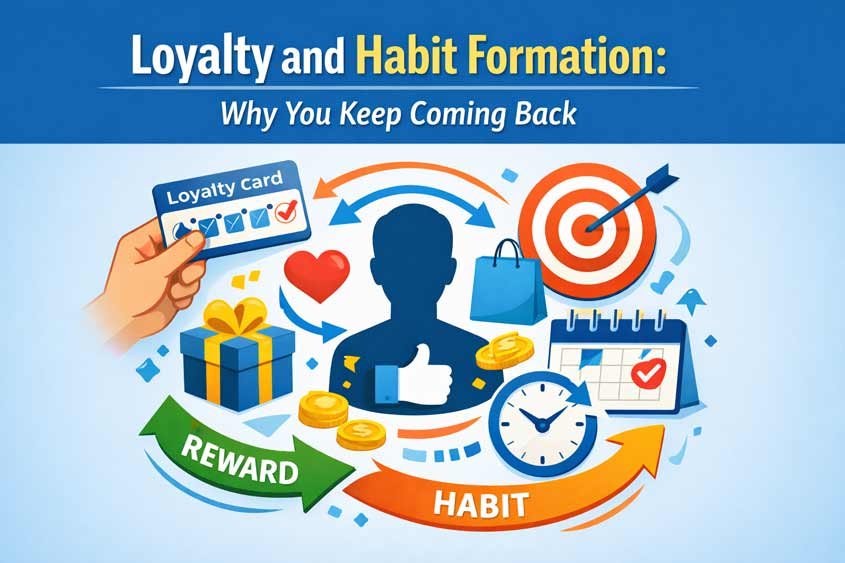
It Starts With One Swipe
You didn’t plan to become loyal to that supermarket.
You just signed up because it felt like the smart thing to do. A quick scan at checkout. A small discount. Maybe a few points. Nothing serious.
But that’s how loyalty programs psychology works. It doesn’t ask for a big commitment. It starts small. Quiet. Almost invisible.
That first swipe matters more than it looks.
Because the moment you use a loyalty card, something shifts. You’re no longer just a customer. You’re a participant in a system designed to shape your behavior over time. Not force it. Shape it. Slowly. Consistently.
Think about it. You walk into two supermarkets. One offers you nothing. The other reminds you that you have points waiting. Maybe even a personalized discount. Which one feels easier to choose?
That feeling isn’t random. It’s built on a mix of psychological triggers working together.
There’s the commitment effect. You’ve already signed up, so coming back feels like following through. There’s loss aversion. You don’t want your points to go to waste. There’s even a bit of the endowment effect. Those points feel like they’re already yours, even though you haven’t used them yet.
And then habit kicks in.
You stop comparing as much. You stop thinking as much. You go where it feels familiar. Where your “progress” is stored. Where your past decisions seem to reward your future ones.
Supermarkets understand this deeply. They’re not just selling products. They’re building loops. Visit. Buy. Earn. Return. Repeat.
It’s the same logic you see in mobile apps, airlines, coffee chains. Anywhere repeat behavior matters. The system rewards consistency, not necessarily rational decisions.
And here’s the part most people miss. Loyalty programs don’t just reward you for coming back. They quietly train you to want to come back.
Once that loop is in place, everything else becomes easier. Personalized offers feel more relevant. Discounts feel more valuable. Even higher prices can slip by unnoticed because you’re focused on what you’re “getting back.”
All of it starts with one simple action.
A swipe.
And from there, the habit builds itself.
Table of Contents
Loyalty Cards and Points
Loyalty cards look simple.
Scan. Earn. Save.
That’s the surface. Underneath, they’re one of the most effective habit-building tools in modern retail. And once you understand the mechanics, you start to notice how deliberately they’re designed to pull you back in.
At the core of loyalty programs psychology is a very specific goal. Not just to reward purchases, but to shape future ones. The system doesn’t care about a single transaction. It cares about the next ten.
Points are the hook.
You buy groceries worth 100 lei. You earn points. Nothing dramatic happens. No instant reward. Just a small accumulation stored somewhere in your account.
That delay is intentional.
Immediate discounts feel good, sure. But points create something more powerful. They create unfinished business.
You now have value sitting there, waiting to be used. Not in your wallet. Not visible. But real enough that you don’t want to ignore it.
This is where the sunk cost effect starts doing its thing.
You’ve already “invested” in this supermarket. Every purchase added to your point balance. Walking away now feels like losing something, even if you never consciously thought of it as an investment.
So you return. Not necessarily because prices are better. Not because the experience is superior. But because leaving means abandoning those accumulated points.
And that feels wrong.
It’s subtle, but it adds up.
Let’s say you’ve collected points over a few weeks. Maybe they’re worth a small discount. Nothing huge. But enough to justify another visit. So you go back. You redeem them. While you’re there, you shop again. And just like that, the cycle resets.
Earn. Accumulate. Return.
This loop is where loyalty programs psychology becomes powerful. It turns isolated decisions into a pattern.
There’s another layer here that most people don’t notice.
Progress.
Many loyalty systems show you how close you are to a reward. Spend 20 more lei to unlock a discount. Buy two more items to reach the next tier. You’re not just collecting points. You’re moving toward something.
That sense of progress taps into the same drive that keeps people playing games or completing challenges. You don’t want to stop halfway.
Even if the reward itself is small.
Especially if the gap is small.
You’ve probably experienced this. You’re at checkout and realize you’re just short of a reward threshold. So you grab one more item. Not because you need it. Because you’re close.
That’s not a coincidence.
It’s a mix of goal gradient effect and loss aversion. The closer you get to a reward, the more motivated you feel to complete it. And once you’re close, not finishing feels like losing something you almost had.
Retailers design for that moment.
And then there’s frequency.
Points don’t just bring you back. They shorten the time between visits.
If rewards expire, the pressure increases. You don’t want your points to disappear, so you come back sooner than you normally would. Even if you don’t need much. Even if your fridge is still full.
You justify it.
“I’ll just grab a few things.”
But supermarkets know how that goes. Once you’re inside, other triggers kick in. Product placement. promotions. sensory cues. The original reason for visiting becomes irrelevant.
The important part is that you showed up.
Over time, this repeated behavior turns into habit.
You stop asking “Where should I shop?” and start defaulting to “I’ll go there.” The decision shrinks. It becomes automatic.
And that’s the real win for retailers.
Because once a habit forms, price sensitivity drops. You’re less likely to compare alternatives. Less likely to switch for small differences. The friction of changing feels higher than the potential benefit.
Loyalty cards also create a sense of identity, even if it’s weak. You’re not just shopping. You’re a “member.” You have access to exclusive prices, special offers, personalized deals.
That exclusivity matters.
It taps into social proof and belonging. If something is labeled as “for members only,” it feels more valuable, even if the actual benefit is modest.
And let’s be honest. It feels good to think you’re getting a better deal than everyone else.
Even when everyone else has the same card.
Airlines do this with miles. Coffee chains do it with stamps. E-commerce platforms do it with reward credits. The structure stays the same.
You accumulate. You anticipate. You return.
Supermarkets just apply it at a higher frequency. You shop for groceries every week, sometimes more. That gives the system more chances to reinforce the loop. More chances to turn behavior into routine.
And once that routine is in place, the original incentive becomes less important.
You’re not coming back just for the points anymore.
You’re coming back because it’s what you do.
That’s the end goal of loyalty programs psychology. Not to make you think more, but to make you think less.
To replace active decisions with automatic ones.
To turn a simple swipe into a pattern that repeats itself without effort.
And the most interesting part?
It rarely feels like manipulation.
It feels like you’re being rewarded.
Personalized Offers
Points get you back in the door.
Personalized offers decide what you do once you’re inside.
This is where loyalty programs psychology becomes more precise. Less about broad behavior, more about you. Your habits. Your patterns. Your weak spots.
Every time you use a loyalty card, you’re not just collecting points. You’re generating data.
What you buy.
How often you buy it.
What time of day you shop.
What you ignore.
What you switch.
Over time, this builds a detailed picture of your behavior. Not in a creepy, all knowing way. In a practical, predictive one.
Supermarkets don’t need to know everything about you. They just need to know what you’re likely to buy next.
And once they have that, they can start shaping your decisions before you even make them.
You open the app. You see discounts that feel oddly relevant. Your usual yogurt brand. That snack you bought twice last week. A product you hesitated over but didn’t buy.
It feels helpful. Convenient. Almost like the store “gets” you.
That feeling is doing a lot of work.
Relevance reduces friction.
When you’re faced with too many choices, you slow down. You hesitate. Sometimes you don’t buy at all. This is basic cognitive load. Too many options create resistance.
Personalized offers cut through that.
Instead of scanning an entire shelf, you’re guided toward a few options that already match your preferences. The decision becomes easier. Faster.
And faster decisions usually mean less critical thinking.
That’s where higher conversion comes from. Not just better offers, but less resistance.
There’s also familiarity at play.
You’re more likely to choose something you’ve bought before. That’s the mere exposure effect. The more often you see or use a product, the more comfortable it feels.
Personalized offers lean heavily on this. They don’t always try to change your behavior. They reinforce it.
You buy the same coffee again. The same cereal. The same ready meal.
It feels like consistency.
But it’s also conditioning.
Because every time you accept a personalized offer, you strengthen the loop. The system suggested something. You followed it. The outcome was fine. Maybe even good.
Next time, you trust it a little more.
And trust reduces scrutiny.
Now layer in timing.
Some offers appear right when you’re most likely to need them. Discounts on staples just as you’re running low. Promotions before the weekend. Convenience meals during busy weekdays.
This isn’t random.
It’s based on patterns across thousands, sometimes millions, of customers. If people who buy product A tend to buy product B three days later, the system learns that. Then it nudges you at the right moment.
It feels like coincidence.
It’s not.
There’s also a subtle push toward higher margin or strategic products.
You might notice offers for items you don’t usually buy. Not completely random. Just slightly outside your normal pattern.
That’s intentional.
Retailers use anchoring here. If your usual product costs 10 lei, they might show you a “discount” on a premium version at 12 lei. It feels like an upgrade. A deal. Even though you’re spending more than usual.
And because it’s personalized, it feels justified.
“This is actually relevant to me.”
That justification matters.
People don’t like feeling manipulated. But they’re very comfortable feeling understood.
Personalized offers shift the narrative from “they’re trying to sell to me” to “they’re helping me choose.”
That’s a big difference.
It also ties into the idea of default choices.
When something is presented directly to you, especially in a limited set, it starts to feel like the natural option. You’re less likely to explore alternatives. Less likely to compare prices across brands.
You follow the path that’s been laid out.
E-commerce platforms do this all the time. “Recommended for you.” Streaming services. “Because you watched this.” It’s the same structure.
Supermarkets just apply it to everyday purchases.
And because groceries are frequent, low involvement decisions, the effect compounds quickly.
You don’t spend much time questioning a discount on something you already buy.
You accept it.
Then you accept the next one.
Then the next.
Over time, your basket starts to reflect not just your preferences, but the system’s influence on those preferences.
That’s the part most people don’t see.
Personalized offers don’t just respond to your behavior. They shape it.
They reinforce certain choices, introduce new ones, and quietly phase out others.
You think you’re choosing based on habit.
But your habit is being edited in the background.
And because everything feels relevant, the resistance stays low.
No pressure. No obvious push. Just a steady stream of “helpful” suggestions that happen to increase how much you buy and how often you buy it.
That’s loyalty programs psychology at its most refined.
Not broad incentives. Not visible pressure.
Just small, well-timed nudges that feel like your own decisions.
You Didn’t Build the Habit by Accident
By now, the pattern should feel familiar.
You signed up. You scanned a card. You earned a few points. You came back to use them. Then you came back again because there was another offer waiting.
At no point did it feel like a big decision.
That’s exactly the point.
Loyalty programs psychology doesn’t rely on dramatic persuasion. It works through accumulation. Small actions, repeated often enough, start to look like preference. Then they turn into routine.
And routine is where the real shift happens.
You stop evaluating options. You stop comparing prices across stores. You don’t ask “Where should I shop today?” You just go.
Not because it’s objectively better. Because it feels easier.
That ease is engineered.
Points created a reason to return. The sunk cost effect made leaving feel wasteful. Personalized offers reduced friction and guided your choices. Layer in other triggers like default positioning, anchoring, and familiarity, and the whole system starts to reinforce itself.
Each piece is simple on its own. Together, they’re hard to break.
And here’s the uncomfortable part.
Most of the time, you still feel in control.
You see a discount and think you’re being smart. You redeem points and feel rewarded. You accept an offer because it’s “relevant.”
All of that is true.
But it’s also incomplete.
Because those actions are happening inside a structure designed to guide them. The system doesn’t need to force you. It just needs to make one option consistently easier, faster, and slightly more rewarding than the others.
Over time, that’s enough.
This isn’t limited to supermarkets. Airlines, retail apps, subscription services, even gaming platforms use the same logic. Encourage repeat behavior. Track it. Refine it. Feed it back to you in a way that feels personal.
The result is predictable.
You come back. More often than you planned. You spend a bit more than you intended. And it rarely feels like a mistake.
That’s why loyalty programs are so effective. Not because they trick you once, but because they quietly train you over time.
So the next time you reach for your loyalty card or open an app full of tailored offers, pause for a second.
Ask yourself a simple question.
Are you choosing this store…
Or are you continuing a pattern that was designed for you?

Gabriel Comanoiu is a digital marketing expert who has run his own agency since 2016. He learned marketing by testing, analyzing, and refining campaigns across multiple channels. In his book series Impulse Buying Psychology, he shares the psychological triggers behind every purchase, showing how to create marketing that connects, persuades, and converts.