
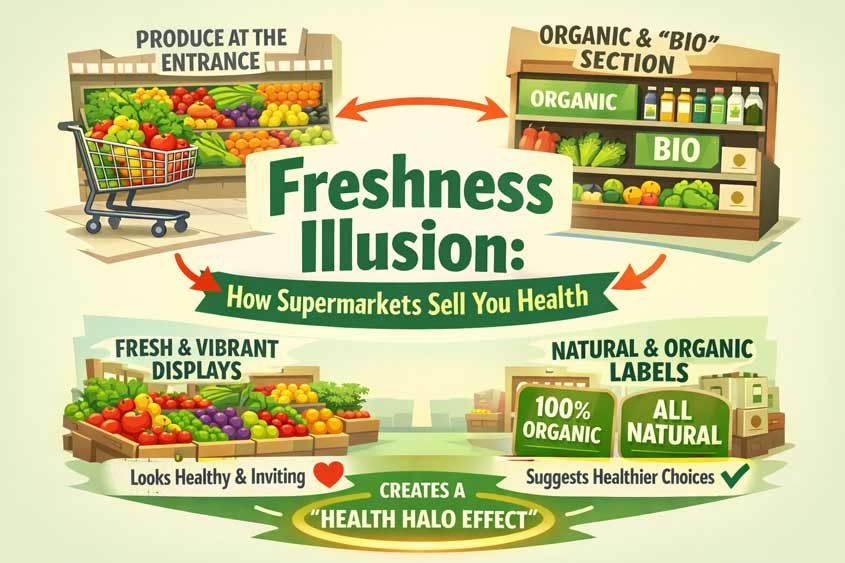
It Starts with Freshness
You walk into a supermarket with a plan. Maybe even a strict one. Just a few essentials, in and out, no nonsense. Then it hits you. A burst of color. Greens that look almost too green. Stacks of oranges glowing under soft light. The faint smell of something fresh, clean, alive. You slow down without realizing it.
And just like that, your brain makes a quiet decision before you do.
This is where supermarket freshness psychology begins to work on you.
Most people think they make rational choices in a store. Price, need, maybe a quick comparison. But the environment is doing a lot more heavy lifting than you’d expect. That wall of produce at the entrance isn’t there by accident. It’s engineered. Carefully. Repeated across thousands of stores because it works.
Freshness signals do something powerful. They create a first impression that spills over everything else you’re about to do. When you see crisp vegetables and vibrant fruit right away, your brain tags the entire store as high quality. Clean. Trustworthy. Healthy. Even if the rest of your basket ends up looking very different.
That’s the trick. You start your shopping feeling like someone who makes good choices.
And once that identity kicks in, something interesting happens. You become more flexible. A little indulgence later doesn’t feel like a contradiction. It feels earned. You picked spinach. You chose apples. That frozen pizza? That chocolate bar? It balances out… right?
This is where freshness blends with other psychological triggers. The halo effect is doing its job, letting one positive impression influence everything else. There’s also a subtle form of moral licensing. You made a “good” choice, so now you allow yourself a “bad” one without friction. Add in reduced decision fatigue early on, and you’re already on a different path than the one you planned.
Supermarkets understand this deeply. They don’t just sell products. They shape the story you tell yourself while shopping.
And the story usually starts with something that looks very simple.
Fresh. Clean. Healthy.
From there, everything else gets easier to sell.
Table of Contents
The Produce Section Is Not Where You Think It Is
You probably think the produce section is at the entrance because it makes sense. Fresh items first. Logical flow. Start healthy, then move inward.
That’s the story. It’s not the reason.
The real reason sits right in the middle of supermarket freshness psychology. The entrance is where your mindset gets shaped. Not influenced a little. Set.
When you walk in and hit a wall of fresh produce, your brain processes a few things almost instantly. Color variety signals abundance. Bright greens suggest freshness. Slight imperfections in fruits signal natural, not factory-made. Even the way items are stacked, slightly messy but not too messy, creates the illusion of a recent restock.
You’re not consciously analyzing any of this. But your brain is. Fast.
And it concludes: this place is fresh, this place is quality, this place is good for you.
That conclusion doesn’t stay in the produce section. It spreads.
This is the halo effect in action. One strong positive signal influences your perception of everything that follows. Suddenly, the packaged meals don’t feel as processed. The bakery items feel more artisanal. Even the snacks feel… less guilty.
It sounds irrational, because it is. But it’s consistent. And more importantly, it’s predictable enough that supermarkets design entire layouts around it.
There’s also something else happening. Something a bit more subtle.
You feel like you’re off to a good start.
You picked up apples. Maybe some spinach. Bananas. It’s a small win, but your brain logs it as progress. You’re being responsible. You’re making better choices. You’re the kind of person who shops like this.
That identity matters more than the items themselves.
Because once you see yourself that way, your decision-making shifts. Not immediately. Not obviously. But enough.
Later, when you pass by something indulgent, you don’t evaluate it from scratch. You evaluate it in context. And the context says you’ve already done well.
So the question quietly changes from “Should I buy this?” to “Why not?”
That’s moral licensing. You give yourself permission because of earlier behavior. And supermarkets rely on it heavily.
Think about how often your basket evolves. You start with fresh ingredients. Then something convenient slips in. Then something indulgent. By the time you reach checkout, the mix tells a completely different story than your intention at the entrance.
But it doesn’t feel inconsistent. It feels balanced.
That feeling is engineered.
Even the sensory details in the produce section are doing work. Some stores lightly mist vegetables to make them glisten. Water droplets signal freshness, even if they don’t actually improve quality. Lighting is warmer and more directional, making colors pop. In some cases, subtle scent cues are introduced, either through nearby bakery sections or actual scent marketing, to reinforce the idea of freshness and immediacy.
Touch plays a role too. Produce is one of the few areas where you’re encouraged to interact. You pick things up. You inspect them. That physical engagement increases your sense of ownership before you even put the item in your cart. It’s a small psychological shift, but it makes you more invested in the shopping process overall.
More invested means less resistant later.
And then there’s pacing.
The produce section slows you down. You don’t rush through it the same way you might rush through packaged goods. You browse. You compare. You make small decisions. This early slowdown matters because it eases you into the shopping experience. It reduces friction. You’re no longer in “get in, get out” mode.
You’re in shopping mode.
Once that switch happens, everything else becomes easier to sell. Not because you need it. Because you’re now receptive to it.
This ties into another trigger you’ll recognize: reduced cognitive resistance. Early low-stakes decisions warm up your brain. By the time you hit more complex or tempting choices, your mental guard is slightly lower. Not gone. Just lower enough.
And supermarkets don’t need a big shift. Small changes, multiplied across hundreds of decisions, are enough.
There’s also strategic placement within the produce section itself. High-margin items often sit at eye level. Pre-cut fruits, organic selections, or packaged salads are placed where you naturally look first. These items carry higher prices but feel justified because they live inside a “healthy” context.
You don’t question them the same way you would if they were placed next to snacks.
Context shapes perception. And in supermarket freshness psychology, context is everything.
You’ll also notice transitions. The produce section often leads directly into other categories that benefit from the freshness halo. Fresh juices. Smoothies. Premium dairy. Sometimes even baked goods. The shift is gradual, almost invisible, but intentional.
You move from clearly healthy to slightly indulgent without a hard line.
That smooth transition keeps your internal narrative intact. You’re still the person who started with fresh choices. You’re just expanding a bit.
And by the time you reach the center aisles, where processed and high-margin products dominate, the groundwork is already done.
At that point, the store doesn’t need to convince you from scratch.
It just needs to keep the story going.
Organic Sections Don’t Just Sell Better Food
At some point in your route, you hit a shift.
The lighting gets softer. The shelves look cleaner. Packaging changes. Words like organic, bio, natural, premium start appearing more often. Prices quietly climb. Not aggressively. Just enough to make you pause for half a second.
Then you keep going.
Because by now, the store has already done something important. It has earned a baseline level of trust. That first impression from the entrance, the fresh produce, the slow start, it all builds toward this moment.
This is where supermarket freshness psychology moves from impression to validation.
Organic and premium sections are not just about offering higher quality products. They are there to confirm a belief that’s already forming in your head. That this store is different. Better. More careful about what it sells.
And once that belief settles in, your behavior adjusts to match it.
You stop comparing as aggressively. You question prices less. You assume a level of quality without needing proof every time. That’s not laziness. That’s cognitive efficiency. Your brain prefers shortcuts, especially after it feels like it has enough information.
These sections are designed to provide exactly that.
Look at how they’re positioned. They’re rarely hidden, but they’re also not always at the very front. You usually encounter them after you’ve already had a few positive interactions. Fresh produce. Clean layout. Maybe a pleasant sensory cue. By the time you arrive here, you’re warmed up.
And that timing matters.
Because premium sections rely heavily on perception. Not just the product itself, but everything around it. Wider spacing between items. Less clutter. More neutral or earthy color tones. Even the shelf height and arrangement feel calmer, more intentional.
All of it signals one thing: quality.
This is classic signaling theory at work. When direct evaluation is difficult, you rely on indirect cues. You don’t analyze every ingredient list in detail. You read the environment. And the environment tells you what to think.
There’s also an element of price anchoring here. When you see higher prices in a dedicated, well-designed section, they don’t feel random. They feel justified. Almost expected.
And that expectation changes how you interpret everything else in the store.
Suddenly, mid-range products seem more reasonable. Even affordable. That’s the contrast effect. By placing premium options in a clear, elevated context, supermarkets reshape your sense of what “normal” pricing looks like.
It’s subtle, but it spreads.
You might not buy the most expensive organic item. But you’re now more comfortable spending slightly more than you originally planned. The ceiling moved, so everything below it feels safer.
Trust plays a big role here too.
Organic and premium labels carry an implicit promise. Better sourcing. Higher standards. More care. Whether that promise is always justified is a separate conversation. What matters is that the signal exists and is widely recognized.
And supermarkets amplify that signal through placement.
These sections are often positioned near transitions. Between fresh and packaged goods. Between essentials and indulgences. They act as a bridge, connecting different parts of the store while maintaining a consistent narrative.
You’re still making good choices. Just more refined ones.
That narrative is powerful because it reduces internal conflict. Buying a premium snack feels different from buying a regular one. It feels considered. Intentional. Even responsible, in a way.
Same category. Different story.
This is where identity starts to play a bigger role.
Earlier, you felt like someone who makes healthy choices. Now, you feel like someone who makes better choices. More informed. More selective. Maybe even a bit more disciplined.
And once you adopt that identity, your purchases follow.
You reach for products that align with it. Packaging that looks cleaner. Brands that communicate transparency. Items that feel less mass-produced. Even if the difference is marginal, the perception is enough.
Because perception drives behavior more than objective differences in many cases.
There’s also a trust transfer happening.
When a store presents a well-curated organic or premium section, it signals that someone made decisions on your behalf. That the store filtered options. That it removed lower-quality items from this space.
That curation reduces your decision effort. You don’t feel like you need to double-check everything. The environment already did part of the work.
And when decision effort drops, purchase likelihood increases.
This connects to another familiar trigger: decision fatigue. As you move through the store, your mental energy slowly decreases. Premium sections counteract that by simplifying choices. Fewer options. Clearer positioning. Stronger signals.
It feels easier to decide here. So you do.
Even small design details reinforce this. Product groupings are tighter. Messaging is more focused. You won’t see as many loud promotions or discount tags. That absence itself becomes a signal.
No discount chaos means confidence in value.
And that confidence rubs off on you.
Interestingly, these sections don’t always need to generate the highest sales volume to be effective. Their role is broader. They elevate the perception of the entire store. They act as a reference point.
A kind of internal benchmark that shapes how you see everything else.
So even if you only buy one item from the organic section, its impact goes beyond that purchase. It influences how you evaluate the rest of your basket.
It makes your overall shopping feel more justified.
And that justification matters most at the end.
Because when you reach checkout and glance over everything you picked up, your brain quickly tries to make sense of it. To build a coherent story. Fresh produce. A few premium items. Some indulgences.
It doesn’t look random.
It looks balanced. Thoughtful. Even smart.
That feeling isn’t accidental. It’s the result of a carefully structured journey through signals, cues, and small psychological nudges that guide you from one decision to the next.
By the time you leave the store, you don’t just have a bag of products.
You have a version of your choices that feels right.
You Didn’t Build the Basket by Accident
By the time you reach checkout, your basket tells a story.
Not a random one. Not even a fully rational one. A carefully shaped one.
You started with fresh produce. That moment mattered more than it looked. It set the tone. It gave you a sense of control, of intention, of doing things right. That early signal, driven by supermarket freshness psychology, stayed with you longer than you think.
Then came the subtle shifts. A premium product here. A slightly more expensive option there. Nothing dramatic. Just small adjustments that felt reasonable in the moment. Each one made sense on its own.
Together, they changed everything.
Because once you feel like you’re making good choices, you stop questioning every decision. You rely on the narrative you’ve already built. Fresh equals healthy. Premium equals quality. And if those are true, then the rest must be fine too.
That’s the quiet power behind it all. Supermarkets don’t need to push you hard. They guide you just enough so you do the rest yourself.
You justify as you go.
That indulgent item you added halfway through? It didn’t feel like a break from your plan. It felt like a reward. The extra snack? Balanced by the fruit at the start. The ready meal? You’ve been “good” already.
This is where supermarket freshness psychology blends with other triggers you’ve probably seen before. The halo effect softens your judgment. Moral licensing gives you permission. Price anchoring resets your expectations. Even decision fatigue plays its part, making later choices faster and less critical.
None of these act alone. They stack.
And the store layout is built to support that stacking effect from entrance to exit.
What makes this powerful is how natural it feels. You don’t feel manipulated. You feel like yourself. Making your own decisions. Following your own preferences.
But the environment shaped those preferences before you even realized it.
Once you see it, it’s hard to unsee.
You start noticing why produce always comes first. Why premium sections feel calmer. Why certain products appear right after you’ve made a “good” choice. The flow stops feeling random.
It feels designed. Because it is.
That doesn’t mean you should fight it at every step. That’s not realistic. But it does mean you can pause at key moments. Especially after those early wins. Ask yourself a simple question: would I still pick this if it was the first thing I saw?
Sometimes the answer will still be yes. And that’s fine.
But sometimes, it won’t.
And that small gap between what you planned and what you picked up, that’s where all of this lives.

Gabriel Comanoiu is a digital marketing expert who has run his own agency since 2016. He learned marketing by testing, analyzing, and refining campaigns across multiple channels. In his book series Impulse Buying Psychology, he shares the psychological triggers behind every purchase, showing how to create marketing that connects, persuades, and converts.