
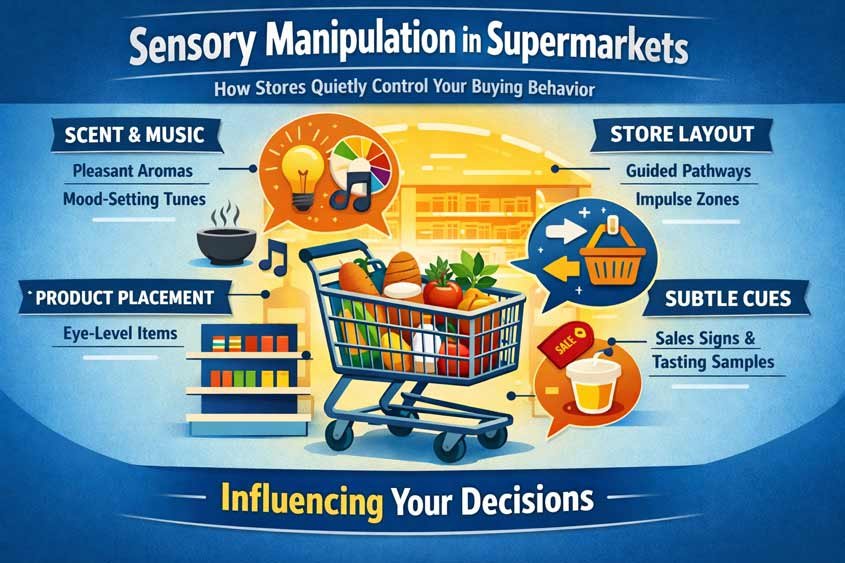
The Invisible Hand Guiding Your Cart
You walk into a supermarket thinking you’re there for milk, maybe some eggs, maybe bread. Five minutes later, something shifts. You slow down a bit. You glance at things you didn’t plan to buy. By the time you reach the checkout, your basket tells a slightly different story than the one you had in your head.
That shift isn’t random.
What you’re experiencing is sensory marketing in supermarkets at work. Not loud, not obvious. Quiet, controlled, and surprisingly precise. It doesn’t try to convince you with arguments. It shapes how you feel, how long you stay, and what catches your attention.
Think about it. You don’t consciously analyze the lighting when you enter a store. You don’t question why a certain smell makes you suddenly hungry. You don’t notice the tempo of the music changing your walking speed. But your brain does. Constantly.
Supermarkets understand something simple but powerful: most buying decisions are not fully rational. They happen fast. They’re influenced by mood, comfort, and subtle cues in your environment. So instead of pushing harder with discounts or messages, stores adjust the environment itself.
It’s the same principle used in hotels, casinos, even high-end retail. Control the atmosphere, and you influence behavior without resistance.
And here’s where it gets interesting. Sensory marketing in supermarkets doesn’t work in isolation. It stacks with other psychological triggers you’ve probably heard about, like product placement, scarcity cues, and the classic “essentials at the back” layout. You’re already navigating a carefully designed path. The sensory layer just makes that path feel natural.
Almost like it was your idea.
That’s the real strength of these tactics. They don’t interrupt you. They blend in. They guide rather than push.
You might still believe you’re fully in control of your decisions. And to some extent, you are. But the environment you’re in? That’s doing more of the heavy lifting than most people realize.
Once you start noticing it, you can’t really unsee it.
Table of Contents
Lighting
Lighting is one of those things you rarely notice… until you do. And once you see it, it’s hard to ignore how intentional it is.
In sensory marketing in supermarkets, lighting isn’t just about visibility. It’s about shaping perception. It tells you what feels fresh, what feels safe, what deserves your attention. Quietly, without asking.
Start with the bakery section. Ever noticed how the light feels warmer there? Slightly golden, almost soft. Bread looks richer. Pastries look… alive, somehow. That’s not accidental. Warm lighting enhances browns and golds, making baked goods appear fresher and more comforting. Even if they’ve been sitting there for hours.
The same trick shows up in produce. Tomatoes look deeper red. Greens feel more vibrant. There’s a subtle glow that nudges you toward the idea of freshness, even before you touch anything. Your brain makes a quick judgment: this looks good, so it probably is.
And you move closer.
Now contrast that with the packaged goods aisles. The lighting shifts. It becomes brighter, cooler, more neutral. Almost clinical.
That change matters.
Bright white lighting increases clarity. Labels are easier to read. Colors look more “true.” It creates a sense of transparency and trust, which is exactly what you need when choosing between similar products. You’re comparing prices, ingredients, brands. You want to feel like you’re making a rational decision.
So the environment supports that feeling.
This is where sensory marketing in supermarkets gets clever. Different zones trigger different mindsets. Fresh sections lean into emotion and appetite. Packaged goods lean into logic and comparison. Same store, different psychological mode.
And it doesn’t stop there.
Lighting also directs your movement. Brighter areas pull your attention. Slightly dimmer zones fade into the background. High-margin products often sit exactly where the light is strongest. Not aggressively spotlighted, just… subtly more visible.
You look where it’s easiest to look.
There’s also a pacing effect. Warmer, softer lighting tends to slow you down. You linger a bit longer in those sections, maybe pick up one extra item. Cooler, brighter lighting keeps you moving. More scanning, less lingering. It’s almost like the store is controlling your rhythm without you noticing.
Retailers in fashion and electronics use the same principle. Think about how a luxury boutique feels compared to a big-box electronics store. One invites you to stay, the other encourages quick decisions. Supermarkets borrow from both, depending on the section.
And here’s something most people miss. Lighting works together with other triggers. End-of-aisle displays, for example, often get stronger illumination. Combine that with your natural tendency to notice what’s directly in front of you, and suddenly those products feel more important than they actually are.
No discount needed.
So next time you’re in a supermarket, pause for a second. Look at how the light changes as you move. Bakery to produce. Produce to dry goods. It’s not just design. It’s direction.
And chances are, it’s already shaping what ends up in your cart.
Smell (scent marketing)
If lighting works on your eyes, smell goes straight for something deeper. Faster, less filtered. You don’t stop to analyze a scent. You react to it.
That’s why scent is one of the most powerful tools in sensory marketing in supermarkets.
Walk into a store and catch the smell of fresh bread. Warm, slightly sweet, familiar. For a second, you’re not thinking about your shopping list. You’re thinking about comfort. Maybe a memory. Maybe just the idea of something fresh out of the oven.
Here’s the part most people don’t question: that smell is often placed very deliberately.
Bakeries are usually positioned near the entrance or along high-traffic paths. Not hidden in the back. Not tucked away. Right where your first impressions form. Because the first few minutes inside a store matter more than you’d expect. That’s when your brain sets the tone. Am I relaxed? Am I hungry? Am I open to browsing?
A well-placed scent answers all three.
And yes, sometimes the bread is genuinely baking. Other times, the timing is… adjusted. Fresh batches come out when foot traffic peaks. In some cases, scent can even be subtly enhanced to carry further. Not fake, but optimized.
Because once that smell hits, something shifts.
Hunger increases. That part is straightforward. Studies in consumer behavior consistently show that when you shop while hungry, you buy more food and you’re less strict about sticking to a plan. But it’s not just about hunger. It’s about emotional comfort.
Smell is closely tied to memory and emotion. More than sight. More than sound. A familiar food scent can lower your guard a bit. Make the environment feel safe, pleasant, even nostalgic. And when you feel good, you tend to reward yourself more.
So you add something extra to your cart. Maybe a pastry. Maybe something completely unrelated that just “feels right” in the moment.
This is where sensory marketing in supermarkets becomes less about logic and more about state of mind. You’re not being convinced. You’re being nudged into a different mood, and that mood does the rest.
Other industries use this heavily. Hotels use signature scents to create a consistent emotional experience. Clothing stores use subtle fragrances to make spaces feel more premium. Even car dealerships sometimes use scent to make vehicles feel “newer” or more appealing.
Supermarkets just tie it directly to appetite.
And scent rarely works alone. Combine it with warm lighting in the bakery section, maybe some slow background music, and suddenly you’re not just passing through. You’re lingering. Looking. Considering things you didn’t plan for.
That’s when impulse buying kicks in.
It’s also worth noticing what you don’t smell. Cleaning products, raw materials, anything that might break the illusion of freshness. Those are controlled, minimized, kept out of your sensory focus. What you experience is curated.
Carefully.
Next time you walk into a supermarket, pay attention to that first scent you notice. Where it hits you. How it makes you feel. And what you reach for a few minutes later.
The connection is usually closer than it seems.
Music tempo
You probably don’t walk into a supermarket and think, “Let me check the playlist before I shop.” And yet, that background music is doing more work than most price tags.
In sensory marketing in supermarkets, music is less about entertainment and more about pacing. It sets the rhythm of your movement, and your movement shapes how much you buy.
Start with tempo. Slow music has a very specific effect. It reduces your walking speed. Not dramatically, not in a way you’d notice, but just enough. You linger a bit longer in each aisle. You scan more shelves. You give more products a chance to catch your attention.
Now stretch that across an entire store.
If you spend even a few extra seconds in each section, your total time inside increases. And time is one of the strongest predictors of basket size. The longer you stay, the more you buy. It’s that simple.
There’s solid research behind this. Studies comparing fast and slow tempo music in retail environments show that slower music can increase sales volume. The mechanism is straightforward: slower pace leads to longer exposure, and longer exposure leads to more opportunities for unplanned purchases.
You don’t feel rushed, so you don’t act rushed.
Contrast that with faster music. Higher tempo nudges you to move quicker. It creates a subtle sense of urgency. That can be useful in high-turnover environments, like convenience stores or fast food chains, where speed matters. But supermarkets? They want you to stay.
So they slow things down.
But tempo is only part of the story. Volume and familiarity matter too. Music is usually kept at a moderate level, enough to influence your mood without demanding attention. If it’s too loud, it becomes intrusive. Too quiet, and it loses its effect.
Familiar tracks can make you feel more comfortable, more at ease. That comfort reduces friction. You’re less focused on “getting in and out” and more open to browsing. On the other hand, neutral or instrumental music keeps things calm without pulling your attention away from the products.
Again, it’s about balance.
This ties directly into other psychological triggers inside the store. Think about maze-like layouts or end-of-aisle displays. Those tactics rely on you moving through more space and noticing more items. Slow music supports that by stretching your time and softening your pace.
It all connects.
Different sections can even have slightly different musical tones. Fresh areas might lean toward softer, more relaxed tracks. Busier aisles might use something a bit more neutral to keep flow steady. You won’t consciously register the shift, but your behavior adjusts.
Retailers outside supermarkets use the same principle. Restaurants slow down music during dinner service to encourage longer stays and higher spending. Fashion stores adjust tempo depending on brand positioning. Even gyms use fast music to push intensity and speed.
Same tool, different goal.
And here’s the part most people miss. Music doesn’t force you to do anything. It just changes the conditions around your decisions. You still choose what goes into your cart. But those choices happen in an environment that quietly stretches your time, softens your focus, and increases your exposure to temptation.
So next time you’re shopping, try this. Pay attention to your walking speed. Notice how it shifts between stores, or even between different moments in the same store. Then listen closely.
Chances are, the music is setting the pace.
Temperature control
Temperature is one of the least visible tools in sensory marketing in supermarkets. You don’t see it. You rarely question it. But you feel it the entire time you’re inside the store.
And that feeling changes how you behave.
Most supermarkets are kept slightly on the cooler side. Not cold enough to make you uncomfortable, just cool enough to keep you alert. That detail matters more than it seems.
Cooler environments help maintain focus. You move with a bit more էնergy, a bit more awareness. You don’t feel sluggish. You don’t feel like you need to rush out either. You stay in that middle zone where browsing feels easy.
That’s exactly where supermarkets want you.
Because when you’re alert, you notice more. More products, more promotions, more small details that can turn into unplanned purchases. You’re mentally present, but not under pressure.
Now flip the scenario.
Think about how you feel in a warm, slightly stuffy store. Your pace changes. You move faster, but not in a productive way. You just want to get what you need and leave. Browsing feels like effort. Decision-making feels heavier.
That’s not good for sales.
Warmer environments reduce the time you spend inside. Less time means fewer opportunities to pick up extra items. So supermarkets avoid that at all costs. Even small increases in temperature can shorten your visit.
There’s a balance here, though.
Too cold, and you become uncomfortable. You rush through the store, arms crossed, focused on getting out. Too warm, and you lose patience. The sweet spot sits right in between, slightly cool, steady, almost unnoticeable.
You’re not thinking about the temperature. You’re just… staying longer.
This is where sensory marketing in supermarkets becomes very precise. Temperature doesn’t work alone. It supports everything else happening around you.
Slow music keeps your pace relaxed. Lighting draws your attention. Scent triggers appetite. Temperature makes sure your body stays in a state where all of those signals can actually work.
If you were too hot or too cold, the rest would fall apart.
Different zones can even have subtle variations. Refrigerated sections are obviously colder, but transition areas are managed carefully so the shift doesn’t feel abrupt. Fresh sections often feel slightly cooler, reinforcing the idea of freshness and cleanliness. It’s not just visual, it’s physical.
Your brain connects coolness with quality, especially for food.
Other industries use the same principle. Casinos keep temperatures controlled to keep players comfortable for long periods. Office spaces adjust temperature to maintain productivity. Even gyms use temperature strategically to influence performance and perceived effort.
In supermarkets, the goal is simple. Keep you in the store, in a state where buying feels easy.
And just like with other triggers, temperature pairs with layout decisions. Essentials placed at the back only work if you’re willing to walk the full distance. A comfortable environment makes that walk feel effortless. Combine that with end-of-aisle displays and cross merchandising, and your path becomes longer, slower, and more profitable.
Without you noticing why.
Next time you’re shopping, pay attention to how long you’re willing to stay. Then step outside. The contrast hits immediately.
Inside, it felt just right. That wasn’t luck.
You Were Never Just Shopping
By the time you reach the checkout, it feels simple. You walked in, you picked what you needed, maybe a few extras, and now you’re done.
But if you rewind the experience, step by step, it starts to look different.
The lighting shaped what looked fresh and trustworthy. The scent nudged your appetite before you even realized it. The music slowed your pace just enough to keep you browsing. The temperature kept you comfortable, alert, willing to stay a little longer. None of these elements asked for your attention. That’s exactly why they worked.
This is sensory marketing in supermarkets at its most effective. It doesn’t interrupt your decisions. It builds the conditions around them.
And the result is subtle but measurable. You spend more time inside. You notice more products. You make more unplanned choices. Not because you were pushed, but because the environment made those choices feel natural.
That’s the part most people underestimate.
It’s easy to think influence comes from discounts, promotions, or bold messaging. Those matter, sure. But they work best when the sensory layer is already doing its job. A well-lit product in a comfortable environment, paired with the right mood, has a much higher chance of ending up in your cart than the same product in a poorly designed space.
And this doesn’t exist in isolation. It connects with everything else happening in the store. The right-turn bias that guides your first steps. The layout that makes you pass through multiple categories. The placement of essentials at the back. Sensory marketing doesn’t replace these tactics, it amplifies them.
So where does that leave you?
Not powerless. Just more aware.
Once you notice how sensory marketing in supermarkets works, you start to see the patterns. You recognize when you’re slowing down, when something “feels” fresh, when you’re tempted without a clear reason. That awareness doesn’t stop the influence completely, but it gives you a pause. A moment to decide if that extra item actually belongs in your cart.
And sometimes, it still will.
Because at the end of the day, these tactics don’t force behavior. They guide it. Gently, consistently, and at scale.
You walked in to buy a few things.
You walked out with a bit more.
And now you know why.

Gabriel Comanoiu is a digital marketing expert who has run his own agency since 2016. He learned marketing by testing, analyzing, and refining campaigns across multiple channels. In his book series Impulse Buying Psychology, he shares the psychological triggers behind every purchase, showing how to create marketing that connects, persuades, and converts.