
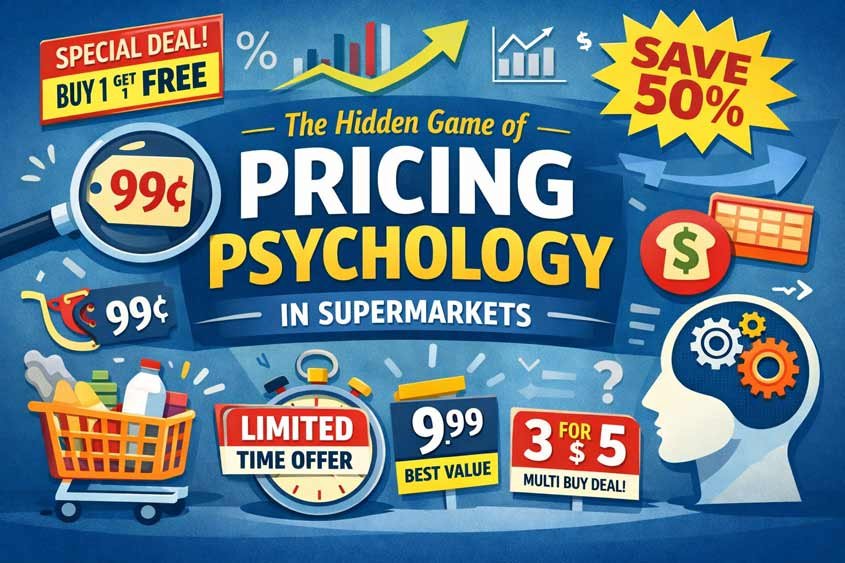
Why Prices Don’t Mean What You Think They Mean
You walk into a supermarket thinking you’re making simple, rational decisions. You need milk, maybe some pasta, a few snacks. You glance at prices, compare quickly, and move on. It feels straightforward. It isn’t.
Pricing psychology in supermarkets is doing quiet work the entire time.
Every number you see has been chosen, tested, and positioned with intention. Not just to inform you, but to guide you. Sometimes gently, sometimes aggressively. The price tag is less about the product’s value and more about how your brain interprets that value in a split second.
Here’s the part most people underestimate. Your brain does not read prices the way you think it does. It doesn’t calculate carefully. It shortcuts. It relies on patterns, habits, and tiny cues that feel insignificant in the moment. A one cent difference. The position of a product on a shelf. The presence of a more expensive option nearby. These details shape your perception before you even realize a decision has been made.
And supermarkets know this very well.
They don’t need to force you to buy. That would be obvious and uncomfortable. Instead, they design an environment where your decisions feel natural, even logical. You think you spotted a good deal. You think you compared options. But often, the comparison itself was engineered in advance.
Think about the last time you saw something priced at 9.99. It probably felt cheaper than 10, even though the difference is almost nothing. Or when a slightly expensive product suddenly seemed reasonable because a much pricier one was sitting right next to it. That shift in perception didn’t happen by accident.
Pricing psychology in supermarkets works closely with other subtle triggers too. Store layout nudges your movement. Music tempo affects how fast you walk. Product placement influences what you even notice in the first place. Pricing is just one layer, but it’s the layer where the final decision happens.
And it happens fast.
You rarely stand in an aisle calculating true value per unit, weighing long term benefit against cost. You react. You estimate. You choose what feels right in the moment.
That’s exactly where these tactics live.
Once you start noticing them, you can’t really unsee them. Prices stop being neutral numbers. They become signals, cues, little nudges pointing you in a direction someone else planned before you even entered the store.
Table of Contents
Charm Pricing (9.99 Instead of 10)
You’ve seen it your whole life. 1.99. 4.99. 9.99. It’s so common it barely registers anymore. That’s exactly why it works.
Charm pricing sits right at the core of pricing psychology in supermarkets. It looks like a tiny adjustment, just one cent shaved off the “real” price. But that one cent changes how your brain categorizes the number entirely.
Here’s what’s actually happening.
Your brain reads prices from left to right. Fast. Almost automatically. The first digit carries the most weight, because it sets the tone before you even process the rest. This is called the left digit effect, and it’s doing more heavy lifting than you’d expect.
When you see 9.99, your brain locks onto the 9. Not the 99 at the end. Not the full value. Just the 9. That number quietly places the item in the “nine range” in your mind, even though it’s one cent away from ten.
So instead of thinking “this is basically ten,” your brain goes “this is nine-something.” And that subtle shift matters. It feels cheaper. Not logically. Perceptually.
Now scale that across a full shopping trip.
Imagine ten items, each reduced by just one cent to hit that .99 ending. The actual savings are negligible. Ten cents total. But the perceived savings? Much larger. You feel like you consistently chose lower-priced options. It creates a sense of control, even discipline. Like you’re being smart with money.
Supermarkets lean into this because it doesn’t trigger resistance. There’s no pressure. No urgency. Just a quiet nudge.
And it works across categories.
Electronics retailers use 499 instead of 500. Clothing brands use 39.99 instead of 40. Restaurants do it with menu prices. Even digital subscriptions follow the same pattern. It’s everywhere because the human brain hasn’t really adapted to it. We still process numbers the same way.
What’s interesting is how this interacts with other psychological triggers around you.
Pair a 9.99 price with a product placed at eye level, and it feels like a smart, easy choice. Add a “limited time” sign nearby, and now you’ve got urgency layered on top of perceived value. Play slower music in the background, and you spend just a bit more time browsing, giving that price more chances to land. None of these tactics exist in isolation.
They stack.
There’s also a subtle emotional effect. Rounded numbers like 10 or 20 feel clean, deliberate, almost premium. You’ll often see them in higher-end environments. A product priced at 20 feels intentional. A product at 19.99 feels like a deal.
Same product. Different story.
So when you’re walking through a supermarket and everything seems slightly cheaper than expected, pause for a second. Ask yourself what you actually saved. One cent? Two? Or just the feeling of saving?
That’s the real product being sold.
Once you notice the left digit effect, you start catching it everywhere. Not just in supermarkets. Online stores, ads, even service pricing. It’s one of the simplest tools in pricing psychology, but also one of the most consistent.
And it sets the stage for something even more powerful.
Anchor Pricing
Anchor pricing is one of the sneakiest tricks in pricing psychology in supermarkets. It’s subtle, but it has a massive influence on what you decide to buy.
The idea is simple: your brain uses nearby prices as reference points—or anchors—to judge whether a product is expensive, cheap, or just right. And supermarkets are experts at setting those anchors without you even noticing.
Picture this: you’re in the coffee aisle, scanning for a bag to take home. You spot a $12 option. Right next to it sits a $20 bag. Suddenly, that $12 bag doesn’t just feel reasonable—it feels like a steal. Without consciously thinking about it, your brain compares the two, and the higher-priced option makes the target product appear more affordable.
That’s the anchor at work.
Anchoring works because human decision-making is inherently relative. Rarely do we evaluate a price in isolation. Our brains are wired to compare, contrast, and categorize. In supermarkets, this principle is everywhere. Expensive wines sit next to mid-tier options. Premium cheeses flank everyday brands. Even household products like detergent are grouped with more expensive versions, subtly nudging you toward the middle option.
What’s clever about anchoring is how flexible it is. A higher-priced item doesn’t have to be outrageously expensive—it just needs to be more than the target item, creating a psychological reference point. And you’ll often see multiple layers: ultra-premium items in the corner, high-mid-tier in the center, and standard options at eye level.
Your brain immediately processes the hierarchy without you noticing.
Anchor pricing also interacts with other tactics. A charm price like $19.99 on the target item next to a $25 anchor feels even more appealing. Add in decoy options or bulk discounts, and suddenly your shopping decisions feel effortless, even smart.
You think you’re getting a bargain, but really your choice was heavily influenced by context.
This tactic isn’t limited to physical supermarkets either. Online stores do it constantly. The “compare at” price above clothing items, suggested retail prices on electronics, or premium subscription tiers next to standard plans all rely on anchoring.
You instinctively evaluate the cheaper option as better value.
Anchor pricing also taps into our natural fear of missing out. When you see that $20 coffee next to $12, you might wonder:
“Am I really getting the best deal if I don’t take this one?”
That subtle nudge increases the likelihood of purchase without pressure.
The psychological power comes down to framing. The target item is framed as a relative bargain, even if, objectively, the price isn’t a discount at all. Your brain treats the $12 coffee as a value pick because it’s compared to $20, not because of any inherent savings.
Supermarkets often layer anchoring with placement strategies, like putting anchors at eye level or near the end of an aisle, so your attention naturally falls on the target product first, with the expensive option subtly reinforcing its appeal.
You’re making a choice—but the frame of reference was designed for you.
Once you start noticing anchor pricing, it becomes easy to see how many of your “good deals” were actually influenced by context.
Prices rarely exist in isolation.
And in the supermarket game, context is king.
Decoy Pricing
Decoy pricing is a masterclass in subtle influence. You’ve seen it countless times without realizing it—three similar products lined up on a shelf, each with slightly different features and prices. One of them exists primarily to steer your choice.
That’s the decoy, and it’s one of the most effective tactics in pricing psychology in supermarkets.
The setup is straightforward: a low-priced option, a high-priced option, and a middle option carefully positioned to look like the best value.
Your brain evaluates the options, and almost automatically, the middle one feels like the smart choice.
You’re not being forced to buy it.
You’re being guided.
For example, imagine a supermarket snack aisle. You see a small bag of gourmet chips for $2, a large bag for $5, and a medium bag for $4. The medium bag is slightly over the low-priced small bag, but it’s also far cheaper than the large. Suddenly, it feels like the “goldilocks” option: not too cheap, not too expensive, but offering the most perceived value.
That’s the decoy at work.
Decoy pricing works because humans aren’t great at evaluating value in isolation. We rely on relative comparisons.
When a decoy is placed carefully, it highlights the advantages of the middle option without any conscious effort on your part. The high-priced option makes the middle seem reasonable. The low-priced option makes the middle seem like a quality choice.
This tactic shows up in countless forms across supermarkets. Coffee selections often feature small, medium, and large sizes priced so the middle feels like the optimal deal. Bottled water, chocolate boxes, and even prepared meals use the same logic.
Some stores even use subtle labeling, like “most popular” or “best value,” to reinforce the decoy’s purpose without forcing a purchase.
Decoy pricing also interacts beautifully with other psychological triggers. Pair a decoy with charm pricing—$9.99 for the middle option instead of $10—and the perceived deal becomes even more compelling. Add an anchor nearby, like a premium $15 option, and your brain is doubly guided toward the middle choice.
It’s not manipulation in the overt sense; it’s steering, framing, and making your decision feel natural.
The genius of decoys is that they reduce decision fatigue. Three options are easier to compare than twenty, and the decoy simplifies the evaluation process. You end up choosing without agonizing over whether you’re getting the best deal.
The supermarket has nudged you to the choice that maximizes their revenue—or moves inventory faster—while keeping you feeling like you won.
Even online shopping employs decoy pricing. Subscription services often list three tiers, with the middle tier highlighted as the “best value.” Software packages, meal kits, and streaming services use the same trick.
Your brain interprets it as guidance, not pressure.
Once you start noticing decoy pricing in supermarkets, it becomes hard to ignore. That “best value” choice often wasn’t your spontaneous pick—it was engineered.
Yet it feels natural, reasonable, even clever. That’s the brilliance of it.
Decoy pricing doesn’t push, prod, or guilt you. It simply sets the stage so that when you pick the middle option, it feels like your idea.
And that feeling—autonomy plus perceived value—is exactly why it works.
Unit Pricing Confusion
Unit pricing confusion is one of the quietest, yet most effective, tactics in pricing psychology in supermarkets.
On the surface, it looks harmless: the same product offered in multiple sizes or packaging formats. But for your brain, this setup creates a maze of numbers and comparisons that isn’t as simple as it seems.
Imagine you’re looking at laundry detergent. There’s a 32-ounce bottle for $6.99, a 64-ounce bottle for $13.49, and a 96-ounce bottle for $19.95. Your first instinct is to figure out which is the best deal per ounce.
But do you really want to pull out your phone calculator in the middle of the aisle?
Probably not.
Most people glance, make an estimate, and pick something that “feels right.” That’s exactly the point.
Different package sizes create cognitive overload.
Your brain has to juggle more numbers, do quick mental math, and weigh perceived value against price. And when decision-making becomes mentally taxing, your brain defaults to shortcuts. You stop comparing rationally and rely on gut feelings, brand familiarity, or even package appearance.
That’s when supermarkets win: you make faster, less rational choices, and often spend more than you would if the math were simple.
This tactic isn’t limited to household essentials. It’s everywhere: cereals, snacks, bottled drinks, even frozen meals.
Supermarkets frequently introduce slightly different sizes, formats, or multipacks—not for convenience, but to make your comparison task harder.
The more options you have, the less likely you are to calculate exact value, and the more likely you are to pick a larger, pricier option because it “feels” like a better deal.
Unit pricing confusion also interacts with other triggers. Combine it with bulk discounts, and suddenly “buy 2 get 1 free” feels irresistible because your brain can’t easily compute the exact per-unit savings.
Pair it with charm pricing or anchor pricing, and your perception of value becomes even more distorted. You think you’re making a savvy choice, but the environment has nudged you toward spending more.
Even the labeling is strategic.
Some products list price per ounce or per unit, but not always in a clear, comparable way.
Fonts, placement, and small print make the information harder to digest quickly.
Most shoppers skip the details, relying instead on packaging cues, color-coded labels, or the overall price tag. Supermarkets know this, and they design packaging to exploit exactly how people read and process numbers under mild time pressure.
The psychological takeaway is simple: when presented with multiple package sizes and pricing formats, your brain can easily get overwhelmed.
That overload reduces deliberate, rational decision-making and pushes you toward fast, emotional, or habitual choices.
The more complex the pricing options, the higher the likelihood of a quick purchase.
Once you start noticing unit pricing confusion, it becomes clear how many of your decisions were guided by complexity rather than clarity. The choices feel free, but the mental load subtly nudges you to spend more, pick larger packages, or stick with familiar brands—all while thinking you’re being smart.
Unit pricing confusion is a perfect example of how supermarkets rely on cognitive psychology.
By making simple math slightly inconvenient, they turn your shopping experience into a series of fast, gut-driven decisions that benefit their bottom line.
Bulk Discounts
Bulk discounts are among the most emotionally charged tools in supermarket pricing psychology. You’ve seen them everywhere: buy two, get one free; three for the price of two; or “stock up and save.” On the surface, they promise savings. But underneath, they’re leveraging a deep-seated psychological bias called loss aversion.
Loss aversion is simple: your brain hates missing out. The pain of losing—or the feeling that you’re missing a deal—is more powerful than the satisfaction of gaining something of equivalent value.
When a supermarket offers “buy two, get one free,” your brain immediately calculates what you’d lose if you skip the offer. That potential loss feels more urgent than the actual money you’d save. Suddenly, buying more isn’t optional—it’s protective.
Picture this: you’re in the cereal aisle. You only need one box, but the sign screams “Buy 2, Get 1 Free.” Your instinct isn’t to calculate unit price rationally. It’s to avoid leaving money on the table. You grab three boxes instead of one. Even if your total spend increases, your brain interprets it as avoiding a loss, which feels smart and practical.
That’s the magic of bulk discounts.
Supermarkets know this instinct is universal. It doesn’t matter if the product is perishable, seasonal, or something you didn’t originally plan to buy.
The framing of the deal—the “free” item—triggers a sense of scarcity and urgency. Your brain interprets the offer as limited and immediate. Missing it would be a mistake.
That’s why bulk discounts often create impulse purchases, even for products you rarely use.
Bulk discounts also interact with other pricing tactics. Pair a bulk offer with charm pricing—say $4.99 per item in a three-for-two deal—and the deal looks even more attractive. Add anchor pricing by placing a single item nearby at $6, and the “deal” becomes irresistible. Suddenly, your rational evaluation of need, storage, or budget takes a back seat. The perceived value dominates.
These offers work beyond physical supermarkets too.
Online grocery stores, meal kits, and subscription boxes often promote multi-item deals or free add-ons.
The psychology is identical: your brain focuses on avoiding the loss of the deal, rather than the actual utility of the items.
You feel like a savvy shopper, but really, your choices are guided by the framing of value.
Bulk discounts don’t force you to buy. They just trigger a mental shortcut: avoid loss, maximize perceived gain. And because the perceived loss of skipping the offer feels stronger than the real cost, you end up buying more, storing more, and spending more.
It’s a subtle but powerful nudge, wrapped in the language of “saving money.”
The brilliance of bulk discounts is their simplicity.
No complicated comparisons, no hidden calculations.
Just a clear offer that makes your brain act faster, prioritize immediate gains, and override careful deliberation.
Once you notice how often you’ve bought extra because of this, it becomes obvious how much your decisions were shaped by psychology rather than actual need.
You Were Never Just Paying a Price
By now, it’s clear: when you shop, you’re not just paying a price.
You’re navigating a carefully constructed landscape of psychological cues, each designed to guide your choices without you realizing it.
Pricing psychology in supermarkets is subtle, pervasive, and surprisingly effective.
Every tactic we’ve explored—charm pricing, anchor pricing, decoy options, unit pricing confusion, and bulk discounts—has one goal: to influence your perception of value.
A price tag is rarely neutral. It’s a signal, a nudge, a frame through which your brain interprets what’s cheap, what’s expensive, and what’s worth your attention.
One cent makes a product feel cheaper. A premium option makes the mid-tier seem like a bargain.
A cleverly placed decoy steers you toward a choice that feels obvious.
And the mere presence of multiple package sizes or bulk deals primes your brain to act faster and spend more.
These tactics don’t just operate individually—they layer on top of each other. Music, lighting, product placement, and even shelf height amplify their effects.
Your decisions are the result of an environment engineered for persuasion, not just your personal judgment.
You feel autonomous, but your brain is responding to subtle cues that influence your behavior every step of the way.
The takeaway isn’t cynicism—it’s awareness.
Once you recognize these strategies, you can shop with a clearer eye.
You can spot when a price is doing more than just stating a value, when a “deal” is nudging you toward buying more than you need, and when your choices are being guided by context rather than conscious deliberation.
That awareness doesn’t make supermarkets less effective—but it gives you the power to respond intentionally rather than react automatically.
At the end of the day, you were never just paying a price. You were participating in a conversation between your brain and the store, one that leverages psychology to influence perception, judgment, and behavior.
Understanding that conversation changes how you approach shopping. It turns seemingly mundane decisions into opportunities to recognize, question, and sometimes resist the subtle tricks at work.
When you leave the store next time, take a moment to notice the numbers, the placements, and the deals.
See which products drew you in and ask why.
The more you observe, the more you realize that each price is not just a number—it’s a carefully designed signal, a psychological invitation that shaped your choices before you even reached for your wallet.

Gabriel Comanoiu is a digital marketing expert who has run his own agency since 2016. He learned marketing by testing, analyzing, and refining campaigns across multiple channels. In his book series Impulse Buying Psychology, he shares the psychological triggers behind every purchase, showing how to create marketing that connects, persuades, and converts.