
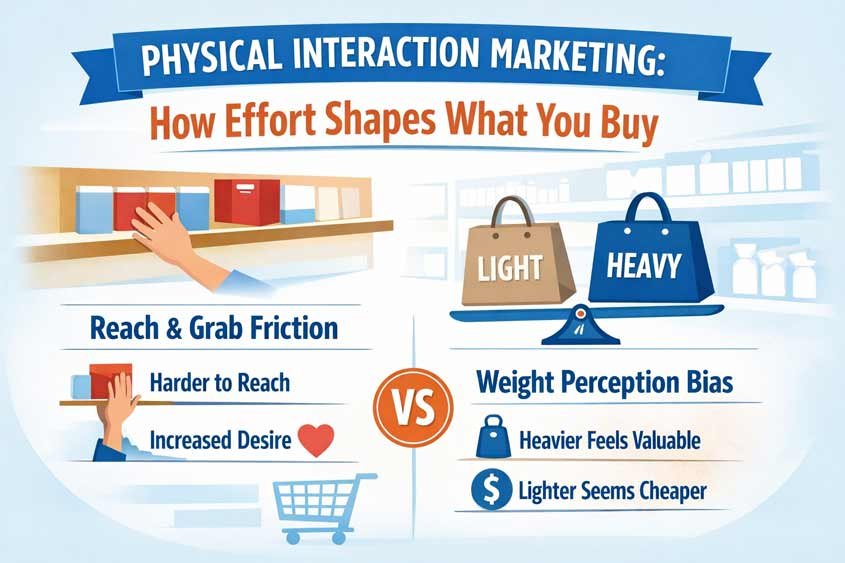
The Hidden Power of Touch: Why Effort Quietly Shapes Every Purchase
Walk into any supermarket and you think you’re making simple choices. You grab what you need, maybe compare a few prices, toss things in your cart, move on. It feels straightforward. Logical, even.
But there’s a layer underneath all that. A physical layer.
The way you reach for a product. The angle of your arm. How far you have to bend. Whether something feels easy to grab or just slightly annoying to get to. These aren’t random details. They’re part of a carefully designed system built around physical interaction marketing.
And here’s the uncomfortable truth. Your body often decides before your brain catches up.
You don’t stand there thinking, “This product is 20 percent easier to reach, so I will buy it.” You just… take it. Because it’s right there. Because it feels effortless. Because it doesn’t interrupt your flow.
Effort, or more precisely the reduction of effort, is one of the most reliable ways to influence behavior. Not just in retail, but everywhere. Apps reduce clicks. Restaurants simplify menus. Streaming platforms autoplay the next episode. Less friction always wins.
Supermarkets take that principle and translate it into physical space.
They design shelves, aisles, and product placement so that certain items align perfectly with your natural movement. Eye level becomes buy level. Hand level becomes the default choice. Anything that requires extra effort, even a small stretch or bend, quietly drops in priority.
And it’s not just about convenience. It’s about perception.
When something is easy to access, your brain reads it as more available, more popular, more “normal” to choose. That ties directly into other psychological triggers like social proof and familiarity bias. If it’s right in front of you, it must be what most people pick… right?
On the flip side, when a product demands effort, it creates hesitation. Not conscious resistance. Just a tiny pause. And in a store environment filled with hundreds of decisions, even a one-second delay can be enough to lose the sale.
That’s where physical interaction marketing becomes powerful. It operates below awareness. It doesn’t argue with you. It doesn’t try to convince you. It simply reshapes the environment so that the easiest action is also the most profitable one for the retailer.
And once you start noticing it, you can’t really unsee it.
Why are premium brands often placed right where your hand naturally lands? Why do bulk or budget options sit lower, forcing you to bend? Why do some products feel oddly “in the way” while others seem to appear exactly when you need them?
None of that is accidental.
Table of Contents
Reach and Grab Friction: The Silent Force Behind What You Pick
Stand in front of a supermarket shelf and don’t look at the brands. Just notice your body for a second.
Where do your eyes land first?
Where does your hand go without thinking?
That zone right there, between your chest and your eyes, is the most valuable real estate in retail. Not because it looks nice. Because it requires the least effort. And in physical interaction marketing, less effort almost always means more sales.
You don’t experience this as a decision. It feels automatic. You reach, you grab, you move on. But that smooth motion is exactly what retailers and brands are paying for.
Products placed at eye level or within easy arm reach consistently outperform identical products placed higher or lower. The difference isn’t subtle. In many retail tests, shifting a product from a lower shelf to eye level can significantly increase sales without changing price, packaging, or promotion. Same product. Same shopper. Different physical effort.
That’s the leverage.
Your brain is wired to conserve energy. It prefers actions that feel easy, fast, and uninterrupted. So when a product sits right in your natural path, it becomes the default. Not because it’s better. Because it’s there.
And here’s where it gets interesting. This doesn’t just affect what you notice. It affects what you evaluate.
When something is easy to grab, your brain gives it a small advantage before you even think about it. It feels more convenient, more familiar, sometimes even more trustworthy. That’s effort bias quietly shaping perception.
Now flip the scenario.
A product is placed on the top shelf. You have to stretch a bit. Maybe go on your toes. Or it’s on the bottom shelf, forcing you to bend down, shift your balance, maybe even move your cart.
None of that feels like a big deal. But it is.
Every extra physical step introduces friction. And friction breaks flow.
Shopping, especially in supermarkets, is often a semi-automatic process. You’re moving, scanning, grabbing, repeating. The moment something disrupts that rhythm, even slightly, your brain looks for an easier alternative. Usually, it’s the product sitting right in front of you.
That’s why lower and higher shelves tend to underperform. Not because people can’t reach them, but because they don’t want to.
Of course, retailers know this. So those “weaker” zones aren’t wasted. They’re used strategically.
Lower shelves often hold bulk items, larger packaging, or budget options. Why? Because if you’re specifically looking for those, you’ll make the effort. You’ll bend down because you already have intent. Price-sensitive shoppers are more willing to trade effort for savings. That’s a different psychological trigger kicking in, the price quality heuristic in reverse.
Top shelves, on the other hand, are often used for overstock, niche products, or items that don’t rely on impulse. Sometimes even premium products go up there, but only when their branding is strong enough to pull attention despite the effort.
And then there’s the middle zone. The battlefield.
This is where high-margin products live. Private labels. Strategic brands. Items the retailer wants you to pick without thinking too much. Because here’s the thing. When reach is easy, comparison drops.
You’re less likely to scan alternatives. Less likely to check price per unit. Less likely to question your choice. The physical ease creates cognitive ease. And cognitive ease leads to faster, less critical decisions.
This ties directly into other psychological triggers you’ve probably seen before. Anchoring, for example. If the first product you comfortably grab sets a price expectation, everything else gets judged relative to it. Or the decoy effect. Place a slightly worse option nearby, but make the better one easier to reach, and suddenly the “right” choice feels obvious.
Even social proof sneaks in here. When the most accessible product also looks slightly more touched, slightly more picked over, your brain reads it as popular. And popularity reduces risk.
It’s all layered together.
Now think beyond supermarkets for a second.
Ever noticed how apps place key buttons exactly where your thumb rests? Or how fast food chains position best-selling items at the easiest ordering points? Same principle. Different environment. Physical interaction marketing isn’t limited to shelves. It’s about aligning the desired action with the path of least resistance.
Back in the store, small design tweaks can create big shifts.
A product moved just 20 centimeters higher can lose visibility and accessibility. A shelf angled slightly downward can make items easier to grab and therefore more likely to sell. Even the spacing between products matters. Too tight, and grabbing feels awkward. Too loose, and it breaks visual flow.
Retailers test these things constantly.
And here’s a subtle one most people miss. The direction of movement.
In many stores, shoppers naturally move from right to left or follow a specific aisle flow. Products placed in the direction of that movement, within easy reach, benefit from momentum. You’re already moving that way, so grabbing feels like a continuation, not a decision.
Interrupt that flow, and you lose the moment.
So what does this mean for you as a shopper?
It means that what feels like your choice is often shaped before you even notice the options. The product you pick first isn’t always the best one. It’s just the easiest one.
And for marketers, this is where the real game is played.
You don’t always need a better product. Or a lower price. Or louder messaging. Sometimes, you just need better placement. Reduce the effort by a fraction, and you shift behavior at scale.
It sounds almost too simple. But that’s the point.
The most effective tactics in physical interaction marketing don’t feel like tactics. They feel like convenience.
And convenience is incredibly hard to resist.
Weight Perception Bias: Why Heavier Feels Better (Even When It’s Not)
Pick up two products that look almost identical.
Same size. Similar packaging. Same price range.
One feels slightly heavier in your hand.
Which one do you trust more?
Most people won’t say it out loud, but they lean toward the heavier one. It feels more solid. More real. Like you’re getting something of substance. And that reaction happens fast, before any rational comparison kicks in.
This is weight perception bias. A quiet but powerful piece of physical interaction marketing.
Your brain uses physical cues to fill in gaps. When you don’t have complete information, you rely on shortcuts. Weight becomes one of those shortcuts. Heavier often translates to higher quality, durability, even effectiveness.
It’s not logical. But it’s consistent.
You see this across industries, not just in supermarkets.
Pick up a premium smartphone. It often has a certain weight to it. Not too heavy, but not light either. That balance is engineered. Too light, and it feels cheap. Too heavy, and it becomes uncomfortable. The “right” weight signals quality without effort.
Wine bottles are another classic example. Heavier glass subtly suggests a higher-end product. The liquid inside hasn’t changed. But your expectation has.
Back in the supermarket, this bias shows up everywhere.
A jar of pasta sauce with thicker glass feels more premium than a lighter plastic version, even if the contents are similar. A chocolate box with a bit of heft seems more indulgent. A shampoo bottle that resists your grip slightly feels more “professional.”
None of these reactions are conscious decisions. You don’t stand there analyzing grams. You just feel it and move on.
And that feeling sticks.
In physical interaction marketing, this matters because touch reinforces belief. When you pick something up, you’re not just observing it. You’re experiencing it. And physical experience carries more weight than visual cues alone. Literally and psychologically.
Now here’s where it gets strategic.
Brands don’t just accept weight perception bias. They design for it.
Packaging is often adjusted to create a specific feel in your hand. Thicker materials. Weighted bases. Internal structures that add mass without adding product. Sometimes even the distribution of weight is manipulated so the item feels more stable when lifted.
It’s not about deception in an obvious sense. It’s about guiding perception.
If a product feels substantial, your brain assumes it delivers more value. That assumption reduces doubt. And reduced doubt speeds up decisions.
This ties closely to the price quality heuristic. When something feels heavier and looks refined, a higher price becomes easier to accept. In some cases, the physical sensation justifies the cost before you even check the label.
There’s also a link to effort justification, another psychological trigger worth noticing.
If you’ve gone through the motion of picking something up and it feels “worth it” in your hand, you’re more likely to follow through with the purchase. The act of lifting creates a small investment. And once that investment feels validated, abandoning the product creates friction.
So you keep it.
Retail environments are designed to encourage this interaction. Notice how many products are placed in ways that invite touch. Open-top freezers. Bins you can dig through. Slightly protruding items that are easy to grab.
The goal is simple. Get it into your hands.
Because once it’s in your hands, weight perception bias starts doing its work.
There’s also an interesting contrast when brands go the other way.
Some products intentionally feel lighter. Think of items positioned around convenience or efficiency. A lightweight vacuum cleaner, for example, signals ease of use. A light snack pack suggests low calories or guilt-free consumption.
So the direction of the bias depends on the promise.
If the product is about strength, durability, or indulgence, heavier wins. If it’s about speed, simplicity, or health, lighter can be more persuasive.
That’s where alignment matters.
When the physical feel matches the product story, the message becomes stronger without needing extra words. That’s one of the core advantages of physical interaction marketing. It communicates through experience, not explanation.
Now consider how subtle this can get.
Even small differences in weight can shift perception. You don’t need a dramatic change. A slight increase is enough to tip the scale, no pun intended. Your brain isn’t measuring precisely. It’s reacting to contrast.
And once that initial impression is formed, confirmation bias kicks in. You start noticing details that support your first feeling. The packaging looks nicer. The brand seems more reliable. The product feels like a better choice.
All from a few extra grams.
There’s also a social layer to this.
Heavier, more substantial products often align with status signaling. They feel like something you’d be proud to place on your kitchen counter or pull out in front of guests. That ties into identity-based buying. You’re not just choosing a product. You’re choosing what it says about you.
So the physical sensation connects to perception, which connects to identity.
And suddenly, a simple object carries more meaning than it should.
From a practical standpoint, this creates a clear advantage for brands that understand it.
If you can’t compete on price, you can compete on feel. If your product category is crowded, physical differentiation becomes a shortcut to standing out. Not visually, but experientially.
That’s harder to copy.
For you as a shopper, it’s worth pausing for a second next time you pick something up.
Ask yourself, would this feel as “good” if it were lighter? Would I judge it the same way?
Sometimes the answer is yes. Often, it’s not.
And that’s the point.
Weight perception bias doesn’t force your decision. It nudges it. Quietly, consistently, and very effectively.
Combined with reach and grab friction, it completes a powerful loop. First, the product is easy to pick up. Then, once it’s in your hand, it feels right.
At that stage, the decision is already leaning in one direction.
And most of the time, you won’t even notice why.
Designed to Feel Right: Why Effort and Touch Decide More Than You Think
You walk into a store thinking you’re making choices based on need, price, maybe a bit of habit.
But step back for a second, and a different pattern shows up.
What you buy is often shaped before you even start comparing options. It begins with where your hand naturally goes. It continues with how a product feels once you pick it up. And by the time you’re actually “deciding,” a lot of the work is already done.
That’s the real power of physical interaction marketing.
It doesn’t rely on loud messaging or aggressive persuasion. It works quietly, through your body. Through movement. Through touch. Through effort, or more precisely, the absence of it.
When something is easy to reach, it gets chosen more often. Not because it’s better, but because it fits your natural flow. No interruption. No friction. Just a smooth grab and go.
When something feels heavier, more solid, more substantial, it gains an edge. It feels like better value. More reliable. Worth the price. Again, not because of what it is, but because of how it feels in your hand.
Put those two together, and you get a powerful combination. Easy to pick up. Feels right when you hold it.
At that point, the decision almost closes itself.
And what makes this especially effective is how it blends with other psychological triggers you’ve probably seen across retail.
Scarcity cues can push you to act faster. Anchoring can shape how you interpret price. Social proof can reduce hesitation. But physical interaction marketing sets the stage before any of those even come into play.
It decides what gets touched.
And what gets touched has a much higher chance of being bought.
That’s a simple rule, but it holds up across categories.
Think about electronics stores where demo units are always within reach. Cosmetic sections where testers invite you to try before you think. Even clothing racks arranged so certain pieces slide out more easily than others.
Same principle. Different context.
The easier it is to interact, the more likely you are to engage. And once you engage, the path to purchase shortens.
For marketers, this creates a clear opportunity.
You don’t always need to change the product. Or the price. Or the messaging. Sometimes, you just need to redesign the interaction. Adjust placement. Rethink packaging weight. Remove small points of friction that most people would never consciously notice.
Those small changes scale fast.
A slight improvement in accessibility can shift sales across thousands of shoppers a day. A subtle packaging tweak can reposition an entire product line without a single word being changed.
It’s quiet leverage.
For you, as the shopper, it gives you a different kind of awareness.
Not to overanalyze every purchase. That’s not realistic. But to recognize that ease and feel are influencing you more than you think.
Next time you reach for something, pause for a second.
Was that your choice, or just the easiest one available?
When something feels premium in your hand, ask yourself if the weight is part of the story.
These aren’t tricks you can completely avoid. They’re built into the environment. But once you notice them, you start seeing the pattern everywhere.
And that changes how you move through it.
Because physical interaction marketing doesn’t force decisions.
It just makes certain decisions feel natural.
And what feels natural is very hard to resist.

Gabriel Comanoiu is a digital marketing expert who has run his own agency since 2016. He learned marketing by testing, analyzing, and refining campaigns across multiple channels. In his book series Impulse Buying Psychology, he shares the psychological triggers behind every purchase, showing how to create marketing that connects, persuades, and converts.