
The Invisible Hand
You probably think you’re making independent decisions when you shop. You pick what you need, compare a few prices, and maybe grab something extra if it feels worth it. Straightforward, right?
Not quite.
Modern supermarkets don’t just rely on shelf placement, lighting, or clever packaging anymore. Those still matter, sure. But there’s a quieter layer running underneath everything now. One you don’t see, don’t question, and rarely notice unless you’re looking for it. That layer is digital supermarket psychology.
It works through data. Your data.
Every time you scan a loyalty card, open a store app, or even just walk through certain stores with sensors and cameras, you’re feeding a system that’s constantly learning how you behave. What you buy on weekdays versus weekends. Whether you respond to discounts or ignore them. If you tend to switch brands or stick to habits. Over time, the system builds a version of you that’s surprisingly accurate. Not perfect, but good enough to predict your next move.
And once it can predict you, it can start nudging you.
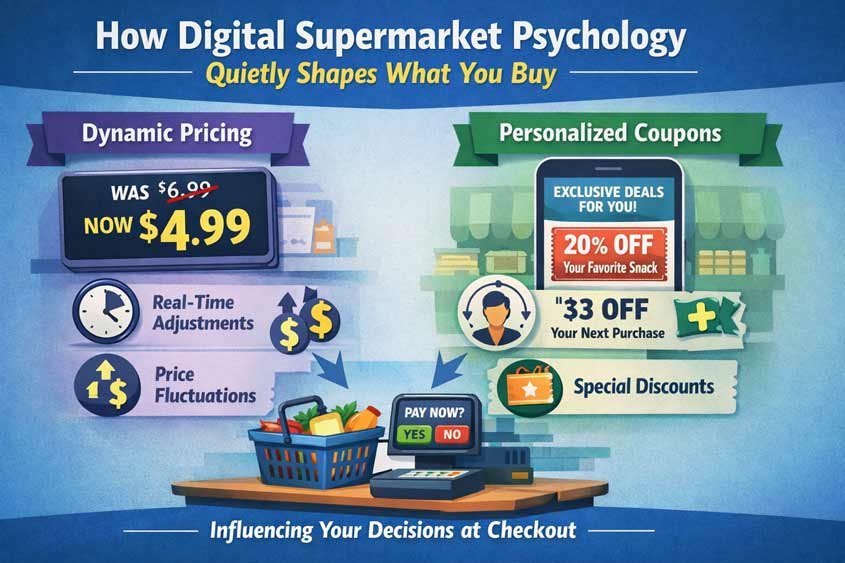
This is where digital supermarket psychology becomes powerful. Instead of influencing everyone the same way, stores can subtly adjust the experience for you specifically. Prices might shift based on demand or timing. Offers can appear right when you’re most likely to say yes. Even the order of products you see in an app can be tailored to your past behavior.
It’s not loud. It doesn’t feel like persuasion. That’s the point.
Think about the last time you got a coupon that felt oddly relevant. Or when a “limited-time offer” showed up just as you were about to restock something. That’s not coincidence. It’s the same logic behind classic triggers like scarcity and the default effect, just upgraded with real-time data and automation.
And here’s the interesting part. You still feel in control.
That’s what makes digital supermarket psychology different from traditional tactics like shelf positioning or checkout impulse zones. Those are visible. You can notice them if you try. But digital triggers operate in the background, shaping timing, context, and perception without drawing attention to themselves.
You’re not being forced. You’re being guided. Quietly.
Once you start noticing it, it’s hard to unsee. Prices that change. Offers that follow you. Patterns that feel a little too convenient.
So the real question isn’t whether supermarkets use these tactics. They do.
The question is how far they can go before you realize what’s actually influencing your decisions.
Table of Contents
Dynamic Pricing (in some markets)
You walk into a supermarket on a quiet Tuesday afternoon. Fewer people. Slower pace. You grab a few staples, maybe something extra. Nothing unusual.
Now imagine walking into that same store on a busy Saturday evening. Same products. Same shelves.
Different prices.
That’s not a hypothetical in some markets. It’s already happening. And it sits right at the core of digital supermarket psychology.
Dynamic pricing means prices are not fixed. They shift based on variables like demand, time of day, inventory levels, or even external factors like weather or local events. The price you see is not just “the price.” It’s the price right now, in this moment, under these conditions.
And here’s where it gets interesting. You’re usually not aware of it.
In traditional retail, price tags are static. Changing them takes effort. Staff need to replace labels, update systems, manage errors. That friction kept pricing relatively stable.
Digital infrastructure removes that friction.
Electronic shelf labels, centralized pricing systems, and real-time data feeds allow supermarkets to adjust prices instantly across entire stores or regions. No delay. No visible process. One update, and it’s done.
So what actually drives these changes?
Start with demand. If a product suddenly becomes popular, prices can rise slightly to capture that increased willingness to pay. This is the same principle airlines and hotels use, just applied to groceries. You’ve probably seen it in action with seasonal products. Think ice cream during a heatwave or certain ingredients right before holidays. Demand spikes, and pricing quietly follows.
Then there’s time-based pricing. Some stores experiment with lowering prices late in the day for perishable goods. Fresh meals, bakery items, produce. The logic is simple. Sell at a lower margin now or risk wasting the product entirely. But it doesn’t stop there. In more advanced setups, pricing can fluctuate throughout the day based on shopping patterns. Morning shoppers might see slightly different prices than evening shoppers.
Inventory plays a big role too. Overstocked items can trigger automatic discounts to clear space. Low stock can do the opposite. It’s a constant balancing act between supply and demand, handled by algorithms instead of manual decisions.
Now layer in your behavior.
This is where digital supermarket psychology really starts to show its teeth.
If you consistently buy a specific brand, rarely switch, and don’t respond to discounts, the system learns something valuable. You are less price-sensitive for that product. In theory, that opens the door for subtle price increases without losing your purchase.
On the flip side, if you often wait for promotions or switch brands based on price, you might see more aggressive discounts or better-timed offers. Not because the store is being generous, but because it’s optimizing for conversion.
It’s segmentation, just more granular and automated.
And it ties directly into other psychological triggers you’ve probably written about. Scarcity, for example. When prices rise alongside visible stock reduction, it reinforces urgency. You feel like you need to act now. Or anchoring. A higher initial price makes a later “discount” feel more valuable, even if the final price is still profitable for the store.
There’s also a subtle interaction with loss aversion. If you notice prices fluctuating, you may start buying earlier to avoid potential increases. You’re not reacting to a current loss. You’re trying to avoid a future one. That anticipation drives behavior.
But here’s the thing most people miss.
Dynamic pricing doesn’t need extreme changes to be effective.
Even small adjustments matter. A few cents here, a slight increase there. Over hundreds of products and thousands of customers, those micro changes add up. And because they’re small, they rarely trigger resistance. You don’t question a five percent difference the same way you would a twenty percent jump.
It flies under the radar.
There’s also a perception layer. Supermarkets have to be careful. If customers feel prices are unfair or inconsistent, trust drops fast. That’s why most implementations are subtle or limited to certain categories. Or framed in ways that feel acceptable, like discounts on expiring products rather than increases on popular ones.
Transparency is selective.
You’ll often see the benefits highlighted. “Reduced price.” “Manager’s special.” “Limited time offer.” What you don’t see is the full pricing logic behind the scenes. The algorithm doesn’t explain itself.
And honestly, it doesn’t need to.
Because from your perspective, everything still feels normal. You’re choosing. You’re comparing. You’re deciding.
But the environment is shifting around you in real time.
That’s the real power of digital supermarket psychology in pricing. It doesn’t force decisions. It reshapes the context in which decisions happen.
Once you start paying attention, patterns begin to emerge. Prices that seem to move with timing. Discounts that appear just often enough to keep you engaged. Products that feel slightly more expensive when you’re most likely to need them.
Not random. Not accidental.
Designed.
And the more data the system collects, the sharper those adjustments become.
So next time you see a price, it’s worth asking a simple question.
Is this the price for the product… or the price for me?
Personalized Coupons at Checkout or App
You finish shopping. You’ve made your choices. In your mind, the decision phase is over.
Then it happens.
A coupon prints at checkout. Or a notification pops up in the app. Maybe a clean little “Just for you” section appears right when you’re about to leave. And somehow, it’s not random. It’s for something you actually buy. Or almost bought. Or were thinking about last week.
That moment right there is one of the clearest expressions of digital supermarket psychology.
Because it doesn’t just influence what you buy today. It quietly programs what you’ll do next time.
Personalized coupons are built on a simple idea. Your past behavior predicts your future behavior. But instead of just observing that pattern, supermarkets actively shape it.
Every purchase you make feeds into a profile. Frequency. Brand preference. Price sensitivity. Even timing. Do you shop every Sunday morning? Do you tend to restock certain items every two weeks? Do you respond to discounts on snacks but ignore them on essentials?
Over time, the system stops guessing. It starts anticipating.
And then it intervenes.
Let’s say you regularly buy a specific brand of coffee. No switching. No hesitation. From a traditional perspective, there’s no reason to discount that product for you. You’re already loyal.
But digital supermarket psychology doesn’t always aim for immediate margin. Sometimes it plays a longer game.
You might receive a small coupon for that exact coffee. Not a huge discount. Just enough to register. It creates a subtle reinforcement loop. You feel validated in your choice. Maybe even a bit rewarded. So what happens next time? You come back and buy it again.
That’s habit reinforcement, strengthened by data.
Now flip the scenario.
You’re inconsistent with a category. Maybe you switch between brands of yogurt depending on what’s on sale. That signals flexibility. The system sees an opportunity.
Next time, you might get a targeted coupon nudging you toward one specific brand. Not randomly, but strategically. The goal is to convert you from a switcher into a repeat buyer. Once that happens, the need for discounts drops over time.
It’s not just about giving you a deal. It’s about training your preferences.
And the timing matters just as much as the offer itself.
Coupons delivered at checkout hit you at a very specific psychological moment. You’ve just completed a purchase. Your brain is in a state of closure. That’s where the peak-end rule comes into play. The final part of your experience shapes how you remember the entire trip.
A well-timed, relevant coupon can tilt that memory in a positive direction. You leave feeling like you got extra value, even if the savings apply to a future visit. That increases the likelihood you’ll return.
It’s a loop. Shop. Receive reward. Come back. Repeat.
App-based coupons take this even further.
Now the supermarket isn’t limited to the checkout moment. It can reach you anytime. Before you shop. During. Even days after your last visit. And because it has your data, the messaging can be precise.
You might open the app and see a curated list of offers that feel oddly aligned with your needs. Not everything is relevant, but enough of it is. That’s intentional. A mix of accuracy and variety keeps you engaged without making the system feel too predictable.
There’s also an element of perceived exclusivity. Labels like “Just for you” or “Your deals” tap into personalization bias. You feel singled out in a positive way. Even if, logically, you know thousands of other customers are getting similar treatment.
It feels personal.
And that feeling changes how you evaluate the offer.
A generic discount is easy to ignore. A personalized one feels harder to dismiss. It creates a subtle pressure. If this is tailored to me, maybe I should use it. Otherwise, I’m wasting something that was specifically given to me.
That’s loss aversion again, just framed differently.
Then there’s the role of timing in habit formation.
If you tend to shop every Saturday, and you consistently receive fresh coupons on Friday evening, something starts to lock in. The cue appears. You anticipate the reward. The behavior follows. Over time, it becomes automatic.
You’re not deciding to shop. You’re following a pattern that feels natural.
And once that habit is established, the supermarket has effectively secured a recurring visit.
There’s also cross-selling happening beneath the surface.
Let’s say you frequently buy pasta but rarely buy premium sauces. The system can introduce targeted coupons for those higher-margin items, paired with your usual purchases. Not aggressively. Just enough to get you to try it once.
If the experience is good, that single trial can turn into a new habit. Now your average basket value increases, driven by a well-placed nudge.
This connects with the idea of the default effect. Once a product becomes part of your routine, you stop evaluating alternatives. The effort to switch feels unnecessary. Personalized coupons help initiate that first step into a new default.
And here’s where things get even more subtle.
Not all coupons are meant to be used.
Some exist to influence perception rather than behavior. Seeing a list of personalized deals can create the impression that the store is consistently offering value. Even if you only use one or two, the overall experience feels beneficial.
It builds trust. Or at least the feeling of it.
That perception carries over into future decisions. You’re less likely to question prices if you believe you’re getting good deals regularly.
Digital supermarket psychology doesn’t just change what you buy. It changes how you feel about buying.
And that’s a much more durable advantage.
Because once you trust the system, or at least stop questioning it, the need for constant incentives decreases. The relationship shifts from transactional to habitual.
You go back because it feels right. Because it’s easy. Because it’s familiar.
Not because you consciously calculated the best option.
And all of that can start with something as simple as a coupon printed at the bottom of a receipt.
So next time you see one, take a second look.
It might not just be a discount.
It might be the first step in shaping your next ten shopping trips.
When the Store Starts Thinking for You
At some point, the supermarket stopped being just a place.
It became a system.
You still walk the aisles. You still pick up products, compare options, make what feel like independent decisions. But layered on top of that familiar experience is something far more adaptive. Quiet, responsive, always learning. That’s the real engine behind digital supermarket psychology.
Dynamic pricing shifts the ground under your feet without you noticing. Personalized coupons pull you back in before you’ve even thought about your next trip. Together, they don’t just react to your behavior. They start to shape it.
And the key detail here is subtlety.
None of this feels aggressive. You’re not being pushed in an obvious way. There’s no hard sell, no pressure. Just small adjustments. A price that feels slightly urgent. An offer that feels well-timed. A reminder that shows up at the exact moment it should.
Individually, these moments seem harmless. Even helpful.
But stack them over time, and something changes.
Your shopping becomes smoother. Faster. More predictable. You revisit the same store, buy the same brands, respond to the same patterns. It feels like convenience, and in many ways, it is. But it’s also conditioning. The kind that builds quietly, without resistance.
That’s what makes digital supermarket psychology so effective. It doesn’t interrupt your decisions. It builds around them. It uses what you’ve already done to guide what you’ll do next.
And it connects seamlessly with the other triggers you’ve seen before. The default effect keeps you anchored to familiar choices. Scarcity adds urgency at just the right moment. The peak-end rule shapes how you remember the entire experience. Even anchoring slips in through pricing and perceived value.
Only now, all of it is coordinated. Not manually, but through data.
So where does that leave you?
Not powerless. But not fully independent either.
The more aware you are, the more you start to notice the patterns. Why certain offers appear. Why some prices feel inconsistent. Why your habits feel so… stable. That awareness doesn’t remove the influence, but it changes how you respond to it.
You pause more. Question more. Sometimes even break the pattern.
And that’s the interesting tension modern supermarkets are navigating.
They want to guide you without being obvious. Influence you without losing your trust. Optimize your behavior without making you feel controlled.
Because the moment it feels manipulative, the whole system cracks.
Until then, it just keeps learning.
Adapting. Refining. Nudging.
So the next time your shopping experience feels unusually smooth, almost like the store knows exactly what you need… it probably does.

Gabriel Comanoiu is a digital marketing expert who has run his own agency since 2016. He learned marketing by testing, analyzing, and refining campaigns across multiple channels. In his book series Impulse Buying Psychology, he shares the psychological triggers behind every purchase, showing how to create marketing that connects, persuades, and converts.