
The Store Isn’t Selling Food. It’s Selling Feelings.
Walk into a supermarket and you think you’re there to make rational decisions. You’ve got a list. Maybe even a budget. You feel in control.
You’re not.
What you’re stepping into is a carefully engineered environment built on emotional triggers in supermarkets. Not obvious ones. Not loud or aggressive. Subtle signals that work under your awareness, nudging your appetite, your mood, and your sense of reward in very specific directions.
It starts before you even reach the shelves.
The warm smell of bread drifting from the bakery section. The soft lighting over fresh produce. The slight shift in temperature as you move deeper into the store. None of this is accidental. These are physiological cues designed to influence how your body feels first, and only then how your brain decides.
Because here’s the uncomfortable truth: you don’t buy food based on logic as much as you think. You buy based on how you feel in the moment. And supermarkets are very, very good at shaping that moment.
Hunger is one of the most powerful levers. When your body thinks it needs food, your decision-making changes. You become more impulsive. You prioritize immediate satisfaction. You stop comparing options carefully. This is where emotional triggers in supermarkets quietly take over, blending with other tactics like scarcity cues, price anchoring, and visual dominance to push certain products into your basket.
But it doesn’t stop at hunger.
There’s also the reward system. That little internal voice that says, “You’ve been good, you deserve this.” Supermarkets don’t just allow that voice. They amplify it. They structure your journey so you earn small psychological wins, then use those wins to justify bigger, less rational purchases later on.
Think about it. You pick up something healthy. Fresh vegetables, maybe. It feels responsible. Disciplined. And almost immediately, your brain starts negotiating. A small indulgence suddenly feels reasonable. Even deserved.
That’s not random. That’s design.
What makes emotional triggers in supermarkets so effective is how they layer together. Sensory cues influence your body. Store layout controls your exposure. Cognitive biases handle the final push. You don’t notice the system because each piece feels natural on its own.
But together, they reshape how you shop.
And once you start seeing it, you can’t really unsee it.
Table of Contents
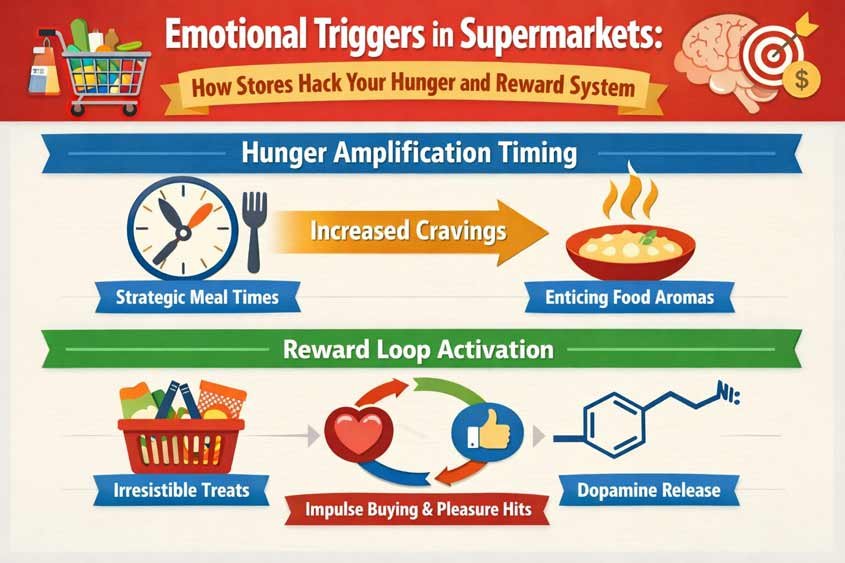
Hunger Amplification Timing: Making You Hungry at the Worst Possible Moment
You’d think supermarkets would want you calm, focused, and rational.
They don’t.
They want you just a little bit hungry. Not starving. Not uncomfortable. Just enough that your brain starts prioritizing immediate reward over careful thinking. That’s where emotional triggers in supermarkets become especially effective, and hunger amplification timing sits right at the center of it.
Look at how most stores are structured.
You walk in, and within the first few minutes, something hits you. Maybe it’s the smell of fresh bread from the bakery. Warm, slightly sweet, familiar. Or maybe it’s a sampling station offering small bites. Cheese cubes. Sausage slices. Something salty, something rich.
This doesn’t happen by accident, and it definitely doesn’t happen near checkout.
It happens early or somewhere around the middle of your journey. Right before you hit the high-margin zones. Ready meals. Snacks. Premium products. The stuff you don’t strictly need but end up buying anyway.
Here’s what’s going on.
Your body reacts to sensory cues faster than your brain can rationalize them. Smell, in particular, has a direct connection to memory and appetite. When you catch that bakery scent, your brain doesn’t analyze it logically. It jumps straight to association. Fresh bread. Comfort. Warm meals. Maybe even childhood.
At the same time, your body starts preparing to eat. Salivation increases. Hunger signals kick in. Even if you weren’t hungry when you walked in.
So now you’re shopping in a different state.
And this state changes your behavior in predictable ways.
You move faster through “boring” categories. You spend less time comparing prices. You’re more drawn to ready-to-eat items and high-calorie options. Studies consistently show that hungry shoppers buy more food overall and choose more indulgent products. The shift is measurable, not subtle.
This is why emotional triggers in supermarkets are timed, not just placed.
A bakery at the entrance is one version. But many stores go further. They stagger these cues. You might encounter a second wave deeper inside the store. A hot food counter. A rotisserie chicken station. Another sampling area.
Each one refreshes the hunger signal.
Each one keeps you in that slightly impulsive state longer.
And notice what happens right after.
You’re guided into aisles filled with snacks, sweets, and convenience foods. Products that benefit from reduced decision quality. Products that rely on impulse rather than planning. This is where hunger does its best work.
There’s also a subtle interaction with other psychological triggers.
Take decision fatigue. By the time you’ve navigated produce, dairy, and a few aisles, your mental energy is already lower. Add hunger on top of that, and your ability to evaluate options drops even further. You default to what’s easy, familiar, or emotionally appealing.
Or consider the anchoring effect. When you’re hungry, a premium ready meal doesn’t feel as expensive as it would otherwise. Your internal reference point shifts. Immediate satisfaction becomes more valuable, so the price feels more justified.
Even visual merchandising plays a role here. Bright packaging, bold colors, and large displays become more effective when your brain is already primed for reward. The isolation effect kicks in harder. The product that stands out visually now also aligns with your internal state.
And then there’s the sampling itself.
At first glance, giving away free food seems like a simple tactic. But it’s doing multiple jobs at once.
First, it activates taste. Once you’ve eaten even a small amount, your appetite often increases rather than decreases. Your body expects more. That’s a biological response, not a marketing trick, but supermarkets use it anyway.
Second, it creates a sense of reciprocity. You got something for free. There’s a subtle pressure to give something back, often by purchasing the product or at least staying engaged with that category.
Third, it lowers your guard. Sampling feels friendly. Generous. It shifts your perception of the store from purely transactional to slightly social. That emotional shift makes you more receptive to other cues around you.
All of this feeds into the same outcome.
You buy more. And you buy differently than you planned.
What’s interesting is how precise this timing can get.
High-performing stores don’t just rely on a single trigger. They layer them in sequence. Entrance scent to spark initial appetite. Mid-store sampling to reinforce it. Strategic placement of indulgent categories immediately after. It’s almost like a rhythm.
Stimulus. Response. Opportunity.
Repeat.
And once you’re aware of it, you start noticing small details.
Why does the bakery smell stronger at certain times of day? Because traffic is higher, and the impact multiplies. Why are samples often placed near premium products instead of basic staples? Because the margin justifies the tactic.
Even the path you take through the store matters. Layouts are often designed to guide you past these sensory triggers before you reach key decision zones. You think you’re wandering. You’re not.
You’re being guided through a sequence designed to shift your internal state at just the right moments.
This is what makes emotional triggers in supermarkets so effective. They don’t try to force a decision. They change the conditions under which the decision is made.
And hunger is one of the easiest conditions to manipulate.
If you walk in already hungry, the effect doubles. If you walk in full, the store works to close that gap. Either way, the goal is the same: move you away from strict planning and toward flexible, emotionally driven choices.
You don’t need to be completely out of control for this to work. Just a small shift is enough.
A slightly stronger craving. A slightly weaker filter.
That’s all it takes.
Reward Loop Activation: How One “Good Choice” Unlocks Three Bad Ones
You pick up a bag of spinach.
Or maybe it’s fresh salmon. Greek yogurt. Something clean, sensible, aligned with the version of you that has things under control.
And right there, something shifts.
You feel good about that choice. Slightly proud, even. It’s a small win, but your brain doesn’t treat it as small. It logs it as progress. Discipline. Effort.
Now here’s where emotional triggers in supermarkets start doing something a bit sneaky.
That good choice doesn’t just sit there quietly. It turns into permission.
“I’ve been good, so this is fine.”
That sentence, or some version of it, shows up fast. And once it does, your decision-making framework changes. You’re no longer optimizing for consistency. You’re balancing a mental ledger.
Healthy on one side. Indulgent on the other.
And as long as the balance feels acceptable, you keep going.
This is the reward loop.
It’s not about one impulsive purchase. It’s about a sequence. A pattern where each decision justifies the next one. Supermarkets don’t create this behavior, but they absolutely design around it.
Look at how product categories are arranged.
You often start in areas that encourage “good” behavior. Fresh produce. Whole foods. Items associated with health, discipline, and long-term thinking. These sections are calm, open, almost aspirational.
You fill your basket with a few of these items, and something important happens. You build psychological credit.
Now, when you move deeper into the store, the environment shifts. More color. More density. More options tied to comfort and reward. Snacks. Desserts. Ready meals. This is where emotional triggers in supermarkets lean hard on your internal justification system.
Because now, you’re not making isolated decisions.
You’re negotiating with yourself.
That chocolate bar isn’t just a chocolate bar. It’s a reward for the healthy choices you already made. The frozen pizza isn’t just convenience. It’s a reasonable trade-off because you bought vegetables earlier.
And the more “good” items you add early on, the stronger this effect becomes.
There’s a concept in consumer psychology called moral licensing. When you do something that aligns with your values, you give yourself permission to act against those values later. Not consciously, not explicitly. It just feels… fair.
Supermarkets build entire journeys around this.
They don’t put indulgent, high-margin items right at the entrance and hope for the best. They wait. They let you earn the reward first.
And then they present it.
Often at the exact moment your decision quality is already starting to dip. You’ve been shopping for a while. You’ve made multiple choices. Maybe you’re slightly hungry, thanks to the earlier sensory cues. Decision fatigue is creeping in.
This is when the reward loop hits hardest.
There’s also an interesting interaction with pricing.
Once you’ve justified one indulgence, the barrier for the next one drops. The first “treat” is the hardest to rationalize. After that, it gets easier. Your brain shifts from “Should I?” to “Why not?”
This is where basket size quietly expands.
You didn’t plan to buy snacks. But now you have one, so adding another doesn’t feel like a big jump. You didn’t plan to get dessert. But you already broke the pattern, so the consistency is gone anyway.
And just like that, your original plan dissolves.
What makes emotional triggers in supermarkets so effective here is how they layer multiple biases at once.
There’s mental accounting. You categorize your purchases into “good” and “bad” instead of evaluating total spend or nutritional value objectively.
There’s the sunk cost effect. You’ve already invested time and effort into shopping “properly,” so you want to feel like the trip includes some enjoyment too.
There’s even a bit of identity signaling. Buying healthy items reinforces a certain self-image. Adding a few indulgences doesn’t break that image, it humanizes it. Makes it feel more realistic.
And supermarkets quietly support all of this.
Think about in-store messaging. Labels like “treat yourself,” “you deserve it,” or “guilty pleasure.” These aren’t random phrases. They mirror the internal dialogue already happening in your head. They validate it.
Or consider product placement.
You’ll often find indulgent items positioned right after healthier sections or along transition points in the store. It’s not just about visibility. It’s about timing. Catching you right when your brain is most receptive to reward-based thinking.
Even checkout lanes play a role.
By the time you get there, your cognitive resources are low. You’ve made dozens of decisions. Your basket already contains a mix of planned and unplanned items. Adding one more small indulgence feels insignificant.
But it’s not insignificant when scaled across millions of shoppers.
That’s the system.
And it works because it doesn’t fight your psychology. It follows it.
The reward loop isn’t forced on you. It emerges naturally from how your brain handles effort, discipline, and gratification. Supermarkets just create the perfect conditions for it to unfold.
What’s slightly uncomfortable is how predictable it becomes once you see it.
You can almost map the moment. The first “good” choice. The subtle shift in mindset. The first justified indulgence. Then the second, easier one. Then maybe a third you barely think about.
It feels like freedom. Like you’re making flexible, reasonable decisions.
But the structure underneath is anything but random.
Emotional triggers in supermarkets thrive on these small internal negotiations. Not dramatic impulses, just quiet trade-offs that add up over the course of a single shopping trip.
And by the time you reach the checkout, the version of your basket often tells a very different story than the version you imagined when you walked in.
You Were Never Just Buying Food
By the time you reach the checkout, something interesting has happened.
You didn’t just collect items. You moved through a sequence of emotional states. Subtle shifts, but enough to change what you chose, how much you spent, and how carefully you evaluated each decision.
That’s the real function of emotional triggers in supermarkets.
They don’t force you to buy anything. They shape the conditions around you so that certain choices feel easier, more justified, more aligned with how you feel in the moment.
Think back to the flow.
You walked in neutral, maybe slightly focused. Then came the sensory cues. Smells, samples, small environmental nudges that quietly increased your appetite. Hunger crept in, not enough to notice consciously, but enough to shift your priorities.
Then you started making “good” decisions. Responsible ones. The kind that build a sense of control. And almost immediately, that control turned into flexibility. The reward loop kicked in. One justified indulgence opened the door for the next.
At no point did it feel like you lost control.
That’s what makes it effective.
Emotional triggers in supermarkets work best when they stay invisible. When each step feels like your own idea. Your own preference. Your own choice.
But underneath, there’s structure.
Timing of sensory cues. Placement of product categories. Sequencing that blends hunger, decision fatigue, anchoring, and reward-based thinking into a single experience. Each element is simple on its own. Together, they create momentum.
And momentum is hard to interrupt once it starts.
This isn’t unique to supermarkets, by the way.
You’ll see the same patterns in restaurants that place high-margin items after you’ve already committed to a meal. In e-commerce stores that show small add-ons after you’ve added something “responsible” to your cart. In subscription models that reward initial commitment, then expand your spending gradually.
Different environments, same psychology.
Which makes this useful beyond just shopping.
Once you understand how emotional triggers in supermarkets work, you start recognizing the mechanics elsewhere. You notice when your decisions are being shaped by timing instead of need. When a “small” choice is actually setting up a larger one.
And maybe more importantly, you can design better systems yourself.
If you’re in marketing, this is leverage. You don’t need louder messages or bigger discounts. You need better sequencing. Better alignment with how people actually feel as they move through a decision process.
If you’re a consumer, it’s awareness. Not perfect resistance, just awareness. Enough to pause, occasionally, and ask a simple question:
“Would I still buy this if I felt slightly different right now?”
Sometimes the answer will still be yes.
But sometimes it won’t. And that’s where the value is.
Because emotional triggers in supermarkets don’t rely on big moments. They rely on small, repeatable shifts. The kind that are easy to miss, but hard to undo once they stack together.
And once you see the pattern, you realize something slightly uncomfortable.
You were never just buying food.

Gabriel Comanoiu is a digital marketing expert who has run his own agency since 2016. He learned marketing by testing, analyzing, and refining campaigns across multiple channels. In his book series Impulse Buying Psychology, he shares the psychological triggers behind every purchase, showing how to create marketing that connects, persuades, and converts.