
The Invisible Hand on Your Shopping Cart
You walk into a supermarket thinking you’re in control. You’ve got your list. Maybe even a budget. You’re just here to grab what you need and get out. Simple.
But watch what actually happens.
You turn right. Most people do. You head toward the same aisles you always visit. You reach for the same brands without really thinking about it. Not because they’re the best. Not because you compared options. Just because… that’s what you always do.
That’s the default effect in action. And in retail, especially supermarkets, it’s not accidental. It’s engineered.
Default effect marketing is built on a simple idea: when faced with repeated decisions, your brain looks for shortcuts. Evaluating every option every time would be exhausting. So instead, you rely on patterns. Habits. Familiar routes. Familiar products. Familiar choices. The first time you pick something, it might be deliberate. The fifth time? It’s automatic.
Supermarkets lean heavily into this.
They don’t need to convince you every time. That would be inefficient. Instead, they focus on shaping your first few decisions and then reinforcing them until they stick. Layouts stay mostly the same. Product placements barely shift. Your path through the store becomes predictable. And once that path is locked in, so are your purchases.
This is where things get interesting. Because the default effect doesn’t work alone.
It quietly teams up with other psychological triggers you’ve probably heard of. Familiarity bias makes repeated exposure feel like preference. The mere exposure effect nudges you toward things you’ve seen often. Even anchoring plays a role when the first product you notice sets a reference point for everything else. Before you realize it, you’re not choosing freely. You’re following a script that feels like your own idea.
And the real power here? You don’t question it.
You don’t stop in the cereal aisle and think, “Wait, why do I always buy this brand?” You just reach out and grab it. Decision made in seconds. No friction. No analysis.
From a business perspective, that’s gold.
From your perspective… well, it means a lot of your “choices” aren’t really choices at all.
In this article, you’ll see exactly how supermarkets build and reinforce these defaults. How store layouts quietly train your behavior over time. How brands use shelf space to become your automatic pick. And most importantly, how these patterns lock in so deeply that breaking them starts to feel uncomfortable.
Once you notice it, you can’t unsee it.
Table of Contents
Path Dependency: How Your Route Becomes Your Reality
The first few times you walk into a supermarket, you’re alert.
You scan signs. You look around. You actively search for what you need. Your brain is doing real work. Where’s the milk? Which aisle has pasta? Is this layout even logical?
Fast forward a few visits.
You stop thinking.
You walk in and your body just… goes. Right turn. Produce. Dairy. Snacks. Checkout. You’re no longer navigating. You’re executing a routine.
That’s path dependency. And in default effect marketing, it’s one of the most powerful forces in the entire store.
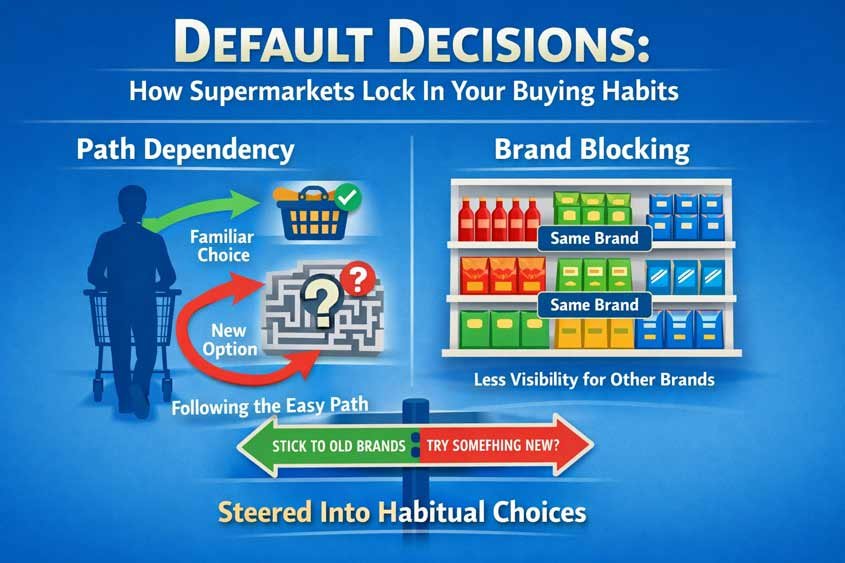
Path dependency means your past decisions shape your future ones. Once you follow a certain route often enough, it becomes your default path. And once that path is locked in, something subtle but important happens: you stop evaluating alternatives.
Not consciously. It just fades away.
You don’t compare every cereal brand. You compare the two that sit directly in your line of sight. You don’t explore every aisle. You revisit the ones that are already part of your loop. The rest of the store might as well not exist.
From the supermarket’s point of view, this is exactly the goal.
Store layouts are not designed for discovery. They’re designed for repetition.
That’s why major layout changes are rare. When they do happen, people get annoyed. You’ve probably felt it. Suddenly you can’t find anything. Your usual route is broken. What should be a quick trip turns into a frustrating search.
That frustration tells you something important: your behavior wasn’t flexible. It was conditioned.
Retailers know this. So instead of constantly redesigning the space, they optimize within a stable structure. Small adjustments. Strategic placements. But the overall flow? It stays familiar. Predictable. Comfortable.
Because comfort keeps you moving on autopilot.
And autopilot is where default effect marketing does its best work.
Think about how this interacts with cognitive load. Every decision you make during a shopping trip consumes mental energy. Early on, you’re relatively fresh. You might compare prices, check labels, even try something new. But as you move through the store, that energy drops. Decision fatigue starts creeping in.
Now combine that with a fixed path.
By the time you reach certain categories, you’re not in the mood to analyze. You’re following your route, grabbing what feels right, leaning heavily on habit. This is where supermarkets often position higher margin or impulse products. Not randomly. Precisely where your decision quality is lower.
It’s a quiet alignment of two forces: path dependency and decision fatigue sequencing.
And it works.
There’s also a visibility effect here that most people miss.
If your route doesn’t take you past a product, that product has almost no chance of being chosen. Not because it’s worse. Just because it’s invisible to your routine. Over time, entire categories or brands get filtered out of your personal shopping universe simply because they’re off-path.
You didn’t reject them. You never considered them.
That’s a strong form of behavioral narrowing.
It’s similar to what happens in digital environments. Think about streaming platforms or online stores. You click what’s familiar. Algorithms reinforce it. Your world shrinks to a predictable loop of content or products. Supermarkets do the same thing physically, without an algorithm. The layout is the algorithm.
And your feet follow it.
There’s an interesting side effect here. The more you repeat a path, the more confident you feel in your choices along that path. Familiarity creates a sense of correctness. “I always buy this, so it must be good.” That’s not careful evaluation. That’s reinforcement.
This is where default effect marketing blends with familiarity bias and even a bit of the sunk cost fallacy. You’ve invested time in learning your route. You’ve repeated it dozens of times. Changing it feels inefficient. Almost wrong. So you stick with it.
Even if better options exist just one aisle over.
Supermarkets occasionally test this boundary. They might introduce small disruptions. A promotional island. A seasonal display placed right in your path. Something that gently interrupts your flow without breaking it completely.
Notice how these are positioned.
Not at the edges of the store. Right where you already walk.
They’re not trying to make you explore. They’re inserting new decisions into your existing routine. Much easier than forcing you to create a new one.
Because creating new paths requires effort. Reinforcing old ones requires almost none.
This principle extends beyond supermarkets.
In e-commerce, homepage layouts rarely change dramatically for returning users. Navigation menus stay consistent. Categories remain in familiar positions. The goal is the same: reduce friction, reinforce habit, and keep you moving along a known path.
In physical retail, though, the effect is more embodied. You literally walk your habits.
And once your body learns something, it’s hard to unlearn.
There’s one more layer worth noticing.
Path dependency doesn’t just influence what you see. It influences how fast you move. Familiar routes are faster. You spend less time per decision. That sounds efficient, but it also means fewer moments of reflection. Less time to question. Less time to compare.
Speed becomes the enemy of deliberate choice.
And supermarkets quietly encourage that speed once your path is established.
So when you think about default effect marketing, don’t just think about products or pricing. Think about movement. Think about repetition. Think about how a simple route through a store can shape dozens of decisions without you realizing it.
You’re not just buying products.
You’re following a path that’s been rehearsed so many times it feels like instinct.
And instinct, in this case, is exactly what the system was designed to create.
Brand Blocking: When One Choice Feels Like the Only Choice
Stand in front of a supermarket shelf and just… pause for a second.
Look at how the products are arranged.
At first glance, it feels like variety. Different colors, different packages, different price points. Plenty of choice. But then your eyes adjust. Patterns start to show up. One brand stretches across the shelf. Same logo, repeated again and again. Slight variations, sure. Different flavors, sizes, maybe a “new recipe” label thrown in.
But it’s the same brand.
That’s brand blocking. And inside default effect marketing, it’s a quiet powerhouse.
The idea is simple. If one brand takes up more physical space, it dominates your visual field. And what you see more, you tend to choose more. Not because it’s objectively better. Because it feels familiar. Available. Safe.
Your brain reads repetition as a signal.
“If it’s everywhere, it must be popular.”
“If it’s popular, it’s probably good.”
“If it’s probably good, I don’t need to overthink this.”
Decision made.
This is where brand blocking links directly to the default effect. Because once you’ve picked that dominant brand a few times, it becomes your automatic choice. You stop scanning the shelf. You stop comparing alternatives. Your hand goes straight to the familiar block of color and logo.
It’s almost mechanical.
And here’s the key detail most people miss: brand blocking doesn’t eliminate competitors. It buries them.
They’re still there. Smaller presence. Less repetition. Maybe placed slightly above or below your natural eye line. You could choose them. Nothing is stopping you.
Except attention.
Attention is limited. And brand blocking consumes most of it.
There’s a concept in psychology called the mere exposure effect. The more you see something, the more you tend to like it. Even if you don’t consciously register that you’ve seen it before. Supermarkets exploit this relentlessly. By giving one brand more shelf space, they increase exposure without increasing advertising.
No extra ads. No extra messaging. Just physical presence.
And presence builds preference.
Now layer in familiarity bias. When faced with multiple options, you lean toward what feels known. It reduces uncertainty. It lowers perceived risk. You don’t want to experiment every time you buy something as basic as pasta or cereal. So you default to the brand that feels familiar.
Brand blocking accelerates that familiarity.
It compresses time. A brand that occupies half the shelf can feel “established” much faster than a brand with two or three facings. You might only visit the store once a week, but within a few visits, that dominant brand starts to feel like the standard.
Not one option among many.
The option.
There’s also a physical aspect to this that’s easy to overlook. Products placed in a continuous block are easier to grab. Your eyes don’t need to jump around. Your hand doesn’t hesitate. You spot the brand instantly and reach for it.
Low friction matters.
This connects with another subtle trigger: reach and grab ease. When a product is not only visible but also easy to access within a large, uninterrupted space, it wins by default. You don’t need to search. You don’t need to adjust. It’s just… there.
Waiting.
And because it’s always there, it reinforces your habit every single time.
This is how dominance turns into routine.
Supermarkets often reserve this kind of shelf space for established brands or higher margin products. It’s not random. Shelf space is negotiated, tested, optimized. If a brand proves it can convert attention into sales, it earns more space. More space leads to more visibility. More visibility leads to more sales.
Feedback loop.
Once that loop starts, it’s hard for smaller brands to break in. Even if they offer better quality or a lower price, they face a visibility problem. They’re competing against a wall of familiarity. And familiarity, in most everyday decisions, wins.
Think about how this plays out across different categories.
In beverages, you’ll often see entire sections dominated by one or two major brands. In snacks, the same pattern repeats. In household products, cleaning supplies, dairy alternatives… the logic is consistent. Create visual dominance. Reinforce recognition. Let the default effect take over.
This isn’t limited to physical retail, by the way.
In e-commerce, brand blocking shows up as “featured products,” “best sellers,” or entire rows dedicated to one brand. On streaming platforms, it’s the same with featured content. The layout changes, but the psychology doesn’t. Dominance creates familiarity. Familiarity drives choice.
Back in the supermarket, though, the effect feels more subtle. Less intrusive.
You don’t feel like you’re being pushed.
You feel like you’re choosing.
That’s the brilliance of it.
There’s also an emotional layer here. Repeated exposure builds a kind of quiet trust. Not deep loyalty. Not strong attachment. Just a low level comfort. “This is what I usually get.” And in a busy day, that’s often enough.
You don’t need excitement for every purchase.
You need certainty.
Brand blocking delivers that certainty by removing doubt. It narrows your field of vision until one option feels like the obvious one. And once that feeling sets in, you stop questioning it.
Even when better alternatives are right next to it.
Tie this back to path dependency and you get a powerful combination. Your route takes you to the same shelf. The same section of that shelf is dominated by the same brand. Your past choices reinforce your future ones. And every visit strengthens the pattern.
It’s not just that you prefer the brand.
It’s that you rarely give others a real chance.
That’s default effect marketing at full strength. Not forcing a decision. Just shaping the environment until one decision feels natural, effortless, and repeatable.
And when something feels natural, you don’t analyze it.
You just reach out and grab it.
The Comfort Trap: When Familiar Choices Stop Being Choices
By the time you reach the checkout, it feels like you’ve made dozens of small, sensible decisions.
You got what you needed. Maybe even saved time. Nothing dramatic happened. No pressure, no obvious manipulation. Just a smooth, familiar trip through the store.
That’s exactly the point.
Default effect marketing doesn’t try to convince you in the moment. It works earlier than that. It shapes your environment, then lets repetition do the rest. Your route becomes predictable. Your attention narrows. Certain brands show up more often than others. And over time, those patterns stop feeling like influence.
They feel like preference.
Path dependency keeps you moving through the same aisles, seeing the same options, skipping entire categories without noticing. Brand blocking fills your field of view with the same names until they feel like the safe, obvious choice. Put them together and something interesting happens: your decisions speed up, but your awareness slows down.
You’re choosing faster. But questioning less.
And that’s where the real shift happens.
Because once a behavior becomes a habit, it stops competing. New options don’t need to be worse to lose. They just need to be unfamiliar. And unfamiliar requires effort. A pause. A comparison. A tiny moment of friction most people avoid when they’re just trying to get through their shopping list.
So the default wins.
Again and again.
This pattern isn’t limited to supermarkets. You see it in how you use apps, how you browse websites, even how you choose restaurants. The first few decisions shape the next hundred. The difference in retail is how physical it feels. You walk the habit. You reach for it. You repeat it without thinking.
And repetition builds confidence.
Not real confidence based on evaluation. The kind that comes from recognition. “I’ve bought this before, so it must be right.” That quiet assumption is one of the strongest drivers of consistent sales. Stronger than discounts in many cases. More stable than promotions.
Because habits don’t expire.
If you zoom out, you’ll notice how other psychological triggers quietly support this system. Familiarity bias reinforces repeated exposure. Anchoring influences how you perceive value once you spot your usual brand. Even scarcity cues, like low stock signals, can push you to stick with what you know instead of risking a switch.
It’s all connected.
And it all points in the same direction: reduce effort, reduce uncertainty, reinforce the default.
So what do you do with this?
You don’t need to overhaul your entire shopping routine. That’s unrealistic. But you can interrupt the pattern in small ways. Change your route occasionally. Look one shelf higher or lower than usual. Pick one category where you deliberately compare options instead of grabbing automatically.
Not every time. Just enough to break the loop.
Because once you see how default effect marketing works, you start to notice the invisible structure behind your decisions. The store doesn’t change. But your awareness does.
And that alone shifts the balance a bit.
You’re still walking the same aisles.
You’re just not sleepwalking through them anymore.

Gabriel Comanoiu is a digital marketing expert who has run his own agency since 2016. He learned marketing by testing, analyzing, and refining campaigns across multiple channels. In his book series Impulse Buying Psychology, he shares the psychological triggers behind every purchase, showing how to create marketing that connects, persuades, and converts.