
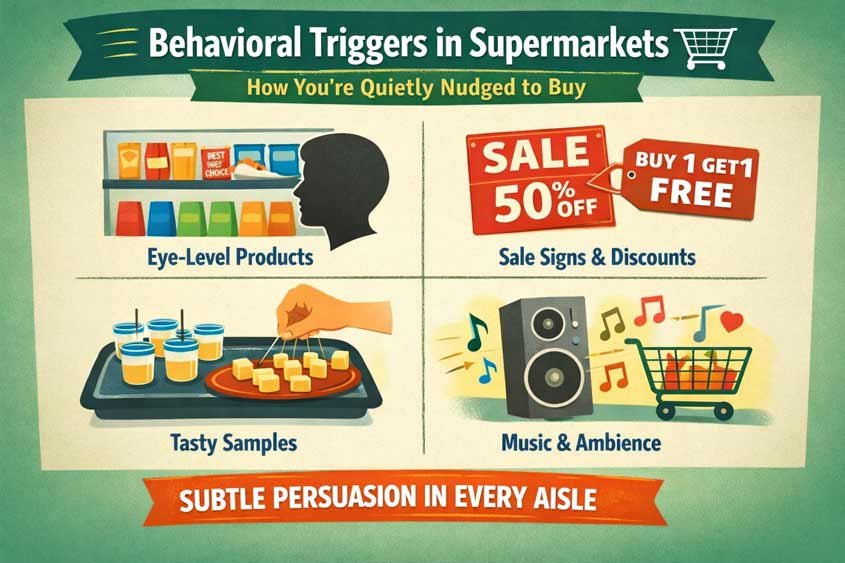
Why You Buy Without Deciding
You walk into a supermarket thinking you’re in control. You have a list. A rough budget. Maybe even a plan to be quick about it. And yet, somehow, you leave with more than you intended. Not random. Not accidental. Predictable.
That’s where behavioral triggers in supermarkets come in.
These are small, deliberate cues designed to influence your decisions without asking for your attention. You don’t notice them because they don’t feel like persuasion. They feel like convenience. Or timing. Or just… what you felt like buying in that moment.
But your brain is doing something very specific behind the scenes.
Supermarkets are built for mental shortcuts. Your brain loves shortcuts. It’s efficient that way. You can’t analyze every product, every price, every choice. So instead, you rely on quick judgments. What looks popular. What feels like a deal. What’s right in front of you when your energy dips.
And supermarkets know exactly when that happens.
Early in your visit, you’re more rational. You compare. You check prices. You stick to your plan. But as you move through the store, something shifts. Decision fatigue creeps in. Each small choice drains a bit of your focus. White bread or whole grain. Brand A or Brand B. 500 grams or 750. It adds up faster than you think.
By the time you reach certain areas of the store, you’re not really deciding anymore. You’re reacting.
That’s when behavioral triggers in supermarkets start working harder.
You’ll see cues that tap into loss aversion. Signals that suggest urgency. Subtle nudges that use social proof. Even product placement that leans on something as simple as eye level bias. None of these tactics force you to buy. They just tilt the odds.
And here’s the part most people underestimate: these triggers don’t work because you’re careless. They work because you’re human.
Your brain is wired to conserve effort. To avoid missing out. To follow what others seem to prefer. These tendencies show up everywhere, not just in supermarkets. Online stores use them. Restaurants use them. Even subscription apps lean heavily on the same patterns.
So when you feel like you “just grabbed a few extra things,” it wasn’t just a moment of weakness. It was a system doing exactly what it was designed to do.
And once you start noticing these behavioral triggers in supermarkets, it’s hard to unsee them.
Table of Contents
Impulse Items at Checkout
You’ve made it through the store. Your cart is full. You checked most items off your list. At this point, you feel done.
But you’re not done. Not yet.
Now you’re standing at the checkout.
This is one of the most carefully engineered moments in the entire supermarket. Not because of what you came to buy, but because of what you didn’t plan to buy.
Look around. Candy bars. Gum. Chocolate. Small snacks. Sometimes batteries. Magazines. Cheap drinks. Everything within arm’s reach. Everything easy to grab without thinking too much about it.
This isn’t random placement. It’s a direct application of behavioral triggers in supermarkets.
By the time you reach checkout, your mental energy is low. You’ve made dozens of small decisions already. Your brain is tired of evaluating. Psychologists call this decision fatigue. You don’t feel it in a dramatic way. It shows up quietly. You stop comparing as much. You stop questioning small purchases. You just… allow things.
That’s exactly the moment these products are waiting for.
Think about it. You’re standing still. There’s nothing else to do. No movement, no distraction, just waiting. Your eyes wander. Your hands are free. And suddenly, grabbing a chocolate bar feels almost automatic.
It’s not hunger, not really. It’s reduced resistance.
Impulse control drops when your brain is fatigued. That’s been observed across different contexts, not just retail. After repeated decisions, people are more likely to choose the easiest, most immediately rewarding option. In a supermarket, that often means sugar, quick snacks, or small indulgences.
And notice the price point.
These items are cheap enough to bypass your internal “Is this worth it?” filter. You’re not analyzing value the same way you would with a larger purchase. A few lei here and there doesn’t feel like a real decision. That’s part of the design.
There’s also an interesting layering of triggers happening here.
First, proximity. Everything is within reach. No effort required. Then, visibility. Bright packaging, familiar brands, eye level placement. Then, immediacy. You can consume these products right away, which taps into instant gratification.
Some stores even combine this with subtle scarcity signals. Limited edition flavors. Seasonal packaging. Things that quietly suggest, “this might not be here next time.”
And if you’re shopping with kids, the effect multiplies. Placement is often deliberately aligned with a child’s eye level. Requests happen. Pressure builds. Your already tired brain looks for the fastest way to resolve the situation.
So you say yes.
What’s interesting is that this same setup shows up outside supermarkets too. Online checkouts with “add this before you go.” Fast food counters displaying desserts right where you order. Even streaming platforms nudging you with one more episode when you’re already mentally drained.
Different context. Same psychology.
Impulse items at checkout are not about tricking you into buying something you don’t want. They’re about catching you at a moment when your ability to say no is slightly weaker than usual.
And that small difference, repeated across thousands of customers every day, turns into a massive amount of extra sales.
Once you recognize how behavioral triggers in supermarkets work at checkout, you start to notice the pattern everywhere.
Loss Aversion Framing
You’re walking down an aisle and see a bright sign: “Save 5 lei.”
It feels like a win. Like you’re making a smart choice.
But pause for a second. What’s actually happening?
The product costs 15 lei. You’re still spending money. Yet your brain focuses on what you’re avoiding losing, not what you’re paying. That shift in perception is one of the most powerful behavioral triggers in supermarkets.
It’s called loss aversion.
People react more strongly to losses than to gains. This isn’t a guess. It shows up consistently in decision making. Losing 5 lei feels worse than gaining 5 lei feels good. So when a supermarket frames a price as something you might lose if you don’t act, your brain pays attention.
“Save 5 lei” hits differently than “Costs 15 lei.” Same math. Different reaction.
Let’s break it down clearly.
Option A
You see a product priced at 15 lei.
Option B
You see the same product labeled “20 lei, now 15 lei, save 5 lei.”
The final price is identical. But Option B creates tension. If you don’t buy now, you’re losing the chance to save. That sense of potential loss nudges you toward action.
You’re no longer just evaluating a purchase. You’re trying to avoid a bad outcome.
Supermarkets use this framing everywhere. Discount tags. Multi buy offers. Loyalty pricing. Even shelf labels that highlight “you save” instead of “you pay.” It’s subtle, but it reshapes how you interpret value.
And it often works even when the “saving” isn’t that meaningful.
For example, a product discounted from 20 lei to 18 lei might not be something you need. But the presence of a “save 2 lei” message still creates a small push. Your brain registers the avoided loss before it fully processes whether the purchase makes sense at all.
That’s the key. Speed.
Behavioral triggers in supermarkets are designed to work faster than your rational evaluation. Loss aversion is especially effective because it taps into something automatic. You don’t sit there analyzing the percentage difference. You react.
There’s also a layering effect with other triggers.
Combine loss aversion with scarcity signals like “limited time offer,” and the pressure increases. Add social proof cues like “popular choice,” and your brain starts stacking justifications. Now it feels less like a decision and more like the obvious move.
Even online shopping uses the same structure. “Only today.” “Last chance to save.” “Deal ends soon.” The environment changes, but the psychology stays consistent.
Here’s something most people don’t notice: loss aversion framing doesn’t just push you to buy. It can push you to buy more.
Bulk offers are a good example. “Buy 2, save 5 lei.” Now the potential loss isn’t just about one item. It’s about missing a bigger saving. So you adjust your behavior to avoid that loss, even if it means spending more overall.
You walk in planning to buy one. You leave with two.
From a strict numbers perspective, you spent more money. But psychologically, it feels like you avoided a loss. That feeling is what drives the decision.
And once you start spotting this pattern, it becomes very obvious. You’ll see how often prices are framed around what you might lose rather than what you’re actually paying.
That’s not an accident. It’s one of the most reliable behavioral triggers in supermarkets, and it quietly shapes how you judge almost every deal you see.
Social Proof Cues
You’re standing in front of a shelf with ten similar products. Same category. Similar prices. No obvious difference.
This is where things slow down.
Your brain doesn’t like this kind of situation. Too many options. Not enough clarity. You could compare ingredients, check unit prices, read labels… but let’s be honest, you probably won’t. Not every time.
So you look for a shortcut.
That’s exactly where social proof steps in as one of the most effective behavioral triggers in supermarkets.
“Best seller.”
“Most popular.”
“Customer favorite.”
These labels seem harmless. Informational, even. But they do something very specific. They reduce uncertainty.
When you see that other people are choosing a product, your brain relaxes a bit. The risk feels lower. If many others picked it, it’s probably good enough. Maybe even the safer choice.
You’re no longer deciding in isolation. You’re following a signal.
This matters more than most people realize.
In situations where the difference between options is unclear, people tend to rely on what others are doing. It’s efficient. You skip the analysis and move forward. Supermarkets know this, so they make those signals visible at the exact moment you need them.
And timing is everything here.
Social proof cues often appear when you’re already slightly fatigued. Mid shop, not at the beginning. You’ve made a few decisions already. Your mental energy is dipping. You’re more open to guidance.
So when a product quietly says “most popular,” it feels like help, not influence.
There’s also a subtle trust transfer happening.
You might not trust the brand completely. You might not trust the pricing. But you tend to trust the collective behavior of other shoppers. It feels neutral. Unbiased. Even though, in reality, that signal is curated.
And here’s where it gets interesting.
These cues don’t need to be precise to work.
“Best seller” doesn’t always mean the absolute top selling product across the entire store. It might mean top in that category, in that location, or during a certain period. Sometimes the criteria are flexible. But your brain doesn’t stop to question that. It just registers popularity.
That’s enough.
Social proof also combines easily with other triggers.
Pair it with loss aversion, and you get something like “Most popular, save 5 lei.” Now you’re not just following the crowd, you’re also avoiding a loss. Add scarcity signals like “limited stock,” and the pressure builds further. Popular, discounted, and running out. That combination is hard to ignore.
You’ll see the same structure outside supermarkets too.
Online stores highlight “top rated” or “trending now.” Restaurants point out “chef’s choice.” Streaming platforms show “most watched.” Different industries, same behavioral pattern.
Because at the core, it solves the same problem: decision uncertainty.
And that’s really what social proof cues are about.
They don’t force you to buy anything. They simply make one option feel easier to choose than the others.
In a store full of choices, that small shift can be enough.
Once you notice how behavioral triggers in supermarkets use social proof, you start catching those little labels everywhere. And you realize they’re not just guiding you. They’re narrowing your path.
Scarcity Signals
You see a shelf that looks slightly empty. A few items left. Gaps where products should be.
Something changes in how you feel about that product.
It suddenly seems more valuable.
That’s scarcity, one of the most instinctive behavioral triggers in supermarkets.
When availability appears limited, your brain shifts from evaluation to urgency. You stop asking, “Do I need this?” and start thinking, “What if I miss this?”
That’s a completely different decision.
Scarcity works because it taps into a basic survival instinct. Limited resources have always meant importance. If something is running out, it must be worth having. That logic still runs in the background, even in a modern supermarket.
And it doesn’t take much to trigger it.
A shelf that’s not fully stocked. A small cluster of remaining items. A sign that says “limited stock” or “while supplies last.” Even subtle cues like slightly disorganized placement can create the impression that others have already taken most of what was there.
Your brain fills in the story.
“People are buying this.”
“It might not be here later.”
“I should decide now.”
That’s the shift supermarkets are aiming for.
Because urgency reduces hesitation.
When you feel like time or availability is limited, you’re less likely to compare alternatives. You’re less likely to walk away and think about it. The decision compresses into the moment. And in that moment, speed usually wins over logic.
What’s interesting is that scarcity doesn’t have to be real to be effective.
Sometimes stock is genuinely low. Other times, the display is designed to look that way. Fewer items placed on a larger shelf. Gaps left intentionally. It creates the same perception, even if there’s more inventory in the back.
Your reaction doesn’t depend on actual supply. It depends on what you see.
Scarcity also amplifies other behavioral triggers in supermarkets.
Pair it with loss aversion, and now you’re not just missing a product, you’re losing the chance to get it at a good price. Combine it with social proof, and it becomes “everyone else is buying this and there’s not much left.” That’s a strong push.
Even anchoring can play a role. If a product was previously fully stocked and now looks depleted, the contrast makes the remaining items feel more desirable. Like something has changed, even if it hasn’t.
You’ll notice similar patterns outside supermarkets.
Online stores show “only 3 left in stock.” Booking platforms highlight “last room available.” Ticketing sites warn you that “20 people are viewing this right now.” Different formats, same underlying mechanism.
Scarcity creates pressure by narrowing your perceived window of opportunity.
And once that window feels small, your behavior adjusts.
You move faster. You question less. You act.
That’s why this tactic is so consistent across retail environments. It doesn’t rely on complex messaging. It relies on perception.
A slightly empty shelf can do more than a detailed product description ever could.
And once you start noticing how behavioral triggers in supermarkets use scarcity, you realize how often that sense of urgency is carefully constructed, not accidental.
You Didn’t Choose as Freely as You Think
At this point, the pattern is hard to ignore.
What felt like a series of small, personal choices starts to look more like a guided path. Not forced. Not obvious. But shaped in quiet, consistent ways.
That’s the real power of behavioral triggers in supermarkets.
They don’t try to override your decisions. They work by adjusting the environment around those decisions. A product placed at the right moment. A price framed to highlight what you might lose. A label that tells you what others are buying. A shelf that makes something feel scarce.
Individually, each of these seems minor. Easy to dismiss. But together, they create momentum.
You move through the store thinking you’re deciding what to buy. In reality, many of those decisions were made easier, faster, and slightly tilted before you even noticed them.
And it’s not about manipulation in some dramatic sense. It’s about probability.
If enough people react to impulse items at checkout, sales increase. If enough shoppers respond to loss aversion framing, discounts become more effective. If social proof reduces hesitation, more products move. If scarcity creates urgency, fewer people walk away.
These are tested patterns. Repeated. Refined. Scaled.
That’s why you see the same behavioral triggers in supermarkets, online stores, apps, and even service businesses. The context changes, but your decision process stays surprisingly consistent.
So what do you do with this?
You don’t need to fight every tactic. That’s unrealistic. You’re not going to analyze every shelf or question every label. But awareness changes how you respond.
You start noticing when a “deal” is framed to trigger loss aversion rather than actual value. You catch yourself reaching for something at checkout and pause, even briefly. You recognize when “most popular” is guiding your choice more than your own preference.
That pause matters.
Because most of these triggers rely on speed. Quick reactions. Low resistance. The moment you slow things down, even slightly, their influence weakens.
And sometimes, that’s enough to shift the outcome.
You still buy what you need. You still enjoy the experience. But you’re a bit more deliberate. A bit harder to nudge without realizing it.
That’s the difference.
Behavioral triggers in supermarkets aren’t going anywhere. If anything, they’ll get more refined. More subtle. More integrated into how stores are designed.
But once you see them, you stop moving through the store on autopilot.
And that alone puts you in a very different position than most shoppers.

Gabriel Comanoiu is a digital marketing expert who has run his own agency since 2016. He learned marketing by testing, analyzing, and refining campaigns across multiple channels. In his book series Impulse Buying Psychology, he shares the psychological triggers behind every purchase, showing how to create marketing that connects, persuades, and converts.