
I pulled into the gas station with one mission: buy fuel, maybe use the restroom, and get back on the road before my patience and my lower back both gave out completely.
That was it.
No shopping. No browsing. No “while I’m here.”
I was a grown man on a practical errand. Forty something years old. Experienced. Focused. Immune, or so I believed, to overpriced nonsense displayed under fluorescent lights.
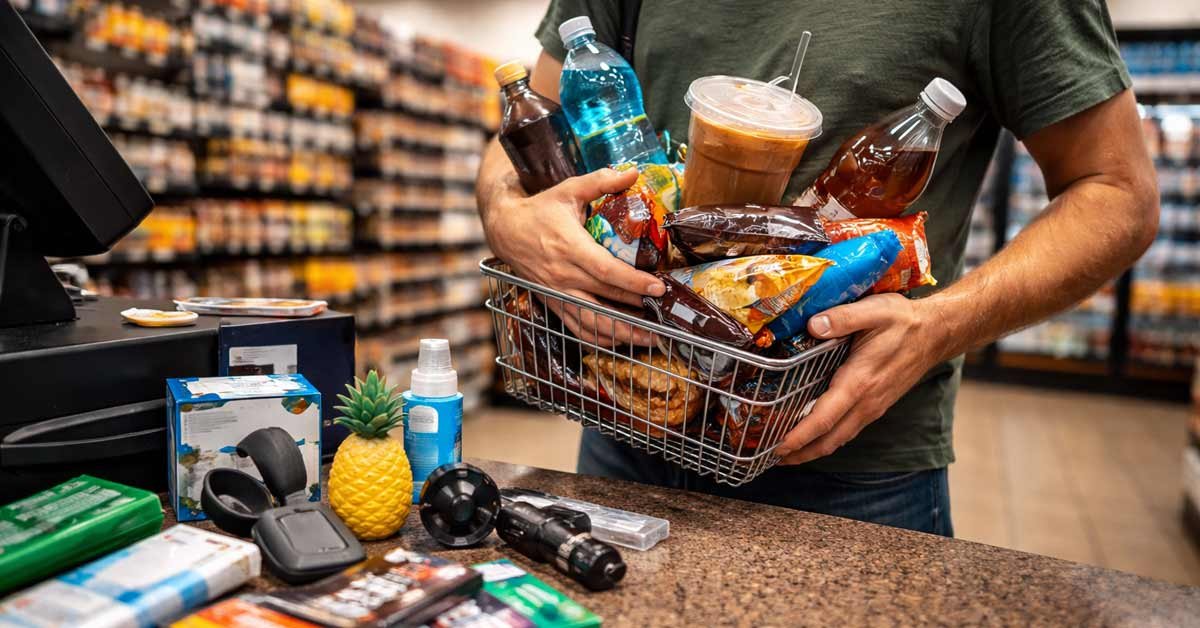
Ten minutes later, I walked out carrying enough random purchases to survive a minor apocalypse, accessorize my car like it had a midlife crisis, and financially contribute to someone’s yacht payment.
It started innocently enough.
The fuel pump clicked, and while the numbers climbed high enough to make me question all my life choices, I noticed the convenience store entrance glowing like a beacon of false hope.
“Use the restroom,” I told myself.
“Maybe grab water.”
Water.
That beautiful lie.
The second I walked inside, my brain stopped functioning like an adult brain and transformed into the decision making skills of a sleep deprived raccoon.
First came the cold drink wall.
Rows of brightly colored bottles practically screamed at me. Giant labels promised energy, hydration, focus, electrolytes, vitamins, and apparently spiritual enlightenment.
I only wanted water.
But plain water suddenly felt depressing.
After all, I’d been driving for hours. I was tired. Slightly annoyed. My brain whispered, “You deserve flavor.”
So instead of one bottle of water, I somehow grabbed:
A giant iced coffee I didn’t need,
A neon sports drink that looked radioactive,
And a bottled tea because it was “2 for something.”
I didn’t even fully understand the deal. I just knew the sign suggested savings, and my primitive brain loves the illusion of victory.
This is convenience premium in its purest form.
You’re trapped in a place where everything costs too much, but leaving feels like surrender.
Then came snacks.
I wasn’t hungry when I entered.
Important detail.
I was not hungry.
But gas stations don’t care about your hunger. They care about your weaknesses.
The smell of hot food hit me first. Something rotating on heated rollers had clearly been engineered by scientists to smell far better than it had any right to.
Suddenly, I needed salty things.
Then sweet things.
Then “something for later.”
Within minutes, I had assembled a collection that suggested I was preparing for a road trip across a continent instead of a 90 minute drive home:
Chips,
Jerky,
Chocolate,
Two pastries,
And a family sized bag of candy I justified by saying, “I can save some.”
I knew that was false while thinking it.
This is micro impulse spending.
Each item seems harmless alone.
Three dollars here.
Five dollars there.
Two for one somewhere else.
Individually, they feel insignificant.
Collectively, they quietly become the GDP of a small village.
Then fatigue really took the wheel.
Near the automotive aisle, I spotted “essential” car accessories.
Now, I had entered this gas station because my car needed fuel.
Apparently, after fifteen minutes inside, I had become convinced my vehicle was an underprepared survival machine.
I bought:
An air freshener shaped like something aggressive,
A phone mount I was fairly sure would break immediately,
A microfiber cloth,
And emergency windshield wipes despite the fact I had survived decades without emergency windshield wipes.
Why?
Because tired brains confuse possibility with necessity.
“Someday this might help,” I thought.
Someday, apparently, was worth $14.99.
But the true psychological ambush was waiting near the register.
The final boss.
That narrow snake line of bizarre products no human intentionally shops for:
Discount sunglasses,
Mystery charging cables,
Novelty keychains,
Travel pillows,
Mini flashlights,
And promotional items so random they felt like rejected game show prizes.
I should have recognized the trap.
Instead, I saw a suspiciously labeled “limited time offer” on a small gadget I absolutely did not need but suddenly believed would improve my daily life.
I still don’t fully know what it does.
I bought it because it was “only” a few extra dollars.
This is small purchase rationalization.
Your brain says:
“You already spent this much. What’s a little more?”
That sentence has probably destroyed more budgets than inflation.
By the time the cashier rang everything up, I stood there in silence like a man watching his own financial dignity leave his body.
Fuel was expensive enough.
But my “quick stop” had evolved into:
Fuel,
Three drinks,
Enough snacks for a youth soccer team,
Car gadgets,
And one deeply questionable promotional item that may or may not also be a bottle opener.
The total looked less like a pit stop and more like a payment plan.
I actually laughed.
Not because it was funny.
Because once your gas station receipt crosses a certain threshold, laughter becomes a defense mechanism.
Driving away, I did what every person does after making ridiculous impulse purchases:
I immediately started justifying everything.
“The coffee will keep me alert.”
“The snacks are practical.”
“The phone mount is safety-related.”
“The candy was on sale.”
“The weird gadget… builds character.”
This is how smart people lose arguments with themselves.
Gas stations understand human psychology better than most therapists.
They know you’re tired.
They know you’re rushed.
They know you’ll pay extra for convenience because leaving to find cheaper options feels exhausting.
They know small purchases bypass your internal alarm system.
They know strategic placement can turn boredom into spending.
And most dangerously, they know your brain is weakest when you think, “I’m just grabbing one thing.”
I arrived needing fuel.
I left with enough unnecessary merchandise to question whether I had accidentally wandered into a traveling carnival gift shop.
Now, whenever I stop for gas, I treat the convenience store like a psychological obstacle course.
Mission:
Pay at the pump.
Do not enter.
Drive away.
Because I’ve learned something important.
The most expensive vacations aren’t always flights or hotels.
Sometimes they’re fluorescently lit pit stops where your wallet slowly leaks money one snack at a time.

Gabriel Comanoiu is a digital marketing expert who has run his own agency since 2016. He learned marketing by testing, analyzing, and refining campaigns across multiple channels. In his book series Impulse Buying Psychology, he shares the psychological triggers behind every purchase, showing how to create marketing that connects, persuades, and converts.