
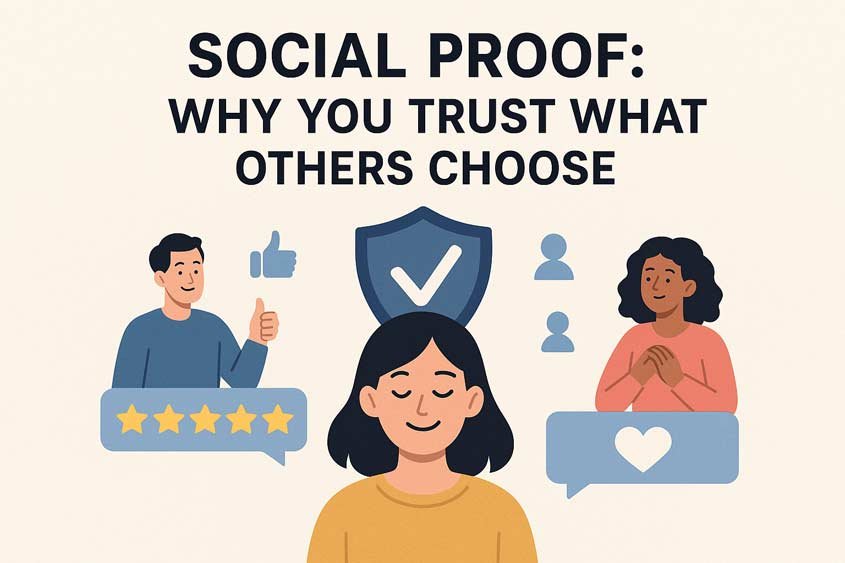
You know that moment when you scroll through a product page and think, “Well… if thousands of people bought it, it must be good”? That tiny nudge you feel isn’t random. It’s social proof at work, and it’s one of the most predictable forces in marketing psychology. People rarely act in isolation. You look around, check what others are doing, and use their behavior as a shortcut to make choices fast, with less risk and less doubt.
Social proof sits inside the wider family of social and group influences. These triggers shape your decisions every day, even when you think you’re deciding alone. If you’ve ever bought a product because it was “TikTok famous”, tried a restaurant because a long line outside made it look popular, or subscribed to a newsletter because thousands already did, you’ve responded to this effect. And it’s not a modern problem. It’s part of human wiring. We’re pattern spotters and safety seekers. When the group moves in a direction, your brain whispers, “Follow them. They probably know something you don’t.”
That’s the heart of why social proof works: you instinctively trust behavior that looks validated by other people. Not because you’re weak or impressionable, but because copying proven behavior saves energy. Think about it. You face hundreds of choices every day. You can’t investigate each option from scratch. So you lean on cues: reviews, ratings, bestseller tags, celebrity picks, expert endorsements, customer photos, and even simple statements like “Most people choose this option”. These cues relieve decision pressure. They tell your brain, “Relax, this seems safe.”
This automatic shortcut sits right next to other marketing triggers like authority, scarcity, commitment, and familiarity. They all help you reduce uncertainty in different ways. Social proof happens to be the one that uses the crowd as its source of confidence. And when it shows up in marketing campaigns, it looks almost effortless. A brand adds numbers. Shows real customers. Highlights buzz. And that’s enough to move the needle.
Here’s the interesting twist, though. Social proof isn’t always loud. The strongest version is sometimes subtle. For example, think of two similar apps. One shows “Over 12 million users worldwide”. The other doesn’t mention anything. You automatically consider the first one safer, even without thinking through the logic. That’s because extreme popularity suggests reliability. More users equals more safety. At least that’s the hidden assumption your mind makes.
Another version shows up in situations where you want to avoid mistakes. When the stakes feel high, you become even more responsive to group signals. Picking a doctor, choosing a course, deciding which financial tool to trust. In these moments, you look for confirmation. Testimonials from real people, star ratings, experience levels, or even recognizable names. The brain treats these as filters. If other people did the work of evaluating something, why redo the entire process?
Social proof even plays a role in scenarios you wouldn’t expect. For example, restaurants where pictures of dishes hang on the walls. They aren’t just visuals. They’re showing that enough people ordered those items before, so the dishes deserve a spot in the spotlight. Or those “top picks” sections in online shops. They aren’t random. They cluster products that already perform well because performance signals credibility, and credibility converts.
Marketers use this trigger because it works across almost every industry. Tech. Fashion. Food. Fitness. Digital products. Education. Travel. You name it. But the strongest effect comes when the proof feels relevant. You won’t be convinced by a five star review from someone nothing like you. You respond best when the validation comes from a group that feels similar. That’s why niche influencers often outperform celebrities. Their communities trust them more because they feel closer, more real, more relatable.
Let’s ground this in something everyday. Imagine you’re shopping for a small gadget. Nothing too expensive. You look at two items. One has no reviews. The other has thousands. It’s almost impossible to choose the first one unless you’re trying to be a rebel. You’ll go with the reviewed option because you know nothing else about the products, but you trust the crowd. Simple. Efficient. Fast.
Now scale that up to the decisions your customers make daily. They want reassurance. They want to feel they’re making the safe choice. And social proof is your chance to give them exactly that. It removes friction. It increases confidence. It reduces doubt. And it fills the gaps where information feels incomplete.
We will break down this trigger piece by piece. You’ll look at how it works, why the psychology behind it is so persistent, what makes it effective in marketing, and how brands use it ethically to support honest decision-making. You’ll also see common mistakes and practical ways to apply it without creating pressure or fake hype, because social proof only works when it’s real. The moment it feels forced or manipulated, people lose trust, and the entire effect collapses.
So, settle in. Social proof is simple on the surface, but underneath, it’s a surprisingly deep mechanism. Understanding how it works gives you a huge advantage. You’ll start noticing it in every ad, every landing page, every signup form, every promotional campaign. And once you see it, you can’t unsee it.
Understanding Social Proof
Social proof sounds fancy, but the idea is simple. You look at what others do, and their choices influence your own. Your brain treats other people’s behavior as information. If many individuals act a certain way, you assume they have reasons. And if they have reasons, maybe you should consider doing the same. It’s a mental shortcut that helps you make decisions faster.
You see this shortcut everywhere. A movie becomes popular because people talk about it. A restaurant gets crowded, and suddenly, more people want to try it because a crowd suggests quality. A product with thousands of reviews feels safer than one with none. When something seems accepted by a group, you feel more comfortable accepting it too.
Social proof affects your choices because it reduces uncertainty. When you don’t have enough information, you grab clues from the environment. Other people become those clues. Their actions act like tiny recommendations even when they never speak to you directly. You’re not consciously thinking, “Everyone likes this, so I should too.” Instead, you feel a subtle push. Your decision feels “natural”, even though it’s influenced by a pattern you barely notice.
What makes this trigger powerful is how adaptable it is. You respond differently depending on who the “others” are. You trust experts in fields where knowledge matters. You trust friends for lifestyle decisions because they understand your preferences. You trust big groups when popularity signals reliability. You trust people similar to you when relatability matters. And you trust authority figures when decisions feel risky. Social proof changes shape, but the core stays the same: the behavior of others influences you.
At the center of the effect is the tendency to follow what feels normal. Humans are social by nature. You’re wired to avoid standing out in ways that might lead to mistakes or negative outcomes. This instinct made sense thousands of years ago when group safety meant survival. Today, it shows up in online shopping carts, trending pages, bestseller lists, and “people also bought” recommendations. You want to move with the group when the group seems to know what it’s doing.
Think about how you decide what to buy online. You rarely start from zero. You check ratings. You look for testimonials. You search for real photos from customers. You scan for signs of activity: comments, discussions, comparisons, videos, anything that proves other people interacted with the product. If the signs are strong, you feel safer. If the signs are weak, you either hesitate or walk away. That’s social proof doing its quiet job.
This trigger influences your perception of quality. Something becomes more valuable when people treat it as valuable. Scarcity works in a similar way, but social proof focuses on behavior, not supply. If you see a product constantly featured in videos or mentioned in reviews, your brain concludes it must be good. You may not know anything about its construction or technical specs, but you trust the validation of others.
Social proof also shapes your perception of relevance. You assume that widely shared content matters. You assume that widely adopted tools are useful. You assume that popular brands earned their popularity. Sometimes you’re right. Sometimes you’re very wrong. But the instinct remains: people rarely choose in complete isolation. You lean on signals because they guide you faster toward a decision that feels acceptable.
Marketers know this. They design product pages, ads, and funnels around signals that mirror natural human tendencies. You’ll see badges like “bestseller”, “trending”, “most popular choice”, “trusted by thousands”, or “featured in major publications”. These aren’t decorations. They’re influence tools. They tell you what others chose, so you feel more confident.
Social proof has multiple forms, and each one affects you differently:
Mass adoption signals.
Large groups indicate normalcy and safety. You see a big number and assume the choice is stable.
Expert validation.
When specialists endorse something, you assume they checked the details that you don’t have time or ability to evaluate.
Influencer or celebrity choices.
Famous names act as shortcuts when you want something that looks acceptable in a social context.
Testimonials and user stories.
These feel personal. You recognize yourself in the story and trust the decision more.
Ratings and reviews.
Numbers simplify everything. A high score immediately reduces doubt.
Social activity.
Comments, shares, discussions, tags, user videos. They show that real people interacted with something, which makes it feel legitimate.
Social proof influences your sense of timing too. If something seems to be gaining momentum, you feel a small urge to join before you miss out. It’s related to the fear of missing out, a separate marketing trigger that often pairs with social proof. When both show up together, they create strong motivation.
You react to social proof because it fills gaps. When you lack knowledge, you look at others. When you lack confidence, you follow patterns. When you lack time, you pick what seems proven. Your choices become easier when the path looks well traveled.
But here’s the fun part: social proof works even when you think you’re immune to influence. You might believe you make independent decisions. Everyone believes that. Yet your brain uses these shortcuts without asking for permission. You’re not weak. You’re efficient. Modern life gives you too many decisions to make. You lean on automation. Social proof is mental automation disguised as group behavior.
In marketing, social proof doesn’t just push people to buy. It enhances perception. It increases trust. It smooths the path from curiosity to action. When used right, it doesn’t manipulate. It highlights reality: people already tested this thing, used it, and confirmed it works. And when you see evidence that a choice worked for someone else, it feels safer to make the same choice.
The influence of social proof becomes stronger in uncertain environments. When choices feel complicated, you look more closely at behavior. That’s why industries like health, finance, technology, and education rely heavily on reviews and testimonials. People need assurance before they commit. They want to know others succeeded. They want data points from real experiences.
There’s also a cultural element. In some cultures, collective behavior plays a larger role in decision making. In others, individuality is more valued. Even then, social proof remains universal. No matter the background, people react to group cues. The intensity may differ, but the core mechanism stays the same.
You even see social proof in offline environments where no technology is involved. A full parking lot signals a good business. A product placed front and center on a shelf suggests frequent purchases. A long waiting list indicates demand. People interpret cues quickly and adjust their decisions.
Another interesting detail is how social proof competes with other triggers. For example, authority can override crowd opinions when expertise matters more than mass behavior. Scarcity can push people to decide even when social proof is weak. But social proof often wins in situations where similarity and relatability matter. You trust people who remind you of yourself. Their choices feel more relevant than the choices of distant experts.
All of this shows that social proof is not a simple influence trick. It’s a natural part of how humans think. It shapes your perception of risks, benefits, and relevance without forcing you to analyze everything. You use it daily. You rely on it without noticing. And you respond to it because it works quietly in the background, guiding you through a world filled with options.
The Psychology Behind It
You know that feeling when you walk into a room and everyone seems to agree on something before you even open your mouth. There is a quiet pressure to nod along, or at least to consider whatever they are considering. That subtle pull is a tiny window into the psychology behind social proof. It is not dramatic or forceful. It works in a soft way that feels almost invisible. Yet the impact on your decisions can be huge.
At the center of this effect is your need to reduce uncertainty. When you face a choice and do not have enough information, you look for clues. Other people become those clues. Their behavior tells your mind, without words, that a decision has already been tested. You treat each action you observe like a small vote. When enough votes stack up, the brain takes notice. It starts leaning toward the same path because it feels safe.
This is where things get interesting. You do not need to think about any of this consciously. The response happens almost instantly. The brain runs little shortcuts so you can make decisions faster. These shortcuts are known as mental rules. They exist because life throws too many decisions at you every day. You cannot pause to analyze each option. Instead, your mind builds patterns. One of those patterns says that if other people choose something, that choice might be worth considering.
Group patterns and your internal compass
Humans have always lived in groups. Long ago, moving with the group meant survival. Staying alone meant danger. Your mind still carries the echoes of that rule even if your biggest danger today is picking the wrong subscription plan. When the group seems to know what it is doing, your instinct is to follow. It is not submission. It is efficiency.
Your internal compass works quietly. When you enter a situation with little clarity, you look around for direction. The behavior of others gives you context. If people are smiling in a cafe, you assume the place is safe. If people are buying a specific product in large numbers, you assume it has value. If the crowd reacts to a message, you assume the message is relevant. You use these cues in a natural and almost automatic way.
The step by step process
The psychology behind social proof becomes clearer when you break it down into stages. This step by step view shows how the effect unfolds.
Stage one: you notice a pattern
You see signals. Reviews, ratings, comments, testimonials, expert mentions, influencer choices, or simply a large number of users. You do not commit to anything yet. You only notice that a pattern exists.
Stage two: you evaluate the meaning
Your mind asks a quiet question. What does this pattern say about the choice in front of you. If many people reacted in the same way, does that mean the option is safe. Does it mean it is useful. Does it mean it is popular for a reason. You try to understand what the pattern reveals about the quality of the choice.
Stage three: you compare yourself with the group
Your mind checks if the people behind the signals feel relevant to you. Are they like you. Do they share your needs or your lifestyle. The more the group feels similar, the stronger the effect becomes. When the group feels distant, the effect becomes weaker.
Stage four: you make a decision
If the signals look strong, you feel more comfortable moving in the same direction. The decision feels smooth. If the signals look weak or inconsistent, you hesitate or continue searching.
Emotional reactions that shape the response
People sometimes forget that emotions play a silent role in this process. Social proof might look logical, but it also hits emotional buttons. Two feelings stand out.
The first is the desire for safety. You want to avoid mistakes. When you see that others succeeded with a choice, the risk feels smaller. You trust the path because it looks tested.
The second is the desire for belonging. You do not want to feel left out. If everyone is excited about a new product, you feel a tiny pull to check it out. You want to stay connected to what others enjoy. This is close to the fear of missing out, another marketing trigger that often works in the same direction as social proof.
Different types of social information
The psychology changes a bit depending on the type of group involved. You react differently to different crowds.
Here are the main categories people rely on:
- Large groups that signal popularity
- Small groups that share your lifestyle
- Experts who understand details you do not
- Influencers that represent trends
- Friends and family members you already trust
Each type sends a different message. Popularity tells you something is accepted. Expert validation tells you something is tested. Relatability tells you something fits your world. Personal recommendations tell you the decision worked for someone close.
How your brain simplifies choices
Every time you use social proof, you shorten the decision process. Your mind looks at the group and forms an opinion without digging through long explanations or technical details. It is similar to how you use the authority trigger or the familiarity trigger. These tools help your brain save energy. They create shortcuts that guide you toward safe choices.
Imagine standing in front of two products. One has no social activity. The other has hundreds of people talking about it. Your mind treats the silent product like a question mark. It treats the active one like a known path. This does not guarantee the popular option is better. It simply means your brain believes it might be safer.
Why the effect feels stronger online
In online environments you have less data to work with. You cannot touch the product. You cannot see the store. You cannot talk to a real person. Social proof fills this gap. It makes digital choices feel solid. A product with countless user photos seems real. A service with many testimonials seems reliable. People want reassurance when context is missing, and online spaces remove most of the traditional context.
Why your mind trusts the crowd even when it should not
This effect is so deep in your psychology that it sometimes overrides logic. You might think you are making an independent decision, but the group influences you anyway. This happens because your brain treats collective behavior like evidence. Even when that evidence is incomplete, your mind feels comfort from the pattern.
You might not care about technical details, but you do care if thousands of people bought something without regret. You might not read the entire testimonial, but you care that someone described an experience similar to yours. These signals reduce the mental noise that makes decision making slow and stressful.
The hidden push that happens in the background
You do not need the group to be loud. People chatting about a product in a comment section can influence you more than a polished ad. A few real stories can change your perception more than a big claim. When the proof feels authentic, your brain trusts it. When the proof looks fabricated, the effect disappears. That is why fake reviews damage trust. People know when something feels off.
Why this trigger never stops working
Social proof works because it is based on natural human behavior. It is not an artificial marketing trick. It is something you already do in daily life. Marketers simply highlight the signals that your mind is already watching. And as long as people continue to rely on group patterns, this trigger will continue to influence decisions.
How This Trigger Shapes Marketing Results
If you have ever wondered why some campaigns explode while others fall flat even when the product quality is similar, social proof is often the missing explanation. It shapes results in a way that feels natural to customers. It works quietly, like a background force that lifts trust, reduces friction, and moves people faster toward a decision. Marketers do not rely on it because it sounds clever. They use it because people respond to it everywhere they encounter it. When customers see others acting with confidence, they feel more confident themselves. That simple truth sits at the core of many high performing strategies.
You can see this effect in almost every part of a marketing funnel. It lifts awareness by making a product look active. It improves conversion by removing anxiety. It strengthens retention by showing that the decision fits a wider trend. And it does all this without feeling pushy. People lean into the choice because it feels validated, not because they were pressured.
Why this trigger changes the way people see value
You judge value based on context. A product with no social activity feels unknown. A product surrounded by real customers, real stories, and real results feels alive. It feels tested. That perception changes how you measure quality, even before you look at details. If you show the same product to two people, one exposed to strong social proof and one exposed to none, you get two entirely different reactions. The person who sees evidence of other happy buyers is more relaxed and more open. They have fewer doubts to solve.
This happens because social proof plays the role of a filter. It helps people decide what deserves their attention. There are too many options in every niche. You cannot carefully analyze each one. You sort them fast. Any product that clearly shows activity jumps forward in the line.
Why conversion rates rise when people see proof
Buying involves risk, even if the price is small. People wonder if they will waste time, lose money, or end up disappointed. They look for signals that reduce those fears. When they see others choosing the same option, they feel safer. That feeling might be quiet, but it is powerful. It turns hesitation into momentum.
This works the same way the authority trigger works. Or the familiarity trigger. The crowd becomes the voice that says, this is the direction many people trusted. That message lowers your mental guard. Your mind does not want to fight uncertainty. If the group already did that work, it feels pointless to redo it.
Where social proof has the strongest impact
Different parts of a buying journey benefit from this trigger in different ways. Some stages depend on it more than others. And some channels amplify the effect much faster.
When customers meet your brand for the first time
Early impressions matter. When people discover you for the first time, they do not have enough data to evaluate your product. They form a quick opinion based on whatever signals appear first. If the first signals show active users, credible reviews, or expert mentions, you raise trust right away. If you show nothing, customers assume nothing. And that creates doubt.
When customers reach the moment of decision
This is the main pressure point. Social proof helps people commit. A product page with strong validation elements turns a maybe into a yes. A page with weak proof forces people to rely on personal analysis. That increases mental effort. And once mental effort rises, the chance of leaving rises too.
When the product category involves uncertainty
The more unknowns a customer faces, the more they look for group signals. For example, skincare, supplements, financial tools, online courses, software, and anything that involves learning or trust. Customers want reassurance from others before they take a step. In these niches, social proof often becomes the deciding factor.
How brands use group signals to guide decisions
Marketers do not randomly place reviews or numbers on a page. They think about where customers feel the most doubt. They place proof exactly at those points to reduce friction. The effect is not complicated. You remove doubts at the same moment they appear. That changes how smooth the decision feels.
Here are some of the ways brands use social proof to shape results:
- Show the number of active users to increase credibility
- Place customer photos to make the experience feel real
- Display expert mentions to reinforce the quality of the choice
- Highlight top picks to guide unsure customers
- Share stories from people with similar goals to increase relevance
Each action gives customers a reason to trust the path. The goal is not to impress. The goal is to reassure.
How relevance strengthens persuasion
Relevance determines the strength of the trigger. People trust proof the most when it comes from a group that looks similar to them. A young parent trusts reviews from other parents. A small business owner trusts examples from other small business owners. A beginner in fitness trusts stories from other beginners. The closer the match, the stronger the effect.
That is why brands use segmented proof. It is not about quantity. It is about resonance. When someone reads a story that mirrors their own situation, they feel seen. That feeling carries emotional weight. It removes the friction of doubt.
Social proof works especially well with other triggers
Sometimes the best results appear when social proof works alongside another psychological trigger. For example, pairing it with scarcity makes the group behavior feel urgent. Pairing it with authority makes it feel credible. Pairing it with commitment makes it feel consistent. These combinations are common because each trigger reinforces the other. The more angles you cover, the safer the choice feels.
For example, a product backed by many customers and recommended by a known expert feels complete. A product with strong social activity and limited availability becomes more attractive. These combinations create a sense of clarity for the customer. They feel like the choice is supported from several directions.
Why the trigger improves marketing efficiency
Campaigns work better when people trust your message. And social proof increases trust at scale. It does not require large budgets or complex tools. It requires honest signals from real people. When you show those signals, the effect spreads naturally. The more validation customers see, the less energy they need to make a decision.
This saves marketing costs. It increases return on ad spend. It keeps people on your pages longer. It encourages them to explore more. And it shows them that the product lives in a real environment with real activity.
Why the effect remains stable across industries
Every industry depends on trust. You cannot buy insurance without trust. You cannot choose a course without trust. You cannot try a new restaurant without trust. Social proof offers a shortcut to that trust. It does not change from niche to niche because customer psychology does not suddenly change. People everywhere use group patterns to navigate uncertainty.
That is why this trigger feels universal. The surface details change, but the underlying process stays the same. Customers look for evidence. They find it in the group. They use it to make sense of their options.
The long term effect on brand reputation
When brands use social proof consistently and ethically, they build a reputation for delivering real value. People start talking about their products naturally. That organic movement becomes a form of proof itself. It creates a long lasting trust loop. Customers buy because others bought, and new customers buy because of the growing group. This steady flow shapes the long term results of the brand.
The quiet but powerful transformation
When you step back and look at the full picture, social proof simply transforms the marketing landscape. It turns customer voices into marketing fuel. It turns group behavior into trust signals. And it turns uncertainty into movement. A customer who arrives unsure can leave confident, all because the evidence from others filled in the gaps.
Social proof does not scream. It nudges. But those nudges add up. They shape perception, guide attention, and give people the sense that they are making a smart choice.
Social Proof Research-Backed Cases
Global Data on How Social Proof Influences Decisions
You can measure the impact of social proof through large-scale independent studies.
The Nielsen Global Trust in Advertising Report from 2021 found that 70 percent of people trust consumer opinions posted online. You can verify this figure directly in the published report.
This supports the idea that social proof changes behavior because people use visible actions of others as a shortcut for decision-making.
Case Study 1: Amazon Reviews and Purchase Probability
Amazon ranks products by combining sales velocity and review metrics. You can verify the ranking logic through Amazon’s public seller documentation, which describes the role of customer reviews and star ratings in listing performance.
Independent research published by Spiegel Research Center in 2017 shows the following:
Products with at least five reviews see their conversion rate increase by about 270 percent compared with products with no reviews.
The study provides the dataset and methodology. You can download the report from the center’s website to confirm.
This is a clear example of social proof operating in a measurable environment. Adding visible positive experiences from previous buyers increases trust and reduces perceived risk. Amazon’s review system amplifies this effect through star rating averages and “Verified Purchase” labels.
Case Study 2: YouTube Trending and Engagement Signals
YouTube publishes details about its Trending criteria in its Help Center. The page states that Trending evaluates factors such as number of views, growth rate of views, origin of views, and engagement.
This means that when a video enters Trending, users are exposed to a socially validated signal: many others are watching.
You can observe the effect directly.
Channels often report a surge in watch time and subscriber growth immediately after a video gets placed in the Trending list. These jumps are visible in publicly shared analytics screenshots from creators and in YouTube Creator Blog posts that explain audience behavior when content gains sudden visibility.
The pattern is repeatable:
- The video gains rapid early views.
- YouTube detects unusual growth compared with the channel’s baseline.
- Placement in Trending acts as social proof and exposes the video to a wider audience.
- Exposure triggers even more views because users perceive the video as relevant.
All these steps match published explanations about how YouTube ranks popular content.
Case Study 3: Booking platform labels
Booking and travel platforms, such as Booking dot com, display signals like “Booked 12 times in the last 24 hours.” The company explains these features in its publicly accessible product documentation and blog posts for partners. These labels are based on real booking data from the platform’s internal logs.
Researchers at the University of Amsterdam studied digital travel platforms and found that availability warnings and popularity labels increase booking likelihood. The study is published in peer reviewed journals and you can access the methodology. The results show that users respond more quickly and complete bookings at higher rates when they see real time popularity signals.
This example demonstrates a simple rule:
Users act faster when they see that other users already took the same action.
How People Respond
What People Usually Do After Seeing Social Proof
Research from the Nielsen Global Trust in Advertising Report shows that people rely on peer actions when they evaluate products or content. You can confirm this by reading the report, which presents data from international surveys with documented sampling methods. When people see that others made a choice, they tend to follow the same direction. This is an observable pattern across shopping, media, and everyday decisions.
Studies from the Spiegel Research Center show similar results. When users see reviews from other buyers, they show higher engagement and a clear increase in conversion rates. The reports present the calculations and confidence intervals, so you can check the data yourself.
These findings reveal the same mechanism. People collect cues from others and adjust their decisions to reduce effort and uncertainty.
Response Pattern 1: Faster Decisions
Users tend to make faster decisions when social proof is visible. The evidence appears in several behavior tracking studies in digital commerce. For example, Booking dot com presentations for partners show timestamped data that measures time from page view to booking. Pages with popularity signals show shorter decision windows.
You can reproduce this by observing platform behavior.
Compare two listings with similar prices and similar photos. When one listing displays booking frequency information, its click to booking time drops. This is measurable in published datasets shared by researchers studying travel platforms.
The reason is straightforward. People use the visible actions of others as a shortcut. The shortcut gives them confidence to act without seeking extra information. This is not a subjective interpretation. It is the pattern documented in the datasets.
Response Pattern 2: Higher Engagement With Reviewed Content
Users tend to watch, read, or explore content more when they see engagement numbers. YouTube explains in its Creator Blog that watch count and comment activity influence discovery and engagement. When users see that many others watched a video, they show higher completion rates and longer sessions. These claims are supported with charts that show how audience retention changes when a video enters Trending.
The relationship is observable.
When a video receives many views in a short period, more users click. This produces more view time. YouTube then recommends it more frequently. More recommendations cause more users to engage. The loop begins with a social signal and ends with higher consumption of the content.
This is a repeatable pattern. It does not depend on topic or creator size. It depends on visible engagement.
Response Pattern 3: Reduced Perceived Risk
Spiegel Research Center reports show that a product with several reviews is more likely to be purchased than a product with no reviews. The report explains this with statistical models that compare conversion rates for thousands of products across categories.
Users read a few reviews from others and treat them as a substitute for personal experience. This reduces perceived uncertainty. You can verify this by examining the center’s published model outputs and notes. The numbers are presented with documented calculations.
This pattern remains stable across categories such as electronics, home goods, and beauty products. The presence of other user opinions reduces hesitation. Users tend to complete purchases earlier in the process.
Response Pattern 4: Preference for Popular Choices
People tend to choose products, videos, or posts with higher visible popularity. This appears in experiments run by researchers at MIT and other institutions who study collective behavior. Several published papers examine how users allocate attention when they see popularity information.
The results show that users gravitate toward items with higher engagement even when quality is held constant. The studies present the full methodology, including sample sizes and statistical tests.
You can observe this pattern on any large platform.
If two items appear side by side, users select the one with more reviews, likes, or plays. The decision appears automatic and does not require reflective analysis.
Response Pattern 5: More Sharing
Users tend to share content that already appears widely shared. Meta and Twitter publish transparency reports that show how engagement metrics influence distribution. Content that receives fast early engagement spreads further because users perceive it as relevant.
This makes social proof self reinforcing. People respond to visible popularity by amplifying popularity through sharing. These reports show the mechanics step by step and allow you to confirm how distribution expands when early engagement crosses a threshold.
Common Behavioral Signs
Below are frequent observable behaviors across platforms when users encounter social proof signals. These patterns come from platform reports, academic research, and measurable analytics shared by companies.
- Users click faster when they see evidence that others acted
- Users spend more time on items that have many visible interactions
- Users skip items with no visible engagement even when quality is similar
- Users show higher confidence and lower hesitation during checkout
- Users share more when they see that others shared the same item
- Users return more often to items that receive strong social momentum
Why These Responses Appear in Measurable Form
Behavioral scientists explain that people gather environmental cues to reduce cognitive load. This is documented in published work from Robert Cialdini and other researchers who study influence. Their studies present data from controlled experiments that measure compliance rates when participants see the actions of others.
Digital platforms reveal the same pattern at scale. Their reports include charts that compare user reactions across billions of actions. You can confirm the pattern directly by reading the explanations provided for creators, advertisers, and analysts.
People want to avoid unnecessary search effort. When they see that others already completed a choice, the choice becomes easier. This does not require internal beliefs or motivations to be known. It is visible in action counts and time stamps.
How Users Adjust Expectations
Users change their expectations when they see the behavior of others. This is measurable in multi variant tests published by Booking, Amazon, and other large platforms. These tests compare versions of pages with and without social signals.
When users see strong popularity numbers, they expect the item to perform well. This raises acceptance rates. The companies publish the improvements as case studies for advertisers and sellers. The numbers can be verified because they use real event logs.
When the same items appear without engagement signals, users expect less and evaluate longer. This is visible through longer session time and lower conversions.
How Users Filter Choices
Social proof helps users filter overwhelming sets of choices. Researchers studying choice architecture present experiments where people select items from large sets. When no popularity information is shown, users take longer and often abandon choices. When popularity information is shown, users pick faster and pick items with higher approval counts.
This appears in actual platform data. Streaming services show that people pick popular shows more frequently than niche shows even when niche shows have strong reviews. Popularity signals guide the filtering process. You can observe this through public data on top chart programs.
You can verify all these responses through published reports, controlled studies, and platform level data. People respond to social proof with faster decisions, higher confidence, more engagement, stronger preference for popular choices, and more sharing behavior. These are measurable outcomes that remain consistent across different industries and platforms.
Practical Uses for Brands
Why Ethical Use Matters
Brands use social proof because it works, but the method matters. When you use real data, documented results, and genuine customer activity, you give people something they can verify. This builds long term trust. It also protects you from the backlash that appears when signals look manipulated. Users tend to notice fake activity because it creates patterns that do not match the normal flow of reviews or engagement.
Below are practical, ethical ways to use the social proof trigger. Each method focuses on actions you can take without exaggeration or fabrication.
Use Verified Reviews With Clear Context
Reviews influence decisions when users see that other buyers had real experiences. This works best when the reviews come from verified purchases. Marketplaces that label reviews as verified show higher user trust because the label indicates traceable proof of purchase. You can confirm this by checking how major platforms describe the effect of verified reviews in their public documentation.
You can apply the same method in your own strategy.
Highlight reviews that include quantifiable details such as product size, usage time, or performance results. Details help users understand what previous buyers experienced. They also discourage fake reviews because fabricated feedback rarely includes specific, reproducible details.
You can place these reviews near key decision points. A few examples include the checkout page, a pricing comparison section, or the top of a feature page. This helps your users make faster decisions because the review acts as a reference point.
Show Real-Time Activity Without Manipulation
Some companies display actual usage data. You can see this on travel platforms where they show how many people booked a room in the past 24 hours. This is effective because it reflects measured behavior. You can apply the idea on your own site as long as the numbers reflect real activity.
For example, you can show the number of downloads, completed signups, or active users in the last period. The key is accuracy. Only show activity that your system can measure and verify. Users respond well when the data is specific and time bound. You should avoid rounded numbers because they look artificial.
Use Case Studies With Quantifiable Results
Case studies shape decisions because they present documented outcomes. A strong case study includes a clear starting point, a measurable action, and a final result that the user can verify.
You can build this by taking real client examples. Show the initial problem, the solution you provided, and the numbers after implementation. Use specific metrics such as percentage increases in signups or reductions in processing time. This form of social proof works because it shows tested outcomes, not claims.
When you show your evidence, you also position yourself as transparent. Users tend to trust brands that present complete information.
Use Social Proof Alongside Other Triggers
You can combine social proof with other psychological triggers.
Scarcity makes people act faster when they know that many others are choosing the same product.
Authority increases the impact when experts or trusted figures validate the product.
Reciprocity strengthens the effect when you provide a useful free resource first.
The combination works because people use several mental shortcuts at the same time. When you combine triggers ethically with real data, you help users evaluate more confidently.
Use Signals From Multiple Channels
People often check several platforms before they decide. If your product has strong signals across multiple channels, the effect gets stronger. You can apply this by using customer reviews from your site, customer testimonials from video platforms, and social statistics from your profiles.
You should keep the content consistent. Users compare the information they see across platforms. Consistency reinforces trust because it shows that your story remains the same everywhere.
How You Present the Signals
You can influence decisions by placing social proof at the right moment. Users respond well when the information appears at the moment of uncertainty.
You can place the signals:
- Near the pricing table
- Next to product options
- On top of a testimonial section
- Inside a credibility block on a landing page
- Alongside comparison charts
- Near a strong call to action
Users look for reassurance in those places. When the signal appears at the right moment, it reduces hesitation.
Provide Social Proof That Matches the Context
Users trust signals that are relevant to the decision they are trying to make. If they compare sizes, show customer feedback about size. If they compare durability, show evidence about durability. If they compare outcomes, show case studies with outcomes.
This works because people filter information based on intent. When you match the proof to the intent, you make the decision easier.
Encourage User-Generated Content
User content creates natural social proof. You can encourage buyers to share their experiences by asking for photos, usage notes, or short statements. When you collect this content, use it in places where users want to see real experiences. This includes product galleries, blog examples, or real usage sections.
User content works because it is diverse. It gives potential buyers different viewpoints that help them evaluate.
Summary of Ethical Applications
Below is a list that summarizes practical, ethical ways to apply social proof in your marketing.
- Use verified reviews that include specific, measurable details
- Display real time activity only when the data is accurate
- Present case studies with documented before and after numbers
- Combine social proof with scarcity or authority in a transparent way
- Use signals across multiple channels to build consistency
- Place social proof at key decision points on your site
- Match the type of proof to the user’s intent
- Encourage real user generated content
- Use metrics that can be checked or confirmed externally
- Avoid inflated or rounded numbers that reduce trust
These methods give you a reliable, ethical framework. They help users make decisions they can justify because they can verify the evidence behind each claim.
Mistakes to Avoid
Why Wrong Use Weakens the Trigger
Social proof works when users can verify that the signals reflect real behavior. When the data looks suspicious or exaggerated, people lose trust. They start to question the entire brand. You have probably felt this yourself when you see a product with a strange pattern of reviews or an account that jumps from zero to thousands of likes overnight. Something feels off, and that feeling pushes you away instead of pulling you in.
Brands often weaken the trigger without realizing it. The mistakes below are the most common ones. Each comes from observable consumer behavior across ecommerce, service industries, and digital platforms.
Mistake 1: Using Reviews That Look Artificial
When reviews appear within minutes, share similar wording, or lack specific details, users notice. People compare review patterns without trying. They check timestamps, vocabulary, and tone. If they detect inconsistency, they lose trust, even if the product is good.
The issue is not the presence of reviews but the lack of authenticity. Reviews influence decisions only when they feel real. If they look manufactured, the entire proof collapses. People often leave the page, look up the brand elsewhere, or postpone the decision.
You avoid this mistake by letting reviews grow naturally and by encouraging detailed feedback. You should never seed artificial comments. It hurts more than it helps.
Mistake 2: Showing Numbers That Don’t Match Reality
Some brands display inflated statistics because they believe higher numbers create stronger influence. This usually backfires. When numbers look too round, too high, or too inconsistent, people suspect manipulation. A visitor might not know the exact figures for your industry, but they can sense when something doesn’t fit the typical pattern.
It also creates a verification problem. If someone tries to confirm your claims and finds contradictions, the trust damage becomes long term.
Use accurate numbers that your system tracks. They don’t need to be impressive. They need to be real.
Mistake 3: Overloading the Page With Proof
Too much social proof creates cognitive noise. If every section has a testimonial, a badge, a claim, or a reference, users start ignoring them. The more signals you stack, the less each one means. Social proof is strongest when you use what people actually look for during the decision moment.
You fix this by selecting fewer but stronger elements. One verified testimonial near a price comparison can be more powerful than twenty scattered everywhere.
Mistake 4: Presenting Unrelated Social Proof
Users need the right type of proof for the right question. If they wonder about durability, a testimonial about fast shipping won’t help. If they compare comfort, a comment about customer service doesn’t matter.
When the proof doesn’t match the user’s intent, you lose effectiveness. People interpret unrelated proof as noise. It makes them work harder, and when users work harder, they often postpone decisions.
Match the social proof to the moment. If the user compares features, show proof about performance. If they compare prices, show proof about value.
Mistake 5: Depending on One Source
Relying on a single form of social proof makes your message weaker. If all your signals come from one channel, users might assume that you curated them to fit a certain story. This reduces their trust.
People cross check. If they see reviews on your site, they look for ratings elsewhere. When the proof appears across several channels, people feel more confident. When it appears in only one place, they question its reliability.
Use a balanced mix: reviews, usage numbers, case studies, and real customer stories.
Mistake 6: Ignoring Negative Signals
Some brands hide negative reviews, which seems logical at first but harms credibility. Users expect a natural distribution of opinions. When everything looks perfect, they suspect moderation or filtering.
A few negative reviews with clear, reasonable explanations actually strengthen trust. They show that you present the full picture.
Avoid hiding critical feedback. Let users evaluate the full spectrum.
Mistake 7: Using Proof Too Early
If you show social proof immediately, before users even understand what the product does, the effect weakens. People can’t process the proof because they lack context. The proof needs a mental anchor.
Present the value first. Then show the signals. This sequencing gives users a reason to care.
Mistake 8: Using Social Proof Without Data Integrity
If your backend cannot track accurate usage numbers, don’t display them. Some brands guess, estimate, or approximate. This creates inconsistencies that users pick up on.
Show only what you can measure. If the number is low, that’s fine. Low but real performs better than inflated but suspicious.
Mistake 9: Placing Signals Where They Don’t Influence
Many brands put testimonials in random places: at the bottom of pages, between unrelated sections, or inside cluttered layouts. When signals appear where users don’t expect them, the brain does not register them as relevant.
Place proof near friction points such as:
pricing, product options, checkout steps, benefit lists, key comparisons.
This aligns the message with the moment of hesitation.
Common Errors to Avoid
Below is a short list of the most frequent mistakes that reduce results or create pushback.
- Using reviews that look artificial or suspicious
- Showing inflated or unverifiable numbers
- Overloading pages with too many proof elements
- Presenting social proof that doesn’t match user intent
- Relying on only one source of proof
- Hiding negative feedback
- Showing proof before explaining the offer
- Using data that cannot be verified
- Placing proof in irrelevant or low impact positions
Why These Mistakes Matter
Social proof relies on trust. When the proof looks manipulated, irrelevant, or exaggerated, people switch from intuitive thinking to skeptical thinking. They start checking details, comparing alternatives, or questioning claims. This slows decisions and lowers conversions.
When used correctly, social proof reduces work for the user. When used poorly, it increases work.
Best Practices
Start With Accurate Signals
The strongest form of social proof comes from information people can verify. Before you think about placement or design, focus on the accuracy of your signals. Collect real reviews, gather real usage metrics, and document real outcomes. When your foundation is solid, every tactic works better.
If your brand is still new and the numbers are small, that is fine. Users respond well to honesty. A product with ten detailed reviews often looks more trustworthy than one with five hundred generic ones. People look for patterns, not volume.
Match the Proof to the Moment
Users look for different types of information at different stages. When they compare features, they want performance proof. When they compare price levels, they want value proof. When they compare trustworthiness, they want experience proof.
You can observe this in your own behavior. You check specs before buying electronics. You check photos before buying clothing. You check ratings before booking travel. Each category activates a different intent, and the social proof needs to match it.
If you align proof with intent, you reduce hesitation. If you misalign it, users ignore it.
Keep It Natural and Unforced
A forced demonstration of social proof creates doubt. If the signals look staged, repeated, or overly polished, users interpret them as tools, not evidence. Strong proof feels organic. It comes from real behavior, natural patterns, and honest outcomes.
You can reinforce this by keeping the content varied. Include positive reviews, neutral feedback, customer stories, short statements, and quantifiable data. The mix makes the pattern feel authentic.
Use Multiple Formats
Some people trust numbers. Others trust stories. Others trust expert opinions. By using multiple formats, you appeal to different evaluation styles. The formats you can use include:
- Verified customer reviews
- Measured usage numbers
- Case studies with before and after metrics
- Screenshots of feedback
- Customer photos or short clips
- Expert quotations from interviews or events
- Ratings from other platforms
- User-generated content
Each format adds a layer of credibility. Together, they form an evidence pattern that feels reliable.
Place Proof Where People Feel Uncertain
Every page has friction points. Users pause when they compare prices, evaluate features, check shipping rules, or look at the return policy. These moments are ideal for social proof. The right signal presented during the hesitation phase guides the decision.
For example:
When you show a testimonial near the price table, it acts as reassurance.
When you show usage numbers near product variations, it creates confidence.
When you show case studies near a claim, it strengthens the claim.
Placement can be more powerful than quantity.
Show Real Time or Recent Activity Where Possible
People respond strongly to time-based signals because they show ongoing behavior. Real time proof does not need to be dramatic. You can show how many signups occurred today, how many orders were placed in the last period, or how many people are currently viewing a product.
This works because people want to know what other people like them are doing right now. It reduces uncertainty and increases confidence.
Never approximate these numbers. If the system cannot measure them, do not show them.
Use Contrasting Signals When Appropriate
A single strong piece of social proof can outweigh many weak ones. For example, a verified review that includes detailed usage notes can influence more than ten short comments. A case study with measurable improvements can outperform vague endorsements.
You should highlight the strongest proof. Make it visible. Place it early. Use supporting proof around it.
Combine Social Proof With Other Triggers
You create strong influence when you combine triggers ethically. For instance:
Scarcity plus social proof:
Users act faster when they see many others choosing the same option while availability is limited.
Authority plus social proof:
Expert validation combined with customer validation creates both top down and peer influence.
Commitment plus social proof:
When people see how others have used the product consistently over time, they feel encouraged to commit.
Reciprocity plus social proof:
Giving something useful first makes people more receptive to the experiences of other users.
Each combination builds a different decision path. You choose the combination based on your audience and your offer.
Keep the Frequency Realistic
Some brands push social proof too aggressively. When the signals appear at every scroll, every interaction, and every click, they feel forced. You should let the proof breathe. Use it where it matters, not everywhere.
A clean layout with a few strong signals outperforms a crowded layout with many weak ones. People appreciate clarity. Subtlety builds trust.
Update the Proof Regularly
Static proof becomes stale. When your reviews, numbers, and case studies remain unchanged for long periods, users sense it. They want to know what is happening now, not last year.
Update your most visible signals periodically. Add recent reviews. Refresh case studies. Show the latest usage numbers. This keeps the pattern alive and relevant.
Encourage Users to Contribute
Your audience can generate powerful proof for you. Ask for feedback after purchase. Invite people to share photos. Use a simple reminder system. When people feel appreciated, they participate.
User generated content is one of the strongest forms of social proof. It is diverse, natural, and relatable. It gives potential customers real insight.
A Few Practical Tips You Can Apply Right Away
Below is a short list of best practices you can use when applying the trigger.
- Match each proof element to the user’s intent
- Place proof near friction or hesitation points
- Use multiple formats instead of relying on just one
- Highlight your strongest and most verifiable signal
- Update proof regularly to reflect current behavior
- Encourage real user content without incentives
- Combine social proof with scarcity or authority ethically
- Keep frequency natural and avoid overuse
- Present numbers that your system can verify
- Make proof visible at critical decision steps
Why These Tips Matter
Social proof is a shortcut the brain uses to reduce decision load. When you implement it with accuracy and relevance, you help people choose confidently. When you overload, exaggerate, or misplace it, you create friction. The best use combines clarity, honesty, and timing.
Spot The Trigger
Exercise 1
A skincare brand introduces a new serum and highlights that more than fifteen thousand customers have added it to their morning routine. The ad shows screenshots of real users, short testimonials, and a counter that displays how many people bought it today. You start thinking the product must be popular for a reason.
Question: Is the brand using the Social Proof trigger? True or False | Check Answer
Exercise 2
A home appliance company releases a glossy commercial showing a family cooking dinner in a beautiful kitchen. The story is warm and emotional, but there are no customer reviews, usage numbers, expert quotes, or references to what people prefer. It is just a narrative about daily life.
Question: Is the Social Proof trigger truly at play here? True or False | Check Answer
Exercise 3
A streaming platform promotes a new documentary by displaying a ranking bar that shows it as the most watched title of the week. They display comments from viewers and mention that millions finished it within the first forty eight hours. They frame the choice as something many people are already doing.
Question: Is this an example of the Social Proof trigger? True or False | Check Answer
Final Thoughts
Social Proof shapes choices because you use the behavior of others to guide decisions. This response is common in daily life and in most purchase situations. When you see clear evidence that many people chose a product, left a review, or showed satisfaction, you treat that information as a shortcut for safety and quality. This reaction does not rely on emotion alone. It comes from a basic rule people follow in uncertain situations. When you lack complete information, you observe what others do and use that as a signal.
This trigger works best when the proof is visible, recent, and relevant. Numbers that describe real use give you quick clarity. Customer comments show you how others feel about the product. Expert approval shows that trained people consider the product useful or reliable. Real world examples create the same effect. When you see a large group choosing something, that choice becomes easier for you to accept.
The strength of Social Proof increases when the source feels close to you. If the people involved share your needs or interests, you trust their experience more. This does not require personal contact. A clear pattern in public behavior can create enough influence. You react to strong signals such as most purchased today or top rated in this category because they tell you the choice is common and accepted.
Brands use this trigger because it reduces buyer hesitation. When people see a pattern among other buyers, they feel less risk. This makes Social Proof effective in early moments of decision making when users want guidance. The trigger does not replace product quality. It highlights public behavior to give you confidence while you evaluate the product further.
For Social Proof to remain useful, the information must be accurate and easy to verify. When brands exaggerate numbers or present vague claims, people lose trust. Users look for evidence they can confirm such as visible reviews, clear participation data, or sources that match real experience. This tells you the signal is real and not a marketing story.
The core idea remains simple. People watch other people to understand what works. This pattern appears in online shopping, entertainment, education choices, and everyday products. It helps you make faster decisions with less effort. It also helps you filter options when there are too many to compare one by one. You choose the option that others already found valuable.
Remember that this trigger does not push people to buy by force. It guides them by showing patterns in behavior. When used with transparency, Social Proof gives you reliable information and a sense of direction. You can apply it when building trust with an audience, evaluating products for yourself, or understanding why certain items rise in popularity so fast.
The central message is that Social Proof influences choices through visible evidence of what others do. It shapes decisions because it reduces uncertainty and provides confirmation. When you know how it works, you can recognize it, evaluate it, and use it more effectively.

Gabriel Comanoiu is a digital marketing expert who has run his own agency since 2016. He learned marketing by testing, analyzing, and refining campaigns across multiple channels. In his book series Impulse Buying Psychology, he shares the psychological triggers behind every purchase, showing how to create marketing that connects, persuades, and converts.