
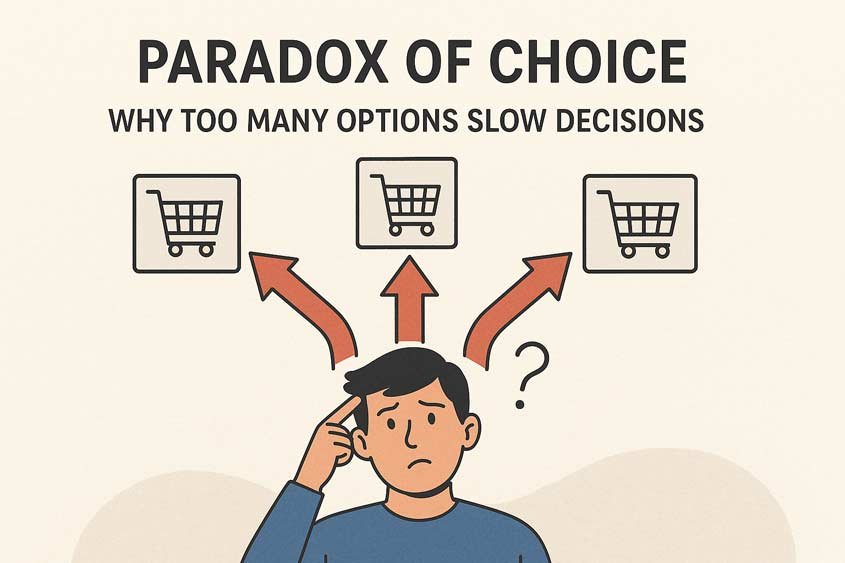
Ever walked into a store, spotted an entire wall of similar products, and felt your brain freeze for a second? That moment right there captures the Paradox of Choice in action. You want to choose, you’re ready to choose, but suddenly every option feels like an exam question you didn’t study for. It’s annoying, a little funny, and weirdly universal. And if you’re in marketing, understanding this moment is pure gold, because it quietly shapes what people buy, when they buy, and even whether they buy at all.
Let’s break it down. The Paradox of Choice is what happens when a person faces more options than their mind can comfortably handle. Instead of feeling empowered, they slow down or stop. Their confidence shrinks. Their uncertainty spikes. They start second-guessing. They analyze to death. And eventually, many of them bounce. Sometimes you give people freedom and accidentally hand them a headache instead. It’s a problem you’ve probably experienced in grocery aisles, subscription pages, online shops, and endless scrolling menus where everything feels equally right and equally wrong.
Table of Contents
Marketers tend to assume that more choice equals more satisfaction, or at least more conversions. But that’s not how human psychology behaves. Your brain is wired for speed. It loves shortcuts. It loves clarity. It loves when decisions feel effortless. In fact, most buying triggers rely on that ease: Cognitive Ease, Anchoring, Authority cues, Priming, Social Proof, the Contrast Effect. When people don’t have to think hard, they move fast. When they have to think too much, everything slows down or derails. The Paradox of Choice is the enemy of flow. It turns simple decisions into friction.
This trigger became famous for its emotional pinch. You see it when customers compare small details that don’t matter. You see it when they worry about making the wrong decision, losing money, picking something inferior, or missing a better deal. Too many options magnify fear of failure. And most people hate feeling responsible for a “bad choice,” so they lean toward postponing. That’s the danger zone for brands: hesitation kills momentum. Once hesitation takes over, abandoning the decision often feels like the safest option.
Think about everyday scenarios. You want a new streaming plan. There are nine tiers. You read each one. You scroll back. You compare features. You consider if you’ll really use 4K resolution at 2 AM. You pause, because maybe there’s a better plan hidden somewhere you missed. The fun of choosing becomes work. You’re not excited anymore. You’re mentally tired. And now the decision feels weirdly serious, even though it’s just entertainment. Multiply this across industries and you start to see why marketers obsess over simplifying choices.
But here’s the twist: the Paradox of Choice doesn’t say options are bad. People love choice. They don’t love too much choice. They need a balance, and that balance depends on context. They want differences that matter, not endless variations that confuse them. They want to feel like they’re choosing, but they also want guidance. That’s why brands that master this trigger stand out. They curate instead of overwhelm. They frame instead of scatter. They help customers make decisions without feeling lost or pressured.
It’s the same reason you’ll see successful companies apply “good, better, best” pricing instead of twelve-tier charts. Or why subscription companies simplify bundles. Or why restaurants trim menus. Or why phone manufacturers highlight curated product lines instead of drowning you in models. Every one of those choices reduces friction. It helps people see what’s best for them without getting paralyzed.
What’s interesting is how this trigger interacts with others. Anchoring becomes more powerful when choices are limited. Priming works better when the brain isn’t juggling four dozen options. Even something like the Decoy Effect relies on having just the right number of choices, not dozens. So when you understand the Paradox of Choice, you start to see how it acts as the backbone for many other psychological triggers in marketing. It’s not a standalone concept; it’s a foundation.
For the modern customer, attention is expensive. Mental energy is expensive. Nobody wants to waste it. So every extra option demands a little more cognitive processing, and every bit of processing pushes customers toward fatigue. People don’t say “I’m overwhelmed by choice” out loud. They just feel it. They hesitate, delay, or bounce quietly. Brands who don’t account for this lose invisible sales every single day.
The whole point of understanding this trigger isn’t to remove choice entirely; it’s to sculpt it. It’s about making options feel manageable, meaningful, and light. Because when your customers feel like choosing is easy, you win. And when they feel like choosing is complicated, they drift away.
When finishing reading, you’ll know how the Paradox of Choice works, what it does to your customers, why it matters in marketing, how brands use it ethically, and how you can apply it without overwhelming your audience. You’ll see real examples, practical uses, mistakes to avoid, and a set of clear ways to apply it in your own marketing strategy. If you’ve ever wondered why some landing pages convert and others flop, this trigger might be the missing piece.
Understanding Paradox of Choice
The Paradox of Choice is a simple idea with a surprisingly big impact: when you give people too many options, they struggle to choose. You’d think more variety would make people happier because they can get exactly what they want. In reality, their decision slows down. Their confidence drops. They feel mental pressure they never asked for. And that tiny moment of friction changes the entire buying experience.
At its core, the Paradox of Choice explains how your brain reacts when the available options exceed your ability to mentally process them. Your mind wants decisions that feel fast and manageable. It wants quick clarity. It wants information that’s easy to sort through, not a buffet of almost identical possibilities. When the number of choices gets too big, your brain shifts into defensive mode. It starts questioning itself. It starts overthinking. It fixates on avoiding the wrong choice instead of finding the right one.
This is where the marketing angle comes in. Choices influence emotion. Emotion influences action. When something feels complicated, your brain pumps the brakes. When it feels simple, you move. The Paradox of Choice sits right in that emotional sweet spot. It’s the force that decides whether someone breezes through a checkout page or abandons their cart halfway. It’s the trigger that shapes how confident a person feels while browsing product lines, reading menus, or comparing subscription tiers.
Let’s get even clearer. The Paradox of Choice affects three major things:
First, it influences decision speed. More options create more mental steps. More mental steps create more hesitation. Even if your customer doesn’t consciously notice it, their brain is dragging itself through the comparison process.
Second, it influences emotional comfort. People want to feel good about their decisions, not stressed or worried. Too many options create anxiety, because each alternative feels like a potential mistake. That fear of choosing wrong makes the whole experience feel heavier.
Third, it influences perceived value. When you see too many options, you struggle to tell what’s good, what’s bad, or what’s worth the price. Clear value signals get lost in the noise. Without clarity, the safest decision becomes delaying the decision or not choosing at all.
Marketers sometimes overlook how quickly these effects show up. Think about how many ecommerce stores automatically assume a big catalog equals a strong brand. Or restaurants that expand their menu because they think more dishes means more happy customers. Or apps that add more paid tiers because they want to “serve everyone.” The intentions are good. The outcome is often the opposite. Complexity feels expensive, not exciting.
Now, if you zoom out, you’ll see this trigger operating across different areas of life. It shows up in social settings, work tasks, entertainment, dating, and even weekend plans. But in marketing, the impact is uniquely direct because your customer is already in a decision-making environment. They’re actively evaluating, comparing, filtering, calculating. Their mental energy is on the line. Every extra choice pulls a little more of that energy away.
A useful way to understand the Paradox of Choice is to look at what the brain prefers. Your mind likes clear categories instead of endless variation. It likes meaningful differences instead of minor ones. It likes progress instead of loops. When you walk into a store and see three types of a product, you feel in control. You can scan. You can process. You can have an opinion. When you see thirty versions, you slow down. You don’t want to miss the best one. The process shifts from choosing to analyzing. That’s where the trouble starts.
This is also why other psychological triggers like Anchoring, the Decoy Effect, and Priming work so well when there are limited options. Your brain can latch onto the important cues faster. It’s not juggling five pages of features. It’s not drowning in comparisons. Simplicity doesn’t just reduce overwhelm; it strengthens every other trigger that supports decision-making.
Here’s another important piece: the Paradox of Choice doesn’t just change behavior. It changes how satisfied someone feels after they’ve chosen. Oddly enough, the more options people have, the less certain they feel afterward. They wonder if they could have chosen better. They replay the decision. They revisit the list mentally. This reduces long-term satisfaction, which is something brands rarely consider. A confused customer might buy once. A confident customer buys again.
You can see how this influences expectations in every modern buying experience. People want curated recommendations. They want default selections that make sense. They want clear best sellers. They want fewer steps and fewer decisions. Even when you think you’re doing them a favor by giving them more power, what you’re actually giving them is more work. And work kills conversions.
Now, none of this means choice is bad. Choice is essential. It gives people autonomy. It gives them personalization. It gives them flexibility. The problem starts when the number of options crosses the brain’s comfortable limit. That limit changes depending on the context, the product, and the emotional state of the buyer. But in every case, the effect is the same: once complexity creeps in, hesitation follows.
Marketers who understand the Paradox of Choice don’t remove freedom. They remove excess. They guide the decision without controlling it. They highlight distinctions instead of piling on more options. They build product ecosystems that feel clear instead of messy. They shape the environment so customers can move smoothly instead of getting stuck.
You experience this whenever a brand offers a simple “good, better, best” ladder. Or when a store highlights its two most popular variations. Or when a website uses filters that matter instead of flooding you with irrelevant ones. Or when a brand uses visual cues to point you toward the recommended choice. These design decisions aren’t random. They exist because the Paradox of Choice is real, predictable, and powerful.
When a customer gets overwhelmed, they feel frustration first, then doubt, then fatigue. That emotional sequence is what marketers try to avoid. Because once fatigue sets in, the brain wants relief. Relief usually comes from abandoning the decision altogether. That’s the moment you lose the sale.
So the Paradox of Choice is more than a theory. It’s a trigger that influences confidence, emotion, clarity, and action. It determines whether people follow through or freeze. It shapes how much mental energy buyers are willing to spend. And for any brand that wants to increase conversions, reduce friction, and create an easy, satisfying buying experience, understanding this trigger is essential.
The Psychology Behind It
When you encounter an endless array of options, something curious happens in your brain. The “Paradox of Choice” doesn’t just exist as a clever phrase; it’s a real psychological effect that explains why more choices can lead to worse decisions—or even decision paralysis. Marketers and psychologists have studied this phenomenon extensively, showing how an abundance of options affects cognition, emotion, and behavior. Let’s break down the process and understand why this trigger works so powerfully in marketing.
Cognitive Overload: Too Many Choices, Too Much Thinking
Your brain has limits on how many options it can process efficiently. When faced with a moderate number of choices, decision-making flows relatively smoothly. Add more options, however, and the cognitive load increases exponentially. Each additional choice demands mental energy: weighing pros and cons, predicting outcomes, and evaluating personal preferences. At some point, your brain hits a bottleneck.
This is where indecision kicks in. Instead of confidently picking the best option, you stall. Sometimes, you avoid choosing entirely, or you make a less satisfying choice just to escape the overwhelming scenario.
Fear of Regret: The Invisible Cost
Another key element is anticipated regret. When more options are available, you subconsciously consider all the ways your choice could be “wrong.” Each new option raises the stakes: you worry you might miss a better deal, choose the wrong product, or waste money.
This fear of regret can make even simple purchases—like picking a toothpaste brand—feel unnecessarily stressful. Marketers leverage this by subtly framing a “best” or “most popular” choice, easing the consumer’s fear of regret and nudging them toward a decision.
Decision Fatigue: The Exhaustion Factor
Repeated exposure to choice doesn’t just slow decisions; it drains mental energy. Decision fatigue sets in when your brain is repeatedly forced to make trade-offs. You may notice it in daily life: after hours of shopping, you feel drained and more likely to make impulsive purchases—or none at all.
Marketing strategies often exploit this by limiting choices in the final stages of a buyer’s journey, like offering a single, clear CTA (call to action) on a checkout page. This reduces cognitive load and helps consumers act before fatigue undermines their decision-making.
Step-by-Step Process of the Paradox of Choice
To visualize the mechanics of this trigger, let’s walk through a typical consumer scenario:
- Exposure: You see a shelf of similar products or an online menu with dozens of options.
- Evaluation: You start comparing features, prices, reviews, and aesthetics. Each choice requires mental energy.
- Overload: Your brain struggles to process all the data; confidence in your ability to pick “the best” diminishes.
- Anticipated Regret: Thoughts of what you might lose or miss start creeping in, amplifying hesitation.
- Decision Fatigue: If the choice isn’t urgent, you delay. If a decision is required, you might opt for the easiest or most familiar option instead of the optimal one.
- Behavioral Outcome: You either leave without buying, make a default choice, or rely on a recommendation or highlight presented by the marketer.
Why Marketers Pay Attention
Understanding this mechanism is crucial for marketers because it directly influences purchase behavior. By strategically reducing options, highlighting one clear choice, or providing guidance, brands can steer consumers toward decisions with confidence.
Examples of Tactics Based on the Psychology Behind It
- Curated Options: Presenting 3–5 carefully chosen products rather than the entire catalog.
- Highlighting a Default: Labeling one option as “best value” or “customer favorite.”
- Segmented Choices: Organizing options into categories to make evaluation easier.
- Decision Support Tools: Providing filters, comparison charts, or guided quizzes to reduce cognitive load.
The Emotional Connection
Beyond cognitive mechanics, the Paradox of Choice affects emotion. Overwhelmed consumers experience anxiety, doubt, and even regret after making a decision. Brands that manage the choice environment can create positive emotions by simplifying the path to purchase. This connects closely with other psychological triggers, such as Social Proof (showing what others choose), Scarcity (limited options can feel less overwhelming), and Anchoring (framing one option as the reference point).
By understanding how the Paradox of Choice operates at both cognitive and emotional levels, you can see why marketers carefully curate, highlight, and simplify options. It’s not manipulation; it’s about designing a choice architecture that aligns with human psychology, reduces stress, and nudges consumers toward decisions they feel good about.
This insight is the foundation for many high-conversion strategies in e-commerce, retail, and service industries. When you recognize how this trigger works, you can anticipate consumer behavior and design experiences that guide action without overwhelming the audience.
Why It Matters in Marketing
The Paradox of Choice isn’t just an interesting concept for psychologists—it’s a powerful tool for marketers who want to influence consumer behavior. When you understand that too many options can overwhelm, confuse, and even paralyze your audience, you can structure your offerings to guide decisions and improve conversion. The practical value lies in creating a choice environment that feels manageable, intuitive, and satisfying for the customer.
Shaping Decisions Through Choice Architecture
Choice architecture refers to the way options are presented to consumers. The Paradox of Choice shows that not all options are created equal in their effect on decision-making. When marketers strategically limit, categorize, or highlight choices, they reduce cognitive load and make the buying process smoother.
Consider an online store that sells 50 types of coffee. If a customer is faced with the entire catalog, they might feel overwhelmed and leave without purchasing. By instead presenting three curated options—say, “Beginner Blend,” “Classic Roast,” and “Premium Dark”—the customer can process the choices quickly and feel confident making a decision.
This approach demonstrates that marketing isn’t only about promoting products—it’s about shaping the decision environment to align with human psychology.
Influence on Purchase Behavior
The Paradox of Choice influences not just whether a consumer buys, but what they buy and how they feel afterward. Research shows that too many choices can:
- Increase indecision, leading to delayed purchases or abandoned shopping carts.
- Heighten anxiety, making consumers second-guess their selection.
- Lower satisfaction post-purchase, as people imagine all the other options they might have chosen.
Marketers use this knowledge to reduce friction in the buying journey. By controlling how many options are presented or highlighting a recommended choice, brands can guide purchases and improve satisfaction.
Practical Marketing Tactics
Understanding the Paradox of Choice allows marketers to implement actionable strategies across industries. Here are some of the most effective approaches:
- Curated Selections: Limiting the number of options displayed to a manageable set of top products.
- Highlighting Recommended Choices: Using labels like “Best Seller” or “Top Pick” to guide decisions.
- Segmenting Options: Organizing choices into categories, filters, or tiers to reduce mental load.
- Simplified Pricing Tiers: Offering a clear entry-level, mid-range, and premium option to reduce confusion.
- Guided Quizzes and Recommendation Tools: Helping consumers identify the best option without having to analyze all possibilities themselves.
These tactics ensure that your audience feels in control while avoiding the overwhelm that can come with too many options.
Examples Across Industries
- E-Commerce: Websites often display a limited number of recommended products on the homepage. Amazon, for instance, uses personalized “Top Picks for You” to reduce choice overload.
- Food & Beverage: Fast-casual restaurants often offer a small menu of signature items, even if they technically have hundreds of potential combinations.
- Subscription Services: Services like meal kits or streaming platforms limit the number of featured choices each day, making it easier for users to act quickly.
- Travel: Airlines and booking platforms often use filters and highlight “Best Value” options to reduce decision fatigue.
Emotional and Psychological Benefits
Beyond facilitating action, managing choice also impacts the customer’s emotional state. When consumers aren’t overwhelmed, they feel more confident, less stressed, and more satisfied with their decisions. This emotional benefit creates trust and encourages repeat engagement. In marketing terms, it strengthens brand loyalty and reduces the likelihood of returns or cancellations.
Connection With Other Triggers
The Paradox of Choice works in tandem with other psychological triggers:
- Anchoring: Highlighting one option sets a mental reference for comparison.
- Social Proof: Showing what others choose reduces perceived risk and supports decision-making.
- Scarcity: Limiting the number of available options can create urgency while reducing cognitive overload.
By combining these triggers, marketers can guide decisions subtly but effectively, creating a frictionless path from consideration to purchase.
Marketers who understand this principle aren’t just selling products—they’re designing experiences that feel simple, satisfying, and psychologically sound. Recognizing the practical value of the Paradox of Choice helps you predict behavior, reduce consumer frustration, and increase conversions in a way that feels natural, not manipulative.
Paradox of Choice Real World Applications
The Paradox of Choice isn’t just a theoretical concept—it’s been observed and applied across multiple industries. Understanding how it manifests in real campaigns helps marketers see the trigger in action and adopt strategies that reduce overwhelm while guiding decisions. Let’s explore several verifiable examples that show exactly how this principle operates in practice.
Case Study 1: Jam Tasting Experiment
One of the most cited studies illustrating the Paradox of Choice comes from behavioral research conducted by Sheena Iyengar and Mark Lepper in 2000. In a supermarket setting, two different setups were tested:
- Setup A: 24 types of gourmet jam were displayed for tasting.
- Setup B: 6 types of gourmet jam were displayed.
The results were striking: while the larger display attracted more initial interest, shoppers were ten times more likely to make a purchase when only six options were available.
Marketing Insight: This experiment demonstrates that more choices can reduce conversion. Marketers in retail, e-commerce, and even digital content can take away a clear lesson: fewer curated options often lead to higher engagement and sales.
Case Study 2: Subscription Plans
Subscription services like Netflix, Spotify, and meal delivery platforms often struggle with choice overload. Presenting users with too many options can lead to decision paralysis and cancellation of the process. To counter this, platforms implement strategies such as:
- Limiting the number of subscription tiers (e.g., Basic, Standard, Premium).
- Highlighting the “most popular” or “best value” tier.
- Using personalized recommendations based on prior behavior.
For example, Netflix’s interface prioritizes trending titles and personalized suggestions instead of showing its entire catalog upfront. This reduces cognitive overload and increases the likelihood that users will start watching a show immediately rather than feeling overwhelmed by the full library.
Marketing Insight: By structuring options clearly and guiding consumers toward a choice, businesses reduce friction and increase satisfaction. Highlighting one “best” option also subtly applies the Anchoring trigger, reinforcing the Paradox of Choice effect.
Case Study 3: Retail Product Bundles
Apple is another excellent example of leveraging the Paradox of Choice. While the company offers multiple models of iPhones, MacBooks, and other devices, it strategically limits options within each product line. Consider the iPhone:
- Apple typically offers 3–4 models per generation.
- Each model comes with a limited set of colors and storage options.
- Marketing highlights the most balanced choice in terms of features and price.
This approach avoids overwhelming customers while subtly nudging them toward the mid-tier option, which tends to maximize both customer satisfaction and revenue.
Marketing Insight: Curating a manageable set of options and emphasizing one as the “ideal choice” simplifies decision-making while maintaining a sense of personal choice. The strategy also leverages Social Proof, as Apple highlights the popularity of specific models.
Common Patterns Across Industries
Across these cases, certain patterns emerge in how the Paradox of Choice is applied effectively:
- Curated Options: Fewer, well-selected options lead to higher engagement.
- Highlighted Choices: Clearly signaling a preferred or popular option reduces decision fatigue.
- Segmentation: Organizing options into logical groups or tiers simplifies evaluation.
- Behavioral Guidance: Recommendations, ratings, or personalized suggestions help consumers act confidently.
By studying these examples, marketers can replicate strategies that respect human cognitive limits while still providing a sense of autonomy and variety.
These case studies demonstrate that the Paradox of Choice is a tangible, measurable phenomenon. When marketers control the choice environment, they guide behavior, reduce cognitive overload, and improve both satisfaction and conversion. From supermarket jams to tech products and subscription services, the principle consistently shows that less can be more—both for the consumer’s experience and the company’s bottom line.
How Consumers React
When consumers face too many options, their reactions are often predictable and observable. The Paradox of Choice doesn’t just affect internal thought processes—it shapes behaviors in ways marketers can see and measure. Understanding these responses is essential for designing effective campaigns, product lines, and shopping experiences.
Decision Paralysis: When Too Many Options Freeze Action
One of the most common behaviors triggered by excessive choice is decision paralysis. Faced with too many options, consumers often delay action or avoid making a decision altogether. This can manifest in several ways:
- Leaving an e-commerce site without completing a purchase.
- Abandoning a shopping cart when overwhelmed by available products.
- Deferring a decision, such as postponing a subscription sign-up or delaying a product upgrade.
In retail experiments, when customers are presented with 24 product options versus six, purchase likelihood significantly decreases, even if interest in browsing is initially high.
Post-Purchase Regret and Doubt
Even when a consumer makes a choice, the abundance of alternatives can lead to regret or doubt. You may notice it in behaviors such as:
- Returning products shortly after purchase.
- Frequently comparing purchased items with alternatives online.
- Expressing dissatisfaction despite objectively positive outcomes.
This behavior highlights the emotional cost of choice overload. Consumers who feel regret or doubt are less likely to develop loyalty or recommend the product to others.
Observable Shopping Patterns
Consumer reactions to the Paradox of Choice can also be seen in patterns of engagement and selection:
- Preference for Defaults: Consumers often select pre-highlighted or recommended options to reduce mental effort.
- Simplification Strategies: Many skip optional features, upgrades, or add-ons to minimize the complexity of their decision.
- Reliance on Social Cues: Ratings, reviews, and testimonials become decisive when individual evaluation feels overwhelming.
- Segmented Decision-Making: Consumers may narrow choices by filtering for price, brand, or category before evaluating options in detail.
Behavioral Indicators of the Paradox of Choice
Marketers can observe the following key behaviors in response to choice overload:
- Extended Browsing Time: Consumers spend longer evaluating options but are not necessarily closer to purchasing.
- Decision Deferral: Choosing to leave the store or site, often without buying anything.
- Reduced Satisfaction: Even after purchasing, consumers may feel uncertain or disappointed.
- Increased Requests for Guidance: Seeking recommendations, using filters, or asking customer support for help.
Why These Responses Occur
The underlying reason for these behaviors is cognitive strain. Every additional option increases mental load, forcing consumers to consider more possibilities and anticipate more potential regrets. This aligns with the concepts of decision fatigue and anticipated regret, which directly influence observable shopping behaviors.
Psychological Triggers Interacting with Choice
Consumers’ reactions often interact with other psychological triggers:
- Anchoring: Highlighted options serve as a reference point, simplifying the evaluation.
- Social Proof: Seeing what others choose reduces stress and guides behavior.
- Scarcity: Limiting availability creates urgency and can overcome paralysis.
- Authority: Expert recommendations or ratings help consumers navigate complex choices.
How Marketers Can Observe and Measure Reactions
Understanding consumer responses is not theoretical—it’s measurable. Techniques include:
- Tracking browsing and purchase paths online to identify drop-offs.
- Monitoring time spent per product and number of items considered.
- Conducting post-purchase surveys to assess regret, satisfaction, or perceived overload.
- A/B testing the number of choices presented to evaluate conversion and engagement.
By understanding how consumers naturally react to the Paradox of Choice, marketers can design choice environments that minimize frustration, reduce cognitive overload, and increase both satisfaction and conversion. Observing these behaviors gives actionable insights into how people truly engage with products and services in complex decision landscapes.
How Brands Use It Effectively
Brands that understand the Paradox of Choice can design experiences that simplify decisions, reduce stress, and increase satisfaction. Using this trigger ethically means guiding consumers without manipulating or deceiving them. When applied correctly, it benefits both the customer and the business by improving conversions, loyalty, and long-term trust.
Curating Product Options
One of the most practical applications of the Paradox of Choice is curating the number of products available. Too many options can overwhelm customers, so ethical brands focus on presenting the most relevant and high-quality options.
For example, clothing retailers often showcase a limited number of outfits or featured collections rather than displaying the entire inventory at once. By curating choices, brands make the shopping experience easier while allowing consumers to feel confident in their selection.
Highlighting Recommended or Popular Options
Marketers can use signals like “Best Seller,” “Most Popular,” or “Editor’s Choice” to guide decisions. This strategy helps consumers quickly identify a suitable option without feeling pressured or restricted.
- Recommended options serve as anchors, making the evaluation of other choices easier.
- Highlighting popularity leverages Social Proof, showing that others trust this product.
- This approach reduces cognitive load while maintaining a sense of autonomy.
Segmenting Choices
Organizing options into clear categories or tiers is another effective method. Subscription services, for instance, may offer three main plans: Basic, Standard, and Premium. Consumers can quickly compare benefits within each tier rather than wading through dozens of possibilities.
Segmentation can also apply to e-commerce filters, product bundles, or service features. By grouping options logically, brands reduce overwhelm and guide consumers toward decisions that match their needs.
Ethical Use of the Trigger
Applying the Paradox of Choice ethically means:
- Avoiding manipulative tactics, such as hiding negative product features.
- Ensuring transparency in pricing, availability, and product descriptions.
- Respecting consumer autonomy by offering enough variety to meet needs.
- Using guidance tools—like recommendations and curated selections—without coercion.
Ethical implementation strengthens trust, encourages repeat business, and prevents negative feedback.
Actionable Techniques for Brands
Brands can implement the Paradox of Choice effectively with several actionable strategies:
- Curated Selection: Limit visible options to a manageable, high-quality set.
- Highlighting Key Products: Use badges or labels to indicate recommended choices.
- Segmented Options: Organize products into tiers, categories, or filters.
- Decision Support: Offer quizzes, comparison charts, or guided recommendations.
- Simplified Pricing: Provide clear tiers that balance value and features without confusion.
- Personalization: Recommend products based on prior behavior or preferences.
- Limited-Time Highlights: Feature rotating options to reduce overwhelm while creating urgency.
Examples Across Industries
- E-Commerce: Online marketplaces often feature “Top Picks” or curated collections. Amazon recommends a small set of products on category pages to prevent choice overload.
- Subscription Services: Platforms like meal kits or streaming services emphasize curated weekly selections instead of the full catalog.
- Tech Products: Apple and Samsung offer a limited number of models with clearly defined features, guiding consumers toward a choice without overwhelming them.
- Retail Food: Grocery chains highlight seasonal or featured products to simplify the shopping experience.
Benefits for Brands and Consumers
By applying the Paradox of Choice ethically, brands can achieve:
- Higher conversion rates due to reduced decision paralysis.
- Improved customer satisfaction and reduced post-purchase regret.
- Stronger brand loyalty from positive, stress-free experiences.
- More efficient marketing, as curated options require fewer resources while still driving results.
When applied effectively, the Paradox of Choice isn’t just a marketing tactic—it’s a framework for helping consumers make confident, satisfying decisions while boosting brand performance.
Mistakes to Avoid
While the Paradox of Choice is a powerful marketing trigger, it can backfire if misused. Missteps can increase consumer frustration, reduce trust, and even drive potential customers away. Understanding common errors allows marketers to implement this trigger effectively while avoiding unintended negative consequences.
Overloading Consumers
One of the most obvious mistakes is presenting too many options. When brands fail to curate products or services, consumers experience cognitive overload. Even loyal customers may abandon the buying process if the number of choices is excessive.
- Too many product variations in a single category.
- Excessive pricing tiers that create confusion.
- Overcomplicated service packages that require extensive comparison.
The key is to balance variety with manageability—enough options to satisfy different preferences without overwhelming the audience.
Ignoring Guidance Signals
Simply reducing options isn’t always enough. Consumers often need subtle guidance to make decisions efficiently. Failing to highlight recommended, popular, or best-value choices leaves people unsure, increasing the likelihood of hesitation or abandonment.
- Avoid assuming consumers will know which option is optimal.
- Don’t neglect visual cues or labels that clarify the best choice.
Guidance helps reduce decision fatigue while maintaining a sense of autonomy.
Lack of Segmentation
Another common error is presenting choices without organization. Even a moderate number of options can feel overwhelming if they aren’t grouped logically. Unstructured presentations force consumers to evaluate every option individually, leading to frustration and slower decisions.
- Listing dozens of products without categories or filters.
- Offering multiple feature combinations without clear differentiation.
- Failing to highlight tiers for budget, premium, or lifestyle segments.
Logical segmentation simplifies the evaluation process and increases satisfaction.
Neglecting Post-Purchase Satisfaction
The Paradox of Choice doesn’t end at the point of purchase. Overloading consumers or failing to guide them can lead to post-purchase regret or doubt, reducing loyalty. Brands that ignore this emotional component risk disappointing customers, even if they complete the transaction.
- Lack of follow-up guidance or reassurance about the purchase.
- Overpromising benefits without clear comparison to alternatives.
- No easy path for support or decision confirmation after the sale.
Providing reassurance, clear information, and support reinforces confidence and satisfaction.
Common Errors to Avoid
Here’s a concise list of mistakes that reduce the effectiveness of the Paradox of Choice:
- Presenting too many options without curation.
- Failing to highlight recommended or popular products.
- Ignoring segmentation and logical grouping of choices.
- Overcomplicating service packages or pricing tiers.
- Neglecting post-purchase reassurance and support.
- Creating confusion through inconsistent labeling or unclear benefits.
- Assuming all consumers will make optimal decisions without guidance.
Why Avoiding These Mistakes Matters
When these errors occur, the negative effects of the Paradox of Choice are amplified. Instead of facilitating confident decision-making, too many choices lead to:
- Decision paralysis and abandoned purchases.
- Heightened stress and anxiety during the decision process.
- Post-purchase regret and lower satisfaction.
- Reduced brand trust and loyalty.
By actively avoiding these missteps, marketers can ensure that the Paradox of Choice serves as a tool for clarity and guidance rather than confusion and frustration.
When used thoughtfully, the Paradox of Choice helps consumers navigate options with confidence. Avoiding these common errors ensures the experience feels natural, empowering, and aligned with ethical marketing principles.
Best Practices
Applying the Paradox of Choice effectively is about more than just limiting options. It’s about designing an experience that feels intuitive, empowering, and stress-free. Consumers need guidance, clarity, and reassurance, yet they also need to feel they are making their own decisions. Getting this balance right is the key to using this trigger successfully.
Curate Options Thoughtfully
The first step is to evaluate the full range of your offerings. While variety can seem like an advantage, too many options often overwhelm and paralyze consumers. Identify the options that are most relevant, high-quality, or aligned with your audience’s needs, and present them prominently. For example, a fashion retailer might feature a handful of seasonal outfits or trending pieces rather than displaying every product in the catalog. Curating options this way reduces mental load, allowing the consumer to focus on a few choices rather than feeling lost in an endless array.
Highlight Recommended Choices
Consumers often seek guidance when options are abundant. Using visual cues, labels, or badges helps them quickly identify the best choice without feeling pressured.
- Use labels like “Best Seller,” “Top Pick,” or “Most Popular.”
- Include brief descriptions explaining why the option is recommended.
- Ensure recommendations align with consumer interests and needs rather than pushing high-margin items only.
Organize and Segment
The way options are presented matters as much as how many there are. Grouping products into categories or tiers simplifies comparisons. For instance, software subscription plans are often broken into Basic, Standard, and Premium. This tiered approach allows consumers to quickly identify which option suits their needs without evaluating dozens of features at once. Similarly, an e-commerce platform can use filters and categories to help shoppers narrow down options by style, price, or functionality, making the decision process feel structured and manageable.
Provide Decision Support
Beyond curation and organization, additional tools can help guide the consumer while maintaining autonomy. Quizzes, recommendation engines, and side-by-side comparison charts all serve this purpose. A consumer might take a short quiz that matches their preferences to a subset of products, dramatically reducing the number of options they need to evaluate. Alternatively, a comparison chart that clearly outlines differences between features, prices, or sizes allows for informed decision-making without cognitive overload. These tools are particularly useful when consumers face complex products or high-stakes purchases.
Simplify Pricing and Packages
Complicated pricing or feature combinations increase cognitive load. Simplifying tiers and clearly showing differences ensures that consumers understand the value of each option without extensive deliberation.
- Limit packages to a few clear tiers.
- Highlight differences in benefits succinctly.
- Avoid hidden fees or confusing add-ons that could disrupt trust.
Continuously Monitor and Adjust
No implementation is perfect from the start. Consumer behaviors evolve, and preferences can shift. Tracking engagement, conversion rates, and decision patterns can reveal points where choice overload may still occur. Regularly reviewing and refining your choice architecture ensures that your offerings remain both attractive and manageable. Simple adjustments—like highlighting a different recommended product or adjusting category organization—can significantly improve both the customer experience and marketing performance.
Integrating Other Triggers
The Paradox of Choice works even more effectively when combined with other psychological triggers. Social Proof, for example, reinforces highlighted recommendations by showing that other consumers are selecting them. Anchoring can subtly influence perception of value when a recommended option is positioned next to a higher-priced alternative. Scarcity, such as limited-time availability, can motivate decisions without overwhelming the consumer if carefully applied. Combining these triggers strategically enhances clarity, encourages confidence, and strengthens decision-making.
Spot The Trigger
Recognizing the Paradox of Choice in advertising can be tricky. Sometimes it’s subtle, other times it’s overt. The key is observing how the brand structures options and whether it intentionally limits or highlights choices to reduce decision fatigue. Below are three hypothetical exercises to help you practice spotting this trigger in action.
Exercise 1
A high-end coffee shop releases a new seasonal menu with 20 different latte flavors, dozens of add-ons like syrups, milk alternatives, and toppings. The menu doesn’t highlight any recommended options or best-sellers. Customers spend several minutes staring at the menu, unsure what to order.
Question: Is the brand using the Paradox of Choice trigger? (True or False) | Check Answer
Exercise 2
A smartphone company offers three clearly defined models in its latest release: Basic, Standard, and Premium. The mid-tier model is highlighted as the “most popular choice,” with a brief note explaining why it balances features and price best. The website guides users to compare features in a simple chart.
Question: Is the brand using the Paradox of Choice trigger? (True or False) | Check Answer
Exercise 3
An online fashion retailer curates a “Top Picks for You” collection with six items selected based on customer preferences and browsing history. Each product includes a clear “Best Value” badge or recommendation. The site organizes options by category and provides filters for size, style, and price to streamline the selection process.
Question: Is the brand using the Paradox of Choice trigger? (True or False) | Check Answer
What You Should Remember
The Paradox of Choice is a fundamental concept in marketing psychology that explains why too many options can slow decision-making, reduce satisfaction, and even discourage purchases. Recognizing how this trigger operates allows marketers to design experiences that guide consumers effectively without overwhelming them.
At its core, the Paradox of Choice is about balancing variety and clarity. Consumers crave options, but when the selection becomes excessive, cognitive overload sets in. This leads to hesitation, decision paralysis, and post-purchase regret. By curating offerings, highlighting recommended choices, and organizing options logically, marketers can simplify decisions while still giving consumers the sense of autonomy they desire.
Applying this trigger ethically benefits both the customer and the business. For the consumer, it reduces stress, speeds up decision-making, and increases confidence in their choices. For the brand, it improves conversion rates, enhances satisfaction, and fosters loyalty. When implemented thoughtfully, the Paradox of Choice can also be integrated with other psychological triggers, like Social Proof, Anchoring, and Scarcity, to strengthen results without manipulation.
Real-world examples, from curated supermarket selections to tech product line-ups and subscription services, demonstrate that less can often be more. Limiting options strategically encourages action and ensures that consumers feel in control. Observing consumer behavior—such as reliance on recommendations, default selections, or tiered comparisons—provides insight into how the trigger operates in practice.
Ultimately, the key takeaway is this: clarity and guidance create confidence. Too many options can paralyze, but the right structure, curation, and subtle guidance empower consumers. Brands that respect this balance turn choice into a tool for engagement rather than a source of frustration. By keeping options manageable, highlighting the best paths, and supporting decisions with clear information, you can harness the Paradox of Choice to drive smarter, more satisfying consumer behavior while building long-term trust.

Gabriel Comanoiu is a digital marketing expert who has run his own agency since 2016. He learned marketing by testing, analyzing, and refining campaigns across multiple channels. In his book series Impulse Buying Psychology, he shares the psychological triggers behind every purchase, showing how to create marketing that connects, persuades, and converts.