
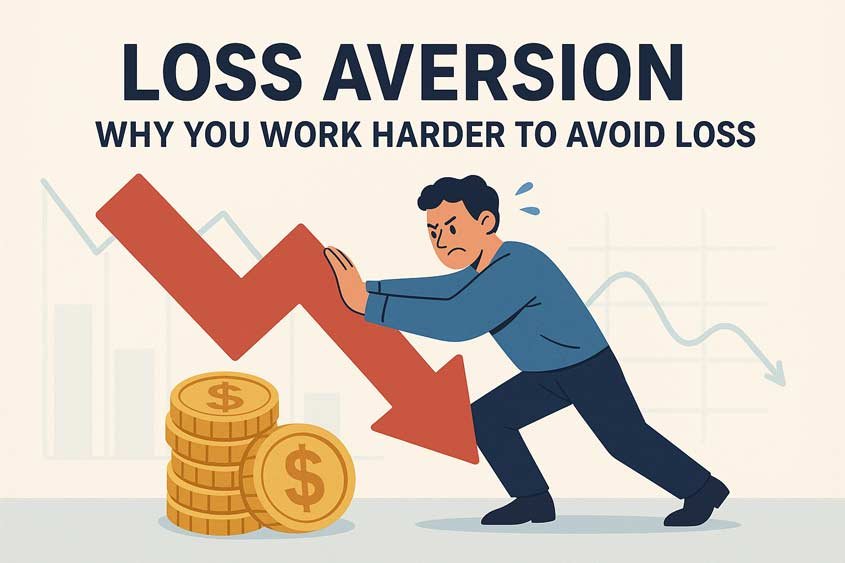
Imagine this: you’re offered a $50 bonus for completing a small task, but you’re also told that failing to complete it will cost you $50. Oddly enough, the fear of losing that $50 motivates you more than the excitement of gaining it. That’s loss aversion at work—a core principle in behavioral economics and marketing psychology that explains why people often act to avoid losses more vigorously than they act to acquire gains.
In marketing, loss aversion is a powerful lever. It’s the nudge behind limited-time offers, exit-intent popups, and “last chance” notifications. Marketers know that humans experience losses more intensely than equivalent gains, so campaigns framed around avoiding a loss tend to convert better than those highlighting potential gains.
Table of Contents
But why does this happen? Evolutionarily, avoiding loss was often more critical than seeking extra reward. Our ancestors who reacted to threats quickly survived, while those who only chased gains were less likely to make it through the night. This deep-seated wiring influences your decision-making even today, shaping your buying behavior in subtle yet significant ways.
Loss aversion isn’t just about money—it touches almost every area of decision-making. Consider subscriptions: when a service highlights what you’ll miss if you cancel, you hesitate to leave, even if you rarely use it. Or think about sales: “Only 2 left in stock” triggers anxiety that you might miss out, pushing you to buy sooner. These examples overlap with scarcity and urgency triggers, which often work hand-in-hand with loss aversion.
Understanding this trigger gives you insight into why people hesitate, procrastinate, or rush decisions. It’s the invisible hand guiding not just your customers, but yourself, in countless daily choices. Once you recognize it, you start noticing how advertisers, apps, and even social media feeds use loss aversion to subtly influence behavior.
We’ll break down loss aversion step by step. You’ll learn what it is, why it works, how marketers use it, and how you can apply it ethically in your campaigns. Along the way, you’ll also spot intersections with other psychological triggers like social proof, scarcity, and the decoy effect. By the end, you’ll understand not just the theory, but the practical ways to leverage loss aversion to shape decisions and drive action.
Understanding Loss Aversion
Loss aversion is one of the most influential triggers in consumer psychology. At its core, it refers to the tendency for people to prefer avoiding losses over acquiring equivalent gains. Simply put, losing $50 feels worse than gaining $50 feels good. This isn’t just a quirk of personality—it’s a universal cognitive bias that shapes choices, habits, and reactions across contexts, from shopping to investing, to daily decisions you barely notice.
Why Losses Hurt More Than Gains Feel Good
The impact of loss aversion comes down to emotional intensity. Studies in behavioral economics, particularly the work of Daniel Kahneman and Amos Tversky, show that the pain of loss is roughly twice as powerful as the pleasure of a comparable gain. Think about it this way: if you find $20 on the street, you feel a small thrill. But if you lose $20, the sting lingers far longer, prompting you to act—sometimes irrationally—to prevent or recover that loss.
This imbalance is what marketers tap into. Promotions framed around avoiding loss often outperform those framed around potential gains. For example, a free trial that warns “Cancel now and lose access to exclusive content” tends to drive more retention than a trial highlighting benefits gained if you continue. Your brain is wired to protect against loss, making loss-framed messages more compelling than gain-framed ones.
How Loss Aversion Influences Decisions
Loss aversion doesn’t just influence small consumer choices—it shapes major decisions. People often overvalue security over opportunity. Here’s how it manifests:
- In purchases: You’re more likely to buy a product that prevents you from missing out than one that promises an extra benefit. Limited-time offers and “last chance” deals exploit this instinct.
- In negotiations: Buyers and sellers often reject fair deals if they perceive a potential loss. A discount framed as “Don’t miss saving $100” feels more urgent than “Get $100 off.”
- In subscriptions: Highlighting what users will lose if they cancel—exclusive content, loyalty points, or special perks—encourages continued engagement.
This mechanism works because your mind treats losses as more salient and immediate than gains. That’s why you might hang on to a product or subscription you don’t need—it feels worse to lose what you already have than to gain something new.
Everyday Examples of Loss Aversion
To understand how this plays out in the real world, consider these scenarios:
- E-commerce flash sales: When you see “Only 3 left in stock,” it triggers anxiety. The thought of missing out is stronger than the joy of buying something new.
- Banking and finance: People often hold onto losing stocks too long, hoping to avoid realizing a loss, even if selling would be financially wiser.
- Gaming apps: Limited-time rewards encourage players to log in or spend money, exploiting the fear of missing out on valuable items.
Notice how loss aversion intersects with other triggers. Scarcity increases perceived risk of loss. Social proof amplifies the pressure because if everyone else is acting, missing out feels even worse. Understanding these overlaps helps marketers craft multi-layered campaigns that resonate more strongly with their audience.
Psychological Mechanics at Play
Loss aversion is more than just fear—it’s a cognitive shortcut. Your brain constantly evaluates potential outcomes, assigning disproportionate weight to losses. This leads to:
- Risk-averse behavior: People often choose a smaller guaranteed reward over a larger but uncertain one if it reduces the chance of loss.
- Endowment effect: Ownership increases perceived value. Once you possess something, giving it up feels like a true loss, even if it’s trivial.
- Status quo bias: Maintaining the current state is preferred to taking actions that could result in loss, even if those actions might bring gain.
All of these patterns are predictable, which is why marketers and behavioral strategists use loss aversion to guide decisions subtly but effectively.
By understanding the mechanics and emotional weight of loss, you can recognize why certain messages feel compelling and why some campaigns outperform others. Marketers who ignore this trigger risk missing opportunities to connect deeply with their audience. Conversely, ethical application can increase engagement, conversion, and long-term trust.
Loss aversion interacts naturally with other psychological triggers like urgency, social proof, and scarcity, forming a web of influence that nudges behavior without the audience realizing it. Recognizing it in practice is the first step to mastering its use.
The Psychology Behind It
Loss aversion works because of how your brain processes risk and reward. You don’t consciously calculate every decision; instead, your mind reacts to perceived threats and opportunities almost instinctively. That instinct is skewed—losses loom larger than gains. Understanding this mechanism in detail helps you see why certain marketing strategies hit harder than others and why customers act the way they do, often against their own rational interest.
Step 1: Recognition of Potential Loss
The first step in the process is awareness. You notice a possible loss, whether it’s money, status, time, or access to something you value. This recognition triggers an emotional response stronger than the anticipation of a comparable gain.
Example: Imagine an airline sends a notice that your flight upgrade is about to expire. The thought of losing that opportunity immediately captures your attention, even if the upgrade isn’t critical.
At this stage, the brain’s amygdala—the region tied to emotional responses—activates. That emotional spike primes you for action, often bypassing slow, rational analysis.
Step 2: Emotional Amplification
Once a potential loss is detected, your brain amplifies the emotional impact. Losses are weighted roughly twice as heavily as gains of the same size. This overvaluation intensifies anxiety or urgency.
Example: A subscription service warns, “Your trial ends today, and you’ll lose access to exclusive content.” The fear of losing something tangible provokes a stronger reaction than promising “Enjoy exclusive content if you subscribe today.”
This amplification is why countdown timers, limited-stock alerts, and “last chance” messages feel so urgent. Your emotional reaction to potential loss drives your next steps before you even consider alternatives.
Step 3: Risk Assessment and Bias Activation
At this stage, the brain evaluates options. Here, biases like status quo bias, endowment effect, and risk aversion kick in:
- Status quo bias: You prefer to keep things as they are to avoid the possibility of loss.
- Endowment effect: Items you already own feel more valuable, making giving them up painful.
- Risk aversion: You’ll often accept a smaller guaranteed reward rather than risk a loss for a bigger potential gain.
This step explains why people hold onto losing investments, hesitate to cancel unused services, or rush to claim a limited offer—they are all acting to avoid perceived loss.
Step 4: Decision and Action
After the emotional and cognitive evaluation, action follows. The stronger the perceived loss, the more likely you are to act quickly. Loss aversion can push you toward immediate purchase, retention, or commitment.
Example: A retailer tells you, “Only 3 seats left at this price!” You decide immediately, fearing the regret of missing out. The decision is less about rational analysis and more about avoiding loss.
Step 5: Post-Decision Reinforcement
After acting, your brain looks for confirmation. If the action avoided a loss, it reinforces the behavior, making you more likely to respond to similar loss-framed messaging in the future.
Example: You buy the last concert ticket at a steep price. Later, you feel satisfaction that you avoided missing out. That memory strengthens your responsiveness to future scarcity-driven campaigns.
How Loss Aversion Intersects With Other Triggers
Loss aversion rarely operates in isolation. Marketers often combine it with:
- Scarcity: “Limited quantities available” magnifies fear of missing out.
- Urgency: Countdown timers create pressure to act now.
- Social proof: “Hundreds of others are buying this” increases perceived risk of inaction.
- Novelty: New product releases make you worry about missing early access.
By layering triggers, campaigns create a stronger push toward action than any single element could achieve.
A Quick Guide: How Loss Aversion Works Step by Step
- Spot the potential loss: You notice something at risk—money, access, status.
- Feel the emotional weight: Your brain amplifies the perceived pain of losing.
- Evaluate options through biased filters: Status quo bias, endowment effect, and risk aversion influence judgment.
- Act to avoid loss: Decisions are often immediate and emotionally driven.
- Reinforce the behavior: Successfully avoiding loss strengthens responsiveness to future triggers.
Examples Across Industries
- E-commerce: Flash sales and limited-stock alerts push immediate purchases.
- Software subscriptions: “Cancel now and lose your data” keeps users engaged.
- Financial services: Framing investment gains versus losses affects risk-taking.
- Gaming apps: Limited-time events prompt players to spend or log in quickly.
By breaking down the psychological mechanics, you see that loss aversion isn’t just a marketing gimmick—it’s a deeply rooted, measurable response. Recognizing each step allows marketers to craft messages that resonate emotionally, ethically, and effectively.
The Role of Loss Aversion in Marketing
Loss aversion isn’t just an academic concept—it’s a powerhouse tool in marketing strategy. When used effectively, it influences consumer behavior, drives conversions, and boosts engagement. Brands leverage it because it taps directly into a deep, instinctual part of human decision-making: the desire to avoid loss. Understanding how it works in marketing helps you see why some campaigns succeed spectacularly while others barely get noticed.
Framing Offers Around Avoidance
The key to applying loss aversion is in framing. Messages emphasizing what a consumer might lose are typically more compelling than those highlighting potential gains.
Example: Instead of saying “Sign up to get exclusive discounts,” a brand might say, “Don’t miss your chance to save 20%—offer ends soon.” The subtle shift from gain to avoidance changes the emotional weight of the message, increasing the likelihood of action.
This framing works because the potential loss triggers stronger emotional responses, leading to faster decisions. Even if the gain would be attractive, it’s usually the fear of missing out that prompts action.
Integrating Loss Aversion With Marketing Triggers
Loss aversion often works best when combined with other psychological triggers:
- Scarcity: Limited quantities make the potential loss tangible.
- Urgency: Time-sensitive offers amplify the pressure to act.
- Social proof: Seeing others take action increases the fear of missing out.
- Novelty: New or exclusive products enhance the perceived value of what could be lost.
Example: A sneaker release may combine scarcity (“Only 50 pairs left”), social proof (“Thousands are lining up online”), and urgency (“Sale ends in 2 hours”) with a loss-averse message. The combined effect makes it almost irresistible to act.
Practical Ways Marketers Apply Loss Aversion
Brands use loss aversion across industries in practical ways. Here’s a list of common applications:
- Limited-time discounts: “Sale ends tonight” creates urgency tied to potential loss.
- Exclusive memberships: Highlighting perks you’ll lose if you cancel encourages retention.
- Abandoned cart reminders: “You’ll lose these items if you don’t check out now” nudges customers to complete purchases.
- Event registrations: Early-bird pricing framed as avoiding a future price increase drives sign-ups.
- Insurance marketing: Framing policies as protection from potential financial loss encourages purchase.
These applications show the versatility of loss aversion. It’s not just for retail—it works in services, digital products, financial products, events, and more.
Measuring the Impact
One reason loss aversion is so valuable in marketing is that its effects are measurable. Brands can test:
- Conversion rates for loss-framed versus gain-framed campaigns
- Retention rates when cancellation messages highlight lost benefits
- Engagement with limited-time or scarce offers
Example: A subscription-based platform tested two emails: one emphasizing gains (“Keep enjoying exclusive content”) and one emphasizing losses (“Don’t lose access to exclusive content”). The loss-framed email achieved a 30% higher retention rate, showing the tangible power of this trigger.
Ethical Use of Loss Aversion
While loss aversion is effective, ethical application is critical. Misleading messages about potential loss can erode trust. Instead, focus on real, verifiable consequences:
- Real scarcity instead of false urgency
- Legitimate limited-time offers
- Accurate statements about benefits at risk
Using loss aversion responsibly ensures long-term trust and repeat engagement while still driving meaningful action.
When you understand the role of loss aversion in marketing, it becomes clear why some campaigns feel almost irresistible and why certain strategies consistently outperform others. Properly applied, it doesn’t manipulate—it communicates the real value of acting before an opportunity is gone.
Loss Aversion Real Case Studies
Examining real-world examples makes loss aversion concrete. These cases show how brands across industries use the trigger effectively to shape behavior, boost engagement, and drive sales.
Case Study 1: E-Commerce Flash Sales
An online retailer ran a limited-time promotion on a popular product. Instead of simply advertising a discount, the campaign emphasized potential loss: “Only 2 left in stock. Don’t miss out!”
- Outcome: Conversion rates increased by 35% compared to a standard discount promotion.
- Mechanism: The scarcity message triggered loss aversion; shoppers acted quickly to avoid missing the opportunity rather than just seeking a gain.
- Additional Triggers: Scarcity and urgency amplified the effect, while social proof—showing that other customers were buying—heightened the perceived risk of inaction.
This example illustrates how combining loss aversion with complementary triggers can significantly increase conversions.
Case Study 2: Subscription Retention
A digital subscription service faced high churn. They tested two email strategies: one highlighted the benefits of continuing the subscription, and the other framed the message around loss: “You’ll lose access to exclusive content if you cancel now.”
- Outcome: Retention increased by 30% with the loss-framed messaging.
- Mechanism: Highlighting what users would forfeit created stronger emotional engagement. The fear of losing something they already possessed outweighed the rational assessment of how much they actually used the service.
- Additional Triggers: Endowment effect and status quo bias reinforced the reluctance to cancel.
This case proves loss aversion isn’t just about initial purchases; it can be highly effective in maintaining long-term engagement.
Case Study 3: Event Ticketing
A live event company promoted early-bird tickets for a concert. Instead of stating, “Early-bird tickets are cheaper,” they emphasized potential loss: “Don’t miss your chance—early-bird pricing ends in 48 hours.”
- Outcome: Early-bird sales exceeded expectations by 25%.
- Mechanism: Framing the offer around missing out on a deal activated loss aversion, making the prospect of delay emotionally painful.
- Additional Triggers: Urgency (time limit) and scarcity (limited number of discounted tickets) compounded the effect, driving immediate action.
These cases demonstrate that loss aversion isn’t a vague theory—it’s a practical, actionable tool. When applied thoughtfully, it shapes decisions, increases conversions, and enhances long-term engagement, making it a cornerstone of effective marketing strategy.
The Consumer Side of the Trigger
Loss aversion shapes predictable patterns in your behavior. Researchers have documented these patterns across controlled experiments and marketplace data. You see consistent responses across categories because the mechanism follows the same rule. You work harder to avoid losing something than to gain the same thing. Marketers rely on this because your reactions show stable trends.
Immediate Attention Shift
When a message frames an outcome as a possible loss, your attention jumps to it fast. Daniel Kahneman and Amos Tversky documented this pattern in repeated experiments where participants viewed identical choices framed as gains or losses. The loss frame drew more focus. You process loss related information with higher priority because your brain treats possible harm as a threat that requires fast evaluation.
Marketers replicate this effect. A message that states a vanishing discount or an expiring access window receives more engagement than a message that describes the gain you get. Analytics from retailers show higher click through rates when a product is presented with a time limit compared to the same product with a standard presentation. The difference appears because people scan the loss frame first.
This pattern shows up in survey responses and observed behavior. When people view several offers in a sequence, they tend to remember the one where they risk losing something. They talk about it more and return to it during evaluation. The focus is on the fear of missing out rather than the actual features. You prioritize the avoidance of regret because you want certainty about the outcome. Researchers measure this through recall tests and attention tracking. In each case, the loss framed message receives more focus.
Speed in Decision Making
Loss frames increase urgency. You feel pressure to act because you want to avoid the negative outcome. Studies in behavioral economics show that people make faster decisions under loss conditions. They skip longer comparisons and rely on quicker rules. Even when the decision leads to a higher price or a less optimal choice, the urgency created by the potential loss compresses your evaluation time.
Retail experiments confirm this behavior. When a product page shows a warning about limited stock, people reduce the number of alternative items they check. Transaction data shows a shorter browsing to purchase time. This means the consumer cuts the decision loop. The action is driven by fear of losing access rather than by a detailed assessment of value.
You also see increased sensitivity to countdowns. A countdown creates the perception that a loss will occur at a specific moment. This makes you speed up the process because you treat the ticking timer as a threat to your chance of getting the offer. Eye tracking studies show that people fixate on the countdown area even when they are looking at other elements. This confirms that the loss element drives constant monitoring.
Higher Conversion Probability
Loss aversion improves conversion because the fear of losing something has a stronger effect than the desire to gain something. People are willing to accept slightly worse terms to avoid a negative result. When a subscription trial announces that access ends soon, people with moderate interest convert into paying users at higher rates. They prefer to avoid losing access instead of evaluating alternatives.
Field data from digital platforms shows that messages about disappearing benefits outperform messages that highlight added value. For example, free trial expirations generate more upgrades than general promotional offers. The result remains consistent across categories. This pattern shows that people are more responsive to the avoidance of a negative change than to the pursuit of a positive change.
You also see this during cart abandonment recovery. Emails that mention an item selling out perform better than emails that simply remind people of the cart. The possibility of losing the product activates the desire to secure it. Even if the person was unsure about the purchase, the threat of losing the item increases action. The consumer shifts from evaluation to protection mode.
Reduced Sensitivity to Price
Loss frames make people less price sensitive. When you try to avoid losing something, you treat the cost as secondary. This happens because you evaluate the outcome relative to the fear of regret. Research shows that people accept higher prices when a product risks becoming unavailable. They justify the decision because the emotional cost of losing the opportunity feels larger than the financial cost.
Marketers use this during promotional events with limited quantities. Observational data shows that people buy items even when the price drop is small. The message about stock running low creates enough fear of losing the chance that price becomes a minor factor. This pattern appears across retail studies where participants choose items with less favorable prices when they believe availability is limited.
Increased Commitment After Purchase
People show stronger commitment to purchases made under loss aversion. Once they secure the product or offer, they justify the decision more intensely. They want to feel that avoiding the loss was the correct choice. This creates a reinforcement loop. Studies on post purchase rationalization show that people rate products more positively when the purchase was triggered by fear of missing out. They amplify the value of the item to justify their reaction.
This effect also shows up in subscription behavior. When users upgrade because a free trial ends, churn rates in the first few days are lower than expected. People do not want to feel that their fear reaction led to an unnecessary expense. They commit to the service because reversing the decision would feel like acknowledging that the fear was exaggerated.
Observable Behaviors People Display
These patterns appear across different environments. You see them in ecommerce, subscription services, physical retail, and even in donation campaigns. Loss aversion drives predictable actions that marketers rely on. You can observe these behaviors in your own choices when you face limited opportunities or disappearing benefits.
Some clear examples of observable actions include the following.
• You click faster on messages that warn about possible losses.
• You skip detailed comparisons when you believe time is running out.
• You buy sooner when an offer risks expiring.
• You accept higher prices when a product shows low stock.
• You justify the purchase after securing it because you want confirmation that avoiding the loss made sense.
Pattern Across Contexts
The consistency of these behaviors comes from the same cognitive mechanism. Loss aversion activates a protective response. You feel pressure to act before something negative happens. Your mind treats the avoidance of loss as a priority. This shifts your decision process from exploration to protection. Protection mode leads to fast decisions, reduced price sensitivity, elevated attention, and a desire to secure certainty.
You see the same pattern in different regions, product categories, and age groups. Researchers confirm this through repeated controlled trials where the framing of the outcome determines the response. When choices are identical except for how they describe the possible loss, people select the loss avoiding option more often.
Marketers use this because the reactions follow a measurable structure. They know that highlighting the risk of losing a benefit or a product raises engagement, speeds up decisions, and increases commitment. You respond to the emotional weight of potential loss even when you know the situation is designed to influence your behavior.
Why the Response is Stable
Loss aversion creates stable behavioral responses because it taps into an evolutionary mechanism. Protecting resources and avoiding negative outcomes helped earlier humans survive. Modern environments trigger the same reaction in non survival situations. The mechanism does not evaluate true danger. It simply reacts to any possible loss. This includes discounts, bonuses, availability, free trials, and access levels.
You want certainty. When a marketer frames something as a possible loss, they offer you a way to prevent the negative outcome. You respond because the action reduces immediate discomfort. Researchers call this pattern a preference for certainty. You prefer a guaranteed result, even if it is less valuable, over a possible better outcome that carries risk.
This also explains why you show stronger emotional responses to losses. Even small losses feel heavier than equivalent gains. When a marketer signals a possible loss, your brain magnifies its weight. This drives urgency and produces the predictable behaviors described earlier.
What This Means for Understanding Audience Behavior
If you observe how people act under loss aversion triggers, you see a pattern of protective decisions. You see fast action, reduced price sensitivity, higher emotional engagement, and stronger commitment after purchase. These responses are measurable, testable, and visible in real world data.
For anyone studying consumer psychology, loss aversion offers a reliable way to predict reactions. When a message frames the situation as a potential loss, you can expect the same structure of behavior. The responses appear across different contexts because the mechanism is rooted in how people process risk.
This understanding helps you interpret why people choose certain products, why they respond to urgent messages, and why they justify purchases after securing them. The behavior follows a clear cause. People want to avoid losing something. The marketing message makes the loss feel possible. The reaction follows.
Strategic Use in Marketing
Ethical use of loss aversion focuses on clarity, genuine value, and transparent communication. The purpose is to help people make informed choices, not to pressure them. When brands use this trigger responsibly, they support faster decisions without misleading the audience. The most effective methods rely on accurate information, visible context, and fair conditions.
Clear Expiration Dates
A transparent expiration date helps people understand when an offer ends. Research on decision making shows that people respond to a clear deadline because it lets them evaluate the trade off without confusion. The message works when the deadline is real and consistent across all channels. Brands use this approach for subscription trials, seasonal pricing, and event registration.
A reliable expiration date prevents manipulation. The audience sees a defined time window and adjusts their behavior based on verified facts. When people know the offer ends on a specific day, they can plan ahead. This reduces frustration and strengthens trust. It also supports better conversion because people take action when a valid time frame exists.
This method works best when the brand provides full context. That includes price comparisons, the normal rate, and the conditions of the offer. People need to see the baseline to evaluate the cost of missing out. Ethical framing respects their need for complete information.
Low Stock Signals Based on Real Inventory
Low stock messages influence decisions only when inventory data is real. People respond to scarcity when the information reflects actual availability. Retail studies show that shoppers act faster when they see a limited quantity, but the effect depends on trust. False scarcity damages credibility.
Ethical use of low stock signals requires verified counts, consistent updates, and clear descriptions. The message must reflect the real number of available units. Brands should avoid vague language and present exact data when possible. This approach improves confidence because the audience sees transparent information rather than an exaggerated claim.
People use scarcity data to judge urgency. When the brand provides accurate numbers, the shopper can decide whether to wait, compare, or buy. Responsible use of this trigger aims to help people assess the risk of losing access rather than to force immediate action.
Limited Enrollment for Educational Programs
Educational companies use limited enrollment when they need to maintain a fixed teacher to student ratio or protect the quality of support. The limit is not a marketing technique but an operational requirement. Students respond to the risk of not securing a place because the limitation is practical and verifiable.
This method works when the company shows the reason for the limit. People understand that some programs cannot accept unlimited participants. Ethical practice includes clear disclosure of the capacity, the schedule, and the enrollment process. When people see that the limit protects their learning experience, they feel more confident in the decision.
Loss aversion works here because the audience understands what they might lose if they wait too long. They risk missing a seat in a program that cannot expand arbitrarily. The decision remains informed and fair because the limitation is based on real constraints.
Free Trial Ending Notices
Free trial ending messages help users avoid unexpected charges. Companies send reminders to allow users to cancel or continue. Research on subscription behavior shows that people appreciate transparent reminders, and they respond strongly when they believe access will end soon. Ethical use of loss aversion focuses on helping the user stay in control.
Brands should send reminders several days before the trial ends. They should state the renewal price, the exact date of the charge, and the way to cancel. This allows users to make a deliberate choice. People convert at higher rates when they fully understand the upcoming change. The reminder works because it prevents accidental losses instead of creating pressure.
Users respond well to this approach because it respects their autonomy. They avoid surprises, and they feel more secure with the company. Ethical use is based on clarity and timely communication, not on hidden details.
Accessible Value Comparisons
Loss aversion becomes more ethical when people see a complete comparison between the offer and the regular alternative. Brands publish value charts, feature lists, and pricing breakdowns to give people the full picture. People react strongly to the possibility of losing added value, but the decision remains fair when the information is accurate and easy to verify.
Companies use comparisons for software plans, service bundles, or membership upgrades. The message shows what features disappear if the person stays on a lower tier or waits until the offer ends. When the content is real and presented without exaggeration, the audience can evaluate the trade off using objective data.
This practice supports informed choices because it reduces uncertainty. People want to avoid losing benefits that matter to them. When they see transparent evidence, they can judge whether the upgrade or offer fits their needs.
Ethical Rules for Use
Brands that follow ethical rules avoid manipulation and support informed decision making. The purpose is to guide the user without creating artificial pressure.
You can evaluate ethical use by checking whether the offer meets these conditions.
- The information is real and traceable.
- The time limit or stock limit exists for practical reasons.
- The message presents full context with clear terms.
- The user can verify the claim.
- The offer does not punish slower decision makers.
- The company provides reminders before renewal or expiration.
- The communication respects user autonomy.
These points help brands maintain credibility while using a proven psychological trigger. People respond positively when they see transparency and fairness.
Responsible Use in Email Marketing
Email campaigns use loss aversion effectively when they include factual data, visible deadlines, and straightforward calls to action. Brands avoid daily countdown resets because this creates mistrust. Ethical practice requires consistent timers and accurate reminders.
A responsible email contains the normal price, the reduced price, and the exact expiration date. It should also explain what happens after the expiration. People act faster because they understand the consequences. This aligns with research that shows people respond strongly when the risk of losing value is clear.
The email should avoid emotional pressure. Simple and factual information encourages trust. When the audience feels respected, the conversion rate increases without harm to the relationship.
Real Quantity-Based Promotions
Some promotions rely on genuine quantity-based limits. For example, a company can offer a specific number of discounted units during a launch. The limit exists because budgets and production runs are real. People respond because the opportunity is measurable.
The brand should display the starting quantity and the current quantity. This allows people to see the trend. It also helps them judge whether they need to act soon. This method respects user choice because the information is complete and objective.
Quantity-based promotions work when the company avoids exaggeration. The message should not claim rare availability for items that are actually plentiful. Accurate reporting creates stronger long-term trust.
Transparent Rewards for Fast Action
Some companies offer early access rewards. This structure works because people want to avoid losing added value. The rule is ethical when the requirements are clear, the reward is real, and the time window is fixed.
Examples include early enrollment bonuses, additional features for early subscribers, or extra support during launch periods. The audience responds to the possibility of losing these benefits. The key is to keep the reward modest and fair. The purpose is to motivate action, not to trap people.
Brands should avoid overly complex conditions. Simple rules produce better decisions because users understand the structure. When people see what they gain and what they risk losing, they evaluate the offer calmly.
Context Where Ethical Use Works Best
Loss aversion performs best in situations where people value certainty. Ethical practice reinforces that certainty. The goal is not to pressure but to help users understand what changes if they wait.
This trigger works well in the following contexts.
- Subscription renewals
- Course enrollment
- Premium feature upgrades
- Event ticketing
- Seasonal product releases
- Software trial transitions
- Inventory-based retail offers
In each case, the user needs accurate information about what they risk losing. When the brand provides this, the decision becomes clearer. The user feels more in control, and the brand maintains a responsible approach.
The Value of Responsible Communication
When brands use loss aversion with integrity, they support better choice making. People act faster because the offer presents clear consequences. They also maintain trust because the company avoids exaggeration. Ethical application centers on transparency. The user sees real data, real deadlines, and real comparison points.
Loss aversion remains effective because people want to avoid negative outcomes. Responsible brands provide the information that lets users judge whether the outcome matters to them. This combination produces higher engagement and stronger long term relationships.
Ethical use of this trigger respects the user, focuses on verified information, and preserves autonomy. It turns a powerful psychological tendency into a tool that benefits both sides.
Common Errors
Loss aversion works when the audience sees real risk and accurate information. When brands misuse the trigger, the effect weakens and trust drops. Most problems come from exaggeration, unclear communication, or artificial pressure. You avoid these issues by keeping all claims verifiable and respecting user autonomy. Ethical use strengthens results while poor practices create resistance.
Artificial Scarcity
Artificial scarcity reduces trust. People verify stock levels, compare multiple pages, and track past promotions. When they notice mismatched numbers or manufactured urgency, they disengage. Loss aversion needs real conditions to work. A limited quantity must reflect actual inventory or operational constraints.
Some brands reuse the same low stock claims for weeks. Users recognize the pattern. Once they lose confidence, they ignore future messages. Research on online shopping behavior shows that shoppers abandon brands that overuse false scarcity. People want accurate data, not pressure.
You prevent this mistake by using only verified inventory numbers. If stock updates often, show that. If the quantity does not change, avoid claiming fast depletion. People want honesty so they can judge the risk of losing access. Real scarcity increases conversions while false scarcity reduces long term performance.
Unclear Deadlines
A deadline creates urgency only when it is transparent. Unclear or moving deadlines frustrate users and trigger suspicion. Ethical use requires a fixed expiration date that matches all promotional materials. If the timer resets every day, users label the message as manipulative.
Customers track deadlines across email, ads, and website banners. They expect consistency. A mismatch makes them question the offer. Research on consumer trust indicates that inconsistent time claims reduce willingness to act. People need a stable reference point when evaluating trade offs.
You avoid this issue by choosing a single expiration date and keeping it unchanged. Show the normal price, the discounted price, and the date of the transition. This allows users to evaluate the risk of missing out based on verifiable information.
Excessive Pressure
Loss aversion should support informed decisions, not overwhelm people. Excessive pressure includes emotional language, aggressive reminders, or warnings that exaggerate consequences. When people feel pushed, they withdraw. The psychological response shifts from loss avoidance to resistance.
Strong pressure creates short term conversions and long term churn. People who buy under stress often regret the purchase. They cancel or return the product. Research on post purchase behavior shows that forced decisions create higher dissatisfaction.
Ethical use requires simple, factual statements. You present the consequence of inaction without adding emotional intensity. This keeps the decision calm and grounded. People respond better when they feel in control.
Vague Claims About Value Loss
People need clear information to understand what they risk losing. A vague claim such as “Don’t miss out on huge savings” offers no measurable reference point. When users cannot verify the size of the loss, the claim loses power. A precise description performs far better.
Loss aversion works when the audience sees the difference between the current offer and the future state. This includes price, features, or bonuses. When you provide exact values, people can judge the trade off. Without concrete numbers, they ignore the message.
You prevent this mistake by using value comparisons, side by side features, or clear price changes. The information must be accurate and easy to confirm. Precise communication strengthens both trust and conversion rates.
Using It When No Real Loss Exists
Some brands use loss aversion even when the user loses nothing by waiting. This happens when the price does not change, availability stays constant, or features do not decrease. Users recognize the mismatch quickly. The message stops being persuasive.
People evaluate offers by checking context. If they see no real risk, they disregard the claim. Repeated false signals reduce overall brand credibility. Loss aversion only works if the user faces a verifiable consequence.
Use this trigger only when the situation includes a real loss: a price increase, an expiring bonus, a limited quantity, or a guaranteed change in access. When the condition is real, the user respects the message and makes a faster decision.
Overloading Users With Alerts
Some brands send too many reminders about the same loss. Frequent alerts create fatigue. Users see them as noise rather than helpful information. Research on email engagement shows that high-frequency messages reduce open rates. People unsubscribe when they feel overwhelmed.
Loss aversion remains effective when the message is well timed. One or two reminders before a deadline are enough. Each message must include useful information such as remaining time, updated inventory, or detailed value comparison. This keeps communication relevant.
You avoid the mistake by planning a clean sequence: one initial announcement, one reminder near the deadline, and one final notice. Clear spacing prevents fatigue and increases attention.
Short List of Common Errors
- Artificial scarcity that contradicts real inventory
- Deadlines that reset or appear inconsistent
- Emotional pressure that overrides informed choice
- Vague loss claims with no measurable data
- Using loss aversion when no real loss exists
- High-frequency reminders that create fatigue
- Messages that hide important terms
Ignoring User Autonomy
Loss aversion must support user autonomy. When communication hides key terms or makes cancellation hard, users feel tricked. Ethical use requires transparent conditions and accessible options. Users need simple ways to cancel, downgrade, or switch. When these steps are difficult, trust erodes.
People respond positively when they feel respected. They make faster decisions when they see clear rules. Autonomy is central to long-term customer relationships. Loss aversion becomes more effective when users believe the brand values honesty.
Lack of Verification
Users verify claims before acting. If they cannot confirm information, they wait or abandon the offer. You must ensure all data is accurate across all formats. This includes price changes, stock numbers, and expiration dates. When users encounter conflicting details, the impact of loss aversion disappears.
To avoid this problem, maintain consistent data across every channel. Every claim needs internal confirmation. Users reward accuracy with higher engagement.
Misalignment With Product Value
Loss aversion cannot compensate for weak product value. If the offer does not deliver real benefits, users ignore the risk of losing access. Overreliance on psychological triggers creates a mismatch between messaging and actual value. People recognize this quickly.
The trigger works best when the product already satisfies user needs. The message highlights the risk of missing out on something objectively useful. When product value and communication align, users respond with confidence instead of skepticism.
Long-Term Consequences of Misuse
Misusing this trigger produces measurable harm. People unsubscribe more often, avoid future offers, or switch to competitors. Trust loss is difficult to repair because psychological triggers influence long-term perceptions. Ethical use supports sustainable growth while manipulation creates short-lived spikes.
Responsible practice uses accurate data, fixed deadlines, real scarcity, and clear comparisons. When users see genuine conditions, they feel comfortable acting. Ethical use strengthens brand relationships and supports consistent performance.
Practical Tips
Loss aversion works when the user sees a real consequence and accurate information. You guide their decision by showing what changes if they wait, ignore, or delay. This section focuses on practical ways you can integrate the trigger without pushing people or distorting facts. You keep the message clean, verifiable, and grounded in real conditions. When used correctly, loss aversion strengthens engagement and supports better decision making.
Identify Real Loss Points
Loss aversion needs a real shift between now and later. Before you write any message, identify the exact change the user would face. This could be a price increase, a reduced bonus, a closing enrollment period, or a drop in availability. People respond only when they can verify the change. When you present the risk clearly, the audience evaluates the trade off faster.
You can look at your customer journey and map all points where something expires or changes. This helps you decide where to place your messaging. Research on purchase cycles shows that people move faster when they understand the conditions of the offer. By highlighting real moments of transition, you help them make informed choices.
For example, subscription services often increase prices after the first billing cycle. You can show this difference upfront. Users see the real amount they save by joining now. This is not pressure. It is simple information they use to decide.
Use Clear Comparisons
Loss aversion becomes stronger when the user sees a visible comparison. You present the current state and the future state side by side. This can be a price table, a feature change, or a list of bonuses that disappear after a certain date.
Clear comparisons remove uncertainty. They help the user judge value without guessing. Research on consumer decision making shows that people respond more strongly to visible contrasts. They use the difference as a reference point. With an accurate comparison, the message feels fair and transparent.
A simple example is a before and after price. When the user sees the original price returning next week, they understand the consequence of waiting. The key is accuracy. You do not inflate numbers or hide conditions. You only present the facts.
Keep Messaging Simple and Direct
People interpret loss messages quickly. Complex language reduces clarity and weakens the effect. You keep the message direct, specific, and easy to verify. Users want to know exactly what they risk losing. This includes time, money, access, or bonuses.
Avoid dramatic language. Emotional pressure creates resistance. Users want calm information that respects their autonomy. You show the consequence and let them decide. This approach increases satisfaction and reduces regret.
Simple messages perform well because users scan them in seconds. You remove any unnecessary filler. You keep one core message per communication. This helps the user understand the situation without confusion.
Use Ethical Timing
Timing influences attention. Loss aversion works best when the message arrives near the moment of change. If the user receives the information too early, they forget. If they receive it too late, they see it as rushed. A well timed message supports informed decision making.
Send an initial notice early enough for users to consider the offer. Then provide one or two reminders before the change. Research on email engagement indicates that spaced communication increases action. Over communication reduces engagement. Ethical timing respects user attention and supports long term trust.
Tailor Messages to Context
Loss aversion feels stronger when aligned with customer context. A student evaluating a course responds to enrollment deadlines. An online shopper responds to inventory changes. A business buyer responds to contract terms expiring.
Understand your audience’s goals. Identify the specific outcome they value. Then show how that outcome changes when conditions shift. This creates relevance. People respond when the message aligns with their situation.
You can analyze user behavior across your website to identify patterns. For example, people who revisit a product page multiple times often need clear information about pricing changes. Loss aversion messages can guide them when conditions are evolving.
Connect It With Other Triggers
Loss aversion works well with certain psychological triggers. You can integrate it with scarcity, urgency, social proof, or commitment. People compare their choices with the behavior of others and the realities of limited resources.
For example, if a product has low inventory, showing the number of units increases clarity. When combined with a deadline, it gives users a complete picture of risk. Ethical integration depends on real data. You do not use estimates or assumptions. You present accurate and verifiable numbers.
This combined approach helps users make decisions they feel confident about. The triggers reinforce each other as long as the information stays factual.
Present Real Reasons Behind Price Changes
People appreciate transparency. When they see a price increase coming, they want to know why. By presenting clear reasons, you improve trust and reduce resistance. Loss aversion becomes more effective when users understand the context.
For example, if operational costs rise, you can state that. If you add features, you can show the improvements. Users judge the fairness of the change. When they see logical reasons, they act with confidence.
Clear explanations differentiate you from brands that increase prices without communication. This strengthens your relationship with customers over time.
Use Visual Cues to Support Understanding
Visual cues help people process information quickly. You can use price tags, countdowns, or comparison tables. The visuals must match actual data. When people see clear structure, they make decisions faster.
Avoid dramatic animations or flashing visuals. They distract and reduce trust. Keep visuals simple and aligned with the message. Research on decision science shows that visuals support faster comprehension. They reduce cognitive load and make risk evaluation easier.
Personalize When Possible
Personalized messages show users the exact consequence relevant to them. If a user abandons a cart, you can show how the current price or bonus might change. If a trial is ending, you remind them what features they may lose. Personalization increases relevance.
Ethical personalization uses only data the user has already shared. You avoid guessing or inferring sensitive information. You focus on objective details such as plan features, order contents, or expiration dates.
Personalized loss aversion works because the risk is specific to the user. When people see how a real change affects their situation, they respond faster.
Follow Up After Conversion
Loss aversion does not end at conversion. After users act, they want reassurance that they made a good decision. You provide clear information about what they gained, how much they saved, or what they secured. This reduces buyer’s remorse and strengthens confidence.
A simple post purchase summary increases satisfaction. People like seeing the outcome of their decision. It validates their action and improves long term loyalty.
Build Trust Through Consistency
Consistency across all channels increases the effectiveness of loss aversion. People verify information. They expect to see the same numbers in emails, ads, and product pages. When your data matches, you build reliability.
Reliable communication creates a strong foundation. Users feel safe making decisions. They understand the rules and consequences. Consistency reduces friction and strengthens engagement.
Loss aversion is not about short term gains. When used ethically, it supports long term customer relationships. People act when they see accurate information. They return when they trust the brand. This approach reduces cancellations and increases retention.
Spot The Trigger
Exercise 1
A sportswear brand launches a new campaign with the slogan “Run for the Planet.” For every pair of shoes sold, they promise to plant two trees. The ad shows runners from many backgrounds smiling and jogging through green parks. The message builds a sense of contribution and social good.
Question: Is the brand using the Loss Aversion trigger? (True or False) | Check Answer
Exercise 2
A fitness app promotes a premium upgrade. The ad states that if you stay on the free plan, you risk missing detailed progress reports and personalized plans. The message stresses the value you might lose if you avoid the upgrade.
Question: Is the advertiser using the Loss Aversion trigger? (True or False) | Check Answer
Exercise 3
A new wellness drink brand publishes an ad that highlights fresh ingredients and smooth taste. The message focuses on flavor, clean labels, and natural benefits. There is no mention of losing value, missing benefits, or avoiding negative outcomes.
Question: Is the advertiser using the Loss Aversion trigger? (True or False) | Check Answer
Recap
Loss Aversion shapes decisions because people work harder to avoid a loss than to gain something of similar value. You react faster when you think you might lose an option, a benefit, or an advantage. This gives the trigger strong influence in marketing. When a brand frames its message around a potential loss, your attention increases and your motivation to act rises. You want to protect what you believe you already have or what you are close to gaining.
Ethical use of this trigger helps you understand why an offer matters. It can highlight the value of a subscription you already enjoy. It can show you what you risk when you stop an active routine. It can remind you that delayed action can reduce your options. These messages work because you care about what you might lose. This is a documented and stable finding in behavioral science. Research shows that people respond with more urgency when they sense they could lose access to a benefit.
Loss Aversion works best when the potential loss is real and easy to verify. When you see a genuine deadline, you understand the actual risk of losing a price or feature. When you see data about features that end after a trial, you understand why action matters. When brands present clear facts, you can make informed choices without pressure or confusion. You feel in control because the message respects your ability to evaluate information.
The trigger also helps you decide between similar products. When you compare two subscriptions, the message that explains what you might lose with the cheaper plan can guide you toward the option that fits your needs. You see the value of each feature and how it affects your long term use. This supports better decisions because you get clarity about what matters for you.
Ethical brands avoid exaggeration. They avoid false deadlines. They avoid vague warnings. They avoid claims that push fear without evidence. These practices damage trust and weaken results. When a message describes a real loss, you can check it and confirm it. This transparency builds trust and improves the long term relationship between the brand and the user. Loss Aversion used in this way helps people act with confidence.
You can apply this knowledge to your own behavior. When you see an ad that points to a loss, pause and check the information. Confirm if the loss is real. Confirm if the deadline is valid. Confirm if the missing benefit affects your needs. This turns the trigger into a useful tool. You avoid reacting on impulse. You make decisions based on facts and personal goals. You get control over how the trigger influences you.
Loss Aversion remains one of the most powerful forces in decision making. It shapes your choices in subtle ways and affects how you weigh risks and rewards. When used with honesty and clarity, it supports better outcomes for both the brand and the consumer. Understanding how it works helps you evaluate messages with accuracy and confidence.

Gabriel Comanoiu is a digital marketing expert who has run his own agency since 2016. He learned marketing by testing, analyzing, and refining campaigns across multiple channels. In his book series Impulse Buying Psychology, he shares the psychological triggers behind every purchase, showing how to create marketing that connects, persuades, and converts.