
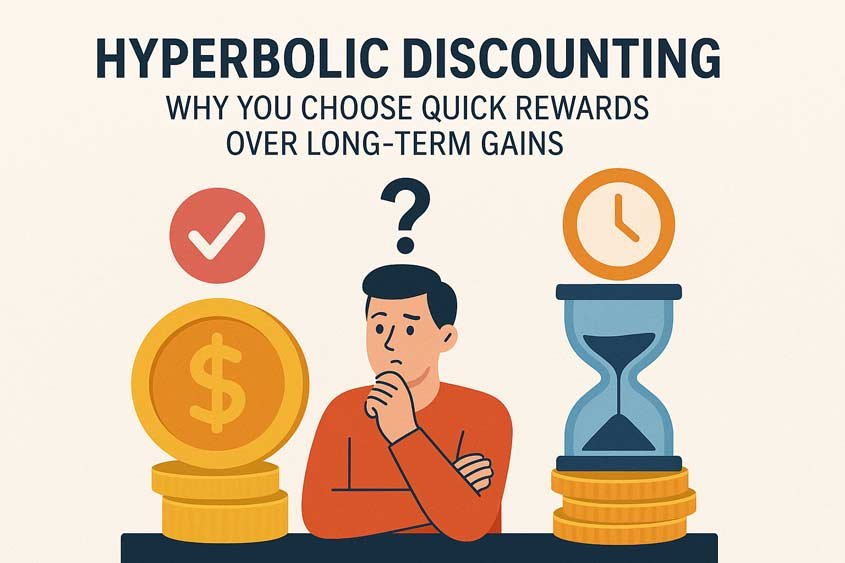
You know that awkward moment when you promise yourself you’ll start saving money, eating cleaner, or finally tackling that dusty online course but somehow end up choosing the quick hit instead? Yeah, that’s Hyperbolic Discounting quietly running the show in the background, and it’s probably influencing you more than you think.
In marketing, this little psychological twist isn’t just some abstract concept researchers like to chat about. It’s one of those hidden gears turning inside almost every buying decision your customers make. And when you start seeing it pop up in ads, product pages, subscription plans, and even checkout flows, you can’t unsee it. Suddenly, you get why a flashy “Buy now, pay later” button spikes conversions or why a “Get instant access” headline feels irresistible even to people who swear they’re rational thinkers. Spoiler: nobody is that rational when immediacy knocks on the door.
Table of Contents
Hyperbolic Discounting sits in the same family of psychological nudges marketers love to study, right next to triggers like Cognitive Ease, Scarcity, and the Peak End Rule. But this one hits differently because you don’t have to build hype or craft deep emotional stories to make it work. All you have to do is tap into something your audience is already wired to crave: immediacy. The shorter the delay between choosing and receiving, the higher the perceived value. Long-term gains feel vague, distant, and kinda boring, while a quick reward? That’s dopamine, baby.
Picture this. You’re scrolling through an app store, and you see two fitness apps. One says, “Build long-term health habits to transform your lifestyle.” Sounds noble, inspiring even, but you swipe right past it. The next one says, “Get visible results in 7 days.” That one? You tap immediately. Rationally, you know seven days won’t change your life. But emotionally, it promises movement right now. And that’s the whole magic of this trigger. It compresses time, shrinks resistance, and nudges people toward the option that feels rewarding in the moment, even when the long-term alternative would serve them better.
Marketers use Hyperbolic Discounting all the time, sometimes intentionally, sometimes by accident. Free trials with instant access. Limited-time bonuses that disappear in hours. Loyalty programs that give small but frequent perks. Subscription upgrades with “unlock these features today.” The pattern repeats itself across industries. You see it in e-commerce, SaaS, financial services, food delivery, gaming, education, and even charities. People don’t just respond to faster rewards. They crave them.
And if you’re building a business or shaping a campaign, understanding this trigger gives you an edge. You start spotting the exact moments when people drop off because the reward feels too far away. You start noticing friction points that make a decision feel heavy instead of immediate. And you realize that the secret isn’t to trick buyers but to design experiences that match how humans actually behave, not how we wish they behaved.
Hyperbolic Discounting explains why an instant coupon grabs more attention than a loyalty program with long-term benefits. It explains why someone chooses a product with a quick bonus over one with better long-term value. It explains why that “delivered today” label has become more powerful than an entire ad campaign. You can try to fight this natural bias, but honestly, it’s smarter to work with it ethically, responsibly, and transparently.
Here’s the wild part: people know they’re choosing the quick reward. They’re aware of it, sometimes painfully aware. Yet they still choose it. Even when the long-term payoff is bigger. Even when they promised themselves they’d be more disciplined. Even when they regret it later. Hyperbolic Discounting collapses the rational timeline into a little bubble where “now” feels enormous and “later” might as well be “never.”
This is why it’s one of the most powerful marketing triggers you can master. It doesn’t rely on persuasion tricks or complex narratives. It aligns with who your customer already is in the moment of deciding. When everything feels urgent, noisy, and distracting, anything that offers instant gratification becomes a magnet. Brands that understand this don’t just sell better. They communicate better. They design experiences that reduce waiting, reduce thinking, reduce emotional distance, and increase the feeling of “I want this right now.”
By the time you finish this chapter, you’ll be able to see Hyperbolic Discounting in practically every piece of marketing around you. You’ll understand why it works, how it works, how consumers react to it, how brands apply it ethically, where people mess it up, and how to use it with confidence. And once you do, your campaigns stop feeling like guesswork and start feeling like strategy.
Understanding Hyperbolic Discounting
If you strip away all the academic jargon, Hyperbolic Discounting is basically your brain saying, “I know the future reward is bigger, but the reward right now feels juicier.” It’s a mental shortcut that pushes you toward immediate gratification, even when the smarter choice sits a little further down the timeline. Marketers love this because it influences how you make decisions in the moment, not how you wish you’d decide when thinking about the long run.
This trigger shapes choices in ecommerce, finance, retail, fitness, education, and even charity campaigns. Whenever a brand wants you to take action now rather than later, this is the lever they quietly pull. And what’s interesting is that it doesn’t work through pressure like Scarcity or through mood shifts like Priming. It works by reshaping the way your mind evaluates time, reward, and impulse.
Below, let’s break it down in a way that doesn’t feel like reading a textbook.
Your Brain Overvalues the Present
Hyperbolic Discounting means your brain gives extra weight to outcomes that happen sooner than ones that happen later. Not a little extra weight. A lot. The immediacy hijacks your attention.
Say you’re shopping for a course that promises long-term career benefits in six months. Feels responsible. Logical. Adult-ish. Then you see another offer that promises a useful shortcut you can apply today. Guess which one gets more clicks.
The short-term option feels alive. Concrete. Tangible. You almost feel the reward before you get it. That emotional kick is what drives the decision. Long-term rewards? They feel abstract, distant, and kind of foggy. So the brain “discounts” them, treating them like they’re worth less than they truly are.
This is why the phrase “instant access” shows up everywhere. The moment you remove waiting, you remove resistance.
You Treat Delayed Rewards Like They Don’t Matter as Much
Here’s the fun part: the value difference isn’t based on logic. It’s not because the faster reward is objectively better. It’s because your mind compresses time weirdly. Anything too far away kind of fades out of emotional focus.
For example:
You can save 50 dollars today or 90 dollars in three months. Most people grab the 50. The math makes no sense. But the emotional math? Totally different story.
Brands know this. So they lean into:
- Free bonuses delivered instantly
- Upgrades that unlock features right away
- Free trials that activate in seconds
- Short-term perks layered on top of long-term products
- Messaging that highlights “today” or “within minutes”
It’s not manipulation. It’s alignment with human behavior. Once you understand how people evaluate time, you can design offers that match it.
The Trigger Influences Impulse, Risk, and Motivation
Hyperbolic Discounting isn’t just about choosing the quick reward. It reshapes motivation, risk perception, and commitment. When a reward is immediate, you feel more motivated. When it’s delayed, you procrastinate. When it’s far away, you even rewrite its importance in your head.
That’s why you sign up for a gym membership in January but stop going in February. In January, the “new you” feels immediate. But once life gets busy, the payoff drifts into the future, and suddenly it doesn’t feel so important.
This is also why financial companies use small immediate perks to counteract the pain of long-term commitments. A credit card offering “start using it today” lands easier than one focused on long-term benefits like interest savings. Even responsible behavior needs an immediate dopamine nudge.
It’s One of the Easiest Triggers to Use Without Feeling Pushy
When you compare Hyperbolic Discounting with something like Fear of Missing Out or Social Proof, this one is actually softer. It doesn’t shout. It doesn’t guilt-trip. It doesn’t rely on emotional spikes.
It simply adjusts the timeline of reward.
That’s why you’ll find marketers sprinkling it into all sorts of strategies:
Fast delivery
Instant downloads
Buy now, use now
Rewards you can redeem early
Bonuses for taking action today
Roadmaps with early wins
Quick wins inside longer programs
Notice that each of these shifts attention back to the present moment. Once the present feels more rewarding, the action becomes easier.
The Trigger Influences Decisions Across Industries
Let’s look at a few different contexts to make this crystal clear.
In ecommerce:
“Order in the next hour for same-day delivery.”
Suddenly the item jumps from “I’ll think about it” to “Ok fine, add to cart.”
In subscription products:
“Unlock premium features instantly, cancel anytime.”
Low commitment, fast reward. Perfect storm.
In fitness:
“See visible progress in 10 days.”
You know it won’t change your life forever, but it lowers the barrier to start.
In charity campaigns:
“Your donation provides meals today.”
Immediate impact feels more meaningful than long-term assistance.
In learning platforms:
“Start the first module right now and get your first win within 15 minutes.”
You’re not thinking about the entire program. You’re thinking about the dopamine you get tonight.
Across every example, the pattern repeats: fast reward equals fast action.
Why It’s So Easy to Miss If You Don’t Look for It
Unlike Scarcity or Social Proof, which are usually loud and obvious, Hyperbolic Discounting hides in the structure of an offer.
Most people don’t notice it because it’s not a tactic; it’s a rewiring of the timeline. A shift in when the reward happens. But that shift changes everything. If a reward moves closer to the present, you make the decision faster. If it moves further away, your interest fades.
This is why so many high-ticket offers fall flat. They talk too much about long-term transformation and forget to give the buyer something they can feel now. Even a tiny early win changes the entire dynamic.
Once you start spotting it, you’ll see that many of the best-performing campaigns rely on this trigger at their core. They make the future feel immediate, and that’s enough to tip the scale.
How This Trigger Operates
Let’s pull the curtain back and walk through exactly how Hyperbolic Discounting moves from a quiet bias in the brain to an active force in the marketplace. I’ll show the psychological mechanism step by step, with real-world signage you can spot in copy, UX, pricing, and product design. Expect plain talk, a few small digressions, and practical signals you can use tomorrow.
Step 1 — Present Bias: the engine that starts everything
At the heart of Hyperbolic Discounting is present bias: the tendency to overweight immediate outcomes relative to future ones. When an option offers a reward now and another offers a bigger reward later, your brain often behaves like it applies a steeper discount to that later reward than it “should.”
How that looks in real life:
- You pick the instant coupon over the slightly larger discount that applies next month.
- You download the “quick tips” ebook instead of enrolling in the semester-long course that would change your career.
Present bias is the trigger’s engine. It’s why short-term gains feel disproportionately attractive. Marketers accelerate decisions when they provide a visible, near-term payoff.
Step 2 — Emotional salience: the short-term reward becomes vivid
Immediate rewards aren’t just sooner; they feel more real. Emotional salience amplifies the perceived value of now. Your brain paints a clearer picture of what you’ll get immediately — the unboxing thrill, the instant access confirmation, the small freebie landing in your inbox — and that vividness makes the immediate option emotionally heavier than the future option.
Signals marketers use to make an immediate reward vivid:
- Screens that confirm immediate delivery or instant access.
- Microcopy that quantifies a quick benefit (“first lesson in 10 minutes”).
- Visuals showing someone enjoying the product now.
This salience layer makes Hyperbolic Discounting more than a cold calculation; it becomes an emotional nudge.
Step 3 — Temporal discounting curve: the math your gut follows
Technically, Hyperbolic Discounting describes how the perceived value of a reward falls off as the delay grows — and it does so non-linearly. In plain language: value drops fast when delays are short, then flattens out. That means shifting a reward from “tomorrow” to “today” yields a bigger change in perceived value than shifting it from “6 months” to “5 months.”
Consequence for marketers:
- Small reductions in wait time near the present yield big gains in action.
- “Delivered in 24 hours” is often far more persuasive than “delivered in 7 days,” even if both are quick.
This temporal curvature explains why small immediacies—free samples, instant confirmations, quick wins—punch above their weight.
Step 4 — Cognitive load and decision friction: why “later” loses
When a choice requires more cognitive effort—more deliberation, more steps, more perceived future planning—people default to the simpler, immediate option. Hyperbolic Discounting profits from friction. Increased friction widens the gap between present and future value in your mind.
What increases friction:
- Complex terms and conditions for long-term offers.
- Long sign-up forms for deferred benefits.
- Vague timelines and no immediate win.
Reduce friction, and you reduce the mental advantage the immediate reward enjoys.
Step 5 — Reinforcement and habit formation: stacking small immediate wins
Once someone takes the immediate option and gets a pleasant result, that action is reinforced. Quick wins lead to repeat behavior. That’s why Hyperbolic Discounting can create momentum for brands: small, frequent rewards build commitment faster than promises of future transformation.
Examples of reinforcement:
- Loyalty points that accumulate for quick purchases.
- Habit-first onboarding that gives a user a visible win on day one.
- Push notifications announcing an immediate perk.
This turns an exploitation of present bias into a sustainable engagement strategy—when handled ethically.
Step 6 — Regret and reconstrual: what happens after the impulsive choice
People often revise how they think about a choice after the fact. If you chose the instant reward and it didn’t deliver, you may reconstrue your motives (“I was tired, I wasn’t thinking”) or you may feel regret. That’s a feedback loop marketers must respect. Misusing Hyperbolic Discounting—promising instant delight that doesn’t materialize—creates backlash.
Good practice:
- Deliver on the instant value you claim.
- Offer next-step nudges to move short-term customers toward long-term value.
- Use follow-ups to reframe the initial action as the start of a positive journey.
Core components that make the mechanism tick (short list)
- Present bias: the tendency to prefer now.
- Emotional salience: immediacy feels more vivid.
- Non-linear temporal discounting: small near-term shifts matter most.
- Friction: increases the gap between now and later.
- Reinforcement: quick wins build behavior.
- Post-choice reconstrual: regret or rationalization after acting.
How this process shows up across contexts
Understanding the mechanism is useful, but seeing it across industries makes it actionable.
SaaS and digital products
You see “instant access” copy, free trials that begin immediately, and entry-level features unlocked the second you sign up. The product is effectively offering a tiny, immediate value that reduces the buyer’s discounting of the overall subscription.
Ecommerce and retail
“Same-day delivery” or “in-store pickup within hours” collapse the timeline. Even if the price is a bit higher, many customers prefer to pay for the immediacy. Retailers also use small free samples at checkout—another quick reward—to lower cart abandonment.
Finance and insurance
Financial services often counteract present bias with immediate small perks: a sign-up bonus, instant cashback on the first transaction, or an immediate quote that shows a tiny win. These tangible, early wins make longer-term financial benefits easier to accept.
Education and training
Courses that promise “first module completed in 15 minutes” or “downloadable workbook now” convert better than programs that only sell the long-term outcome. Quick wins reduce dropout and increase perceived course value.
Nonprofits
“Your donation feeds a child today” beats long-term project-speak because the impact is immediate and vivid. That immediacy is what motivates many one-off donors.
Interaction with other triggers
Hyperbolic Discounting rarely acts alone. It often pairs with other psychological levers:
- Scarcity: when combined, limited-time immediate offers become irresistible.
- Social Proof: seeing others get quick wins reduces hesitation about the immediate option.
- Cognitive Ease: making the immediate option simple to claim increases its appeal.
- Moral Alignment: pairing an instant reward with values (e.g., “buy now, plant a tree today”) multiplies motivation.
You can layer triggers, but be mindful: stacking too many can feel manipulative. The ethical route is to deliver genuine immediate value and then guide the customer toward longer-term benefits.
When you understand these mechanics—present bias, emotional salience, temporal curves, friction, reinforcement, and post-choice reframing—you can design offers that respect your customers’ psychology rather than exploit it. That’s the operational promise of Hyperbolic Discounting: it’s not a magic trick. It’s a map of how people actually behave when faced with choices across time.
How This Trigger Shapes Marketing Results
Hyperbolic Discounting isn’t just a psychological quirk sitting quietly in a lab somewhere. It shapes real buying behavior every day, often faster and more powerfully than most marketers want to admit. If you’ve ever wondered why instant bonuses outperform bigger long-term benefits or why shoppers jump on quick wins even when the math doesn’t add up, this is the section that connects the dots. Think of this as the practical, boots-on-the-ground view of the trigger.
Why immediacy changes everything
When a brand offers something your brain can enjoy right now, your decision process shifts. A reward that arrives minutes after you act carries a different emotional weight than one that lands next week or next month. The moment the reward becomes immediate, your internal cost calculator tilts. You might not consciously think, “I prefer the short-term reward,” but your actions show it.
That’s why “instant access,” “download now,” “use it today,” or “your bonus unlocks immediately” show up in countless campaigns. Even brands that sell long-term results—fitness, finance, education—lean on short-term hits because they know those moments shorten the distance between intention and action.
The closer the reward sits to the present moment, the stronger its pull. This is one reason even subscription brands include immediate perks: onboarding gifts, first-day tools, starter kits, the sort of useful nibble that makes you feel the value before you’ve really paid for it in time or effort.
Hyperbolic Discounting boosts conversion because it reduces the internal objection of “I’ll deal with this later.” Later suffers the steepest discount.
The bridge between interest and action
Marketers often struggle with one specific gap: people showing interest but not taking action. Hyperbolic Discounting acts like a bridge across that gap. When potential buyers know they’ll get something instantly—an experience, a result, a reward—the jump feels easier.
You’ve likely seen this with:
- First-ride credits in mobility apps
- Welcome bonuses in fintech
- Immediate free weeks in streaming platforms
- Same-day value in retail loyalty programs
These offers make commitment feel smaller. The promise isn’t “pay now for something you’ll enjoy later.” It’s “enjoy this now, and the later part is just a nice bonus.”
This is one of the reasons the trigger consistently outperforms logic-based messaging. In marketing, logic loses when it battles time perception.
How it shapes pricing strategy
Pricing isn’t just about the number. It’s about the moment in which value comes to life. Hyperbolic Discounting influences how buyers evaluate price-to-reward ratios.
If a $100 product gives you a reward tomorrow and a $150 product gives you a reward now, the more expensive one can still win because “now” feels more valuable than the $50 difference. Marketers who understand this design pricing with immediate value baked in.
Examples:
- Tiered pricing where the highest tier unlocks instant bonuses
- Early-access upgrades
- Instant refunds or guaranteed “no-wait” perks
- “Buy now, use today” memberships
The perceived time-to-value often matters more than the cost itself. When you compress the reward timeline, you raise willingness to pay.
Shortening the buyer journey
One overlooked benefit of Hyperbolic Discounting in marketing is speed. Immediate rewards shorten the customer journey. You give people a reason to move faster because they can enjoy something right away. Even micro-rewards count.
A few subtle “now-factor” design choices:
- Removing barriers during onboarding
- Showing a visible accomplishment early in the product experience
- Adding time-sensitive quick wins (first-delivery discount, instant store credit)
- Breaking long-term products into “start today” steps
You can see this everywhere from language learning apps giving you your “first word” within 30 seconds, to skincare brands showing expected same-day sensations, to performance coaches offering “your first mindset shift today.”
The immediate reward doesn’t have to be big. It only has to be close.
The emotional hook that builds momentum
People are more likely to continue using a product or service when the early experience feels rewarding. Not because they did some rational cost-benefit analysis, but because the first hit felt good. Hyperbolic Discounting helps marketers create that initial hook that keeps consumers engaged long enough for long-term value to appear.
It’s the same psychology that boosts retention in:
- Habit-building apps
- Loyalty programs
- Subscription services
- Fitness studios
- Online courses
If the first milestone feels far away, consumers disappear fast. If the first milestone sits minutes away, momentum begins.
This early momentum doesn’t just boost retention; it increases perceived value. When customers feel rewarded soon after joining, they’re more likely to justify the purchase and build a positive relationship with the brand. That’s where this trigger becomes more than a conversion tool—it becomes a loyalty driver.
How the trigger pairs with other psychological levers
Hyperbolic Discounting works beautifully alongside other triggers you may use in your marketing ecosystem.
- Pair it with Scarcity, and you get “instant bonus ending tonight.”
- Pair it with Social Proof, and you show how others enjoyed immediate results.
- Pair it with Cognitive Ease, and you make the instant reward feel even easier to get.
- Pair it with Commitment, and the quick win becomes step one in a longer journey.
Small-side note: layering too many triggers can feel gimmicky, so the magic is in subtle combinations. The immediate payoff should feel natural, not forced.
Where this trigger shines the most
While Hyperbolic Discounting influences purchases in almost any category, it tends to offer disproportionate results in industries where long-term benefits are harder to visualize.
Think about:
- Health and fitness
- Finance and investments
- Education and self-development
- Home improvement
- Insurance
- Skincare and wellness
These categories rely on delayed rewards. A gym membership doesn’t pay off today. A savings app pays off years from now. An insurance policy might never deliver something you can “feel.”
But when brands insert even a small immediate reward, the psychological distance shrinks and action becomes more appealing.
For example:
- A gym might offer a free body scan you get today.
- A savings app might give you instant cashback.
- A course might grant immediate access to a cheat sheet.
- A skincare brand might sell “results you can feel after the first use.”
These small present-moment advantages shift behavior far more powerfully than promising future transformation alone.
The marketer’s advantage: reducing the future’s invisibility
Here’s the part many marketers underestimate: the future is vague. It’s blurry. It lacks texture. Your brain can’t feel it. Hyperbolic Discounting gives brands a way to make the future feel closer by anchoring it with something the customer can enjoy immediately.
This means:
- You help customers overcome lack of motivation.
- You reduce the psychological risk of buying.
- You create a sense of momentum that supports long-term satisfaction.
When done well, this isn’t manipulation; it’s guidance. You’re helping someone act on intentions they already have but struggle to execute.
What Hyperbolic Discounting changes in marketing
- It raises conversion by shrinking the time-to-value gap.
- It increases willingness to pay when rewards are immediate.
- It boosts retention by giving customers early wins.
- It shortens the sales cycle by reducing hesitation.
- It strengthens emotional engagement during onboarding.
- It complements other psychological triggers to amplify results.
Hyperbolic Discounting matters because it shapes behavior, not beliefs. It influences what people do, not what they say they want. When you design marketing experiences that deliver even tiny rewards in the present moment, you change how decisions unfold.
Hyperbolic Discounting Real Case Studies
When we talk about hyperbolic discounting in marketing, it’s one thing to explain it in theory, but seeing it in action makes the concept click. Brands across industries leverage this trigger to make you favor immediate rewards over long-term gains—often without you realizing it. Here, we’ll examine real-world examples that clearly demonstrate how this psychological effect drives decisions.
Subscription Models: Streaming Services
One of the clearest applications of hyperbolic discounting is in subscription services like Netflix, Disney+, or Spotify. These companies know you value instant gratification. The appeal isn’t just the content—they design the experience to highlight immediate rewards:
- Immediate access: The moment you subscribe, you can start watching or listening. No waiting. No buildup. Just instant entertainment.
- Trial periods: Free trials exploit the desire for a short-term win. You get a week or month of instant benefits, which often leads to continued subscription, even if the long-term financial impact is higher.
- Highlighting new releases: Platforms push fresh content prominently, making you focus on the “now” experience rather than long-term value or cost.
This works because hyperbolic discounting makes short-term pleasures feel disproportionately more valuable than delayed rewards, such as saving money by skipping a subscription.
Retail Promotions: Limited-Time Discounts
Retailers use short-term incentives to trigger immediate purchases. A classic example is the “Flash Sale” or “Today Only” offer:
- Psychology in play: You see a product discounted for a limited time. Your brain immediately overvalues the immediate benefit (getting a good deal now) versus waiting and possibly paying full price later.
- Tactics used: Countdown timers, stock counters, and limited quantities are all cues that heighten urgency, making the present reward more compelling than future savings or comparison shopping.
- Case in point: Amazon’s Prime Day deals drive a surge of purchases because customers feel they must act now to secure instant gratification, ignoring whether they actually need the items.
This strategy banks on the natural human tendency to overweight immediate rewards and undervalue long-term considerations, which is the essence of hyperbolic discounting.
Gaming Industry: In-App Purchases
Mobile games and freemium apps exploit hyperbolic discounting cleverly. Think of Candy Crush, Clash of Clans, or Fortnite:
- Immediate satisfaction: Players can spend a few dollars for an instant boost or unlock a level immediately rather than grinding over hours or days.
- Progression loops: Games are structured so the immediate reward feels far more satisfying than the slow accrual of benefits, making short-term purchases seem worth it.
- Behavioral nudge: Pop-ups suggesting you can double your coins or get extra energy if you buy now create the perfect hyperbolic discounting scenario. The reward is instant, the cost seems minor, and long-term implications are mentally discounted.
Gaming companies track this behavior carefully, knowing small, immediate wins encourage spending far more effectively than promised rewards in the distant future.
Quick-Serve Food Chains: Instant Gratification
Even fast food relies on hyperbolic discounting. Promotions like “Buy One Get One Free Today Only” or combo meal deals emphasize immediate consumption over long-term health or cost considerations:
- Sensory cues: Ads showing steaming burgers, crispy fries, or iced beverages make the reward feel tangible and present.
- Limited-time offers: Seasonal items or daily deals push you to act now, not later.
- Immediate convenience: The promise of instant satisfaction—your meal ready in minutes—trumps the delayed benefit of eating healthier or cooking at home.
Consumers are drawn to the immediacy of the experience, often ignoring the cumulative long-term effects on diet or finances.
E-Commerce Flash Offers
Online marketplaces like eBay or AliExpress exploit hyperbolic discounting with auction timers and “buy now” incentives:
- Auction dynamics: The ticking clock creates pressure. Bidders focus on the immediate chance to win rather than evaluating the item’s real long-term value.
- Limited stock warnings: Seeing “only 2 left in stock” triggers the present-focused decision-making, nudging you toward instant purchase.
- Free shipping thresholds: You spend more today to reach a free shipping limit, overvaluing immediate convenience and underestimating long-term savings.
What These Cases Reveal
Across industries, the common thread is clear: hyperbolic discounting leverages our natural preference for immediate rewards. Whether it’s digital content, retail, gaming, food, or e-commerce, marketers shape experiences to make you prioritize the “now” over the “later.”
- Immediate wins are emphasized.
- Future costs or delayed benefits are mentally discounted.
- Subtle cues like timers, trials, or limited availability amplify the effect.
These examples demonstrate that hyperbolic discounting isn’t just a theory—it’s a predictable, exploitable pattern of human behavior that savvy marketers integrate seamlessly into campaigns.
These real-world cases also intersect with other marketing triggers: urgency (limited-time offers), scarcity (limited stock), and social proof (seeing others act now). Recognizing these combinations can help you understand not just why you act impulsively, but also how marketers construct these nudges.
How Consumers React
Hyperbolic discounting isn’t just a neat psychological concept—it’s something you experience every time you make a purchase. It shapes behavior in subtle and sometimes obvious ways, influencing your choices more than you realize. Marketers understand this, and they observe predictable patterns in how consumers respond when the allure of instant rewards is presented. Let’s break down how people react to this trigger and why it matters for anyone trying to influence decision-making.
The Pull of Immediate Gratification
When a product or service offers instant benefits, consumers often act quickly, sometimes bypassing careful evaluation. This is the core effect of hyperbolic discounting:
- Prioritizing now over later: You might buy a streaming service subscription immediately because the thought of instant entertainment outweighs the cost, even if waiting would save money or provide better options.
- Emotion over rational: Decisions are frequently driven by how something feels in the moment. That small dopamine hit from a flash sale or bonus item can outweigh logical reasoning about necessity or long-term impact.
- Short-term wins dominate attention: If you see an offer labeled “today only” or “limited stock,” it triggers a sense of urgency that overshadows choices.
This is why immediate rewards—whether tangible or emotional—can consistently override more rational, long-term considerations.
Observable Consumer Behaviors
When hyperbolic discounting is at play, you’ll notice specific behaviors emerging repeatedly across different contexts. These aren’t just theoretical—they’re measurable and observable:
- Impulse purchases: Consumers often make spontaneous buys, particularly when the reward is immediate. Think of grabbing a discounted snack at checkout or purchasing a trending gadget instantly.
- Subscription retention: Free trials or introductory offers leverage immediate value to lock in longer-term commitments, even if consumers intended to cancel later.
- Overlooking alternatives: People frequently ignore better deals or options available in the future because the present benefit seems disproportionately more attractive.
- Social influence amplification: Seeing others enjoy immediate benefits increases the perceived value of acting now, reinforcing the pattern.
These behaviors highlight how hyperbolic discounting can dominate choices even when long-term reasoning would suggest otherwise.
Case Examples Across Industries
- E-Commerce Promotions: Flash sales, countdown timers, and limited stock warnings create a sense of urgency. Shoppers often check out quickly, fearing missing out on the immediate reward.
- Gaming Apps: Players purchase in-game currency or boosters for immediate gains rather than grinding over hours. The satisfaction of instant progress outweighs the cost or long-term strategy.
- Food & Beverage: Limited-time menu items or combo deals entice customers to act immediately. Even if a healthier option exists, the sensory and immediate reward of the promoted item wins.
These scenarios show that the trigger doesn’t just encourage behavior—it predicts it. Marketers can reliably anticipate how consumers will respond, making hyperbolic discounting a cornerstone of strategy.
Why Reactions Vary
While the patterns are consistent, individual responses can differ based on personality, context, and prior experiences:
- Time sensitivity: Some consumers are naturally more present-oriented and respond more strongly to instant rewards. Others, with higher future-oriented thinking, may resist the pull.
- Financial awareness: Those attuned to budgeting or savings may override the urge for immediate gratification, though even they occasionally succumb.
- Emotional state: Stress, excitement, or social pressure can intensify the appeal of immediate rewards, amplifying hyperbolic discounting effects.
Understanding these nuances helps marketers tailor campaigns to target the right audience segments effectively.
Recognizable Patterns Marketers Track
To put this into practical terms, here’s a bullet-pointed list of typical consumer responses to hyperbolic discounting:
- Immediate purchases, often without full evaluation of alternatives
- Increased engagement with offers emphasizing instant benefits
- Heightened sensitivity to urgency cues (timers, limited quantities)
- Preference for tangible, present rewards over abstract future gains
- Quick emotional gratification overriding logical decision-making
These patterns explain why campaigns that exploit hyperbolic discounting often outperform those relying solely on long-term rational appeals. Consumers act on what they can get now, and marketers who understand this can structure offers accordingly.
Implications for Businesses and Consumers
The predictable nature of these reactions creates opportunities—but also ethical responsibilities. Marketers can design campaigns that appeal to instant gratification without misleading or exploiting consumers. On the consumer side, being aware of these tendencies allows you to recognize when you’re being nudged toward a decision that favors short-term pleasure over long-term benefit.
In essence, hyperbolic discounting shapes the decision-making landscape. Observing your own behaviors—whether impulsive buying, subscription renewals, or participation in limited-time offers—reveals the powerful sway of immediate rewards. When you understand these patterns, you gain insight into why people act the way they do, and how to design or resist influence accordingly.
These behaviors often intersect with other triggers like urgency, scarcity, and social proof. Recognizing the full pattern can help you understand not just isolated choices but the broader psychology driving consumer decision-making.
How Brands Use It Effectively
Brands that understand hyperbolic discounting know how to capture attention and prompt action by appealing to consumers’ preference for immediate rewards. The key is not just knowing the psychology but applying it in ways that feel natural, valuable, and ethical. Companies that overuse or manipulate this trigger risk backlash, but when applied thoughtfully, it enhances engagement, boosts conversions, and creates a satisfying customer experience. Let’s break down how businesses leverage this trigger effectively.
Leveraging Instant Gratification in Marketing Campaigns
The first step for any brand is to structure offers around immediate benefits. The more tangible and present-focused the reward, the stronger the pull on the consumer’s behavior:
- Time-limited deals: Flash sales, daily deals, or weekend specials encourage consumers to act now rather than delaying. The clock ticking amplifies urgency.
- Instant bonuses: Free gifts, loyalty points, or additional features delivered immediately upon purchase provide immediate satisfaction, making the transaction feel more rewarding.
- Trial experiences: Offering free trials or demo versions allows consumers to experience the benefit immediately. This creates positive emotional reinforcement and reduces perceived risk.
For example, a subscription software company might provide a 14-day free trial. Users instantly gain access to premium features, which makes them more likely to continue after the trial ends because they’ve experienced the immediate value firsthand.
Applying Hyperbolic Discounting Across Channels
Brands integrate this trigger across multiple marketing channels to maximize impact. The methods vary depending on context but share a common focus: instant benefit.
- Email marketing: Highlighting limited-time promotions or immediate rewards in subject lines and content encourages faster click-throughs.
- Social media: Posts showcasing “in-the-moment” benefits, like new product launches or flash deals, create a sense of urgency that drives immediate interaction.
- Point-of-sale: In-store displays emphasizing instant perks or bonuses at checkout capitalize on impulse buying tendencies.
- Apps and websites: Countdown timers, real-time stock notifications, and instant gratification offers (e.g., “unlock your reward now”) push users toward action before they rethink the decision.
By integrating hyperbolic discounting across channels, brands create a seamless experience that consistently emphasizes present rewards, reinforcing behavioral patterns.
Ethical Implementation Practices
Using hyperbolic discounting effectively doesn’t mean misleading consumers. Ethical use focuses on transparency, fairness, and enhancing value:
- Truthful urgency: Limited-time offers should genuinely be time-limited; creating fake deadlines erodes trust.
- Meaningful rewards: Instant benefits should offer real value, like usable bonuses, relevant add-ons, or authentic experiences.
- Clear communication: Consumers should understand the offer fully—what they gain immediately and what, if any, long-term commitments are required.
- Consumer-centered design: Offers should make life easier or more enjoyable for the consumer, not exploit cognitive bias to generate unnecessary spending.
Brands that adhere to these principles maintain credibility while still benefiting from the motivational power of hyperbolic discounting.
Examples of Effective Applications
- E-Commerce Promotions: Brands like clothing retailers highlight “Order in the next 2 hours for same-day shipping” or add instant discount codes at checkout. Consumers see immediate value and are more likely to complete the purchase.
- Digital Tools and Software: Platforms such as project management apps offer free trials or immediate onboarding bonuses, making users experience benefits right away, increasing adoption rates.
- Mobile Apps and Games: Apps encourage in-app purchases with instant rewards, such as unlocking levels or bonus points, while being transparent about costs and benefits.
Across these examples, the pattern is consistent: immediate gratification nudges behavior in predictable ways while offering genuine, actionable value to the consumer.
When brands align hyperbolic discounting with ethical marketing, the result is not just higher conversions but also a stronger relationship with the audience. Consumers appreciate offers that are rewarding now but fair over time, creating loyalty and repeat engagement.
Mistakes to Avoid
Hyperbolic discounting is a powerful marketing trigger, but like any tool, it can backfire if used carelessly. Brands that push too hard, miscommunicate offers, or exploit the trigger unethically risk eroding trust and alienating customers. Understanding common mistakes helps marketers use this trigger effectively while maintaining credibility and long-term engagement. Here’s a detailed look at the pitfalls to watch for.
Overemphasizing Urgency
One of the most frequent errors is creating urgency where it doesn’t exist. Consumers are quick to spot disingenuous claims:
- Fake deadlines: Using “limited-time only” for offers that aren’t genuinely time-sensitive makes buyers feel tricked once they realize the truth.
- Overloading with countdowns: Displaying multiple timers across pages or campaigns can create stress instead of motivation, reducing engagement.
- Neglecting context: Urgency must feel relevant to the product and consumer; irrelevant pressure can create skepticism rather than action.
When urgency is exaggerated or inconsistent, consumers start ignoring offers, which weakens the effectiveness of future campaigns.
Ignoring Long-Term Value
Hyperbolic discounting focuses on immediate rewards, but ignoring the bigger picture can harm a brand:
- Short-term gains vs. loyalty: Over-prioritizing instant benefits may drive initial sales but fail to build long-term customer relationships.
- Sacrificing quality for speed: Promising immediate rewards without delivering meaningful value can lead to disappointment, returns, and negative reviews.
- Neglecting ethical considerations: Exploiting cognitive bias without clear benefit to the consumer can erode brand trust.
A balance is crucial: the present reward should be enticing but also aligned with sustainable value.
Misaligned Incentives
Sometimes marketers design offers that backfire because the reward isn’t relevant or appealing to the target audience:
- Generic bonuses: Offering a discount or gift that doesn’t resonate with the customer reduces the perceived benefit.
- Inaccessible rewards: Promising instant benefits that are complicated to redeem frustrates consumers rather than motivating them.
- Overcomplicated mechanics: Requiring multiple steps to claim the reward can negate the appeal of immediacy.
Effective campaigns consider what the consumer truly values now, not just what the brand wants to push.
Overuse of the Trigger
Hyperbolic discounting loses effectiveness if overused. Constant exposure can desensitize consumers:
- Frequent flash sales: If every week is a “limited-time offer,” consumers start ignoring the urgency and delay purchases until later.
- Too many bonuses: When instant rewards are abundant, the novelty wears off, and the motivational power decreases.
- Conflicting campaigns: Offering multiple instant incentives simultaneously can confuse or overwhelm the audience.
Maintaining scarcity and occasional immediacy preserves the impact of the trigger.
Observable Negative Reactions
When mistakes occur, consumer pushback can appear in predictable ways:
- Reduced trust in marketing messages
- Lower engagement with future campaigns
- Increased cart abandonment or cancellation rates
- Negative reviews or social media complaints
Brands that ignore these reactions risk long-term damage, even if short-term sales spike.
Avoiding these errors ensures hyperbolic discounting works as intended: motivating consumers now while preserving trust and engagement for the future. By being strategic and ethical, brands can harness the power of immediate gratification without risking credibility.
Application Tips
Hyperbolic discounting is a powerful tool in marketing, but its true potential is unlocked when applied strategically and ethically. Using it effectively means designing campaigns that highlight immediate rewards without undermining long-term trust or value. The goal is to guide consumer behavior in ways that feel natural and satisfying, not manipulative. Let’s explore practical steps you can take to apply this trigger in your marketing efforts.
Prioritize Immediate Value
The first principle is to ensure your offer delivers instant gratification. Consumers respond most strongly when the reward is tangible, easy to perceive, and instantly accessible.
- Examples: Free trials, instant downloads, same-day delivery, or immediate access to premium features.
- Why it works: Hyperbolic discounting makes the present feel disproportionately important. By giving consumers something now, you leverage their natural preference for immediate benefits.
- Actionable tip: Identify the component of your product or service that can be delivered or experienced instantly and emphasize it in your messaging.
Use Time-Limited Incentives Strategically
Time-limited offers exploit hyperbolic discounting effectively, but they must be credible and relevant:
- Examples: Flash sales, “today only” deals, early-bird specials.
- Why it works: The ticking clock creates urgency and encourages action rather than procrastination.
- Actionable tip: Ensure deadlines are authentic. Repeated or false deadlines reduce credibility and weaken consumer trust over time.
Make Rewards Clear and Easy to Redeem
Consumers need to immediately see the benefit and understand how to access it:
- Examples: Bonus items added automatically at checkout, instant digital downloads, or immediate access codes.
- Why it works: Complex or delayed rewards dilute the effect of hyperbolic discounting. The brain overvalues the now, so any friction reduces motivation.
- Actionable tip: Streamline reward delivery so the consumer experiences the benefit with minimal effort.
Highlight Present Benefits in Marketing Messages
Your messaging should emphasize what consumers gain right away, rather than future advantages:
- Examples: “Sign up now and start enjoying premium features immediately” versus “Sign up now and maybe benefit later.”
- Why it works: Hyperbolic discounting causes consumers to overweight immediate gains. Marketing that communicates “instant value” aligns with this bias.
- Actionable tip: Use visuals, headlines, and call-to-actions that put immediate rewards front and center.
Integrate Social Proof with Immediate Rewards
Pairing hyperbolic discounting with social triggers amplifies impact:
- Examples: “Join thousands who have unlocked this benefit today” or showcasing real-time purchases.
- Why it works: Social proof increases the perceived value of acting now, reinforcing the present-focused decision-making bias.
- Actionable tip: Highlight customer activity or feedback that emphasizes immediate gains from participating.
Applying these strategies allows you to leverage hyperbolic discounting effectively while maintaining trust and satisfaction. Consumers respond to immediate rewards naturally, and when your campaigns are structured ethically, both short-term conversions and long-term engagement improve.
Spot The Trigger
Hyperbolic discounting is subtle. It’s not always about flashy ads or obvious urgency—sometimes, it’s the way a reward or offer is structured that nudges you toward acting now instead of later. The exercises below help you spot when this trigger is in play. Read carefully and think about whether the advertiser is appealing to immediate rewards.
Exercise 1
A tech gadget company releases a new smartwatch with advanced health tracking features. Their ad focuses on the smartwatch’s innovative sensors and long-term benefits for your well-being, emphasizing how it helps you stay healthier over the next five years. There is no mention of limited-time offers, immediate bonuses, or instant benefits.
Question: Is the brand using Hyperbolic Discounting? (True or False) | Check Answer
Exercise 2
An online clothing store runs a “48-Hour Flash Sale” campaign. Every item in the collection is 25% off, but only for the next two days. The website shows a countdown timer, and a banner highlights “Act now—don’t miss out on instant savings.”
Question: Is the brand using Hyperbolic Discounting? (True or False) | Check Answer
Exercise 3
A mobile game introduces a new level, offering players the option to spend a small amount of in-game currency to unlock it instantly. Players can also reach the level by playing normally, but it would take several hours. The ad in the app emphasizes “Skip the grind, start the fun immediately!”
Question: Is the brand using Hyperbolic Discounting? (True or False) | Check Answer
Final Thoughts
Hyperbolic discounting is one of those psychological triggers that quietly shapes much of your everyday decision-making. It explains why you often choose the quick win over the longer-term benefit, why you grab a flash sale, subscribe to a free trial, or spend a few dollars for instant gratification in a game. Understanding this mechanism isn’t just academic—it gives you insight into both your own behavior and the strategies brands use to influence it.
At its core, hyperbolic discounting highlights a fundamental bias in human thinking: we overweight immediate rewards and undervalue delayed gains. This bias is predictable, which is why marketers can design offers, messages, and campaigns that capitalize on it. From e-commerce flash sales and limited-time offers to subscription trials and in-app purchases, the appeal of “now” consistently drives consumer action.
Recognizing this trigger allows you to see the subtle nudges that brands use. It intersects with other psychological triggers like urgency, scarcity, and social proof, creating a combined effect that feels irresistible in the moment. You start noticing patterns: timers counting down, bonuses given instantly, or promotions emphasizing immediate access. Each of these tactics is designed to exploit hyperbolic discounting and push behavior toward immediate engagement.
For marketers, the takeaway is clear: using hyperbolic discounting effectively requires balance. The key is offering genuine, tangible benefits now while maintaining trust and long-term value. Overuse or misleading urgency can erode credibility, while well-designed instant rewards reinforce positive experiences and drive both conversions and loyalty. Ethical application ensures that consumers feel satisfied rather than manipulated, which is crucial for sustainable brand growth.
For consumers, understanding hyperbolic discounting can empower better decision-making. Recognizing when immediate rewards are being emphasized helps you pause and evaluate whether acting now aligns with your long-term interests. It doesn’t mean avoiding all instant benefits—it’s about awareness, so you make choices intentionally rather than automatically reacting to every nudge.
Ultimately, hyperbolic discounting shapes countless small decisions that add up over time. By paying attention to how it works and where it appears, you gain both strategic insight and practical knowledge. You see the invisible lever pulling you toward short-term wins and can adjust your actions accordingly. Whether you’re a marketer seeking to ethically leverage the trigger or a consumer aiming to understand your own behaviors, hyperbolic discounting is a lens through which choices become clearer and more manageable.
Understanding the appeal of the “now” doesn’t just explain impulsive purchases; it opens the door to smarter marketing, better decision-making, and a deeper grasp of human behavior. It’s a reminder that even subtle triggers have outsized effects on the decisions we make every day.

Gabriel Comanoiu is a digital marketing expert who has run his own agency since 2016. He learned marketing by testing, analyzing, and refining campaigns across multiple channels. In his book series Impulse Buying Psychology, he shares the psychological triggers behind every purchase, showing how to create marketing that connects, persuades, and converts.