
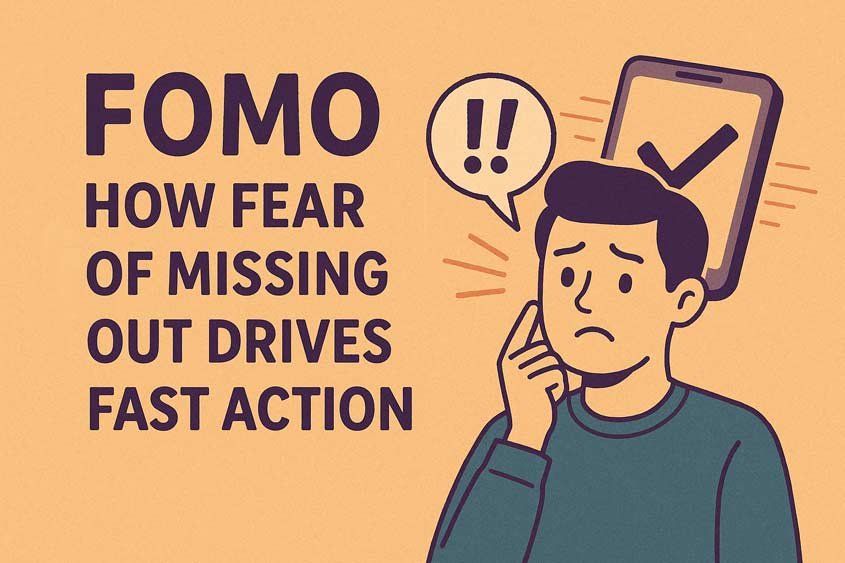
Imagine scrolling through an online store, seeing a limited-time offer flashing at the top of the page: “Only 3 left in stock!” Suddenly, you feel a twinge of urgency. You hesitate, glance at the clock, and before you know it, you’re hitting “Add to Cart.” That feeling—anxiety mixed with urgency—is what marketers call FOMO, or the Fear of Missing Out. It’s one of the most powerful psychological triggers influencing human behavior, especially when it comes to making purchases.
FOMO is not just a trendy buzzword or a social media meme. It taps into a deep-seated part of human psychology: the desire to belong, to stay relevant, and to seize opportunities before they vanish. From flash sales to exclusive memberships, FOMO creates a sense of immediacy that can make consumers act faster than they normally would.
Table of Contents
This trigger thrives because people hate feeling left behind. When a product, event, or experience is portrayed as scarce, exclusive, or fleeting, it activates a mental “now or never” response. Think about concert tickets selling out in minutes, or limited-edition sneakers dropping with a countdown timer. Marketers leverage this urgency by emphasizing scarcity, timing, and social popularity.
It’s not just about scarcity, though. Social influence amplifies FOMO. Seeing peers, influencers, or celebrities snapping up products or attending events can heighten your sense of urgency. You might rationalize it by thinking, “If they got it, maybe I need it too,” even if the product isn’t essential. FOMO interlinks with other buying triggers like social proof, authority, and urgency, creating a chain reaction that nudges consumers toward action.
FOMO also affects decision speed. Unlike rational decision-making, where people weigh pros and cons carefully, FOMO prompts faster choices. When a deal is limited, hesitation feels risky. You might buy something without fully evaluating it simply to avoid the regret of missing out. That’s why marketers often pair FOMO tactics with clear, easy actions: “Buy now,” “Reserve your spot,” “Only a few left.” Simplicity reduces friction and enhances the psychological impact.
Another subtle aspect of FOMO is its emotional impact. It often triggers a mild stress response, nudging people into action. While stress is usually something to avoid, marketers harness it ethically by highlighting opportunity loss rather than creating harmful fear. When done well, it motivates and excites rather than paralyzes.
Industries across the board use FOMO in different ways. Travel companies showcase “last rooms available,” tech brands drop limited edition gadgets, and streaming platforms promote “watch before it’s gone” campaigns. Even in subscription services or online communities, FOMO drives engagement—people join quickly to not miss benefits that others are enjoying.
Understanding FOMO is not just for marketers. As a consumer, recognizing when FOMO is in play can help you make more deliberate choices. Notice the urgency cues, the scarcity signals, and the social influence around a product. Ask yourself: “Am I buying this because I want it, or because I’m afraid of missing out?” Awareness allows you to respond intentionally rather than react impulsively.
We’ll further dive into FOMO. We’ll explore its psychological roots, practical applications in marketing, real-world examples, typical consumer responses, and the most effective ways brands use it without crossing ethical lines. By the end, you’ll not only understand why FOMO works, but also how to leverage it or recognize it in your own purchasing decisions.
Understanding FOMO
FOMO, short for “Fear of Missing Out,” is more than just a passing feeling. At its core, it is a psychological trigger that compels people to act quickly to avoid being left out or losing an opportunity. It’s the emotional tension you feel when you think that others are experiencing something you’re not, or when a chance is slipping through your fingers. While the term gained popularity in social media culture, its roots in human behavior go much deeper, tied to social comparison, scarcity, and the innate need for inclusion.
FOMO can influence almost every type of decision, but it is particularly potent in marketing. It affects what people buy, when they buy it, and even how they perceive a brand. A limited-time offer, a low-stock warning, or an exclusive product release can trigger a rush of action because consumers fear missing the experience or the benefits others are getting. This isn’t limited to products. FOMO can drive sign-ups for online courses, attendance at events, or even engagement with content. Essentially, anything framed as time-sensitive, rare, or socially desirable can activate this trigger.
The phenomenon of FOMO is rooted in two core psychological drivers: scarcity and social proof. Scarcity is the perception that something is in short supply. Humans value rare opportunities more highly than abundant ones—a principle marketers exploit constantly. Social proof, on the other hand, is the influence of observing the behavior of others. Seeing peers, influencers, or large groups enjoying or buying something reinforces the fear of being left out. Together, scarcity and social proof amplify FOMO, creating urgency that accelerates decision-making.
FOMO operates on both conscious and subconscious levels. Consciously, you might recognize that a sale ends today or that only a few items remain. Subconsciously, your brain responds to these cues with a mix of excitement and anxiety. Neuroscientific studies suggest that the anticipation of loss—like missing out on a deal—activates reward pathways in the brain, similar to the anticipation of gaining something positive. This dual activation explains why FOMO can be both motivating and stress-inducing.
It’s important to understand that FOMO doesn’t act in isolation. It often interacts with other psychological triggers in marketing. For example:
- Urgency: Limited-time offers heighten the sense of immediate action required.
- Social Proof: Seeing others engage with a product or service validates its desirability.
- Authority: Recommendations from trusted figures or experts increase the perceived value of the opportunity.
- Novelty: Exclusive or first-to-market products intensify the fear of missing out.
When combined, these triggers create a compelling ecosystem that efficiently drives behavior. A consumer encountering a scarce product, endorsed by influencers, and time-limited experiences multiple triggers simultaneously, increasing the likelihood of action.
FOMO also has behavioral patterns that marketers can anticipate. People tend to overestimate the value of limited opportunities, assume that missing out is a worse outcome than they actually experience, and act impulsively to avoid regret. This is why countdown timers, flash sales, and “only X left” messages are so effective—they tap directly into this behavioral tendency. Even subtle cues, like highlighting how many people have already purchased a product today, can create a sense of urgency and social validation.
It’s worth noting that FOMO doesn’t just influence buying decisions; it affects engagement as well. On social media platforms, FOMO can increase likes, shares, comments, and clicks. Users often interact with content because they don’t want to miss trends, conversations, or experiences that others are part of. This is why marketers leverage FOMO not only to sell products but also to grow brand awareness and maintain relevance in highly competitive markets.
FOMO can vary in intensity depending on the audience and context. Younger demographics, particularly digital natives, are generally more susceptible because social comparison is deeply ingrained in their online experiences. Professionals or high-achievers may experience FOMO when opportunities to advance, network, or learn are scarce. Even mature audiences can respond strongly if an offer touches on exclusivity, value, or social belonging. Understanding your target audience is crucial to applying FOMO effectively.
Another key aspect is that FOMO influences perception. People may see a product as more desirable simply because it is framed as scarce or exclusive. Marketers exploit this by creating experiences that feel limited, special, or time-sensitive. For instance, luxury brands often release limited editions to reinforce exclusivity, while e-commerce platforms highlight low stock or fast-selling items to accelerate purchase decisions. In both cases, the core idea is the same: making consumers feel that they risk missing something valuable if they delay.
FOMO’s influence is also amplified by human regret aversion. Many people prefer to act quickly to avoid the negative emotion of missing out rather than wait and risk indecision. This links closely to behavioral economics concepts like loss aversion, where the pain of losing is felt more strongly than the pleasure of gaining. Marketers can leverage this by framing opportunities in terms of potential loss—like a limited-time discount or a one-time event—rather than solely promoting benefits.
In practice, FOMO is highly versatile. It applies across industries, from fashion and tech to travel and education. Online platforms use FOMO in multiple ways: limited-time product drops, countdown timers, live-streamed events, and “only X seats left” messaging. Even content marketing can trigger FOMO—think of webinar registrations, newsletter sign-ups, or exclusive insider information. The common denominator is creating a perception that if the user doesn’t act, they will miss something others are experiencing.
Ultimately, understanding FOMO allows marketers to design campaigns that not only capture attention but also drive timely action. For consumers, being aware of FOMO can help make more deliberate decisions and reduce impulsive purchases. Recognizing the triggers—scarcity, social proof, urgency, novelty—equips you to see when you are being influenced and respond intentionally rather than reactively.
FOMO is a powerful driver of fast action. It influences what people buy, how quickly they decide, and even how they perceive the value of products or experiences. When applied ethically, it creates excitement, engagement, and satisfaction. Misused, it can feel manipulative, but when done right, it’s a cornerstone of effective marketing psychology that combines human behavior, social influence, and the fear of loss to drive results.
The Psychology Behind It
FOMO works because it taps into fundamental aspects of human psychology. To understand why it drives fast action, we need to break down the mechanisms that underlie it. This is not just a surface-level urge; it’s a deeply rooted response shaped by evolution, social influence, and emotional processing. Marketers leverage this trigger carefully, but knowing how it operates helps both brands and consumers recognize the power of this subtle force.
The Evolutionary Roots of FOMO
Humans evolved in social environments where inclusion in the group was crucial for survival. Missing out on resources, safety, or communal activities could have serious consequences. While modern life is very different, our brains still respond strongly to cues that suggest potential exclusion or lost opportunities. Scarcity and social proof, two core components of FOMO, tap directly into these ancient survival instincts.
When you see that an opportunity is limited, your brain perceives it as a potential loss. Neuroscience research indicates that the anticipation of missing out activates the same neural pathways as real loss or social exclusion. This produces a combination of anxiety and motivation—a push to act quickly to avoid regret. In short, your brain interprets FOMO as a signal to secure a potentially valuable resource before it’s gone.
The Step-by-Step Process of FOMO
FOMO operates through a clear sequence of cognitive and emotional triggers. Here’s a breakdown of how it typically works:
Step 1: Exposure to a Scarcity Cue
You encounter an opportunity framed as rare, time-limited, or exclusive. Examples include limited-edition products, “only a few seats left” messaging, or flash sales. Your brain immediately flags scarcity as a potential loss.
Step 2: Social Validation Kicks In
Next, social proof comes into play. Seeing other people engaging, buying, or attending the event reinforces the idea that this opportunity is desirable. Your mind naturally compares itself to the group, triggering the fear of being left out.
Step 3: Emotional Response
The combination of scarcity and social proof generates an emotional response: mild anxiety, urgency, and anticipation. These emotions act as catalysts, motivating rapid decision-making. The goal isn’t just desire—it’s the avoidance of regret.
Step 4: Evaluation vs. Impulse
At this stage, your rational mind may weigh options, but the emotional pull often dominates. Studies in behavioral economics suggest that loss aversion—the idea that people feel losses more strongly than gains—makes FOMO-driven decisions faster and sometimes less calculated.
Step 5: Action
Finally, the urge culminates in behavior. You buy, sign up, or engage quickly. The faster the perceived scarcity or social pressure, the more immediate the action. Countdown timers, “limited stock” alerts, and recent purchase notifications amplify this step.
Step 6: Post-Action Validation
After acting, people often seek reassurance. Seeing that others also acted—reviews, testimonials, or social mentions—validates the decision and reduces cognitive dissonance. This reinforces the effectiveness of FOMO for future engagement.
Core Psychological Mechanisms
Several key psychological mechanisms underlie FOMO:
- Scarcity Bias: Limited availability increases perceived value. People desire what is scarce more than what is abundant.
- Social Proof: Observing others’ behavior signals what is desirable or normative. It reduces uncertainty about a decision.
- Loss Aversion: The potential regret from missing an opportunity outweighs the potential gain from waiting.
- Urgency: Time constraints create pressure that accelerates action.
- Anticipatory Excitement: The brain anticipates the positive reward of acquiring the opportunity, further motivating behavior.
How These Interact
FOMO rarely occurs in isolation. Scarcity, social proof, and urgency interact synergistically. For instance, seeing that only two tickets remain (scarcity) and that friends have already purchased them (social proof) under a limited-time window (urgency) creates a powerful psychological cocktail that’s difficult to resist.
Examples in Everyday Marketing
Marketers apply FOMO through various techniques:
- E-commerce: Countdown timers for sales, notifications of low stock, and “X people are viewing this” pop-ups.
- Events: Early-bird pricing, limited seating, or exclusive access passes.
- Subscription Services: “Join before the offer ends,” emphasizing missed benefits if delayed.
- Social Media: Highlighting trending content, limited-time challenges, or viral campaigns.
These examples demonstrate how FOMO triggers a rapid decision-making process. They work because they hit the psychological mechanisms described above.
Observable Effects on Behavior
FOMO manifests in several predictable ways:
- Rapid decision-making, often with less evaluation.
- Preference for exclusive or scarce products over abundant alternatives.
- Increased engagement with content, especially if others are participating.
- Heightened emotional response, blending excitement and anxiety.
Understanding these mechanisms allows marketers to design campaigns that not only capture attention but also drive results. When applied ethically, FOMO creates excitement and encourages timely action without manipulating consumers unfairly. Recognizing these psychological steps also helps consumers pause and reflect, making more intentional choices rather than reacting purely out of fear of missing out.
FOMO is powerful because it bridges emotion, cognition, and social influence. It’s a multi-layered process that, when leveraged skillfully, creates both immediate engagement and long-term brand loyalty. By examining the step-by-step workings of FOMO, marketers gain insight into why it consistently drives fast action, and consumers become more aware of the triggers affecting their decisions.
The Role of FOMO in Marketing
FOMO is one of the most practical psychological triggers marketers use to influence consumer behavior. Let’s now focus on its strategic role in marketing campaigns. Understanding how it shapes decisions and drives engagement is crucial for designing campaigns that convert efficiently.
Why Marketers Rely on FOMO
At its essence, marketing is about prompting consumers to take action—whether that’s purchasing a product, signing up for a service, or engaging with content. FOMO directly accelerates this process. By emphasizing scarcity, exclusivity, or time sensitivity, marketers create a sense of urgency that pushes people to act faster than they might under normal circumstances.
FOMO doesn’t just drive immediate sales. It also enhances brand perception. When a product or offer is framed as desirable, limited, or exclusive, consumers associate it with value and status. That perception can influence long-term purchasing behavior, customer loyalty, and willingness to engage with future campaigns.
The Practical Mechanics of FOMO in Marketing
Marketers use FOMO in multiple ways, often layering it with other triggers like urgency, social proof, and novelty to maximize effect. Here’s how these tactics work in practice:
Scarcity Messaging
Highlighting limited availability or time-sensitive offers is a direct application of FOMO. Examples include:
- Limited stock notifications (“Only 3 left in inventory”)
- Countdown timers for sales or events
- Exclusive product editions or early access offers
Scarcity signals value. People naturally prioritize opportunities that seem fleeting, leading to faster purchasing decisions.
Social Proof Amplification
FOMO is often magnified when people see that others are participating. Marketers employ social proof to create a perception that missing out means being left behind:
- Highlighting the number of people currently viewing or buying a product
- Featuring customer testimonials, reviews, or influencer endorsements
- Showcasing trending content or viral campaigns
Social proof reassures consumers that their decision aligns with the behavior of others, reducing hesitation and boosting confidence.
Urgency and Deadlines
Time-based triggers are another critical aspect of FOMO. Limited-time offers create pressure to act immediately:
- Flash sales lasting only a few hours
- Seasonal promotions or event-specific campaigns
- Early-bird discounts for tickets or memberships
The combination of scarcity and urgency pushes consumers to take action before they perceive the opportunity as lost.
FOMO Across Industries
FOMO isn’t restricted to e-commerce. Its versatility makes it applicable across industries:
- Retail and Fashion: Exclusive product drops, limited editions, or flash sales.
- Travel and Hospitality: Last-minute deals, limited rooms, or seasonal packages.
- Technology and Gadgets: Product launches with limited stock or pre-order incentives.
- Education and Online Courses: Early enrollment perks, bonus materials for quick sign-ups.
- Entertainment and Events: Ticket releases, VIP experiences, or limited streaming availability.
Across these contexts, FOMO’s role remains the same: it triggers faster decisions and boosts engagement by framing opportunities as scarce, exclusive, or socially validated.
How FOMO Shapes Consumer Decisions
The influence of FOMO on consumer decisions is multifaceted:
Decision Acceleration
Consumers exposed to FOMO cues make faster choices. When a product appears scarce or an offer is time-limited, people prioritize speed over prolonged evaluation. The fear of regret outweighs the need for extensive deliberation.
Value Perception
FOMO can increase the perceived value of a product or experience. Limited availability, social validation, and exclusivity signal higher desirability, which makes consumers more willing to pay and act.
Engagement Boost
Beyond purchases, FOMO increases engagement. Social media posts, email campaigns, or live events designed with FOMO in mind often see higher click-through rates, shares, and comments. People don’t want to be left out of trends or conversations, so they participate more actively.
Brand Loyalty
Strategically applied FOMO can foster long-term loyalty. Customers who successfully secure a limited opportunity feel satisfaction and connection with the brand. Repeated exposure to these positive experiences strengthens emotional attachment and repeat purchasing.
Ethical Use of FOMO
While FOMO is highly effective, it must be applied ethically. Misleading scarcity or false urgency can damage trust and brand reputation. Marketers should ensure that any limited stock, time-sensitive offer, or social proof is genuine. Ethical use builds excitement and engagement without manipulating consumers unfairly.
FOMO’s practical value in marketing lies in its ability to drive action quickly, influence perceived value, and enhance engagement. It works across industries and can be combined with other psychological triggers to create campaigns that are both persuasive and effective. When applied with transparency and honesty, FOMO not only encourages fast action but also builds long-term brand relationships.
FOMO Real Case Studies
FOMO isn’t just theory—it’s a trigger that produces measurable results when applied strategically. Across industries, brands have leveraged this psychological driver to boost sales, engagement, and customer loyalty. The following real-world examples demonstrate how scarcity, urgency, and social proof converge to create fast action.
Case Study 1: Supreme – Limited-Edition Drops
Supreme, the streetwear brand, is widely known for its exclusive product drops. The company releases limited quantities of apparel and accessories in weekly “drops” that generate massive hype.
How FOMO Was Applied
- Scarcity: Each item is produced in extremely limited numbers. Once it sells out, it rarely returns.
- Social Proof: Fans and resellers post images of purchased items on social media, signaling desirability.
- Urgency: The drops occur on specific days at specific times, often selling out in minutes.
The Results
Supreme’s strategy creates a sense of urgency and exclusivity that drives rapid purchase decisions. The resale market alone demonstrates the success of this FOMO tactic, with some items selling for multiples of the original retail price. Customers act quickly to avoid missing out, proving the trigger’s power in high-demand industries.
Case Study 2: Booking.com – Hotel Availability Notifications
Booking.com, a global travel platform, uses FOMO to increase booking conversions by highlighting scarcity and recent activity.
How FOMO Was Applied
- Scarcity Messaging: “Only 2 rooms left at this price” or “Last available room.”
- Social Proof: “Booked 5 times in the last 24 hours” shows high demand from others.
- Urgency: Limited-time pricing or flash deals push users to act immediately.
The Results
Studies and internal reports from Booking.com show that scarcity messaging can increase conversion rates by up to 10–15%. By showing limited availability and peer activity, the platform accelerates decision-making and reduces hesitation, demonstrating the practical efficiency of FOMO in e-commerce.
Case Study 3: Apple – Product Launch Queues
Apple consistently applies FOMO during product launches. From iPhones to MacBooks, the company creates anticipation and scarcity to drive rapid adoption.
How FOMO Was Applied
- Pre-Orders and Limited Stock: New products are available for pre-order with limited quantities for early buyers.
- Social Proof: Long lines outside stores and social media coverage of purchases amplify desire.
- Exclusivity: Limited edition colors or configurations enhance perceived uniqueness.
The Results
Apple’s launches often see millions of units pre-ordered within hours, creating media buzz and a sense of urgency among late adopters. This FOMO-driven demand not only drives immediate sales but also reinforces brand prestige and consumer loyalty.
Key Insights from the Case Studies
Analyzing these examples reveals several patterns in effective FOMO campaigns:
- Scarcity and exclusivity are central to consumer motivation.
- Social proof amplifies the urgency, confirming that others value the opportunity.
- Timed releases or limited availability accelerate action and reduce hesitation.
- FOMO works across industries: fashion, travel, and technology all benefit from similar psychological mechanics.
By studying these cases, marketers can identify actionable strategies that apply FOMO ethically and effectively, while consumers gain insight into the triggers that influence their decision-making.
How Consumers React
Understanding how consumers respond to FOMO is crucial for marketers and for anyone trying to recognize the influence of this psychological trigger. FOMO doesn’t just exist in abstract; it produces observable behaviors that can be measured, predicted, and strategically addressed. From impulsive purchases to heightened engagement, the responses are consistent across demographics and industries, though intensity may vary based on context and personal susceptibility.
Immediate Behavioral Responses
When consumers encounter FOMO cues, several predictable behaviors emerge almost instantly.
Quick Decision-Making
One of the most common reactions is rapid action. Limited-time offers or low-stock notifications push people to make decisions faster than they usually would. Instead of deliberating over options, consumers act immediately to secure the opportunity. For example, a shopper seeing “Only 2 items left!” may skip comparing alternatives and proceed directly to purchase.
Heightened Engagement
FOMO also increases interaction with content or platforms. People are more likely to click, comment, share, or explore when they perceive that an opportunity might slip away. Social media posts, live events, and trending topics often see high engagement precisely because consumers fear missing out on the experience that others are enjoying.
Emotional Arousal
The emotional dimension of FOMO is critical. Consumers often experience a mix of excitement, anticipation, and mild anxiety. This emotional arousal drives behavior by activating reward pathways in the brain. People are motivated not only by the desire to gain something positive but also by the fear of loss, making them more susceptible to persuasive cues.
Long-Term Behavioral Patterns
Beyond immediate reactions, FOMO can influence consumer behavior over time.
Repeated Participation
When FOMO is successfully leveraged, consumers often return for future opportunities. Limited editions, exclusive content, and early-access deals create a pattern where consumers repeatedly engage with a brand to avoid missing out.
Preference for Scarce Products
Consumers develop a tendency to value products framed as rare or exclusive. They are more likely to prioritize limited items over widely available alternatives, even if the difference in utility or quality is minimal.
Peer Influence Amplification
FOMO encourages consumers to track what others are doing. This leads to social monitoring behaviors such as checking friends’ activity, following influencers, or observing trending topics to avoid missing experiences.
Observable Consumer Responses Across Contexts
Different industries show distinctive manifestations of FOMO-driven behavior:
E-Commerce
- Rapid checkout in response to stock notifications.
- Increased click-through on limited-time offers.
- Preference for products with “hot” or “trending” labels.
Travel and Experiences
- Quick bookings for flights, hotels, or events flagged as scarce.
- Tendency to upgrade or choose exclusive packages to avoid missing out.
- Social sharing of experiences to reinforce status and engagement.
Technology and Product Launches
- Pre-orders and immediate purchases when new devices are released.
- Participation in limited-edition or early-access programs.
- Increased attention to launch announcements and countdowns.
Psychological Underpinnings of Consumer Reactions
Consumer responses to FOMO are tied to a few consistent psychological principles:
- Loss Aversion: The pain of missing out outweighs potential benefits of waiting or exploring alternatives.
- Social Comparison: Observing peers’ participation increases the perceived value of the opportunity.
- Urgency Bias: Time-limited cues accelerate action by creating perceived scarcity of time.
- Anticipated Regret: Consumers act quickly to avoid the emotional discomfort of missing a desirable experience.
By understanding these typical responses, marketers can anticipate behavior, design more effective campaigns, and ethically guide consumer action. Meanwhile, consumers can become more aware of how FOMO influences their choices, allowing for more intentional and thoughtful decision-making.
How Brands Use It Effectively
FOMO is one of the most actionable psychological triggers for marketers, but its effectiveness depends on careful, ethical application. When executed strategically, it drives engagement, accelerates decision-making, and enhances perceived value without crossing into manipulation. Brands across industries have developed practical, repeatable strategies to leverage FOMO while maintaining consumer trust.
Creating Scarcity Without Misleading Consumers
One of the most straightforward ways to use FOMO is through authentic scarcity. This means highlighting limited quantities, exclusive products, or time-bound offers that truly exist. Misrepresenting availability can erode trust, but genuine scarcity enhances desirability and drives timely action.
Examples
- Limited Editions: Releasing products in small quantities with unique features or designs.
- Time-Limited Offers: Flash sales or early-bird pricing that genuinely ends after a set period.
- Exclusive Access: VIP memberships, pre-order options, or early-access content for loyal customers.
When scarcity is authentic, it motivates without misleading the audience, creating urgency and excitement simultaneously.
Leveraging Social Proof
FOMO is amplified when consumers see that others are acting. Social proof reinforces the perception that a product or opportunity is desirable. Brands can ethically apply this by showcasing real activity and engagement rather than fabricating demand.
Examples
- Displaying recent purchases or sign-ups in real time.
- Highlighting positive reviews and testimonials from verified customers.
- Promoting participation in events, challenges, or online communities.
Social proof validates the consumer’s potential decision and increases confidence, creating a natural push to act.
Using Urgency and Timing Strategically
Time-sensitive cues increase the pressure to act without creating stress or fear beyond the normal scope of decision-making. Marketers can use countdowns, seasonal promotions, and limited-time bundles to ethically encourage immediate action.
Examples
- Flash sales that run for a defined number of hours.
- Event registration deadlines for workshops or webinars.
- Seasonal campaigns with clearly communicated start and end dates.
Urgency works best when paired with other triggers, such as social proof or scarcity, reinforcing the need to act now.
Integrating FOMO Across Channels
Brands can maximize FOMO’s impact by applying it consistently across multiple marketing channels. This ensures that consumers encounter the same urgency and scarcity cues wherever they interact with the brand.
Examples
- Email Marketing: Announce exclusive deals with countdown timers and limited availability.
- Website Notifications: Show recent purchases or low-stock alerts in real time.
- Social Media Campaigns: Highlight trending products, upcoming events, or limited access experiences.
- Mobile Apps: Send push notifications for expiring offers or limited quantities.
Consistency across channels reinforces the psychological trigger and maintains momentum, increasing the likelihood of action.
Ethical Principles for Applying FOMO
Effective FOMO campaigns maintain transparency, honesty, and consumer respect. Misleading scarcity, fake testimonials, or false urgency can generate short-term results but erode long-term trust. Brands that follow ethical principles build sustainable engagement. Key considerations include:
- Only claim limited availability when it exists.
- Use real social proof from genuine customers.
- Clearly communicate deadlines and terms.
- Avoid high-pressure tactics that create unnecessary stress or anxiety.
By applying FOMO effectively, brands can create excitement, encourage timely action, and enhance the perceived value of their products or services. Ethical use ensures that consumers respond positively, reinforcing engagement and loyalty while avoiding manipulation.
Mistakes to Avoid
While FOMO is a powerful marketing trigger, it can backfire if misused. Missteps not only reduce effectiveness but can also harm a brand’s reputation and erode consumer trust. Understanding common pitfalls allows marketers to harness FOMO ethically and effectively, ensuring campaigns drive action without alienating their audience.
Overstating Scarcity
One of the most frequent errors is exaggerating scarcity or availability. Claiming that a product is limited when it’s widely available can generate short-term clicks but damages credibility when consumers realize the truth. Repeated false scarcity makes future offers less believable and reduces engagement.
Impact
- Loss of trust among your audience
- Increased skepticism toward future promotions
- Lowered conversion rates over time
Overusing Urgency
Urgency is a core component of FOMO, but overusing it can lead to fatigue or anxiety. Constant “limited-time” offers create a perception that everything is urgent, reducing the effectiveness of each individual campaign. Consumers may become desensitized or develop pushback, ignoring messages entirely.
Impact
- Reduced responsiveness to future offers
- Potential negative emotional association with the brand
- Decreased long-term engagement
Ignoring Social Proof Authenticity
FOMO is amplified by social proof, but using fake testimonials, fabricated reviews, or misleading numbers can be detrimental. Consumers are quick to detect inauthentic social cues, and exposure can harm brand credibility. Authenticity is essential to maintaining trust and sustaining engagement.
Impact
- Negative perception of brand integrity
- Loss of customer loyalty
- Risk of public backlash or regulatory issues
Targeting the Wrong Audience
FOMO is not equally effective for all audiences. Applying it broadly without considering demographic, psychographic, or behavioral characteristics can lead to low engagement or even irritation. Younger, socially active demographics often respond more strongly than older or more analytical consumers. Misaligned campaigns may fail to convert.
Impact
- Poor campaign performance
- Wasted marketing resources
- Potential alienation of key customer segments
Ignoring Ethical Boundaries
Misuse of FOMO can cross into manipulation. For instance, creating fake scarcity, using misleading urgency, or implying social proof that doesn’t exist can push consumers to act out of anxiety rather than informed choice. Brands must ensure that their campaigns respect consumer autonomy and provide clear, truthful information.
Impact
- Damage to brand reputation
- Legal or regulatory consequences
- Long-term decline in consumer trust
Lessons for Marketers
The key to avoiding mistakes is to balance effectiveness with transparency. FOMO works best when it is authentic, clear, and ethically applied. Brands should prioritize genuine scarcity, real social proof, and well-timed urgency rather than relying on manipulative tactics. Testing campaigns and monitoring audience response helps refine strategies, ensuring that FOMO drives desired behavior without negative fallout.
By avoiding these common errors, marketers can maintain trust, enhance engagement, and leverage FOMO as a reliable, ethical tool to encourage fast, confident consumer action.
Practical Tips
FOMO is a highly effective trigger when applied strategically, but its power lies in the execution. To maximize impact, marketers must combine psychological understanding with actionable techniques, ensuring campaigns feel natural, engaging, and ethical. Below are practical tips to apply FOMO effectively, followed by actionable steps you can implement immediately.
Start with Authentic Scarcity
The foundation of FOMO is authenticity. Consumers are highly attuned to misleading claims, so scarcity must be real. This can be achieved by limiting product quantities, offering early-access opportunities, or creating exclusive experiences. When scarcity is genuine, it motivates faster decision-making without eroding trust.
Tips for Scarcity
- Use inventory limits that accurately reflect availability.
- Offer early access or VIP opportunities for loyal customers.
- Introduce limited-time products or special editions to create exclusivity.
Combine Scarcity with Social Proof
FOMO becomes more compelling when paired with social proof. Demonstrating that others are acting reinforces the desirability of the opportunity and reduces hesitation. This combination is particularly effective in digital marketing environments, where real-time engagement can be highlighted.
Tips for Social Proof
- Showcase customer reviews, testimonials, or ratings prominently.
- Display live activity, such as “X people are viewing this product right now.”
- Highlight trending or popular items based on verified metrics.
Leverage Urgency Ethically
Time-based triggers accelerate decision-making by creating a sense of immediacy. However, urgency must be communicated clearly and truthfully to avoid consumer skepticism or frustration. When used correctly, urgency complements scarcity and social proof to drive faster action.
Tips for Urgency
- Use countdown timers for promotions or product releases.
- Clearly communicate start and end dates for offers.
- Limit special benefits, such as bonuses or discounts, to specific timeframes.
Target the Right Audience
Not all consumers respond equally to FOMO. Understanding your audience’s motivations, behaviors, and preferences ensures that FOMO campaigns resonate effectively. Younger, socially active, and trend-sensitive segments often respond more strongly. Tailoring messaging improves relevance and increases engagement.
Tips for Audience Targeting
- Segment your audience based on past behavior or engagement patterns.
- Use personalized messaging to highlight relevant opportunities.
- Test campaigns with smaller groups before scaling widely.
Integrate Across Channels
Consistency across marketing channels strengthens the FOMO effect. When consumers encounter the same cues on websites, email, social media, and mobile apps, the perceived importance and urgency of the opportunity increase. Multi-channel integration also allows you to reinforce key messages without overwhelming your audience.
Tips for Multi-Channel Application
- Sync scarcity and urgency messaging across email, website, and social media.
- Use push notifications or SMS alerts for limited-time offers.
- Maintain a consistent tone and messaging style across all channels.
By following these practical tips, marketers can ethically and effectively apply FOMO to increase engagement, accelerate purchasing behavior, and enhance perceived value. These steps transform abstract psychological principles into actionable strategies that deliver measurable results while maintaining consumer trust.
Spot The Trigger
Now that you’ve explored FOMO and how it operates, it’s time to test your ability to recognize it in real-world marketing. Below are three hypothetical exercises. For each, decide whether the FOMO trigger is being used and pay attention to the cues that signal scarcity, urgency, or social proof.
Exercise 1
A fashion retailer launches a limited-edition sneaker collection. Only 200 pairs are available, and the website displays a live counter showing how many have already been sold. Influencer posts show fans queuing outside the store early in the morning to secure a pair.
Question: Is the brand using the FOMO trigger? (True or False) | Check Answer
Exercise 2
A subscription box company sends an email promoting a new line of seasonal items. The email highlights that early subscribers will receive bonus items but does not mention any time constraints or limited availability. The email also emphasizes product quality and variety.
Question: Is the brand using the FOMO trigger? (True or False) | Check Answer
Exercise 3
A travel agency advertises a weekend getaway deal. The promotion notes that rooms are almost sold out and that several people have booked in the last 24 hours. It encourages booking immediately to secure the discounted rate.
Question: Is the brand using the FOMO trigger? (True or False) | Check Answer
This exercise demonstrates how to spot FOMO cues in marketing campaigns. Notice the recurring elements: limited supply, time-sensitive offers, and signals that others are acting. These are the triggers that push consumers to act quickly.
Key Points Recap
FOMO, or the fear of missing out, is more than a catchy phrase—it’s a powerful psychological trigger that influences decisions, shapes consumer behavior, and drives fast action. Throughout this article, we’ve explored what FOMO is, why it works, and how it manifests in real marketing contexts. Understanding its mechanics helps both marketers and consumers recognize its impact.
At its core, FOMO leverages three primary psychological drivers: scarcity, urgency, and social proof. Scarcity makes opportunities feel limited and valuable. Urgency encourages rapid decision-making to avoid missing out. Social proof validates choices by showing that others are engaging or purchasing. Together, these factors create a compelling motivation for consumers to act quickly, often bypassing extended deliberation or comparison.
Marketers use FOMO across industries—fashion, technology, travel, and more—to boost engagement, accelerate purchases, and enhance perceived value. Case studies like Supreme’s limited-edition drops, Booking.com’s availability notifications, and Apple’s product launches demonstrate how FOMO drives measurable results. Consumers respond with faster decisions, higher engagement, and repeated participation, often valuing exclusive or limited experiences more highly than widely available alternatives.
Ethical application is essential. Misleading scarcity, fake urgency, or fabricated social proof can erode trust and harm long-term relationships with consumers. Effective campaigns balance excitement with transparency, offering genuine limited opportunities and clear information while still motivating action.
Practical tips for applying FOMO include ensuring authenticity, pairing scarcity with social proof, using urgency strategically, targeting the right audience, and integrating messaging across multiple channels. Avoid common mistakes such as overusing urgency, exaggerating scarcity, or relying on inauthentic social cues. These missteps reduce impact and can create pushback.
Recognizing FOMO in marketing also empowers consumers to make more deliberate choices. By spotting cues like limited availability, trending activity, or time-sensitive offers, you can evaluate whether decisions are being driven by genuine interest or by the fear of missing out.
In summary, FOMO is a versatile, evidence-based trigger that shapes consumer behavior by creating urgency and increasing perceived value. When used strategically and ethically, it can enhance engagement, drive faster decision-making, and support brand loyalty. For marketers, it’s a tool to inspire action and reinforce desirability. For consumers, understanding FOMO offers clarity and control over impulsive responses, helping you make more informed choices in a world filled with opportunities and limited-time offers.
FOMO is not just about fear—it’s about motivation, perception, and timing. Recognize it, apply it wisely, and you’ll see how powerful a tool it can be in shaping decisions.

Gabriel Comanoiu is a digital marketing expert who has run his own agency since 2016. He learned marketing by testing, analyzing, and refining campaigns across multiple channels. In his book series Impulse Buying Psychology, he shares the psychological triggers behind every purchase, showing how to create marketing that connects, persuades, and converts.