
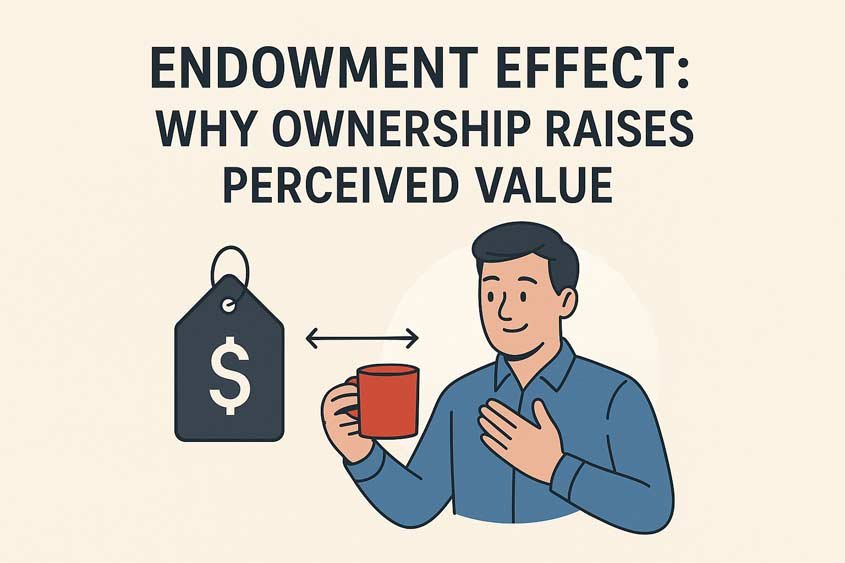
You’ve probably noticed something funny about the way people treat the stuff they own. Give someone a mug, and suddenly it’s not just a mug. It’s their mug, and that tiny shift changes everything. That’s the Endowment Effect in the wild, quietly working behind the scenes and shaping the way you value things, choose products, and justify purchases. In marketing, this trigger sits in the Motivation and Decision-Making family because it taps into the deeper emotional layers of how you evaluate ownership, identity, and loss.
When you look at the Endowment Effect from a marketer’s point of view, it becomes one of those sneaky, powerful drivers you can’t really ignore. The moment a customer feels even a small sense of ownership, their perception shifts. What they already possess feels more valuable than something they don’t. And honestly, that’s why so many brands try to make you feel like something is “yours” long before you actually buy it. That’s the whole game.
Table of Contents
Think about the first time you tested a new phone in a store. You didn’t just look at it behind glass. You held it. You swiped around. You personalized the screen a bit, maybe opened the apps you care about. In a weird way, your brain already started claiming it. Compared to every other phone on the shelf, that one started feeling like the best fit because you already tasted a little bit of ownership. Marketers know this works, and they lean into it hard.
The Endowment Effect shows up everywhere—from real estate to eCommerce, from cars to cosmetics, from SaaS tools to subscription boxes. Sometimes it’s subtle, like when a site tells you “your saved items are waiting.” Other times it’s bold, like when companies offer long free trials so you can integrate their product into your routine. Once the thing becomes part of your day, part of your identity, your brain doesn’t want to let it go. This is why triggers like Familiarity and Commitment often show up beside it; they reinforce the sense of personal connection and possession.
You’ll see the Endowment Effect in everyday behavior too. Maybe you’ve cleaned out a closet and found yourself weirdly attached to some old sweater you haven’t worn in years. You don’t use it, you don’t need it, but because it’s yours, it feels like it has more value than the same sweater sitting on a rack somewhere. Buyers act the same way when they consider parting with something or replacing it—loss aversion kicks in, ownership solidifies, and the perceived value shoots up.
From a marketing psychology perspective, the key insight is this: ownership isn’t just about legal possession. It’s a feeling. It can be temporary, symbolic, or even imaginary. You can make someone feel connected through small touches like personalization, customization, interaction, or even just imagining themselves using the product. Once a customer mentally claims something, they value it more than alternatives. That’s the heart of the trigger.
It’s also why certain ads focus on you living with the product instead of simply buying it. Think of those home improvement commercials that show families cooking in the remodeled kitchen, laughing, and practically settling into the space. They’re selling ownership before you ever lift a hammer. Same with car brands that show you cruising through your favorite roads. They’re nudging you toward “this is your life with this product,” which is a cousin technique to triggers like Anticipation and Identity. And yes, the Endowment Effect is right in the middle of all that.
Marketers who truly understand this trigger don’t just push features. They craft moments that make your brain say, “This is already mine.” It can be through allowing you to try something, personalize something, preview something, or interact with something long enough for the attachment to take root. And once it does, you cling to it a bit tighter. You defend it. You justify its price. You prefer it over alternatives that might even be better on paper.
The intriguing part is how universal this is. It doesn’t matter if you’re a beginner shopper or a seasoned decision-maker. The trigger hits across age groups, cultures, and industries. And if you’re building a brand, using it ethically can help you create bonds that feel real instead of manipulative. You give value first. You let people experience the thing. You invite them to see it as part of themselves. That’s where loyalty begins.
As you go through this chapter, you’re going to see how the Endowment Effect works, where it shows up, why it matters, and how brands use it without crossing ethical lines. You’ll get clear examples, real-world cases, and plenty of actionable ideas for applying it in marketing campaigns. If you’ve ever wondered why “try before you buy” is such a common strategy or why people love personalized recommendations, this is the place where all those threads finally connect.
What is Endowment Effect?
When you break it down, the Endowment Effect is a simple idea with a surprisingly strong influence: you tend to value something more once you feel it’s yours. Even a tiny sense of ownership can shift your judgment. That shift affects buying decisions, pricing decisions, product preferences, and even how long you hold on to something you don’t actually need. In marketing psychology, this trigger sits right in the Motivation and Decision-Making category because it changes how you evaluate options and how you justify choices.
The interesting part is that ownership doesn’t need to be official. Your mind reacts the same way whether you legally own something or you’re just testing it, customizing it, or imagining it in your life. A little touch, a little personalization, or a little interaction is enough. And once your brain accepts something as “mine,” it becomes harder to replace, harder to ignore, and harder to give up.
Below, let’s break the concept into clearer pieces so you can see exactly how this trigger works.
The Basic Definition
At its core, the Endowment Effect describes your tendency to place a higher value on items you own compared to identical items you do not own. The object didn’t change. The quality didn’t change. The usefulness didn’t change. What changed is your relationship with it.
Your sense of ownership boosts the perceived value. This happens fast. In some cases, it happens within seconds. The effect influences everyday decisions without you noticing. When you choose one product repeatedly because it feels familiar, or you justify paying a premium because you “already invested” in something, the trigger is working under the surface.
This also explains why people often demand more money to give something up than they would be willing to pay to get it in the first place. In markets, negotiations, subscriptions, and product trials, this shift in valuation shows up again and again.
Why Ownership Changes Perception
Ownership creates attachment. Once you feel connected to something, your brain treats it differently. You focus on the benefits instead of the flaws. You imagine how losing it would feel, and loss always hits harder than gain. That’s where the effect gets its power.
You can see this in small moments. Someone tries on a jacket in a store, stands in front of the mirror, and suddenly they’re already picturing it as part of their style. A shopper places an item in their online cart, and it becomes “their pick.” A homeowner steps inside a house for a viewing, imagines their furniture in it, and the place instantly feels more valuable.
Marketers understand this psychological shift, which is why they push actions that spark ownership: free trials, samples, temporary access, saved lists, custom settings, interactive demos. Even virtual try-ons trigger a mild sense of possession.
What It Influences in Decision-Making
The Endowment Effect influences several areas of consumer behavior:
- Pricing choices
People pay more for what feels like theirs. They also reject selling or giving up something unless they receive a higher price than its actual market value. This creates a gap between buying price and selling price. - Brand loyalty
Ownership leads to attachment, and attachment leads to sticking with the same brand. Once you feel invested, switching feels like losing something. - Perceived value
The moment an item becomes part of your identity or lifestyle, its importance grows. You start prioritizing it. You defend it in your mind. You choose it even when alternatives are better or cheaper. - Resistance to alternatives
When you already “own” something mentally, competing products feel like a downgrade. This is why people stick with their favorite phone brand or their usual subscription, even if better offers exist. - Justifications and rationalizations
Your mind works overtime to defend your choice. You highlight positives, downplay negatives, and build stories that make your decision feel smart.
This is one of those triggers that blends naturally with others like Familiarity, Identity, Commitment, and Anticipation. They often reinforce each other. Once a product feels like part of you, every other trigger gets amplified.
Ownership Without Buying: How Marketers Trigger It Early
One of the most useful things about the Endowment Effect is that it doesn’t require a purchase to activate. Brands just need to make you feel like something is personalized, selected by you, touched by you, or aligned with your identity.
Examples include:
- letting you personalize a product before buying
- offering free trials with full features
- using “your plan,” “your saved items,” or “your setup” language
- letting you build your own version of something before checkout
- encouraging you to test or handle the product physically
- allowing you to preview how something looks in your home or on your body
The moment your brain accepts it as “mine,” even temporarily, your evaluation shifts and your desire to keep it increases.
A Quick Look at How It Shows Up Across Industries
You’ll see the Endowment Effect in tech, real estate, retail, automotive, B2B tools, and even service industries. A car dealership hands you the keys for a test drive. A software company offers a free month where you set up your dashboard. A home decor brand lets you upload images of your living room to preview products. A clothing brand uses virtual fitting rooms. Every one of these situations creates a small but meaningful sense of ownership.
The trigger shows up even when the stakes are low. Think about sample-sized cosmetics, trial gym passes, or “add to wishlist” nudges. They’re all mild ownership cues. And once a customer feels that tiny spark of possession, the perceived value increases.
Why This Trigger Is so Reliable
The Endowment Effect works because it touches deeply rooted instincts. People want to avoid losing something they feel attached to. Loss aversion, identity protection, and emotional connection combine to create strong reactions. You don’t need logic to justify it. The feeling is enough.
Marketers rely on this because it doesn’t require complexity. You don’t need long explanations, heavy persuasion, or pressure. You just need to create a moment where the customer sees the product as part of their world. The brain handles the rest.
The Psychology Behind It
The Endowment Effect doesn’t feel like a single trick; it’s more like a chain reaction inside your head. Start with a small cue of ownership and the way you assess worth shifts—often before you’re consciously aware. Below I’ll map the psychological mechanism step by step so you can see how the Endowment Effect moves from a tiny interaction into a measurable change in behavior and preference.
Step 1 — Ownership Cue: the moment something becomes “yours”
Everything begins with a cue that nudges your brain to treat an object or experience as yours. That cue can be physical—holding a product, clicking “add to cart,” dragging an item into a wishlist—or mental, like imagining the item in your life. When that cue happens, the Endowment Effect is primed.
This cue doesn’t have to be a purchase. A free trial, a demo, a virtual try-on, or a personalization step is enough. The important point is that the customer now perceives a relationship with the product. Once the relationship exists, valuation changes.
Step 2 — Attachment and Identity linking
After the ownership cue, your brain starts attaching meaning to the object. You don’t just see a thing; you see a potential extension of your identity. The Endowment Effect works through this identity link—ownership becomes a small claim on who you are.
That’s why personalization matters: when you add your name, set your preferences, or customize colors, you aren’t merely changing visuals—you’re letting the item inhabit your personal world. Identity beats abstract features. When something becomes “part of you,” you treat it like an asset.
Step 3 — Integration into routines and mental models
Next, the item slips into your mental models and daily routines. Whether you’ve used a product for five minutes or five weeks, when it’s experienced inside a routine, the Endowment Effect strengthens. Your mental model updates: the product moves from “option” to “tool.”
This integration is why trial periods and onboarding matter so much. The more a customer uses and adapts, the more the object is perceived as necessary, familiar, and, crucially, owned.
Step 4 — Loss aversion kicks in
Loss aversion is the engine that accelerates the Endowment Effect. Once ownership is perceived—even briefly—your brain weighs losses more heavily than gains. Giving up the item feels like a loss; keeping it feels like avoiding harm.
So when you’re asked to pay or decide, the decision isn’t about incremental utility anymore. It’s about protecting what you already “have.” That asymmetry between perceived loss and prospective gain explains why people often demand more to relinquish something than they would pay to acquire it.
Step 5 — Rationalization and post-purchase defense
Finally, once you value something more because of perceived ownership, your mind goes into protective mode. You rationalize. You highlight benefits and minimize flaws. The Endowment Effect invites cognitive work that justifies holding on.
This is why customers often give emotional reasons for purchases that, on paper, look irrational. The psychological chain—cue, attachment, integration, loss aversion, rationalization—produces decisions that feel internally consistent, even when they contradict an outside observer’s logic.
The neurological undertone (briefly)
You don’t need a lab to see the pattern, but neurologically, these steps involve overlapping systems: reward circuits that like possession, memory systems that encode personal use, and threat-related circuits that dislike loss. The Endowment Effect is the behavioral output when those systems talk to each other.
How the process looks in practice
To make this more concrete, here’s how the process flows in a typical marketing scenario: a shopper customizes a product (ownership cue), imagines using it with their name or setting (attachment), tries it at home or in a trial (integration), feels reluctant to give it up when the trial ends (loss aversion), and finally decides to pay because selling feels like loss (rationalization). Across that sequence, the Endowment Effect raised perceived value at each step.
One list marketers must know (tactics that trigger the chain)
- Free trials with low friction (easy setup, immediate use)
- Personalization interfaces (monogramming, color choices, saved preferences)
- Interactive demos and virtual try-ons that let users “place” items in their life
- Temporary possession cues (test drives, samples, day-long rentals)
- Soft ownership language (“your items,” “your setup,” “saved for you”)
- Onboarding sequences that integrate the product into daily workflows
Each item above isn’t just a tactic—each is a specific nudge that activates a step in the Endowment Effect chain.
How other triggers amplify the Endowment Effect
The Endowment Effect rarely works alone. It typically pairs with other psychological triggers to form a multiplier effect:
- Familiarity: repeated exposure makes the ownership cue feel more natural. Familiarity reduces friction and shortens the path from cue to attachment.
- Commitment: small commitments (saving a cart, starting setup) increase follow-through and deepen perceived ownership.
- Identity: appeals to who the buyer believes they are accelerate the attachment stage.
- Anticipation: previews of future enjoyment work as mini-ownership cues—imagining future use is almost like briefly owning it.
- Loss aversion: as discussed, is the power source that makes the shift in valuation persistent.
Understanding these overlaps helps you design experiences where the Endowment Effect is ethical and effective, not manipulative.
Signals that the Endowment Effect is active (what to watch for)
You’ll know the Endowment Effect is working when customers:
- hesitate to cancel trials
- pay above-market prices for a favored configuration
- defend a purchase emotionally after the fact
- prefer a previously used option over a technically better alternative
Those behaviors are exactly what the psychology predicts: perceived ownership changed the calculus.
A caveat: not a guaranteed conversion hack
Finally, a realistic note: the Endowment Effect increases perceived value, but it’s not a magic switch. Poor product-market fit, bad onboarding, or obvious manipulation kills trust and undoes ownership feelings. The best use of the Endowment Effect is paired with genuine value—let people experience real benefits, then let ownership do the rest.
Why It Matters in Marketing
Marketers love the Endowment Effect for one simple reason: it changes the way people judge value. When someone feels connected to a product, even a tiny bit, they treat it differently. They compare it differently. They justify the price differently. And once that shift happens, their decision process isn’t the same as before. That’s why this trigger shows up in smart campaigns across industries. You’re not forcing people to buy. You’re letting them experience the product long enough for their own psychology to pull them closer.
Below, we’ll walk through how this trigger influences decisions, shapes behavior, and strengthens brand outcomes in a way few tactics can match.
The instant value boost
The Endowment Effect increases the perceived value of a product without changing the product itself. That’s the beauty of it. Once a customer feels a sense of ownership—even symbolic—their internal valuation rises.
A shopper who customizes a pair of shoes isn’t looking at the same pair as the next person who browses the website. They’re looking at “their design.” Suddenly the price feels more justifiable. And that subtle upgrade in value perception doesn’t just lead to higher conversion rates. It often creates more willingness to defend the choice, recommend it, or stick with the brand. That’s a hard thing to replicate with pure messaging.
How it shortens the distance to decision
Most buying hesitation comes from uncertainty. People wonder if the product fits their life. They wonder if they’ll regret the purchase. They wonder if something better exists. The moment you help someone experience a product as if they already own it—even briefly—you shrink all that spacing.
A free trial lets someone use a tool before paying. A virtual try-on lets someone see a product on themselves. A test drive lets someone feel what driving the car is like in their real environment. Each of these nudges compresses doubt and expands familiarity. It’s a psychological shortcut: when something already feels part of your world, deciding becomes easier and faster.
And here’s the interesting part: this also ties to the Familiarity trigger. The more comfortable the product feels, the more ownership sticks. That overlap is exactly where conversions get smoother.
It influences how people compare alternatives
Once the Endowment Effect kicks in, people stop comparing options purely on features or price. They compare based on emotional sense of fit. They weigh “what I already like using” more heavily than “what might be slightly better.”
A customer who has tried a product and incorporated it into their routine—even for a short time—evaluates alternatives differently. The competitor has to be significantly better to overcome the perceived loss of giving up what’s already familiar.
In other words, the Endowment Effect changes the default from “maybe I’ll buy this” to “maybe I’ll switch from what I already have.” And switching is always harder.
It increases retention without force
Brands often over-focus on acquisition and underestimate the role of psychological ownership in retention. When customers feel like they own a setup, a style, a configuration, or a workflow, they stay longer. They feel anchored.
Think of subscription platforms that let you build playlists, boards, journals, or saved preferences. Once those personalized elements become part of your digital life, cancelling isn’t just cancelling. It feels like losing something. That’s where loss aversion strengthens the Endowment Effect and quietly boosts retention.
This is different from locking people in with rigid contracts. You’re not trapping them. You’re making the experience worthwhile enough that walking away feels like a genuine loss.
When it reinforces loyalty and advocacy
Another overlooked benefit: emotional ownership often transforms into brand loyalty. You defend what you feel connected to. You recommend it more confidently because it feels like part of your identity.
Fans of certain brands defend them even when competitors release stronger features. They care about the experience, the routine, the comfort. The Endowment Effect amplifies this kind of loyalty because it blends personal identity with the product story. It’s similar to what you see with Identity and Commitment triggers—except here the source is ownership.
How it shapes post-purchase satisfaction
Something interesting happens after customers buy: their brains keep reinforcing the value of what they own. They highlight benefits. They soften flaws. They rationalize the cost. This isn’t manipulation. It’s human nature. People want to feel that they made a good decision.
When the Endowment Effect is set up before the purchase—through trials, interaction, customization—the satisfaction loop gets stronger afterward. Customers feel more aligned with their choice because they didn’t just buy something; they confirmed what they already “had.”
This is why brands that encourage exploration and interaction before the purchase often see fewer returns and more positive reviews. They didn’t just sell. They let the psychology set the stage.
Cross-industry impact you can’t ignore
Real estate agents host open houses where visitors walk through homes like they live there. Car dealerships insist you take the car for a drive. SaaS companies design onboarding flows that mimic daily use. Retail stores display products in real-life scenes instead of sterile racks. These aren’t random tactics. They’re direct applications of the Endowment Effect.
In every one of those contexts, marketers don’t push customers into a decision. They give them space to “try on” the future. And once that imagined ownership takes hold, the decision becomes personal instead of transactional.
A list of ways the Endowment Effect shapes marketing results
- Increases perceived product value without altering features
- Reduces price sensitivity because the buyer feels attached
- Shortens decision time by lowering uncertainty
- Makes comparisons favor the product already “owned”
- Lowers return rates due to stronger post-purchase rationalization
- Strengthens loyalty by tying the product to identity
- Improves retention because leaving feels like losing something
- Increases advocacy because people defend what feels personal
These aren’t theoretical. They show up repeatedly across industries, formats, and customer profiles.
Why ethical use matters
There’s a line between creating experiences that encourage genuine connection and tricking people into feeling attached. Ethical marketing uses the Endowment Effect to let customers explore value—not to hide flaws or exaggerate promises.
When done right:
- You allow ownership to develop naturally.
- You let the product prove itself through real experience.
- You make sure the value holds up beyond the trigger.
That’s what builds trust, not just conversions.
The takeaway for brands
You don’t need a flashy campaign to activate the Endowment Effect. You need moments where the customer interacts with the product as if it’s already part of their world. The more immersive those moments are—whether digital or physical—the stronger the psychological shift.
This trigger matters in marketing because it taps into something primal: humans value what they own more than what they hope to own. The marketer’s job is simply to create the right conditions for that feeling to grow.
Endowment Effect Real Case Studies
Here are several well-documented examples where the Endowment Effect clearly shows up — from classic experiments to real-life markets. These cases prove that once people feel ownership, perceived value goes up.
The Classic “Mug” Study — how something trivial becomes over-valued
In what many consider the canonical demonstration of the Endowment Effect, Daniel Kahneman, Jack Knetsch, and Richard Thaler (1990) gave participants a simple coffee mug. Then they offered those who received a mug the chance to sell it — or offered others (who didn’t get a mug) the chance to buy one. The results surprised classical economic reasoning: people demanded roughly twice as much money to part with the mug as others were willing to pay to acquire the same mug.
That gap between “willingness to accept” (WTA) and “willingness to pay” (WTP) reveals the core of the bias: the mug didn’t change. Its utility and appearance were identical. Only one group owned it. Yet once “owned,” it felt more valuable. This experiment has been repeated many times (with mugs, pens, or other small goods), consistently illustrating that ownership alone inflates value perceptions.
For marketers and product designers, this is powerful. It means that even a small act — giving a user “ownership,” however symbolic — can shift how they value something.
Tickets, Bonuses, and Real-World Goods — ownership beyond mugs
The Endowment Effect doesn’t just apply to small tokens; it shows up in varied real-world contexts:
- In experiments involving event tickets (for instance sports games), people who “owned” a ticket (even hypothetically) assigned much higher selling prices than what non-owners were willing to pay.
- In labour or incentive experiments, people worked harder to keep a bonus framed as already “theirs,” compared to when it was presented as a possible future reward.
- The bias appears across many kinds of items: from everyday goods to collectibles, from food to toys, and even with broad demographic samples (not only students).
What all these examples share: valuation depends not only on the objective characteristics of the item but also on the perceived ownership.
How “Experience First” Marketing Plays on It — sampling, trials, previews
Beyond lab experiments, many real-world marketing strategies leverage the Endowment Effect by giving customers an early sense of ownership before the purchase. Here are concrete applications:
- Some retailers let customers use virtual try-on tools (for fashion, furniture, cosmetics). By letting people see how an item would fit in their life — on their face, in their room, on their body — they generate a mild sense of ownership, which raises perceived value before purchase.
- Businesses offering free trials or rental periods: software companies, subscription boxes, car test-drives, even furniture rentals — these allow potential buyers to treat the item as “theirs,” integrate it temporarily in their routine, then face a decision. That decision tends to lean toward purchase because letting go feels like loss.
- In real estate or used-goods markets (cars, collectibles, antiques), owners often overprice their items compared to market value. Their sense of personal attachment and prior ownership leads them to value subjective benefits that buyers don’t share — a direct manifestation of the Endowment Effect.
These strategies show that the effect works not only in controlled experiments — but also in messy, emotional, real-world decisions.
What research says about variability and context
The Endowment Effect is robust, but not unconditional. Some studies show that prior experience, repeated exposure, or true market participation can reduce the effect’s magnitude. For instance, experiments where participants had real consumption or trading experience sometimes resulted in weaker ownership-based value inflation.
This suggests the effect is stronger when the sense of ownership is fresh, symbolic, or psychological — and weaker when economic rationality, repeated evaluating, or real-world market thinking become dominant.
In other words: the Endowment Effect tends to emerge in early-stage interactions, first impressions, emotional attachments — but can attenuate over time once people treat value more analytically.
Why these examples matter for marketing and business design
These real-case and experimental examples demonstrate three important truths for marketers and product strategists:
- Ownership perception transforms valuation. A low-cost mug becomes “worth more” just because someone got it. That value shift isn’t rational — it’s psychological.
- Temporary or symbolic ownership works: trials, previews, test drives, virtual try-ons — these all mimic ownership enough to trigger the effect.
- The effect is context-sensitive: it works best early, before repeated rational evaluation. Over time, the attachment may fade if objective value doesn’t hold up.
Because of that, a well-designed marketing funnel can use the Endowment Effect as a bridge: hook people into a “taste of ownership,” then deliver real value. If the product holds up, the psychological shift supports satisfaction, loyalty, and justification.
How Consumers React
When the Endowment Effect is in play, consumer behavior shifts in subtle but powerful ways. Understanding these responses is critical for marketers who want to predict actions, frame offers effectively, and avoid pushback. Once people feel ownership — even temporarily or symbolically — their decisions, preferences, and willingness to pay change. Let’s unpack what typically happens.
The Immediate Emotional Response
One of the first observable reactions is emotional attachment. Consumers don’t just “like” the item; they start feeling it belongs to them. This attachment often manifests as:
- A reluctance to consider alternative products
- Increased justification for why the item is valuable
- A tendency to personalize or integrate the item into routines
For example, someone trying a demo version of a subscription software may quickly start imagining their workflow around it. Even if the trial is free, they act as though they already own it. That emotional engagement makes them far more likely to convert into a paying user.
Increased Perceived Value
A hallmark of consumer response under the Endowment Effect is an inflated sense of worth. This happens even when the item itself hasn’t changed or isn’t objectively more valuable. Observable behaviors include:
- Assigning higher monetary value to owned items than similar unowned ones
- Showing reluctance to trade or return items, even if offered a fair deal
- Defending the choice to own the item against criticism or alternatives
Retailers have leveraged this with small tokens like samples, freebies, or early access. Shoppers perceive these items as worth more simply because they touched, held, or otherwise “owned” them, even briefly.
Action Bias — the Desire to Keep What’s “Yours”
Ownership triggers a subtle action bias. Consumers often act to retain or secure the item rather than maximize utility objectively. Observable signs include:
- Following through with purchases after free trials or test periods
- Choosing the familiar or already-owned item over equally good alternatives
- Resisting returns or exchanges even when options are available
For instance, a customer given a pair of shoes on a 30-day try-before-you-buy program may decide to keep them even if another pair is cheaper elsewhere. The simple act of temporary ownership nudged behavior toward retention.
These patterns don’t require conscious thought from consumers. The shift is largely automatic, driven by a sense of loss aversion — giving up the item feels worse than missing an equivalent gain.
Interaction With Other Triggers
Consumer responses are also shaped by interactions with other psychological triggers. For example:
- Scarcity: If ownership is paired with limited availability, people become even more attached.
- Social Proof: Seeing others adopt the same product amplifies the attachment effect.
- Commitment & Consistency: Early adoption or trial creates a small commitment, which consumers are motivated to follow through on, reinforcing perceived value.
Marketers can combine these triggers carefully to amplify engagement, but the key is subtlety — push too hard, and consumers may sense manipulation.
Implications for Marketers
Understanding these consumer responses allows marketers to structure campaigns that feel natural while guiding behavior. For example:
- Offer a free sample or trial to create a mild sense of ownership
- Encourage personalization (e.g., custom engraving, profile-based configurations)
- Frame decisions around retention rather than pure comparison shopping
By anticipating observable reactions — like attachment, overvaluation, and reluctance to return — brands can design experiences that align with natural human behavior rather than forcing choices against it.
These patterns make the Endowment Effect a practical tool in your marketing toolkit. Consumers may act irrationally in the classic economic sense, but they are predictably biased toward retention, valuation, and emotional integration. Recognizing and respecting these tendencies helps marketers create campaigns that work with the brain’s natural inclinations instead of against them.
How Brands Use It Effectively
Brands that understand the Endowment Effect don’t just hope consumers feel ownership — they design experiences that naturally create it. The goal isn’t manipulation; it’s aligning marketing strategies with human behavior in ways that feel organic and ethical. When done right, it builds loyalty, increases perceived value, and makes the customer feel genuinely engaged.
Free Trials and Samples — Touch Before You Buy
One of the most straightforward and ethical applications is offering a free trial or sample. The idea is simple: let the consumer experience ownership in a controlled, temporary way. Once they “have” the item, even briefly, their valuation shifts.
Examples include:
- Software trials: Users get a full-featured month to integrate the product into daily workflow.
- Beauty products: Sample sachets or trial kits let consumers experience the product at home.
- Food and beverages: Tasting stations in stores or small trial packs create a sense of ownership.
The key is letting the experience feel real. If a trial is too limited or artificial, the sense of ownership won’t take hold, and the effect diminishes.
Personalization — Make It Yours
Another method is giving consumers the chance to personalize the product. When someone invests time or effort into customizing an item, they feel ownership before payment. This triggers the Endowment Effect naturally and ethically.
- Custom engraving on jewelry or tech gadgets
- Personalized subscriptions with choice of items each month
- Configurable products like sneakers, laptops, or furniture
This tactic works because the investment of attention or creativity creates a psychological bond. People perceive the item as “theirs” and are more likely to value it highly, leading to stronger brand attachment and fewer returns.
Early Access and Pre-Orders — Claim Before Release
Pre-orders or early access strategies tap into ownership anticipation. Consumers feel they “already have” the product before it’s even delivered.
- Limited edition product drops with early-bird registration
- Sneak previews for new services or memberships
- Beta access for software releases
The sense of possession grows during the waiting period. By the time the product arrives, consumers are invested and more likely to remain committed to their purchase.
Interactive Demonstrations — Engage, Don’t Just Show
Allowing consumers to actively engage with the product strengthens perceived ownership. Hands-on experiences simulate ownership and deepen attachment.
- Car test drives that go beyond 5–10 minutes: allow customers to personalize settings, learn features, and feel “in control”
- Retail furniture setups where buyers arrange pieces themselves before buying
- Virtual try-on technology for fashion and accessories, where the item appears in the consumer’s own environment
These interactions make the product feel part of the user’s life. That psychological ownership can turn casual interest into conversion.
List of Practical, Ethical Applications
Here’s a concise bullet-point list of actionable ways brands ethically harness the Endowment Effect:
- Free trials, samples, or demos to create initial ownership
- Product personalization or customization
- Early access, pre-orders, or exclusive releases
- Interactive experiences in-store or online
- Temporary integration of the product into the consumer’s life
Each of these methods respects the consumer’s autonomy while leveraging natural human behavior. The result: stronger perceived value, higher engagement, and more sustainable brand loyalty.
Combining With Other Triggers
Smart brands often combine the Endowment Effect with other marketing triggers, enhancing impact without overstepping ethical boundaries:
- Scarcity: Limited quantities amplify attachment but must be genuine.
- Social Proof: Highlighting others’ engagement strengthens perceived value.
- Commitment and Consistency: Early actions or micro-commitments reinforce attachment.
The combination works because it aligns with natural decision-making processes. When done subtly, it feels like a thoughtful experience rather than a manipulative nudge.
Closing Thoughts on Brand Application
Effective use of the Endowment Effect isn’t about tricking people. It’s about structuring experiences so consumers genuinely engage with a product or service. By providing opportunities to “own” something psychologically, brands increase perceived value, foster attachment, and enhance satisfaction.
Ethical application strengthens trust and encourages repeat business, making it a cornerstone for marketers who want both results and respect from their audience.
Mistakes to Avoid
Even the most seasoned marketers can misapply the Endowment Effect if they aren’t careful. Missteps not only reduce the psychological impact but can also alienate consumers. Understanding the common errors helps ensure that your campaigns are effective, ethical, and well-received.
Overloading Consumers With Ownership
One of the most frequent mistakes is giving too much “ownership” too quickly. Marketers sometimes assume that more engagement automatically strengthens attachment. In reality, this can backfire.
- Offering excessive free trials or too many samples can make the product feel less special.
- Over-personalization options can overwhelm consumers rather than increase attachment.
- Giving multiple items for free may lead consumers to undervalue them, creating a sense of disposability.
Consumers need to feel a genuine, manageable sense of possession. Too much can dilute the effect and weaken the emotional connection.
Ignoring Context and Timing
The Endowment Effect is strongest in early-stage interactions. Misaligning ownership opportunities with the consumer journey is another common mistake.
- Offering trials or previews after a purchase decision is already finalized provides no attachment benefit.
- Presenting early ownership opportunities in low-engagement moments fails to capture attention and can feel forced.
- Ignoring context can reduce perceived value if the item doesn’t fit the consumer’s needs or timing.
Marketers must strategically align ownership experiences with points where consumers are most receptive.
Creating Unrealistic or Misleading Ownership
Consumers quickly detect when “ownership” is artificial or manipulative. Misrepresenting control or personalization erodes trust and can backfire:
- Fake scarcity or limited ownership claims that aren’t genuine can trigger skepticism.
- Pretending a trial offers full ownership when it limits functionality creates frustration.
- Overpromising the benefits of ownership can lead to disappointment and return behavior.
Transparency and authenticity are critical. Misleading tactics may boost short-term engagement but harm long-term loyalty.
Neglecting Other Influences
The Endowment Effect rarely works in isolation. Ignoring complementary triggers or consumer motivations can limit effectiveness:
- Overlooking social proof may leave potential buyers unconvinced.
- Not pairing ownership experiences with commitment or consistency cues can reduce conversion.
- Failing to consider scarcity may make the ownership experience feel ordinary rather than special.
Effective campaigns combine multiple psychological principles, but each must be applied appropriately to avoid conflicting signals.
List of Common Errors
Here’s a concise overview of mistakes that reduce the impact of the Endowment Effect or generate pushback:
- Overloading consumers with too many items or personalization options
- Misaligning ownership opportunities with timing or context
- Creating artificial or misleading ownership experiences
- Ignoring complementary psychological triggers like scarcity or social proof
- Failing to respect consumer autonomy and transparency
The Risk of Overuse
Even when applied ethically, overusing the Endowment Effect can diminish returns. Consumers may start expecting ownership experiences for every product or trial, reducing perceived value over time. Brands must balance frequency and novelty to maintain the psychological impact.
Corrective Measures
To avoid these pitfalls, marketers should:
- Introduce ownership gradually and meaningfully
- Ensure transparency in trials, personalization, and access
- Monitor consumer reactions and adjust approaches as needed
- Pair ownership experiences with complementary triggers carefully
By avoiding these mistakes, brands preserve both the effectiveness of the Endowment Effect and the trust of their audience. Properly applied, it remains a powerful tool for increasing engagement, attachment, and perceived value.
Application Tips
The Endowment Effect is powerful, but its strength depends on how and when you apply it. Brands that implement it thoughtfully see higher engagement, better perceived value, and more conversions. Let’s break down practical strategies to make this trigger work without feeling manipulative or forced.
Start With Small Ownership
The most effective way to activate the Endowment Effect is by giving consumers a small taste of ownership. This initial exposure creates attachment and primes them for further engagement.
- Offer low-risk samples or trials to create a sense of possession.
- Start with micro-commitments, like filling out a profile or customizing an element of the product.
- Use temporary ownership experiences, such as test drives or demo accounts.
Small ownership experiences make consumers feel the item is theirs without overwhelming them, increasing perceived value naturally.
Encourage Personalization
When consumers invest effort into shaping a product, they attach value to it. Personalization amplifies the Endowment Effect because it transforms a generic item into something uniquely theirs.
- Allow customizations like color, design, or configuration options.
- Offer subscription choices that reflect individual preferences.
- Provide tools that let consumers see how the product fits into their own life.
Even minimal personalization can trigger a sense of ownership, making consumers more likely to follow through with a purchase.
Leverage Previews and Early Access
Letting customers interact with products before purchase strengthens attachment. Previews and early access simulate ownership, prompting a psychological bond.
- Early releases or pre-orders for limited editions create anticipation.
- Beta testing software allows users to “own” part of the experience.
- Showcasing virtual demonstrations of products in real-life scenarios fosters attachment.
The anticipation of ownership enhances perceived value, and by the time the product is available, consumers feel invested.
Combine With Other Ethical Triggers
The Endowment Effect works best when integrated with other psychological principles. Combining triggers can amplify effectiveness while remaining ethical.
- Pair with scarcity by highlighting limited availability of trials or personalized items.
- Use social proof to show that others are engaging with the product.
- Incorporate commitment and consistency by encouraging small, early actions.
Integration ensures the ownership experience feels natural and reinforces the consumer’s decision-making process.
List of Practical Application Tips
Here’s a concise set of actionable steps for using the Endowment Effect effectively:
- Provide small samples, trials, or test experiences to trigger ownership.
- Encourage personalization or customization of the product.
- Offer previews, early access, or beta experiences.
- Pair ownership experiences with scarcity, social proof, and commitment cues.
- Gradually scale ownership opportunities to avoid overwhelming consumers.
Monitor and Adjust
Even with these tactics, observing consumer behavior is essential. Track engagement, conversion rates, and feedback to ensure the sense of ownership is genuinely increasing perceived value. Avoid overusing the effect, and adjust strategies if consumers start perceiving them as gimmicks.
Ethical Considerations
Always prioritize transparency and authenticity. Ownership experiences should be real, achievable, and valuable. Misleading consumers or creating artificial scarcity undermines trust and can backfire. When applied ethically, the Endowment Effect enhances both brand perception and business results.
Spot The Trigger
Recognizing the Endowment Effect in real-world marketing isn’t always obvious. It often appears subtly, through tactics that give you a sense of ownership or temporary possession. The exercises below will help you identify when advertisers are using this trigger effectively.
Exercise 1
A home appliance brand sends out free smart plug devices to a select group of users for a two-week trial. Recipients are encouraged to set them up in their homes, connect them to their routines, and explore all the features. By the end of the trial, many of them feel attached and are ready to buy the full set.
Question: Is the Endowment Effect being used here? (True or False) | Check Answer
Exercise 2
A digital subscription service offers a 7-day free trial for its premium plan. During the trial, users can create playlists, bookmark content, and interact with exclusive features. Even after the trial ends, many users feel reluctant to cancel and end up subscribing.
Question: Is the Endowment Effect being used here? (True or False) | Check Answer
Exercise 3
An online sneaker retailer lets customers virtually customize and preview their shoes in 3D. Users choose colors, patterns, and accessories. Once the design is finalized on the platform, the product feels uniquely theirs, increasing the likelihood of purchase.
Question: Is the Endowment Effect being used here? (True or False) | Check Answer
Final Thoughts
The Endowment Effect is more than a quirky psychological insight — it’s a practical tool for understanding why people value what they feel they own. When someone perceives even temporary or symbolic ownership, their attachment increases, their willingness to pay rises, and their decisions start leaning toward retention rather than abandonment. Recognizing this pattern can reshape how you approach marketing, product design, and customer experience.
Ownership Changes Perceived Value
At its core, the Endowment Effect shows that perceived value isn’t always about objective features. People assign worth based on what feels “theirs.” Even small gestures — a free sample, a trial, or a personalized preview — can create a sense of possession that elevates how consumers view a product. This isn’t manipulation; it’s working with natural human tendencies to help people experience the product more meaningfully.
Influencing Consumer Decisions
When applied ethically, the Endowment Effect helps guide decisions subtly. Customers aren’t forced; they are invited to feel ownership, which shapes behavior in predictable ways:
- They overvalue what they’ve engaged with.
- They resist giving it up once it feels personal.
- They justify their choices more readily, reinforcing satisfaction.
Marketers can use these insights to design experiences that encourage commitment, increase perceived value, and reduce hesitation during purchase decisions.
Complementary Psychological Triggers
The Endowment Effect rarely works in isolation. Pairing it with other marketing triggers amplifies results naturally:
- Scarcity heightens the emotional attachment by signaling limited opportunity.
- Commitment and Consistency reinforce the initial engagement and encourage follow-through.
- Social Proof adds confidence by showing others are also invested.
When combined thoughtfully, these triggers create a seamless path from initial engagement to meaningful ownership, without feeling coercive.
Practical Takeaways
For marketers, the key is in designing ethical, engaging experiences:
- Offer trials, samples, or previews to allow consumers to feel the product.
- Enable personalization to make products uniquely theirs.
- Introduce early access or limited ownership experiences to strengthen attachment.
- Monitor consumer behavior and adjust strategies to maintain authenticity and trust.
By implementing these steps, brands can leverage the Endowment Effect to make products more desirable, purchases more satisfying, and loyalty more lasting.
Ultimately, the Endowment Effect reminds us that ownership is psychological as much as it is physical. It highlights the subtle ways value is assigned and decisions are influenced. Recognizing and ethically applying this principle ensures your marketing strategies are not just effective but aligned with how people naturally think, feel, and decide. It’s a trigger that, when respected and understood, creates lasting engagement, deeper satisfaction, and meaningful consumer relationships.

Gabriel Comanoiu is a digital marketing expert who has run his own agency since 2016. He learned marketing by testing, analyzing, and refining campaigns across multiple channels. In his book series Impulse Buying Psychology, he shares the psychological triggers behind every purchase, showing how to create marketing that connects, persuades, and converts.