
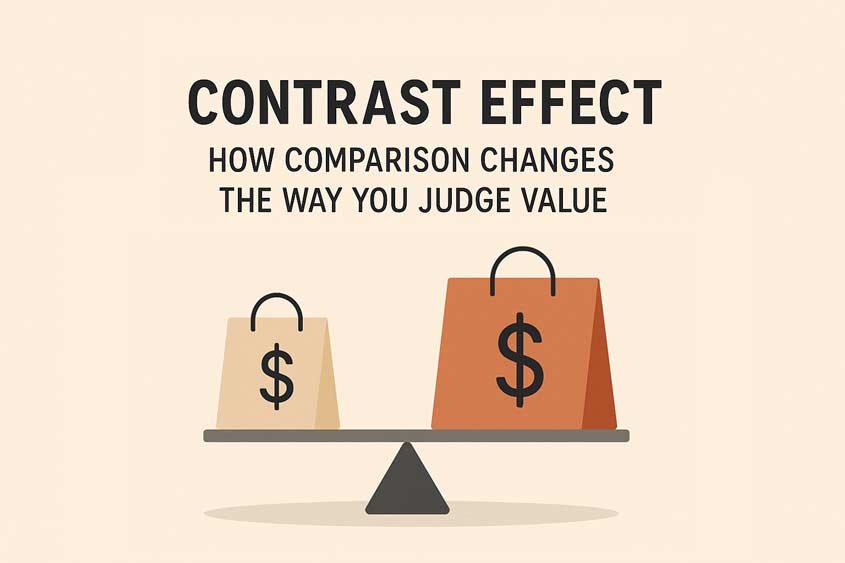
Have you ever noticed how your perception of something changes depending on what you see first? Maybe a $50 watch suddenly feels cheap after spotting a $500 luxury timepiece, or a small coffee seems overpriced until you see the giant, overstuffed $8 latte next to it. This is the Contrast Effect at work, and it’s one of the most powerful triggers in marketing psychology.
The Contrast Effect is all about comparison. Human brains are wired to evaluate things relative to other things rather than in isolation. In marketing, this means that the way products are presented—side by side, in sequence, or against certain benchmarks—can dramatically shift how customers perceive their value. It’s why “before and after” images, upsells, and tiered pricing exist: they make your brain do a quick calculation and feel certain choices are smarter, more affordable, or simply more desirable.
Table of Contents
You might be wondering: isn’t this just common sense? Well, yes and no. While we intuitively compare, marketers have refined ways to use the contrast to push decisions in subtle, yet measurable ways. A luxury brand might put a $2,000 bag next to a $500 bag, making the lower-priced item feel reasonable. A fast-food menu might list the most expensive item first so the next option feels like a bargain. These aren’t random tactics—they’re precise manipulations of perception rooted in cognitive psychology.
Contrast also affects more than price perception. It can influence quality, desirability, and even emotional response. A hotel room might feel more luxurious if the website first shows a sparsely decorated, cheaper room. A streaming service can make a standard subscription feel like a steal after highlighting the premium tier. Essentially, marketers are creating mental reference points that guide you, almost invisibly, toward certain choices.
Understanding the Contrast Effect gives you a window into your own behavior, too. You begin to notice how easily your judgment is shaped by context and comparison. Are you truly evaluating a product on its own merits, or are you being nudged by a strategic setup? This awareness is crucial, not just for marketers aiming to persuade, but for anyone trying to make more rational, deliberate choices in a world designed to influence them.
Throughout this article, we’ll break down the Contrast Effect in depth: how it works, why it’s effective, how brands use it, and what you can do to recognize it in real life. We’ll also explore real-world examples, consumer responses, and practical applications. By the end, you’ll have a thorough understanding of this subtle but powerful force in marketing psychology—and maybe a sharper eye for when it’s being used on you.
The goal isn’t just to impress you with theory. You’ll leave with insights you can immediately spot in your everyday life, from online shopping to streaming platforms, and understand why certain products suddenly feel like a better deal—or more irresistible—than they really are.
What is Contrast Effect?
The Contrast Effect is a psychological phenomenon where the perception of one thing is influenced by what it is compared against. Essentially, you don’t evaluate items in isolation—you judge them relative to other items around them. This is why something can feel expensive, cheap, luxurious, or ordinary depending on the context in which you see it.
At its core, the Contrast Effect affects judgment, decision-making, and perceived value. It can alter how you view price, quality, attractiveness, and even emotional appeal. In marketing, this trigger is everywhere, whether subtly in product listings, pricing strategies, or advertisements designed to shape perception.
The Basic Principle
Imagine you walk into a store looking for a new phone. The first phone you see costs $1,200. The next one you check is $800. Suddenly, that $800 phone feels like a bargain—even if, in absolute terms, it is still expensive. That is the Contrast Effect in action. Your brain automatically compares the two options, creating a mental benchmark that shifts your evaluation.
The principle works in almost any domain:
- Price perception: High-priced items can make mid-range products feel more reasonable.
- Quality judgment: A mediocre product can appear impressive if compared to a lower-quality alternative.
- Emotional evaluation: Experiences, aesthetics, or services can feel better or worse depending on the contrast.
Why It Influences Behavior
Humans are wired for relative evaluation because absolute measures are often hard to judge. In daily life, it’s difficult to assess value without comparison. Marketers exploit this by presenting options strategically to nudge your choices. This isn’t manipulation in the negative sense—it’s an understanding of natural cognitive processes.
Think about online shopping: platforms often show higher-priced items first. When the next option appears, it feels more reasonable. Restaurants do something similar by presenting premium dishes or beverages at the top of the menu to make standard options feel affordable. Even subscription tiers work on the same principle: the most expensive plan sets a mental anchor, making the middle tier appear as the “smart choice.”
Real-World Examples
- Tiered pricing: Many software tools offer three plans—basic, standard, and premium. The premium plan’s high cost makes the standard option seem like the best deal.
- Before-and-after images: Fitness programs or home improvement products show dramatic transformations. The “after” looks more impressive because the “before” establishes a low benchmark.
- Luxury branding: High-end brands intentionally display ultra-luxury products to make their regular lines feel attainable, despite still being expensive.
Connection to Other Psychological Triggers
The Contrast Effect often works in combination with other buying triggers:
- Anchoring: Setting an initial reference point to influence subsequent judgments. Anchoring often creates the context for contrast to operate.
- Scarcity: Limited availability can make a product feel even more valuable compared to others.
- Social Proof: Seeing that many others choose a mid-tier product after being shown a premium one reinforces the perception of smart choice.
Why Marketers Rely on It
The beauty of the Contrast Effect is its subtlety. People don’t usually realize their judgments are being influenced. It’s invisible nudging. And because it taps into a natural cognitive shortcut, it’s highly effective across industries: retail, real estate, luxury goods, subscription services, and even charitable giving.
For instance, fundraising campaigns often present a large suggested donation first. Subsequent smaller amounts feel manageable by contrast. Similarly, a hotel may show an extravagant suite before the standard rooms, making the standard option appear more affordable, even if it is still relatively pricey.
Key Takeaways
- The Contrast Effect changes perception through comparison.
- Context determines whether a product seems valuable, expensive, or desirable.
- It’s widely used in pricing, advertising, and product presentation.
- It often works alongside other psychological triggers to increase influence.
- Awareness of this effect helps consumers make more deliberate, informed decisions.
The Contrast Effect isn’t just an abstract idea—it’s a practical, measurable influence on behavior. Understanding it allows marketers to craft better campaigns and helps consumers recognize when their judgment is being shaped by context rather than intrinsic value.
The Psychology Behind It
The Contrast Effect works because your brain evaluates things in relation to other things rather than on their own. When you see two options side by side, your judgment isn’t absolute—it’s comparative. That’s why a $300 jacket feels reasonable when paired with a $900 designer coat but might feel overpriced if it’s shown alone. This automatic mental comparison happens in milliseconds and often without your awareness.
Marketers leverage this by carefully crafting which items you see first, which follow, and in what context. The first item you encounter sets a reference point, or anchor, which then shapes your perception of everything that comes after. For example, if an online subscription service lists its most expensive plan first, the mid-tier option suddenly looks like a smart compromise. Your brain is wired to make these calculations quickly, and marketers use that to guide your decisions subtly.
The process behind the Contrast Effect unfolds in several psychological steps. First, the anchor establishes your expectations. Then, each subsequent item is measured against that anchor, influencing how you perceive its value, quality, and desirability. The adjustment that happens in your mind often drives the final decision, even if the absolute differences between options aren’t huge. A mid-range hotel room can feel luxurious if the premium suite is presented first, and a $12 latte seems reasonable after seeing the $20 option.
Beyond price, the Contrast Effect influences emotional response. Seeing a dramatic “before and after” in fitness programs or home products triggers satisfaction and excitement, not because the final result is objectively better, but because your brain has a reference point to measure the change. The effect also interacts with other psychological triggers like social proof, scarcity, and anchoring, reinforcing your sense that a choice is smart or desirable.
Different industries exploit this in distinctive ways. Retailers often use high-to-low product sequencing, putting the priciest item first so everything else feels like a bargain. Restaurants list premium menu items at the top to make standard dishes seem reasonable. Online subscription services present tiered plans, highlighting the most expensive option to make the middle tier feel like the logical pick. Even charitable campaigns use it, suggesting a large donation first to make smaller contributions appear manageable.
Why It Feels Natural
Part of what makes the Contrast Effect so effective is that it feels invisible. You rarely notice the mental comparisons taking place. Your emotional reaction—whether it’s excitement, relief, or satisfaction—feels like a genuine preference rather than a response shaped by context. Your brain is simply doing what it evolved to do: compare options to make quick, efficient decisions.
The One List of Key Steps
- Anchor: The first item or reference point sets the baseline.
- Contrast: Subsequent options are evaluated in relation to that baseline.
- Adjustment: Your perception of value, quality, or desirability shifts.
- Decision: The final choice feels natural, often favoring the option that looks best in comparison.
Understanding this step-by-step process helps marketers design campaigns that subtly guide decisions and allows consumers to recognize when their choices are being influenced by relative comparisons rather than absolute value.
This psychological mechanism also explains why some marketing strategies seem effortless. When you notice a mid-tier product feels like the perfect compromise, or a sale item appears irresistible, it’s often because the Contrast Effect has recalibrated your perception without you even realizing it. By becoming aware of these patterns, you can make more informed decisions and better appreciate the psychological strategies at play in marketing.
Why It Matters in Marketing
The Contrast Effect isn’t just a psychological curiosity—it’s a practical tool that marketers use to shape perception and influence buying decisions. By strategically presenting options, products, or experiences, marketers can make certain choices feel more appealing, more affordable, or simply more desirable. Understanding how this trigger works allows brands to design campaigns that guide consumer behavior without overt persuasion.
Shaping Price Perception
One of the most common ways the Contrast Effect is applied is in pricing strategy. Consumers rarely evaluate price in isolation. When you see a high-priced product first, the next item in line seems more reasonable by comparison. This can increase the likelihood that customers will choose mid-tier or even premium options they might otherwise overlook.
For example, an electronics store might display a $2,000 television first, followed by a $1,200 model. Suddenly, the $1,200 TV feels like a bargain. Similarly, software companies often offer three-tier subscriptions. The most expensive tier anchors expectations, making the mid-tier option appear practical and the “smart choice,” even if it’s still profitable for the company.
Enhancing Perceived Quality
The Contrast Effect also influences how consumers perceive quality. Showing a standard product after a low-quality or inferior option can make the first product appear significantly better than it is. In fashion, beauty, or luxury goods, marketers use this to elevate the perceived value of certain items. This strategy also works in service industries—hotels, restaurants, and salons frequently display their premium offerings first, so the standard options appear more attractive in comparison.
Influencing Emotional Response
Beyond rational assessment, the Contrast Effect taps into emotions. Consumers feel satisfaction or relief when they perceive they are making a “better deal” compared to a reference point. This emotional response strengthens engagement and increases the likelihood of conversion. For instance, a meal deal that seems generous compared to a single item purchase triggers positive feelings, which can translate into loyalty and repeat purchases.
How Marketers Apply the Contrast Effect
- Tiered Pricing: Presenting high, medium, and low-priced options to guide the consumer toward the intended choice.
- Upselling & Cross-Selling: Showing premium products first, so add-ons or upgrades feel reasonable.
- Before-and-After Visuals: In beauty, fitness, or home improvement, dramatic comparisons make results seem more impressive.
- Package Comparisons: Bundled products or services are displayed next to standard options to make the package feel like a better deal.
- Menu & Product Sequencing: Restaurants, e-commerce sites, and catalogs list options strategically to influence perceived value.
Practical Value for Brands
The real strength of the Contrast Effect is its versatility. It works across industries—retail, hospitality, digital services, healthcare, and even charitable campaigns. Brands can increase conversion rates, average order value, and customer satisfaction simply by carefully managing the order and presentation of options.
For example, a travel website might show luxury vacation packages first. Mid-tier packages then appear both affordable and appealing. Similarly, a subscription box service displays the highest tier initially, prompting most users to select the middle option, which optimizes revenue while still leaving the customer feeling satisfied.
Complementing Other Triggers
The Contrast Effect often interacts with other psychological triggers to maximize impact:
- Anchoring: The initial reference point creates a framework for comparison.
- Scarcity: Limited availability increases perceived value when compared with standard options.
- Social Proof: Seeing popular choices next to premium or low-quality alternatives reinforces perception.
By combining these triggers, marketers can subtly guide consumer decisions while maintaining the impression of choice.
Key Takeaways
The Contrast Effect matters because it changes how consumers perceive value, price, and quality. Properly applied, it:
- Increases perceived affordability or attractiveness of mid-tier options.
- Elevates perceived quality relative to lower-quality alternatives.
- Triggers positive emotional responses that enhance satisfaction and loyalty.
- Works seamlessly alongside other psychological triggers to boost conversion.
Understanding the practical value of this trigger allows brands to design campaigns that feel natural, persuasive, and customer-friendly. Consumers, in turn, become more aware of how context and comparison influence their choices, making for smarter decision-making in a marketplace full of subtle cues.
Contrast Effect Real Case Studies
The Contrast Effect isn’t just a theoretical concept. Its influence has been observed and measured across multiple industries, demonstrating how powerful relative comparisons can be in shaping consumer behavior. Let’s explore some verifiable, real-world examples to understand its practical impact.
Retail and E-Commerce: Electronics Pricing
An electronics retailer tested the impact of price presentation on a high-end laptop. When customers were shown the $2,500 model first, followed by a $1,500 alternative, the mid-tier model sold significantly more than when it was presented in isolation.
The first, higher-priced model acted as a reference point, making the $1,500 laptop feel like a reasonable and attractive deal. This subtle contrast nudged customers toward the intended choice without forcing a decision, illustrating the psychological power of comparison in driving purchasing behavior.
Subscription Services: Tiered Plans
Streaming services frequently employ the Contrast Effect through tiered pricing. A popular example comes from a major video streaming platform that offers three subscription levels: Basic, Standard, and Premium.
When the Premium option is shown first, its high price establishes an anchor. The Standard plan then appears more appealing, hitting a sweet spot between affordability and perceived value. In repeated A/B testing, companies observed that the majority of customers selected the mid-tier plan, significantly increasing revenue while ensuring users felt satisfied with their choice.
Fitness and Health Products: Before-and-After Demonstrations
Fitness brands and cosmetic companies often leverage the Contrast Effect using dramatic before-and-after images. One verified case involved a skincare brand that showed a series of before-and-after results in its email campaigns.
Consumers who first saw “before” images of problematic skin were more impressed by the “after” transformations. Open rates and click-through rates were measurably higher in campaigns that included the contrast sequence compared to those showing only the end result. Here, the initial benchmark created a reference that magnified the perceived effectiveness of the product.
Lessons from Real Cases
Across industries, these examples show a consistent pattern:
- Initial presentation establishes a reference point.
- Subsequent options or outcomes are evaluated relative to that reference.
- Perceived value, quality, or desirability shifts in favor of the marketer’s intended choice.
- Results are measurable, with higher conversions, engagement, or satisfaction.
Why This Matters for Marketers
These case studies highlight why the Contrast Effect is a core component of strategic marketing. By understanding how context shapes perception, brands can design campaigns that guide behavior ethically and effectively. Whether it’s pricing, visual storytelling, or subscription tiers, subtle comparisons can drive decisions without the consumer feeling pressured.
The beauty of this trigger is its versatility. It works in e-commerce, service industries, fitness and beauty, and even fundraising campaigns. Whenever a consumer evaluates something in relation to a benchmark, marketers can harness the Contrast Effect to make the perceived choice more compelling.
How Consumers React
When the Contrast Effect is in play, consumers rarely notice the subtle shifts in their perception, but their behavior clearly reflects it. Their judgments about value, quality, and desirability are influenced by the context and sequence in which options are presented. Observing these responses helps marketers understand why certain strategies work and allows consumers to recognize how their own decisions are shaped.
Immediate Perceptual Shifts
One of the first observable reactions is a change in perception the moment a comparison is made. Consumers often experience:
- Altered price perception: A product seems cheaper or more reasonable when presented after a higher-priced item.
- Enhanced quality evaluation: Items can feel superior simply because they follow a less impressive option.
- Emotional adjustment: Consumers may feel excitement, relief, or satisfaction as their brains register the “better deal.”
For example, shoppers in a furniture store might see a luxury sofa first. When they move to a slightly less expensive model, it immediately feels like a practical, yet high-quality choice. This is an automatic mental calculation; few consumers are consciously aware that their perception has shifted.
Sequential Comparison Behavior
Consumers respond to the Contrast Effect by naturally comparing options in sequence. This behavior often manifests as:
- Spending more time evaluating mid-tier options after seeing premium alternatives.
- Feeling justified when selecting the option that seems like the “best value” relative to other choices.
- Expressing satisfaction with their decision because the contrast made it appear rational and smart.
In online shopping, for instance, visitors often scroll past the first, most expensive option to consider the second or third, guided by their subconscious comparison. Their attention and selection patterns reflect the underlying influence of contrast, rather than the absolute merits of the products themselves.
Influence on Emotional Engagement
The Contrast Effect triggers observable emotional responses. Consumers may experience:
- Excitement: The perception of getting a great deal.
- Relief: Choosing the mid-tier option feels like a safe, sensible decision.
- Confidence: Selecting a product after comparison can reinforce the sense of making an informed choice.
Marketers often amplify these responses with visual cues, such as highlighting the “best value” option or using price formatting that draws attention to the relative advantage of a particular product.
Behavioral Patterns Across Contexts
Consumers consistently show similar responses across industries. For example:
- E-commerce: Higher-priced items first often increase the selection of mid-tier products.
- Hospitality: Luxury suites listed before standard rooms make standard options appear more appealing.
- Fitness and Beauty: Before-and-after comparisons drive engagement and perceived product effectiveness.
- Restaurants: Expensive dishes at the top of a menu make other items feel more reasonable, increasing orders of mid-range items.
These patterns demonstrate that behavior is guided by perception rather than absolute evaluation. People respond to relative differences more than intrinsic characteristics.
Understanding these observable reactions is critical for marketers. It allows campaigns to be designed with subtle, context-driven influences that guide decision-making ethically. For consumers, awareness of these patterns helps recognize when choices are being shaped by relative positioning rather than inherent quality or price.
The Contrast Effect creates a predictable, measurable set of behavioral responses. When applied responsibly, it can guide consumers toward decisions that feel satisfying and rational, while also increasing engagement and conversion rates.
How Brands Use It Effectively
The Contrast Effect is a powerful tool when brands apply it strategically and ethically. By understanding how consumers evaluate options in relation to each other, companies can design campaigns, pricing, and product presentations that naturally guide decisions. Observing real applications reveals practical strategies that can be replicated across industries.
Strategic Product Sequencing
Brands often lead with high-value or premium options to create a mental reference point. Once consumers encounter this anchor, mid-tier options appear more reasonable and attractive. For example:
- Tech companies display top-tier gadgets first, making standard models feel like the smart compromise.
- Hotels showcase luxury suites before standard rooms to elevate the perceived comfort of the latter.
- E-commerce platforms list the most expensive item in a category first to highlight value in lower-priced alternatives.
This sequencing doesn’t coerce consumers; it simply frames choices in a context that encourages informed selection.
Tiered Pricing and Bundles
Tiered pricing is one of the most common applications of the Contrast Effect. By presenting multiple options with varying features and prices, brands leverage relative comparison to influence choice.
- Subscription services often have three plans: basic, standard, and premium. The premium plan sets a high anchor, making the standard tier feel affordable and balanced.
- Meal kits or bundled products use high-priced bundles first, increasing the appeal of mid-level packages.
- Fitness programs offer premium coaching options before standard plans, enhancing perceived value.
Bundles also highlight savings in comparison to buying items individually, reinforcing the perception of a smart decision.
Visual and Emotional Contrast
Brands often pair products visually or emotionally to emphasize differences. Dramatic “before-and-after” images, side-by-side comparisons, or contrasting product features amplify perception.
- Skincare campaigns show the worst-case scenario first to make results seem more impressive.
- Home improvement products display a bare room next to a transformed one to enhance perceived effectiveness.
- Fashion retailers display premium items with simpler alternatives to create aspirational contrast.
Visual contrasts work hand in hand with price or quality comparisons to influence both rational and emotional responses.
Ethical Considerations
Effective use of the Contrast Effect doesn’t require deception. Ethical application involves:
- Highlighting true differences between options.
- Avoiding exaggerated claims or misleading anchors.
- Ensuring that consumers still have freedom to make informed choices.
Brands that apply the trigger responsibly strengthen trust and long-term engagement, rather than relying on short-term manipulation.
By strategically incorporating the Contrast Effect into campaigns, brands can influence perceptions, increase conversion rates, and guide consumers toward choices that feel natural and satisfying. When executed well, it enhances both marketing effectiveness and customer experience.
Mistakes to Avoid
While the Contrast Effect is a powerful tool, misusing it can backfire. Consumers are perceptive, and poorly applied comparisons can reduce trust, create confusion, or even trigger resistance. Understanding common pitfalls ensures that marketers leverage this trigger effectively without negative consequences.
Overloading with Options
One frequent mistake is presenting too many options at once. When the consumer is confronted with a large number of items, the intended contrast can become diluted, leading to decision fatigue. Instead of feeling guided toward the “smart choice,” consumers may feel overwhelmed and abandon the purchase entirely.
For example, an e-commerce site showing twenty laptops in a single view may prevent any one anchor from creating a meaningful contrast. The subtle influence of the Contrast Effect is lost when the brain has too many reference points to process at once.
Using Unrealistic Anchors
Another common error is presenting a reference point that feels implausible or artificial. If the initial product or price is perceived as irrelevant or unattainable, the contrast can appear manipulative rather than informative.
- Displaying a $10,000 sofa next to a $1,200 model may seem absurd to most shoppers, causing skepticism.
- Inflated “before” images in weight-loss or fitness campaigns can create distrust if results feel exaggerated.
Consumers are quick to detect when comparisons are staged, which can damage credibility and reduce engagement.
Ignoring Emotional Response
The Contrast Effect doesn’t just influence rational judgment; it also triggers emotional responses. Neglecting this aspect can weaken the intended impact. If a consumer doesn’t feel satisfaction, relief, or excitement from the comparison, the perceived value shift may be minimal.
For example, showing mid-tier items without creating a clear premium anchor may leave buyers feeling indifferent, leading to fewer conversions. The emotional component is essential to make the contrast feel meaningful.
Maintaining Effectiveness
Avoiding these mistakes preserves both the ethical use of the Contrast Effect and its effectiveness. Marketers should carefully plan the sequence, relevance, and emotional impact of comparisons. Proper implementation ensures that consumers feel informed, satisfied, and confident in their choices, rather than manipulated.
By understanding the missteps that reduce impact or create pushback, brands can consistently harness the Contrast Effect to guide behavior while maintaining trust and long-term engagement.
Best Practices
Applying the Contrast Effect effectively requires careful planning and attention to how consumers perceive differences. When executed thoughtfully, it can guide decisions, enhance perceived value, and increase satisfaction without feeling manipulative. Here are actionable strategies marketers can use to harness this trigger ethically and efficiently.
Sequence and Presentation Matter
The order in which products or options are presented has a major influence on perception. Leading with high-value or premium options creates a reference point that frames subsequent choices. Consumers naturally compare what comes next to that anchor, making mid-tier options more appealing.
- Online stores can showcase the most expensive items first to make others feel like a smart choice.
- Restaurants can list premium dishes at the top to guide diners toward mid-range selections.
- Service providers, like gyms or subscription services, can display full-feature packages first to make standard plans more attractive.
The key is to ensure the sequence feels logical, relevant, and transparent to the consumer.
Combine Visuals and Emotional Cues
Contrast isn’t only numerical or functional—it’s also visual and emotional. Consumers respond strongly to side-by-side comparisons, dramatic transformations, or aspirational imagery.
- Before-and-after photos can emphasize the impact of fitness, beauty, or home improvement products.
- Highlighting product features with visual cues can enhance perceived value.
- Emotional storytelling paired with contrast increases engagement and satisfaction.
When visual and emotional contrasts are aligned with the brand message, the effect on perception is amplified.
Test and Optimize
Like any psychological trigger, the Contrast Effect works best when tested with real audiences. Small variations in pricing, sequencing, or presentation can significantly affect outcomes.
- A/B testing different product sequences online can reveal which anchors drive the most conversions.
- User feedback can help identify if comparisons feel natural or forced.
- Iterative adjustments allow marketers to maximize the effect without compromising credibility.
Ethical Application
It’s crucial to apply the Contrast Effect in ways that are ethical and respectful. Misleading or exaggerated comparisons can damage trust and reduce long-term engagement. By focusing on real differences, meaningful contrasts, and clear benefits, brands can guide decisions effectively while maintaining integrity.
Following these best practices allows marketers to leverage the Contrast Effect strategically, creating a win-win: consumers feel informed and satisfied, and brands benefit from increased engagement and conversion.
Spot The Trigger
The Contrast Effect can be subtle, but spotting it helps you understand how marketers influence your perception of value. The following exercises let you test your ability to recognize when this trigger is being applied. Each scenario reflects a realistic marketing situation.
Exercise 1
A smartphone brand advertises a premium model priced at $1,200 first. Immediately after, they display a $750 model with fewer features. The $750 phone suddenly feels like a bargain and an obvious “smart choice.”
Question: Is the brand using the Contrast Effect trigger? (True or False) | Check Answer
Exercise 2
A clothing retailer showcases a $500 designer coat, followed by a $200 mid-range coat and a $100 basic option. Seeing the high-end coat first makes the $200 jacket appear both stylish and affordable.
Question: Is the retailer using the Contrast Effect trigger? (True or False) | Check Answer
Exercise 3
An online learning platform lists three courses alphabetically with similar pricing and no emphasis on differences. The order of presentation doesn’t influence your perception of value.
Question: Is the platform using the Contrast Effect trigger? (True or False) | Check Answer
Recognizing the Contrast Effect requires noticing when relative positioning or sequencing alters your perception of value or desirability. If the order of presentation makes one option feel smarter, cheaper, or higher quality compared to another, that’s the trigger at work.
What You Should Remember
The Contrast Effect is one of the most powerful psychological triggers in marketing. It operates silently, shaping how you perceive value, quality, and desirability without you consciously realizing it. The key principle is simple: people evaluate options relative to what they’ve seen before, not in isolation.
When marketers apply the Contrast Effect effectively, your brain naturally compares items, creating a perception that some choices are better, smarter, or more affordable. This is why mid-tier products often feel like the most reasonable pick when displayed after premium options, and why dramatic before-and-after visuals grab attention and generate excitement.
Core Insights
Understanding the Contrast Effect gives you a dual advantage:
- For marketers: It provides a framework to guide decision-making, increase conversions, and highlight value in ways that feel intuitive. Sequencing, visual comparisons, and tiered pricing are practical tools to ethically leverage this trigger.
- For consumers: Awareness helps you recognize when your perception is being influenced by relative comparison rather than absolute value. This insight allows you to make more informed, deliberate choices.
Integration with Other Triggers
The Contrast Effect often works best alongside other psychological triggers. For example:
- Anchoring: Sets the initial reference point for comparison.
- Scarcity: When a high-value option is limited, it intensifies the perceived attractiveness of subsequent choices.
- Social Proof: Popular options presented in contrast to less-chosen items can amplify preference.
Recognizing how these triggers interact helps marketers design campaigns that feel natural while maximizing impact, and it helps consumers understand the subtle forces shaping their decisions.
Practical Takeaways
- Always consider relative context: how one product or option is presented in relation to others affects perception.
- Use visual, numerical, or emotional contrasts to make differences clear and memorable.
- Ensure comparisons are ethical, transparent, and relevant to maintain trust.
- Be aware of how your own preferences may be influenced by sequential presentation, so you can make deliberate decisions.
The Contrast Effect reminds us that judgment is rarely absolute. Your perception is shaped by the sequence, context, and reference points presented to you. For marketers, this is a tool to highlight value; for consumers, it’s a cue to pause and evaluate whether a choice is truly the best for your needs.
Mastering this trigger means balancing influence with integrity. Applied responsibly, it can create campaigns that guide, inform, and satisfy consumers simultaneously, turning a subtle psychological mechanism into a powerful driver of decision-making.

Gabriel Comanoiu is a digital marketing expert who has run his own agency since 2016. He learned marketing by testing, analyzing, and refining campaigns across multiple channels. In his book series Impulse Buying Psychology, he shares the psychological triggers behind every purchase, showing how to create marketing that connects, persuades, and converts.