
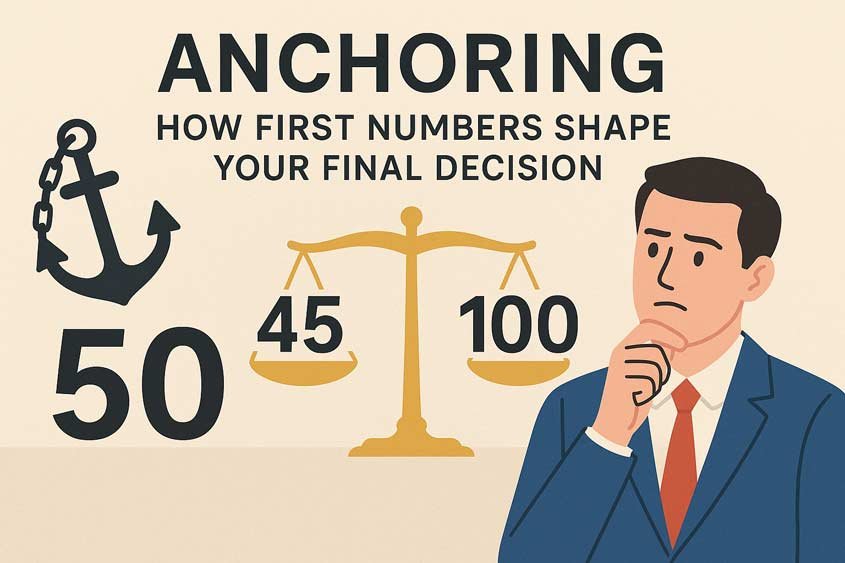
Anchoring sits quietly in the background of more decisions than people like to admit, and once you spot it, you start seeing it everywhere. You check a price, hear a number, or get a quick first impression, and suddenly that tiny detail becomes the reference point your mind clings to. It changes how you feel about everything that comes after. And that’s exactly why Anchoring turns into one of the strongest triggers in marketing psychology.
Think about the last time you saw a product listed as 199 before learning its real value. That first number becomes the anchor. Your brain treats it as a starting point. Even if you know it’s arbitrary, it still shapes your final judgment. It’s wild, right? You’d think you’re immune, but no one is. Even experts fall for it, which is why so many brands use this trigger with confidence. They know you won’t forget the number you saw first, even if you try to adjust.
Table of Contents
Anchoring works on everything from pricing to product comparisons to even how you interpret quality. When a smartwatch is pitched as usually 349 but now available at 219, your brain doesn’t evaluate 219 in a vacuum. It evaluates it against the 349 you saw first. That original number frames what comes next. And guess what? It feels like a deal, even if 219 was the intended price all along.
Marketers lean into Anchoring the same way they use Social Proof, Scarcity, or Contrast. These triggers shape decisions without forcing anything. They nudge. They guide. They hint. Anchoring does its part by setting the stage before your brain starts thinking critically. And once the stage is set, everything else feels logical, even when it’s not.
This trigger doesn’t only show up in pricing. Restaurants do it with menu design. Real estate agencies do it with initial listings. Subscription companies do it with plans placed in a certain order. The anchor becomes the lens through which value is judged. And after reading a bit more about the mechanics, you’re going to start noticing it in places you never considered.
Anchoring works because your brain likes shortcuts. You don’t want to calculate every decision from scratch. You want a reference. A starting number. A baseline. Humans are wired this way, and marketers simply use that wiring. Maybe that sounds a bit sneaky, but it’s not inherently unethical. It becomes unethical only when a brand uses Anchoring to deceive or mislead, which isn’t the goal here. The goal is understanding the psychology behind it, because once you get it, you can use it well—and you can defend yourself from the times it’s used poorly.
Picture a scenario. You walk into a shop to buy headphones. The first pair you see costs 399. You think, wow, that’s steep. Then you spot another pair at 229. Suddenly that second pair feels reasonable, maybe even affordable. But imagine the same store showing you the 229 pair first. Would it still feel as accessible? Unlikely. That first number shapes everything, even if it has nothing to do with what you end up buying. It’s just your brain doing what it does best: comparing.
Anchoring isn’t magic. It’s predictable psychology. The first number becomes the anchor. Every next number becomes the comparison. And that single shift affects perceived fairness, quality, value, and urgency. You can use Anchoring to help customers understand your pricing or guide them toward the right product. You can use it to frame choices clearly so they don’t feel overwhelmed. When applied correctly, Anchoring feels helpful rather than manipulative.
As you go deeper into this article, you’ll see that Anchoring is part of a larger network of triggers that shape buying behavior. Some triggers tap into emotions. Some focus on identity. Some rely on timing. Anchoring deals with perceptions. It deals with your expectations before you even know you’re forming them.
If you’re building a brand or selling anything at all, Anchoring is one of those tools you should understand inside out. It’s practical. It’s powerful. And it’s everywhere.
Defining Anchoring
Anchoring is one of those psychological triggers that sounds simple on paper, yet it quietly shapes a surprising amount of what you consider fair, expensive, cheap, valuable, or even trustworthy. At its core, Anchoring is the tendency for people to rely heavily on the first number, detail, or piece of information they encounter when making a decision. That first piece becomes your mental reference point. Everything after that gets compared against it, whether you realize it or not.
When you walk into a store, and the first winter jacket you see is 380, that number sticks. It becomes your starting point. The next jacket you see, even at 260, gets mentally evaluated in relation to the 380. Without thinking, you decide whether the second one feels cheap, fair, or overpriced based on the anchor. And you don’t consciously choose to do this. Your brain just… does it.
Anchoring influences perception. It affects how you interpret price, quality, size, speed, and even credibility. People think they make decisions through logic, but Anchoring shows how the first detail frames everything else. That frame shapes the entire decision process. And the fascinating part is that the anchor can be unrelated, arbitrary, or even random, yet still powerful.
Marketing leans into Anchoring because it gives structure to how customers evaluate choices. If you show a premium version of a product first, customers interpret everything after through the lens of that premium option. Suddenly the mid-tier plan feels reasonable or even budget-friendly. If you flip the order and show the lowest cost option first, the mid-tier may feel overpriced. Same product. Same person. Totally different reaction. The only thing that changed was the anchor.
Anchoring works on expectations too. Let’s say a subscription service tells you that people usually pay 49 a month for tools like this. That claim creates an expectation of what feels normal, and that expectation shapes your sense of value before you even see their real price. If their plan is 29, it feels like a deal. If it’s 59, it feels premium. You’re not comparing against the market as much as against the anchor they handed you.
Even outside pricing, Anchoring shows up in perception of quality. A brand can say that a product took five years to build, and that detail becomes the anchor for how much effort or precision you assume went into it. Or they mention that the design won an award last year, and your brain uses that as a benchmark before evaluating the rest of the information. Anchors aren’t always numbers. They can be statements, claims, labels, or even emotional cues.
Consider real estate. Agents often show the most expensive property first. Why? Because it sets the anchor. After seeing a home listed at 540000, the next one at 420000 feels like a reasonable compromise. But if the first home you see is 280000, then 420000 suddenly feels high. Anchoring shapes the entire tour, even though nothing changed about the actual homes.
Anchoring also influences your sense of urgency. If a brand positions a countdown timer next to a price and tells you the original cost was much higher, that “original cost” becomes the anchor that defines whether you feel urgency or hesitation. Scarcity, Social Proof, and other triggers play nicely with Anchoring because they all depend on perception. Anchoring sets the baseline that makes the other triggers feel stronger.
But here’s the thing: Anchoring isn’t just a marketing trick. It’s a cognitive shortcut that helps people make faster decisions in a world full of noise. You don’t have time to research every micro-detail, so your mind grabs the first relevant piece of information and uses it as a guide. That guide might be flawed, but it saves mental energy. Marketers simply use that natural behavior to help you interpret what they offer.
Anchoring influences more than price. It shapes how many products customers expect from a bundle. It shapes how long they think shipping should take. It shapes how big a discount feels. It shapes how premium a product seems. That’s why brands often present the anchor in clear, bold form. The first number you see sets the mood of the entire page.
Think about the classic three-tier pricing layout. A brand puts an expensive plan on the left or at the top. You might not buy that plan, but it serves a purpose. It makes the middle plan, the one they actually want to sell, look moderately priced. That expensive plan works as an anchor. Without it, the middle option might look pricey. With it, the middle option feels balanced. The anchor doesn’t need to be purchased to be effective. It only needs to exist.
Anchoring isn’t manipulation when used responsibly. In fact, it can help customers navigate choices more clearly. A customer who sees context can decide faster and with more confidence. Without an anchor, everything feels ambiguous. Brands use Anchoring to create clarity, structure, and a sense of direction, and that helps customers evaluate value more easily.
But Anchoring shows its real power when you notice how sticky it is. Once you see a first number, it’s incredibly difficult to ignore. Even if you try to mentally adjust, that adjustment rarely fully cancels the anchor. You can tell yourself that the original price was inflated, but your brain still uses it as a basis for comparison. That’s how deep this trigger is embedded in human judgment.
When you look at marketing through this lens, you start to understand why certain strategies work so consistently across industries. Luxury brands set high anchors to communicate exclusivity. Airlines use multiple pricing tiers to frame the “reasonable choice.” Tech companies reveal the highest-priced configuration first to make the default model feel accessible. The first detail creates your mental frame, and the rest falls into place automatically.
Anchoring is simple, powerful, and universal. It shapes what you believe, what you expect, and what you choose. And once you internalize how it works, you see marketing differently. You see why some messages feel persuasive without trying. You see why brands structure information the way they do. You see how your own decisions get shaped before you even start thinking.
How It Works
Understanding how Anchoring operates means watching a few mental gears turn in sequence. It looks simple on the surface: you see a number and use it as a reference. Under the surface there are predictable cognitive steps that make that reference stubborn. I will walk you through the psychological mechanism in plain language, step by step, so you can see where marketers nudge and where consumers can resist or reflect.
Step 1: First exposure becomes the reference point
The process starts with exposure. The first number, claim, or comparison you see becomes a reference point in your working memory. That initial piece of information is what psychologists call an anchor. Anchors can be explicit numbers like prices and percentages or implicit frames like premium labels, award mentions, or even imagery that implies scale. The key is that the anchor occupies a privileged mental slot. Once it is there, your brain uses it as a baseline for evaluating subsequent information.
Why this happens: your brain prefers shortcuts. Anchors reduce the mental work required to evaluate options. Rather than compute value from scratch, you perform small adjustments from the anchor. That feels faster and easier even if it is less accurate.
Step 2: Adjustment is limited and biased
After the anchor is set, your mind adjusts. You compare new facts to the anchor and shift your judgment accordingly. But here is the kicker: the adjustment is normally insufficient. People do move away from the anchor but rarely far enough. This is why a deliberately high anchor makes a moderate price seem reasonable, and a deliberately low anchor can make a modest upsell feel like a premium choice.
This limited adjustment is not laziness. It is a cognitive bias that has been reliably observed across many studies and real world contexts. It is consistent whether people are estimating probabilities, evaluating speeds, or judging value.
Step 3: Context and relevance determine strength
Not all anchors are equally potent. Anchors that are clearly related to the decision, presented early, and delivered by a credible source will be stronger. Also, anchors that repeat or come from multiple channels reinforce each other. For instance, seeing a high suggested retail price on a product page, then seeing the same number in a display ad, and finally encountering it in a review all combine to strengthen the anchor.
Conversely, irrelevant or obviously arbitrary anchors are weaker. If the anchor looks random or the user sees it as manipulative, resistance increases. That is why transparent anchoring usually performs better in the long run.
Step 4: Interaction with other psychological triggers
Anchoring rarely works alone. It is amplified when paired with other triggers like Social Proof, Scarcity, and Contrast. For example, a high anchor paired with a limited time discount and customer testimonials makes the deal feel timely and validated. Anchoring sets the baseline, and the other triggers fill in emotion and urgency.
When used ethically, this combination helps customers see what matters and make decisions faster. When abused, it corrodes trust.
The internal timeline of a single decision
Imagine a typical shopper encounter and map the timeline mentally.
- Encounter anchor: the first number or claim appears.
- Initial impression: immediate gut reaction forms based on anchor.
- Comparative scan: you see alternatives and compare them to the anchor.
- Partial adjustment: you revise your impression but stay close to the anchor.
- Decision influence: the anchored perception colors the final choice.
That is the mechanism in motion. It is not complicated. It is predictable.
Key cognitive mechanisms at work
- Availability: the anchor stays top of mind so it weighs more heavily.
- Cognitive ease: adjustments feel effortful so your brain favors the anchor.
- Confirmation tendency: subsequent details are interpreted in a way that fits the anchored view.
- Framing: the anchor defines how information is framed and which comparisons seem natural.
Why anchors are sticky even when noticed
You might think that once you spot an anchor you can ignore it. Not quite. People can consciously reject an anchor but their subconscious comparison process still uses it. Even when you deliberately try to adjust, experiments show the correction is rarely complete. That explains why consumers often say a price is unfair and still end up accepting it as reasonable compared to the anchored figure.
This stickiness has practical implications. It explains why some marketing placements feel subtly persuasive without overt persuasion. It also explains why price announces, first impressions, and opening offers matter so much.
Practical micro process marketers exploit
Marketers design the sequence of information so the anchor occurs where it has maximal impact. That usually means presenting the anchor early on the landing page, placing it near visual focus points, or repeating it across touch points. Some common placements that increase anchor strength include suggested retail price labels, comparison columns, and the first plan in a multi tier layout.
A compact list of anchor types and their influence
- Suggested retail price and list price. These create perceived discount.
- Premium option shown first. This makes mid tier options look like value.
- Original delivery or lead time. Sets expectation for speed.
- Bundled item count. Defines what feels generous or stingy.
- Comparative numeric claims such as “most customers pay X.” Sets normality.
Where the process breaks down
Anchoring is not infallible. It breaks down when the anchor lacks credibility, when consumers have strong prior knowledge, or when decision makers deliberate with rigorous comparison. Knowledgeable buyers, for example, will rely on independent data rather than the presented anchor. That is why in some categories, like technical equipment where specs matter, anchoring must be paired with real evidence to move savvy buyers.
Quick note on ethical use
Anchoring is a tool. Like other tools, it can be used to help customers find clarity or to mislead. The safest approach is to use anchoring to create useful context, not to deceive. Provide clear comparisons, show true savings, and avoid inventing phony list prices. When Anchoring is used transparently, it reduces decision friction and increases satisfaction. When it is used to manipulate perceptions without basis, customer trust erodes and conversions fall over time.
Summary of the mechanism
Anchoring works because the first number you encounter becomes a powerful mental baseline. Your mind adjusts from that baseline but not enough. Context and credibility determine how strong the anchor will be. Other triggers amplify the effect. And despite conscious resistance, anchors remain influential because they map directly onto common cognitive shortcuts.
How This Trigger Shapes Marketing Results
Anchoring matters in marketing because your customers rarely evaluate a product in a vacuum. They compare. They judge. They interpret. And the first number or reference point they encounter shapes everything that comes after. When you start looking at campaigns through this lens, you realize how much of marketing revolves around setting the stage so the final decision feels natural, reasonable, or even obvious.
Anchoring builds the frame customers use to judge value
Marketers use Anchoring because it creates the frame that customers rely on when deciding whether something feels worth it. If you introduce a product with a premium version first, the price of the standard version no longer floats freely in the customer’s mind. It sits inside the frame created by the anchor. Suddenly the standard option feels like a safe middle ground instead of an expensive leap.
This is how brands make pricing feel less intimidating. They shape the frame instead of pushing the customer to run complex comparisons. Anchoring gives that frame structure.
Think about how subscription platforms set expectations. When they show a top tier plan at 89 first, everything beneath it benefits from that anchor. The mid tier at 49 feels like the logical choice, even if the customer never intended to spend more than 29. Without the anchor, 49 would feel expensive. With it, 49 looks reasonable.
Anchoring influences this shift quietly. There is no pressure. No hard sell. Just context.
It reduces decision fatigue by creating orientation
Modern buyers have too many options and not enough time. Anchoring helps them orient themselves instantly. A clear anchor offers a starting point, which reduces cognitive load. Decision fatigue fades because the customer knows the baseline from which they should interpret everything else.
In categories with multiple features, sizes, or bundles, orientation becomes even more important. Think cameras, mattresses, software, and kitchen appliances. Without an anchor, customers spin. They compare endlessly. They hesitate. They postpone.
Anchoring breaks that loop. Once the baseline is set, the customer instinctively organizes the remaining options into something that makes sense. In marketing terms, anchoring pulls the buyer out of analysis mode and into decision mode.
Why price anchoring works across industries
The impact of Anchoring is not tied to any specific product category. It works for fashion, SaaS subscriptions, restaurants, gadgets, home decor, travel packages, consulting services, and even charity donations. The underlying mechanism stays the same because people operate with mental shortcuts regardless of what they buy.
Luxury brands rely on extreme anchors to justify exclusivity. Tech companies use moderate anchors to drive customers toward mid tier plans. Restaurants use menu anchors to influence what diners choose. Even airlines have perfected anchoring by listing the most expensive class first, shaping how the rest of the fare feels.
Anchoring works because value is subjective. And marketing exists in that space between logic and emotion.
The silent influence on “fairness”
One of the most interesting impacts of anchoring is how it shapes a customer’s sense of fairness. People want to feel like they are paying a fair price, even if they do not know the true market value of what they are buying. Anchoring plugs that gap. It sets a reference point that makes a price feel fair, generous, or premium.
If the first price you show is 680, then 440 feels fair. If you flip those numbers, the emotional experience flips too. Same product. Different anchor. Entirely different perception of fairness.
A brand that understands this can create smoother buying journeys. Instead of forcing customers to rationalize vague prices, they guide them into comparisons that feel grounded.
Anchoring shapes expectations even before the product appears
In many campaigns the anchor appears before the product does. That is intentional. Once expectations are set, the next piece of information has an easier time landing.
Here are a few examples of expectation anchoring:
- A clothing brand announces a collection “starting at 149” before showing the pieces.
- A service provider says “Most people invest 1500 when working with a consultant in this field.”
- A snack company mentions that a competing product uses 30 sugar, setting the anchor before revealing their healthier alternative.
In each case the anchor defines what feels normal. Then the product slides into that context.
Anchoring and tiered pricing go hand in hand
If you have ever wondered why three tier pricing is everywhere, it is because it pairs perfectly with Anchoring. Three tiers allow marketers to position the anchor exactly where they want it. The most expensive tier becomes a reference point that elevates the perceived value of the middle tier.
There is also a psychological comfort in choosing the “safe” middle option. Anchoring enhances that comfort. It gives the middle tier a sense of balance. Not the cheapest. Not the most extreme. Just right.
This is why many companies intentionally price the highest tier high enough that few will buy it. It still serves its purpose by shaping the reasonableness of everything else.
Anchoring influences speed of decision making
Marketing performance often hinges on reducing friction. Anchoring cuts through confusion and nudges people to decide faster. When the frame is clear, hesitation decreases. And when hesitation decreases, conversions rise.
What looks like confidence is often just the consumer reacting to the anchor. They feel like they are making a clear, informed choice, even when the anchor is doing much of the steering.
A simple list of practical impacts Anchoring has on marketing results
- Increases conversion rates by reducing uncertainty.
- Raises average order value through tiered pricing.
- Strengthens perceived savings when offering discounts.
- Shapes expectations around quality and product category.
- Helps customers feel confident in their decision faster.
Anchoring and the subtle emotional layer
Anchoring is not only about numbers. It influences emotion too. An anchor can make something feel luxurious, budget friendly, high quality, or limited edition. Once that emotional orientation is set, every other detail is interpreted through it.
For example:
Show a product next to a premium, award winning, high price alternative, and the customer sees yours as smart and strategic.
Show the same product next to a budget competitor, and customers may see it as overpriced.
Nothing changed except the anchor. But the emotional tone of the decision changes completely.
This is why marketers often pair Anchoring with other triggers like Authority or Belonging. They work together to create both the factual and the emotional frame.
Why Anchoring remains one of the most reliable triggers
While many psychological triggers depend on mood, personality, or situational context, Anchoring works because it is rooted in a universal shortcut. Everyone uses anchors unconsciously. You cannot opt out simply because you know about it. And that universality makes Anchoring a stable tool for marketers.
Anchoring helps marketers structure information. It helps customers interpret it. And both sides benefit from clarity when done ethically.
The essential takeaway
Anchoring shapes marketing results because it shapes how customers understand value. When the anchor is set intentionally, customers navigate choices more easily, feel more confident, and reach their final decision with less friction. When the anchor is unintentional or poorly designed, brands lose control of the frame and customers form impressions that do not serve the product.
Anchoring is not persuasion through pressure. It is persuasion through framing. And framing is one of the most powerful tools in marketing psychology.
Anchoring Real Case Studies
Anchoring isn’t theoretical fluff — it shows up in real campaigns and experiments with measurable effects. Below are three concise, verifiable examples from retail, grocery/quantity framing, and tech product tiering. Each example explains what the anchor was, how it changed behavior, and the practical lesson you can use in marketing.
Williams-Sonoma: The premium anchor that made a mid-tier product sell better
What happened
A retailer introduced a higher-priced version of an existing product line after initial sales lagged on a mid-priced model. The new premium model was placed alongside the original product. Even though relatively few customers bought the premium offering, the mere presence of that higher price made the original mid-price item look like a value buy, and sales of the mid-price item rose.
Why it worked
The premium model acted as a high anchor. Shoppers compared the mid-priced model to the premium one; relative to the higher anchor, the original product felt like a bargain. Importantly, the premium option didn’t need to sell to be effective — it only needed visibility to change perceptions.
Practical lesson for marketers
If you want to increase demand for a particular SKU or plan, introduce a clearly superior option at a higher price point as a contextual anchor. Use placement and visual prominence to make that anchor obvious, then guide attention to the target product as the “smart” or “value” choice.
Quantity anchors in grocery retail: “Limits” and implied norms
What happened
In supermarket settings, introducing a numeric limit or suggested quantity (for example, a sign that reads “Limit 12 per person” or a displayed bundle count) changes how much people buy. When stores show a large but finite limit or a suggested quantity, customers often buy significantly more than they would without that anchor. The numeric cue creates an implied norm for a reasonable purchase size.
Why it worked
A quantity anchor signals what’s normal or acceptable. Shoppers interpret that number as a social or practical guideline — “If they limit to 12, it must be normal to take many.” The anchor shifts the internal benchmark for “how many” without forcing a decision; shoppers still feel autonomous but buy more.
Practical lesson for marketers
Use quantity anchors where higher volumes are desirable: bundle labels, “packs of X,” purchase limits during promotions, and suggested serving counts. Present the numeric anchor prominently (near the product, on the shelf tag, or in the product description) so it becomes the default mental reference for purchase size.
Tech product tiering: flagship anchors that protect and elevate brand value
What happened
Tech companies frequently launch a high-spec, high-price flagship product and follow with lower-priced models. The flagship’s high price establishes an anchor that elevates perceived value across the range. Consumers who see the flagship first interpret subsequent lower prices as comparatively attractive, even when those prices are still above competitors.
Why it worked
The flagship functions as an exclusivity anchor: it defines the upper bound of what “top” looks like for the brand. That frame preserves premium positioning while making other options feel accessible and rational. Crucially, the anchor helps segment the audience: a small set of buyers validate the high end, while the larger audience picks the middle tier made attractive by comparison.
Practical lesson for marketers
If you sell multiple configurations, reveal the high-end option in a way that highlights its premium status (features, materials, or limited availability). Then present the target product as the considered choice — not bargain basement, but balanced value. This preserves perceived quality while improving conversion on your intended SKU.
Cross-case patterns: what the examples teach you
All three examples share a few common mechanics that make anchoring practical and repeatable:
- Visibility first: The anchor must be presented early and clearly in the decision sequence. First impressions matter.
- Credibility matters: Anchors that seem plausible or are tied to meaningful differences (features, quantity, prestige) stick more reliably.
- The anchor doesn’t have to sell: Its role is framing — not necessarily generating direct purchases.
- Anchors interact with context: Placement, copy, and visual hierarchy determine how strongly the anchor shifts perception.
- Multiple anchors compound: When the same number or frame appears across touchpoints (email, landing page, in-store), its effect strengthens.
Evidence considerations and ethical framing
These cases reflect common, reproducible behaviors observed across retail and experimental settings. Anchoring effects have been replicated in lab studies and field experiments: first numbers bias judgments, and insufficient adjustment from those anchors is predictable. That predictability is what makes anchoring useful to marketers — but it also creates ethical responsibilities.
Use anchoring to clarify choices and help customers compare fairly. Avoid inventing fake “regular prices” or misleading quantity claims. When anchors are honest and contextually meaningful, they reduce decision friction and improve customer satisfaction. When they’re deceptive, they erode trust and harm long-term brand equity.
Quick checklist to adapt these cases to your campaigns
- Decide which outcome you want: increase mid-tier sales, raise average order sizes, or protect premium positioning.
- Choose an anchor type that matches the outcome: a premium option, a quantity suggestion, or a high MSRP.
- Make the anchor visible first (hero placement, shelf tag, first line of the pricing table).
- Use copy and visual design to make the anchor credible (clear specs, features, or rationale).
- Pair the anchor with other helpful cues (social proof, clear comparators, and transparent savings) to avoid the perception of manipulation.
Typical Audience Responses
Consumers don’t think of anchoring as a conscious thing they “notice.” They react to it. The behavior shifts quietly, almost automatically, because the first number they see becomes the mental starting point. Everything after that gets judged relative to it. If you pay attention to how people shop, compare, hesitate, or justify a purchase, you can see this pattern play out over and over.
Below, we’ll break down the typical responses with clear observations, examples, and a few notes on how anchoring interacts with other triggers like scarcity or social proof. Even if someone believes they’re immune, their choices usually say otherwise.
The first number becomes the default frame
When people encounter a number at the start of a decision, they tend to stick to it more than they should. They use it as a benchmark. You can see this when someone compares two similar products: the first price they saw always feels like the “real” one, even if another option is more reasonable.
A shopper sees a winter jacket priced at a high amount. After walking around the store, they find another jacket at a lower price. Even if the second jacket isn’t objectively cheap, it feels like a deal. The first number shaped that perception. That’s anchoring at work.
What’s interesting is that this happens even with people who say they’re rational, analytical, or data-driven. The starting point still influences where they land. They make adjustments, yes, but the adjustment is rarely enough. That’s the core pattern in consumer response.
People justify their choices after the anchor pulls them
Once anchored, consumers tend to rationalize their choices using features, emotions, or narratives that support the anchored frame. They don’t say, “The first price influenced me.” They say, “This version has better battery life,” or “It’s a good investment,” or “It’s not that expensive when you think about how long I’ll use it.”
This matters because marketers often think the anchor does all the heavy lifting. It doesn’t. Anchoring sets the frame, but self-justification seals the decision. You’re watching the combination of a cognitive shortcut and emotional reasoning.
Anchoring often pairs well with triggers like liking, authority, or value perception because those layers make the anchored choice feel even more valid. People want to feel confident in what they buy, so they use whatever cues are available to stabilize the decision.
The “deal feeling” emerges even when there’s no real deal
If the anchor is high, almost anything below it feels appealing. That leads consumers to interpret normal prices as bargains. This can drive quick decisions. You’ll see people buy faster, compare less, and rely more on instinct than analysis.
When someone plans to spend less but sees a premium option first, the entire internal map of prices shifts upward. Suddenly, spending a bit more feels acceptable. It’s the same reason stores place the expensive cocktail at the top of the menu. Once you see it, every other price feels normal or even modest.
The consumer walks away thinking they made a smart choice. They don’t feel tricked. They feel in control. That emotional clarity matters, because if anchoring ever feels manipulative, it backfires. People don’t like the sense of being steered.
Anchoring increases confidence, not accuracy
Anchored consumers often feel more certain about their evaluations, but not necessarily more correct. Their confidence goes up because the anchor gives them structure. Their judgment feels grounded. This can make them more decisive.
A buyer checking out a new laptop might glance at a high-end model first. They won’t buy it, but they walk into the rest of the comparisons with a stronger sense of what counts as reasonable. That confidence speeds the choice, even if the anchor had nothing to do with what the laptop is actually worth.
This is one of the fascinating parts of anchoring: it changes how people feel about the decision as much as the decision itself.
Anchors reduce comparison fatigue
Too many options create stress. Anchors reduce that. When people face a long list of choices, the anchor acts as a filter. It simplifies everything. They use it to narrow the field and decide faster.
This is especially visible in situations where shoppers don’t fully understand what they’re buying. Financial products, insurance plans, SaaS pricing pages, and even camera lenses fall into this category. The anchor gives the mind something to latch onto when the details feel overwhelming.
Anchoring is basically a shortcut that feels helpful. It reduces mental effort. And humans love anything that cuts down effort.
Typical behavioral patterns influenced by anchoring
- People judge all later prices relative to the first one they saw
- They feel more confident in their choices even when the anchor is arbitrary
- They buy quicker when the anchor creates a sense of value
- They justify the purchase after the anchor shapes the direction
- They compare fewer options because the anchor simplifies the decision
- They feel a stronger emotional pull toward mid-tier or “reasonable” choices
- They stick with the brand or product that provided the anchor
Anchoring often pairs with other triggers
Anchoring doesn’t act alone. In real campaigns, it usually sits beside other triggers. Scarcity makes an anchored price more urgent. Authority makes it more believable. Social proof makes it feel validated. Value framing makes it feel fair. Put them together and you get a decision that feels natural and unforced to the buyer.
The key is that anchoring shapes perception first. The other triggers then reinforce the direction the consumer is already leaning toward.
Observable reactions marketers should watch for
If you work with pricing, offers, or messages, you’ll spot consistent signs that anchoring is taking effect. People settle on the middle option more often. They gravitate toward “recommended” packages. They accept upsells more easily after seeing a premium tier. They perceive discounts as more meaningful when the starting price was high. And they believe they found the “smart” option even when the pricing wasn’t exceptional.
These reactions are predictable. They’re also subtle. You can see the outcomes in behavior, but consumers rarely articulate why they chose what they chose. They think they made an informed choice. In truth, anchoring made the informed choice easier to justify.
How Businesses Apply This Trigger
Brands use anchoring to guide decisions, reduce uncertainty, and shape how people judge value. Not in a shady way, but strategically and transparently, that helps customers compare options more easily. If you look closely at how businesses structure prices, present choices, or even introduce new products, you’ll notice anchoring hiding in plain sight. It’s one of those triggers you start seeing everywhere once you finally understand it.
Anchoring works because it quietly establishes the first point of reference. Once that point is set, everything after it feels larger, smaller, cheaper, or more premium by comparison. When brands understand this, they can set the stage so customers feel confident, not confused.
Below are practical, ethical, real ways businesses use anchoring every day.
Setting a premium option first to shape perception
Many brands introduce the highest priced option first. They don’t plan for most people to buy it. Its job is different. It creates the baseline that makes the mid tier option feel balanced and fair.
A coffee chain might launch a limited edition signature drink at a higher price. Even if few people buy it, it shifts perception. The regular drinks suddenly seem affordable. Same thing with gyms offering an elite membership tier. The anchor stabilizes every choice that comes after it.
Most buyers don’t know this is happening, but they feel the influence. They settle into something that feels like the comfortable middle. Businesses rely on this pattern because it improves conversions across the board.
Using comparison layouts to guide attention
Businesses often arrange products so your eyes meet the anchor before anything else. It’s not accidental. It’s intentional design.
A hotel booking site might highlight a particular suite with a higher nightly rate before showing the standard rooms. The suite becomes the frame. Once you scroll down, everything looks more accessible. You don’t need to be told what to think. You feel it on your own.
Anchoring here isn’t about pushing you into the expensive option. It’s about giving context so you can decide with clarity. When people feel clarity, they buy faster and with less hesitation.
Introducing launch prices to influence future perception
This tactic is simple and effective: set a higher introductory anchor so later prices feel reasonable.
A new fitness app might launch with an early access tier that’s intentionally premium. After a short period, the brand introduces “new pricing for broader audiences.” The new prices feel friendlier, even if they were always the real target. Because the first number sticks, the updated price structure feels generous.
You’ll see a version of this in electronics, fashion, beauty products, and online tools. It works because your mind remembers the original anchor, whether you want it to or not.
Using bundles to reframe single item value
Bundles create new anchors all the time. When a brand offers a collection at a certain price, each item inside that bundle inherits the anchor.
A subscription box company might frame its box as containing a specific total value across multiple items. The listed value becomes the anchor, and the actual price of the box feels like a win. Even if people don’t know the exact breakdown of each item, the big anchor shapes the sense of value.
Bundling and anchoring work especially well together because they reduce comparison stress. People think less, rely on the anchor more, and commit sooner.
When brands want to introduce something new
Anchoring is powerful during product launches because new products don’t have existing expectations. Businesses get to set the reference point from scratch.
A skincare brand releasing a new serum can anchor its price by first presenting the limited edition set at a premium. Once the serum’s solo price appears, it feels aligned with the brand’s range. Consumers feel like they’re buying something balanced, not overpriced.
Anchoring helps businesses reduce resistance when customers meet something unfamiliar. It creates a sense of normal before the customer even forms their own baseline.
Ways businesses apply anchoring in practical, ethical ways
Here’s a compact list of how real brands use this trigger while keeping consumer trust intact:
- showing the premium version first so the standard option feels balanced
- using comparison tables to place the anchor where the eye naturally lands
- setting initial higher pricing during early promos to shape later expectations
- offering bundles that create strong value anchors for individual items
- using pricing tiers so the middle option becomes the natural choice
- providing context around value to help customers judge fairness
- presenting past prices or typical market ranges without exaggeration
When applied with integrity, anchoring isn’t manipulation. It’s clarity. It’s structure. It helps customers evaluate products faster, especially when they don’t have time to decode a dozen features or research comparisons. And when you pair anchoring with triggers like authority or social proof, the decision becomes even smoother because the customer has both context and reassurance.
Anchoring also encourages customers to explore products they might’ve ignored otherwise. If the anchor makes something feel within reach, people lean in rather than step back. They don’t always buy the anchored product, but they buy more confidently around it.
What matters most is that the business sets expectations transparently. Anchoring should never hide information, distort value, or inflate claims. Brands that get this right build trust instead of eroding it. And trust is the real long term trigger behind every strong brand.
Common Errors
Anchoring works beautifully when you use it with intention, clarity, and honesty. But when brands get a little too excited or careless with it, the whole thing backfires fast. Customers pick up on weird pricing jumps, vague value claims, or anchors that feel disconnected from reality. And when that happens, trust evaporates. That’s the one thing you really don’t want to lose in marketing, because once trust cracks, every other trigger becomes weaker.
Below are the mistakes that show up most often when businesses try to use anchoring without fully understanding how people react to it.
Setting an unrealistic anchor that feels fake
One of the fastest ways to lose credibility is throwing out a number that doesn’t match the actual market. If a brand lists a jacket that’s clearly worth around the usual range and suddenly claims it was originally triple the price, customers sense the mismatch right away. Anchoring only works when the anchor feels believable. If it doesn’t, the entire offer feels scripted and forced.
You’ve probably seen brands try this with “before” prices. The problem is that people know the category well enough to judge fairness. The moment the anchor feels inflated, the deal feels like a trick instead of a reference point.
Using too many anchors at once
Some brands get excited and throw several numbers at the customer in under ten seconds. A crossed out price, a new price, a “usual price,” a seasonal price, a bundle price, a member price. It’s a mess. When the brain gets too many anchors, none of them anchor anything anymore. The decision becomes harder instead of easier.
This is like trying to plant three first impressions in someone’s mind at once. You just can’t. Customers end up confused or annoyed, and confused people don’t convert.
Anchors that clash with other messaging
Anchoring has to fit with the rest of the story. If a brand positions itself as accessible and budget friendly but uses premium level anchors, the message collapses. The customer wonders which version of the truth they’re supposed to believe.
When the anchor doesn’t line up with the brand identity, the whole experience feels disjointed. Anchoring works best when the number supports the narrative, not contradicts it.
Using unnecessary complexity
Anchoring isn’t complex. Some brands accidentally make it so by hiding the anchor in dense pricing tables or messy descriptions. If people have to work to find the anchor, it loses its effect. The trigger is strongest when it’s simple and immediate.
You’ve probably seen subscription pages where the anchor is buried in footnotes. By the time someone figures it out, they’ve already lost patience.
Anchors used without real context
If you set a number as the anchor but never actually explain why the number matters, it feels empty. Customers need context. It doesn’t have to be a long explanation. Even a few words help. Without context, the anchor seems random, and random numbers don’t guide decisions. They confuse them.
When brands show a high anchor but fail to connect it to value, history, rarity, features, or quality, the anchor floats without purpose.
The common errors you should avoid
Here’s a short list of the mistakes that reduce the impact of anchoring or even push customers away:
- using an anchor that feels inflated or unrealistic
- presenting too many anchors at the same time
- setting a premium anchor that contradicts brand positioning
- hiding the anchor inside complicated layouts or tiny text
- offering an anchor without context, value, or explanation
- relying only on anchoring and ignoring other triggers like contrast or social proof
- updating anchors too often, making the reference point unstable
Anchoring becomes unreliable when businesses forget the human side of the process. Your customer isn’t a calculator. They’re trying to form a quick judgment, and the anchor should help them do that, not overwhelm them.
Used well, anchoring adds clarity and confidence. Used poorly, it adds doubt. The difference between the two comes down to staying realistic, staying consistent, and staying aligned with what the customer already understands about the category.
How to Apply It
Using anchoring effectively in marketing isn’t about tricking people — it’s about framing choices in a way that helps your audience see value clearly. When applied ethically, anchoring can guide decisions without misleading anyone. Here’s how to put it into practice.
Start With a Clear Anchor
The first step is defining what the anchor will be. This could be a high-priced option, a large quantity, or an impressive feature. The key is that the anchor sets a reference point against which all other options are compared.
- Choose a value that is plausible and relevant.
- Make it visible early in the customer journey — on product pages, landing pages, or initial presentations.
- Ensure the anchor aligns with your brand positioning; a luxury brand needs a different anchor than a discount retailer.
Compare Strategically
Once you have the anchor, present other options clearly so the contrast is noticeable. The goal is not to confuse customers but to highlight relative value.
- Use tiered pricing (good, better, best) to help customers see the range.
- Show the benefits of lower-priced or mid-range options in relation to the anchor.
- Emphasize differences in features or outcomes rather than just cost.
Test and Refine
Anchoring can backfire if the reference point feels unrealistic or manipulative. Test different anchors to see how your audience responds. Metrics like conversion rates, average order value, and engagement can guide adjustments.
- A/B test different anchor points.
- Monitor consumer reactions to ensure transparency and trust.
- Adjust positioning, wording, or visuals if the anchor doesn’t influence behavior as expected.
Complement With Other Triggers
Anchoring works even better when combined with other psychological triggers:
- Social Proof: Show how many people bought the premium option.
- Scarcity: Highlight limited quantities to enhance the perceived value of the anchored choice.
- Authority: Include expert endorsements or certifications to strengthen the anchor’s credibility.
Quick List of Actionable Points
- Set a visible and relevant reference point early.
- Use tiered options to highlight relative value.
- Ensure the anchor aligns with brand positioning.
- Test different anchors and monitor consumer behavior.
- Combine with other triggers like social proof, scarcity, or authority.
Anchoring isn’t about manipulation; it’s about guiding decision-making in a clear, ethical, and persuasive way. By thoughtfully establishing reference points and making comparisons easy, you help your audience feel confident in choosing the best option for them.
Spot The Trigger
Recognizing when anchoring is being used in marketing can sharpen your ability to analyze campaigns and understand how pricing, quantity, or reference points influence your decisions. The following exercises let you test your skills with realistic advertising scenarios.
Exercise 1
A luxury perfume brand advertises a new fragrance at $120, highlighting that it was originally $119. The campaign focuses on the scent, the craftsmanship, and the exclusivity of the bottle. You notice the brand emphasizing quality and prestige rather than contrasting the price with higher or lower options.
Question: Is the brand using the Anchoring trigger? (True or False) | Check Answer
Exercise 2
A coffee chain promotes a new seasonal latte. The ad emphasizes its ingredients: locally sourced, organic milk, rare spices, and a handcrafted preparation process. Customers are encouraged to savor the aroma and flavor rather than compare prices or portion sizes.
Question: Is the brand using the Anchoring trigger? (True or False) | Check Answer
Exercise 3
A fitness app introduces a new yoga course. The marketing highlights the instructor’s experience, the course structure, and the flexibility of the schedule. There is no comparison to premium memberships, no previous price mentioned, and no numerical reference point for value.
Question: Is the brand using the Anchoring trigger? (True or False) | Check Answer
These exercises demonstrate that anchoring requires a clear reference point — a number, price, quantity, or benchmark — to influence decisions. Without that comparative cue, other psychological triggers might be at work, but anchoring is not.
What You Should Remember
Anchoring is one of the most powerful psychological triggers in marketing because it subtly shapes how we perceive value, price, and choice. The core idea is simple: the first number or reference point people see heavily influences their subsequent judgments, even if the number itself is arbitrary. Whether it’s a premium product price, a suggested retail value, or a quantity limit, anchors establish a frame of reference that guides decisions.
When consumers encounter an anchor, their brains use it as a mental benchmark. They then evaluate all other options in relation to that anchor rather than on an absolute scale. For instance, a $400 premium product makes a $250 mid-tier product feel more reasonable and attractive. This doesn’t manipulate the customer—it provides context and clarity, helping them make more confident decisions. Anchoring works not only for price but also for quantity, perceived quality, and even time or effort.
Understanding anchoring allows marketers to design offers that are both ethical and effective. By introducing a high anchor first, businesses can position mid-level options as the “smart” or “value” choice. Similarly, showing a larger quantity or a “limit per person” establishes a behavioral norm that consumers often follow. These strategies reinforce value without coercion, as long as transparency is maintained.
Anchoring interacts naturally with other psychological triggers. Social proof, for example, can amplify its effect: seeing that many people choose a higher-priced product alongside a high anchor reinforces the perception of value. Scarcity and urgency can also work alongside anchoring, making the anchored option feel not just appealing but also timely and exclusive. By understanding how these triggers interconnect, marketers can craft campaigns that guide decisions while still respecting consumer autonomy.
From a consumer perspective, recognizing anchoring helps you spot when your perception is being influenced. Awareness makes you less likely to overvalue or undervalue products simply because of an initial number. For marketers, this knowledge ensures campaigns are grounded in real behavioral insights, increasing effectiveness while maintaining ethical standards.
Ultimately, the takeaway is this: the first number matters. It sets expectations, frames comparisons, and influences choices in ways most people aren’t consciously aware of. Anchoring is not a gimmick—it’s a fundamental aspect of human decision-making. Applied thoughtfully, it can make your marketing more persuasive, help your audience make clearer choices, and strengthen the perception of value across products and services.
Remember, the anchor is most effective when it is visible, relevant, and credible. Test different anchors, monitor responses, and combine them with complementary triggers like social proof or authority. This is how anchoring can shape decisions reliably, ethically, and predictably. By keeping these principles in mind, you ensure that both your marketing and your customers benefit: you drive better results while helping people make informed, confident decisions.

Gabriel Comanoiu is a digital marketing expert who has run his own agency since 2016. He learned marketing by testing, analyzing, and refining campaigns across multiple channels. In his book series Impulse Buying Psychology, he shares the psychological triggers behind every purchase, showing how to create marketing that connects, persuades, and converts.