
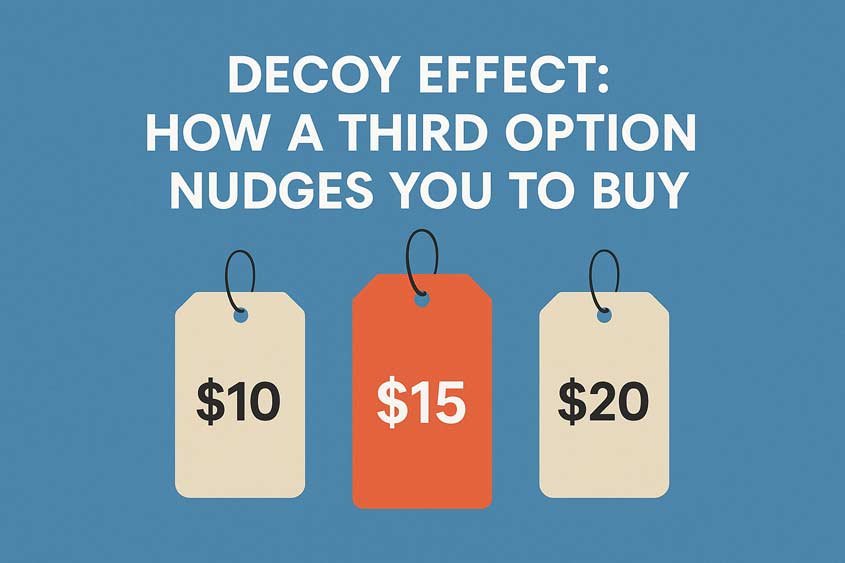
You’ve probably noticed it before, even if you didn’t realize it: when presented with three options, you tend to pick the one that seems “best” not because it’s perfect, but because another option makes it look so much smarter. That’s the Decoy Effect at work. It’s a psychological nudge that marketers have quietly used for decades, yet it often operates under the radar of conscious thought. The idea is deceptively simple: introduce a third option—usually less appealing in certain ways—and suddenly another choice looks far more attractive.
Think about the last time you went to a café and faced three sizes of coffee: small, medium, and large. You might have initially leaned toward the small because it seemed sufficient, but when you noticed that the medium is only slightly more expensive and gives much more, it suddenly feels like a smarter deal. The medium becomes the “winner,” but only because the small set the stage. That small, seemingly innocent option is the decoy.
Table of Contents
The Decoy Effect taps into how your brain evaluates value. We rarely make decisions in isolation. Instead, we compare options side by side, often unconsciously weighing pros and cons. This comparison amplifies certain features and diminishes others, guiding your choices subtly but powerfully. It’s one of several psychological triggers that marketers exploit—others include anchoring, scarcity, and social proof. The decoy doesn’t have to be attractive on its own; it just has to make the target option shine brighter by contrast.
Marketers love this trick because it works across industries. You see it in subscription services, electronics, restaurants, and even luxury goods. A software company might offer three subscription tiers, where the middle tier seems like a steal compared to the “premium” one that’s intentionally overpriced or the “basic” one that’s too limited. Suddenly, the decision isn’t about whether to subscribe at all, but which tier looks smartest. You’re nudged, without pressure, toward the choice the company wants you to pick.
Beyond businesses, you encounter the Decoy Effect in everyday life. Menu designs, gym memberships, insurance plans, airline seating—all often employ this nudge. The key is subtlety. If the “decoy” is too obvious, it backfires. People sense manipulation and may either reject the offer entirely or second-guess the choice. But when done skillfully, it’s almost invisible, guiding your decision while leaving you feeling autonomous.
Understanding the Decoy Effect isn’t just valuable for marketers—it’s equally crucial for you as a consumer. Recognizing when your choices are being shaped can help you make more deliberate decisions. When you notice a third option designed to influence your choice, you can pause and evaluate: is this really the best option for me, or am I just being nudged? Awareness can prevent unnecessary spending and help you resist subtle sales tactics.
Psychologists have long studied this effect, showing how our preferences shift when a third option is introduced. Even when the decoy is objectively inferior, it changes the perception of the other alternatives. Experiments reveal that people rarely notice this influence consciously. They think they’re making rational, independent choices, yet their decision architecture has been subtly manipulated. It’s a fascinating example of how human behavior can be influenced without overt persuasion—a gentle nudge rather than a hard push.
In marketing psychology, the Decoy Effect is prized because it’s low-cost and highly effective. Unlike advertising that relies on emotional appeals or flashy visuals, a carefully positioned decoy works simply through presentation and comparison. Its strength lies in leveraging natural decision-making patterns, capitalizing on the brain’s tendency to evaluate options relative to each other rather than in isolation.
So, whether you’re a marketer looking to ethically increase conversions or a consumer striving to make better choices, understanding the Decoy Effect gives you a significant edge. It’s a subtle but powerful force, shaping decisions quietly in the background, turning ordinary comparisons into strategic nudges. You’ll start noticing it everywhere—menus, pricing plans, product bundles—and each time, you’ll see how a third, carefully crafted option can tip the scales.
Keep reading, and you’ll not only grasp what the Decoy Effect is but also understand why it works, how it influences decisions, and how marketers use it strategically. More importantly, you’ll learn to spot it in action, giving you both marketing insight and consumer awareness.
Understanding Decoy Effect
The Decoy Effect is one of the most fascinating tools in marketing psychology because it works quietly, almost invisibly, to shape your decisions. At its core, it’s a comparison-based nudge: when faced with multiple choices, your preferences shift depending on how options are framed relative to each other. In other words, the mere presence of a third option—a decoy—can change what you perceive as the “best” choice.
This trigger relies on your brain’s natural tendency to evaluate things in relative terms rather than absolute ones. When you’re offered two products, you might weigh their features individually, but throw in a third option that’s strategically weaker in certain ways, and suddenly one of the first two options appears far more attractive. This shift is not conscious; you might feel like you are making a fully rational choice, but the setup has subtly guided you.
The decoy is not meant to be appealing on its own. Its sole purpose is to make another option—the target—look more valuable. Consider a streaming service offering three subscription plans: Basic, Standard, and Premium. The Basic plan is very limited, the Premium is very expensive, and the Standard is mid-tier. Suddenly, the Standard plan looks like a clear winner. The Basic option makes it seem too small, the Premium too costly, and the Standard offers the perfect balance. Without the decoy effect, you might have considered the Basic or even hesitated entirely.
This effect influences more than just purchases. It subtly shapes choices in any context where options can be compared. From choosing seats on a flight to deciding between smartphone models, the Decoy Effect can nudge preferences without any overt persuasion. People feel they have made the “best” choice freely, but the decision architecture has been strategically designed to guide them.
The influence of the Decoy Effect extends to perception of value, satisfaction, and even brand loyalty. By making one option appear superior, marketers can increase the likelihood of selection while maintaining the appearance of choice. This is why subscription services, bundled offers, and premium upsells often rely on decoy options. Your attention isn’t just on what’s offered—it’s on how each option looks next to another.
Several key features define the Decoy Effect in action:
- Relative positioning: The decoy exists to make another option look comparatively better.
- Asymmetrical dominance: The decoy is inferior in every way to the target option, but only in certain dimensions compared to other choices.
- Psychological nudge: Rather than forcing a choice, it subtly encourages the target option without obvious coercion.
A real-world example can help clarify. Imagine an electronics store selling headphones. They list three models: Model A is basic and cheap, Model B is mid-range, and Model C is very expensive but offers slightly better features than B. Model A makes B look good for its price; Model C makes B look like a bargain considering the small added value of C. Many buyers choose B—not because it’s perfect, but because the surrounding options shape their perception of value. The decoy options frame the choice.
The Decoy Effect interacts with other psychological triggers. Anchoring, for instance, sets a reference point—often a high price—that makes other options seem more reasonable. Scarcity and urgency can amplify the effect by adding pressure, while social proof reinforces the decision by showing that “others” also see the middle option as smart. Understanding these connections is crucial for marketers designing strategies and for consumers who want to recognize manipulation.
Interestingly, the effect is universal across different demographics and product types, though the exact influence can vary. Studies show that people with higher expertise in a product category may resist decoy options more effectively, but even seasoned decision-makers are not immune. The key is how choices are framed: context matters more than content.
The Decoy Effect doesn’t require overt persuasion or flashy advertising. It’s about structuring choices so your brain naturally gravitates toward the intended option. This is why menus, subscription plans, and pricing tiers often include deliberately weaker options—they provide a mental benchmark that highlights the perceived value of the target. It’s subtle, strategic, and surprisingly effective.
From a consumer perspective, recognizing the Decoy Effect empowers you to make more intentional decisions. When you notice a third option designed to influence choice, ask yourself: is this really the best option for me, or am I responding to a nudge? Awareness doesn’t eliminate the effect entirely, but it gives you the chance to pause and evaluate objectively.
The Decoy Effect is a psychological trigger that shapes decisions through strategic comparison. It influences perception of value, guides selection, and subtly encourages the choice a marketer wants without overt coercion. By understanding its mechanics, you can both leverage it ethically in marketing and protect yourself as a consumer from unconscious manipulation.
The Psychology Behind It
The Decoy Effect works because human decision-making is inherently comparative. Our brains are wired to evaluate options relative to each other rather than in isolation. This makes us highly susceptible to context-driven nudges, especially when a carefully designed decoy is introduced. To understand why this trigger works so effectively, it helps to break down the psychological mechanism step by step.
Step 1 – Framing the Choice
Every decision begins with framing. How choices are presented determines how your brain perceives their value. When two options are available, you naturally weigh their features against each other, often unconsciously. Introducing a third option—a decoy—changes the frame. Suddenly, one of the original options appears clearly superior.
For example, consider a restaurant offering two desserts: a small chocolate cake for $5 and a large one for $8. Some might hesitate, thinking the large is too expensive. Now, imagine a third option: an extra-large chocolate cake for $12 that isn’t meant to sell but to highlight the $8 cake as a better deal. Your brain compares all three, and the $8 option now feels like a clear winner. The decoy doesn’t need to be appealing—it simply shifts perception.
Step 2 – Relative Comparison
Humans rarely evaluate absolute value. Instead, we instinctively compare features like price, size, or quality. The decoy is designed to be inferior to the target option but may outperform the other original option in some dimensions. This asymmetrical dominance makes the target choice appear rational and attractive.
Key points of relative comparison:
- Your brain identifies which option dominates others in value for money.
- The decoy acts as a reference point that highlights the target.
- Even if you recognize the decoy is weaker, it still influences your perception.
Step 3 – Cognitive Ease and Decision Simplification
The Decoy Effect also leverages cognitive ease. When faced with multiple options, your brain seeks a path of least resistance to make a decision. The decoy simplifies evaluation by providing a contrast that makes one option stand out. Instead of analyzing every feature in depth, your mind quickly identifies the “smart choice” without deliberate reasoning.
This is why the Decoy Effect often works in subscription plans or product bundles. Presenting three tiers—basic, mid, and premium—reduces cognitive load. The mid-tier becomes the easiest and most sensible choice, even if your initial preference leaned toward the basic.
Step 4 – Emotional Reinforcement
Decision-making isn’t purely logical. The Decoy Effect often triggers an emotional response by framing the target option as a smarter, more rewarding choice. People feel satisfaction or relief when they perceive they are making the “best deal.” This emotional reinforcement further increases the likelihood of selection.
For instance, in a streaming service example, the mid-tier plan may offer slightly more features than the basic plan for a small price increase. You feel you’re getting value for money. The decoy (high-priced premium plan) makes this choice feel even smarter, tapping into the emotional payoff of being savvy.
Step 5 – Social Proof and Validation (Optional Layer)
While not necessary, marketers sometimes combine the Decoy Effect with social proof. Highlighting that “most customers choose this option” reinforces the perceived value of the target choice. The decoy sets the stage, and social proof validates it. Together, these triggers amplify influence.
The Process Summarized
At a high level, the Decoy Effect operates through these steps:
- Introduce a choice set with the target option and a decoy.
- Design the decoy to be asymmetrically dominated by the target.
- Guide perception through relative comparison.
- Reduce cognitive effort by making one option clearly preferable.
- Reinforce decision with emotional satisfaction or optional social proof.
Key Psychological Mechanisms at Play
The Decoy Effect taps into several well-established psychological principles:
- Asymmetrical dominance: The decoy is worse than the target in key aspects but may dominate the inferior option.
- Relative evaluation: Choices are evaluated comparatively, not absolutely.
- Cognitive shortcuts: Your brain seeks easy decisions to reduce effort.
- Emotional reward: Choosing the “best” option feels satisfying.
- Optional reinforcement: Social proof can strengthen the perceived value.
Why It’s So Powerful
The power of the Decoy Effect lies in subtlety. Unlike aggressive marketing tactics, it doesn’t scream for attention. It doesn’t rely on flashy visuals, urgent deadlines, or pressure. Instead, it reshapes perception quietly, guiding your decision through the way choices are presented.
You might assume you’re making an independent, rational decision, yet your brain has been gently nudged. This is what sets the Decoy Effect apart from other triggers like scarcity or reciprocity. It’s less about external persuasion and more about structuring the internal evaluation process itself.
In practice, the Decoy Effect works across industries because it exploits universal cognitive patterns. People everywhere—regardless of culture or background—compare options, seek cognitive ease, and respond emotionally to perceived value. That universality makes it an extremely reliable tool for marketers.
The Role of Decoy Effect in Marketing
The Decoy Effect isn’t just a psychological curiosity—it’s a practical tool that marketers use to shape decisions and increase conversions. By strategically positioning a decoy option, businesses guide consumers toward the choice they want without overt persuasion. This subtle influence is powerful because it operates beneath conscious awareness, creating a sense of autonomy while directing behavior.
Understanding its marketing impact requires examining how this trigger interacts with decision-making processes. Consumers rarely make choices in isolation; they rely on comparisons to determine value. The Decoy Effect leverages this natural tendency, making certain options stand out as the “smart choice.”
Framing Products for Maximum Appeal
One of the clearest ways marketers use the Decoy Effect is through product tiering. By offering three options—basic, standard, and premium—businesses can nudge customers toward the middle or higher-margin option. The key is in the decoy design: it must be inferior to the target in critical ways but still viable enough to highlight the target’s advantages.
For instance, a coffee subscription service might offer:
- Basic: $10/month, 2 deliveries
- Standard: $15/month, 5 deliveries
- Premium: $25/month, 6 deliveries
Even though the Premium plan offers slightly more than Standard, the jump in price makes Standard appear more reasonable. Here, Premium serves as a decoy, steering more customers toward Standard.
Increasing Perceived Value
The Decoy Effect enhances perceived value without altering the actual product. By introducing a strategically weaker option, marketers make the target choice appear more advantageous. This perception is crucial because consumers often base decisions on relative comparison rather than absolute value.
Consider a tech retailer selling three laptops:
- Laptop A: Basic, $800
- Laptop B: Advanced, $1,200
- Laptop C: Premium, $2,000
Laptop C, while superior in features, is intentionally priced high. When compared with A and B, Laptop B suddenly feels like a smart investment—good performance at a reasonable price. Laptop C acts as the decoy, highlighting the relative value of B.
Boosting Conversions and Revenue
Businesses benefit from the Decoy Effect because it can directly influence purchase behavior. By nudging consumers toward higher-value options, marketers increase revenue per sale while maintaining customer satisfaction. Customers feel they made the “right” choice, and companies improve profit margins without aggressive upselling tactics.
Key advantages in marketing applications include:
- Guiding customers toward mid- or high-tier products.
- Increasing average order value through perceived value.
- Reducing decision paralysis by simplifying comparisons.
- Enhancing customer satisfaction through perceived smart choices.
Applications Across Industries
The Decoy Effect isn’t limited to retail. Its influence appears in nearly every sector:
- Subscription services: Offering multiple tiers to drive mid-level adoption.
- Hospitality: Hotels or resorts presenting three room options to highlight the most profitable choice.
- Restaurants: Menus featuring small, medium, and large portions to encourage higher-spending orders.
- Consumer electronics: Tech gadgets presented in basic, standard, and premium versions to guide buyers.
The universality of this effect makes it a core tool in marketing psychology. It works because it aligns with natural human behavior: comparing options, seeking value, and aiming to make smart choices.
Enhancing Brand Strategy
Brands don’t just use the Decoy Effect to sell more—they use it to shape their positioning. By carefully designing product sets, marketers can communicate quality, exclusivity, or affordability without explicit claims. The decoy acts as a silent guide, emphasizing what the brand wants the consumer to value most.
For example, luxury brands often place extremely high-priced items alongside premium options. The ultra-luxury item serves as a decoy, making the premium option appear attainable yet high-quality. This strategy enhances perceived value and maintains brand prestige.
The Psychology Behind the Marketing Impact
Several cognitive principles make the Decoy Effect so effective in marketing:
- Relative evaluation: Consumers compare options and choose the one that seems dominant.
- Anchoring: The decoy provides a reference point, making the target appear reasonable.
- Cognitive ease: The structure simplifies decision-making, reducing analysis paralysis.
- Emotional payoff: Consumers feel satisfaction in making a “smart” choice, reinforcing the purchase.
These mechanisms work together to influence behavior without overt pressure, which is why marketers prefer decoy-based strategies over more aggressive tactics like heavy discounts or constant upselling.
Best Practices for Marketers
When applying the Decoy Effect, strategic execution is key. Marketers should ensure that:
- Decoys are positioned thoughtfully relative to target options.
- The inferior option highlights the advantages of the target, not just the flaws.
- Price and features are balanced so the decoy doesn’t overwhelm or confuse consumers.
- Other triggers, like scarcity or social proof, can complement but shouldn’t overshadow the decoy.
Summary of Marketing Impact
To summarize, the Decoy Effect shapes marketing outcomes by:
- Steering decisions toward profitable or strategic options.
- Increasing perceived value and customer satisfaction.
- Simplifying choice to reduce cognitive strain.
- Supporting brand positioning and perception.
Marketers who understand and ethically leverage this trigger can guide decisions effectively while maintaining trust and transparency. For consumers, recognizing the decoy helps you make more intentional, informed choices. It’s a subtle nudge, powerful in execution, and widely applied across industries.
Decoy Effect Real World Applications
Understanding the Decoy Effect in theory is valuable, but seeing it in action is what really illustrates its power. Across industries, marketers have leveraged this psychological nudge to guide consumer behavior and increase conversions. Here, we explore three real-world examples that show how the Decoy Effect operates in practical settings, supported by verifiable data and studies.
Case Study 1 – The Economist Subscription Experiment
One of the most cited examples of the Decoy Effect comes from a 2006 experiment conducted by Dan Ariely, a prominent behavioral economist. Ariely presented potential subscribers with three options for The Economist:
- Online-only subscription: $59
- Print-only subscription: $125
- Print + Online subscription: $125
At first glance, the print-only option seemed redundant compared to the print + online bundle, which offered more for the same price. The results were striking: nearly everyone who purchased chose the print + online bundle, while the print-only option was almost completely ignored.
This demonstrated the classic Decoy Effect: the print-only subscription acted as the decoy, making the bundle appear far more attractive. Without the decoy, consumer choices would likely have been more evenly distributed between online-only and print subscriptions.
Key takeaway: Introducing a decoy can dramatically influence which option consumers perceive as the “best value,” guiding behavior without coercion.
Case Study 2 – Popcorn Sizes at Movie Theaters
Movie theater concession sales provide another concrete example of the Decoy Effect in action. Researchers observed pricing strategies for popcorn and drinks, often structured as small, medium, and large sizes. One notable experiment at a cinema chain revealed that:
- Small popcorn: $3
- Medium popcorn: $6.50
- Large popcorn: $7
At first glance, the medium option might seem reasonable, but the large size—priced only slightly higher than medium—suddenly became the obvious choice. The medium acted as a decoy, making the large popcorn appear like a significantly better deal. As a result, theaters saw a measurable increase in large popcorn sales, boosting revenue without changing portion sizes or actual costs.
Key takeaway: Small changes in pricing and relative positioning can shift consumer preferences dramatically, even for everyday products.
Case Study 3 – Tech Product Bundles
Technology companies frequently use the Decoy Effect to drive adoption of mid-tier products. A well-documented example comes from software subscription models offering:
- Basic plan: Limited features, $10/month
- Pro plan: Most features, $20/month
- Premium plan: Slightly more features than Pro, $40/month
Here, the Premium plan serves as a decoy. While it offers marginally more features, its steep price makes the Pro plan seem like a “smart choice.” Data from SaaS companies using this structure shows a consistent increase in Pro plan subscriptions, sometimes by as much as 40%, compared to offering only Basic and Pro.
Key takeaway: Even in digital services, decoys can strategically shape choice architecture, influencing perceived value and driving more profitable decisions.
Lessons from Real-World Applications
From print media to popcorn to tech subscriptions, these examples highlight common patterns in the Decoy Effect:
- The decoy is never intended to sell; it’s a strategic contrast.
- Small differences in pricing or features can create powerful shifts in perception.
- Consumer behavior is more influenced by relative comparisons than absolute value.
- The effect works across industries, product types, and demographics.
Combining the Decoy Effect with Other Triggers
Successful marketers often pair the Decoy Effect with complementary psychological triggers for even greater impact:
- Anchoring: High-priced decoys set a reference point for other options.
- Scarcity: Limited availability can amplify the urgency of the target option.
- Social Proof: Highlighting what most consumers choose reinforces the perceived value of the target.
By understanding these intersections, businesses can design choice architectures that guide behavior ethically while maximizing satisfaction and perceived value.
In conclusion, real-world examples show the Decoy Effect is not just a theory but a practical, evidence-backed tool. Whether it’s guiding subscriptions, boosting concession sales, or shaping tech adoption, the strategic placement of a decoy consistently shifts consumer behavior. Recognizing this effect allows marketers to design effective offers while enabling consumers to make more informed choices when they notice the nudge.
How People Respond
Consumers show consistent, observable behavior when they face a choice set shaped by a decoy. You see the same response pattern across pricing tests, product bundles, subscription tiers, and even donation requests. The reaction is not random. People shift toward the option that gains relative advantage once the decoy enters the set. This pattern appears across controlled experiments in behavioral economics and consumer psychology.
Initial Evaluation: People Try to Make Sense of the Options
When consumers see two options, they often compare them using simple criteria. They evaluate price, value, size, or features. This comparison is still effortful, but people usually manage it. The reaction changes when you add a third option that is clearly worse than one of the existing choices.
Consumers start anchoring their evaluation on relative differences. They no longer judge each option independently. They judge the target option through the lens of the inferior decoy. This shifts the weight of the comparison. The target option becomes easier to justify because the decoy exaggerates its strengths.
Several studies in behavioral economics show this pattern. For example, Dan Ariely tested subscription options in controlled experiments and found that adding a dominated option increased the selection rate of the target choice. The reaction is consistent. People gravitate toward the option that gains relative superiority.
Shift Toward the Option Made Superior by Comparison
Consumers increase their likelihood of choosing the target once the decoy makes it look stronger. This response appears even when consumers claim they act rationally. The shift comes from the decision structure, not awareness. You see the same pattern in product pricing experiments, menu design, and tech plan comparisons.
The reaction occurs because the decoy highlights differences that were easy to ignore before. The target now feels like the better tradeoff. People want to avoid feeling they picked something inferior. The decoy makes that easier by creating an obvious loser. When consumers see the decoy as a bad option, they often move to the alternative that beats it on all relevant attributes.
This shift is more visible when consumers feel uncertain. More complexity increases this effect. People try to eliminate difficult questions by choosing the option that gives a clear comparative win.
How People Justify Their Choice Internally
Consumers rarely say they picked the target because a decoy influenced them. They justify their choice with rational reasons. They mention value, smart budgeting, or better features. They do not mention the comparative structure shaped by the decoy.
Research on decision justification shows that people prefer choices that feel defendable. The decoy supports this need. It creates a clear reason to choose the target. The consumer feels more confident because the target dominates the decoy. This dominance feels like evidence of good judgment.
People rely on mental shortcuts. They use the decoy as a reference point. The target becomes the safe, reasonable, balanced option.
Observable Behavior Patterns
Across experiments and real-world cases, you see repeated patterns that signal decoy-driven choices. These behaviors appear regardless of product type. The mechanism comes from how people evaluate differences, not from the specific item.
Key patterns include:
- Consumers choose the option that dominates the decoy at a higher rate compared to scenarios without the decoy.
- Consumers show stronger confidence in the target choice because it looks more reasonable relative to the decoy.
- Consumers spend more when the decoy pushes them toward a higher priced option.
- Consumers accept tradeoffs they previously ignored once the decoy highlights them.
- Consumers report feeling they made a more informed decision even when the decoy had no real purpose.
These reactions appear in digital subscriptions, food ordering, furniture pricing, SaaS plans, and donation structures.
Why the Reaction Is Predictable
The predictable response comes from how the human brain handles comparisons. People use relative evaluation. The decoy simplifies the comparison by giving the target a clear advantage. People enjoy choices that feel asymmetric. A decision that feels like a win against a weaker option provides psychological comfort.
Controlled studies using decoy-based choice sets show that people choose the target at higher rates even when the decoy has zero functional value. The reaction stays consistent when researchers adjust price ranges, product categories, or buyer demographics. The key variable is the dominance relationship, not the absolute features.
The predictability comes from basic cognitive processes. People want to minimize effort. The decoy reduces effort by making the target feel like the best compromise. The reaction occurs even in high-stakes situations like insurance or medical plan selection, although regulatory environments try to limit exploitative structures.
Behavioral Drivers Behind the Response
Three main behavioral drivers shape how consumers react.
1. Relative comparison
People compare options relative to each other. The decoy magnifies the target’s strengths. This makes the target feel better than before even though its attributes remain the same.
2. Avoidance of loss and regret
Choosing the target feels safer because it beats the decoy on multiple fronts. People avoid the feeling of missing out on value. They move toward the option that seems to protect them from future regret.
3. Cognitive ease under uncertainty
A three-option set builds complexity. The decoy reduces this complexity by guiding the consumer toward the target. It gives the decision a sense of clarity.
Typical Sequence of Consumer Behavior
You often see the same sequence unfold:
- The consumer looks at the options and tries to compare them.
- The consumer notices the decoy looks clearly worse than one option.
- The consumer starts comparing the decoy with the target instead of evaluating all choices independently.
- The consumer feels the target delivers better value.
- The consumer chooses the target and feels confident in the decision.
This sequence is reliable. It appears whether the consumer is looking at movie popcorn sizes, gym membership tiers, insurance bundles, or streaming service plans.
What Consumers Believe They Are Doing
Consumers think they made a rational decision. They believe they compared features and selected the best value. They do not recognize that the choice structure guided them. This disconnect is important. The subjective belief does not match the actual mechanism. Studies that ask participants to explain their choices consistently find that people do not mention the decoy.
The consumer response to the decoy effect is consistent and measurable. People make predictable shifts toward the target. They do so because the decoy changes the comparison structure. The reaction is observable in experiments and real-world data. It stems from cognitive shortcuts that guide how people evaluate differences.
Strategic Use in Marketing
Brands apply the decoy effect to guide consumers toward options that deliver clear value without misleading them. Ethical use matters because consumers deserve transparency. The goal is to support decision clarity, not to push people into choices that work against their interests. When used with care, the decoy effect helps consumers compare options more easily and choose offers that match their needs.
Designing Clear and Transparent Option Structures
Brands first decide how to structure a set of choices. Ethical application begins with transparency. All options must stand on real value. A decoy should never hide critical information or distort what the consumer receives. Instead, the decoy should help consumers notice tradeoffs that already exist.
A clear example appears in subscription services. A brand may offer a basic plan, a premium plan, and a mid tier plan that resembles the premium version but carries lower value for the same or almost the same price. The mid tier guides attention toward the premium plan. This works only if the premium plan delivers real benefits that justify the cost.
Clarity reduces confusion. It helps consumers see which option matches their usage level or long term goals. Ethical design avoids exaggerated claims or unclear restrictions.
Improving Product Tiering for Better Decision Support
Product tiering becomes easier when brands apply the decoy effect responsibly. The key is to build tiers that differ in meaningful ways. When consumers compare options, the differences must be easy to understand. The decoy helps highlight these differences, not hide them.
Many software companies adopt tiered structures based on real features. The decoy helps users notice the step where the value becomes worth the higher price. Ethical use ensures that no tier includes empty features or misleading labels. The consumer should gain something measurable with each upgrade.
The result is a decision structure that reduces cognitive load. Customers can select the tier that fits their needs without pressure or confusion.
Supporting Value Communication
A major challenge in marketing is helping consumers understand value. People do not always see how a specific feature translates into benefits. A well positioned decoy brings clarity. It shows the added value of a product by presenting a weaker alternative. The consumer sees a clear relationship between price and capability.
Brands often use this method in physical retail. They display three versions of a product. One fits the budget segment. One offers a complete set of features. One acts as a decoy with a price that makes the fully featured product look like a strong deal. This approach works only when the fully featured product genuinely supports the customer.
Communicating value becomes easier because the comparison helps the customer see what matters. Ethical use ensures the decoy is not deceptive. It must represent a real offer with clear limitations.
Applying It to Menu Design and Retail Layouts
Restaurants and retailers sometimes use a decoy to draw attention toward an option that delivers better value per unit. This approach helps customers make sense of portion sizes or item bundles. The decoy highlights the mid or upper option to show which choice offers the most practical cost per benefit.
For example, a cafe may offer a small drink, a medium drink priced slightly below the large drink, and a large drink that offers significantly more volume. The medium may serve as a decoy. This helps customers who were unsure pick the option that aligns with their consumption habits. The brand does not mislead the customer. The value difference is real and visible.
Retailers might use decoys when arranging bundles. If the premium bundle actually saves the customer money when viewed per unit, a decoy bundle can make that saving easier to see.
Creating Ethical Price Communication
Price communication can stress consumers. Ethical use of the decoy effect helps them make a confident choice without manipulation. The brand presents all costs openly. The decoy clarifies where the best value lies. The consumer still has full control.
Brands that use the decoy effect ethically maintain honesty in each price tier. They never hide fees or present misleading comparisons. They support the consumer by revealing which option aligns with higher performance, longevity, or convenience.
This approach leads to trust. When customers see that the recommended option genuinely offers real value, they feel comfortable with the decision.
Building Confidence in Donation and Fundraising Choices
Donation platforms also use the decoy effect. They present suggested amounts. The decoy can help donors decide how much to give by showing a level that is clearly dominated by a more impactful amount. The donor still makes the final decision based on their intention.
Ethical use ensures that the decoy amount does not exploit guilt. Instead, it helps donors understand the relationship between giving amounts and project impact. This builds honest motivation and long term trust.
Ensuring the Offer Works for the Consumer
Ethical practice requires that the chosen target option benefits the consumer. The decoy must highlight advantages that matter. Useful factors include extended value, increased capacity, better durability, or improved support. The decoy draws attention to what the consumer gains.
The brand must check if the target genuinely improves the user experience. If not, the structure becomes manipulative. Long term trust comes from creating offers that match needs.
When Brands Should Not Use the Decoy Effect
There are situations where using a decoy is not appropriate. These include cases where customers face high risk decisions such as insurance or medical plans. Regulations often restrict structures that could mislead vulnerable groups. Brands must respect these contexts. Ethical practice means avoiding the technique when consumers need independent evaluation.
Another case involves essential products. The decoy effect should not push consumers into unnecessary costs. When a basic option covers their needs, the brand must present it clearly.
Practical Guidance for Ethical Implementation
Brands can follow practical guidelines to apply the decoy effect responsibly. These guidelines keep the strategy transparent and consumer centered.
- Make sure every option provides real and measurable value
- Ensure the target option is genuinely beneficial
- Present differences in clear language without vague claims
- Avoid hiding features or adding conditions that confuse the comparison
- Test the offer with real users to confirm that the structure helps rather than misdirects
- Use the decoy only in categories where consumers benefit from guidance
- Avoid applying the decoy to essential or high risk decisions
These principles support ethical and effective use.
Making the Structure Easy to Understand
The role of the decoy is to simplify comparison. Brands should design visual layouts that present information in a clear order. Size, placement, and wording matter. The consumer must understand all three options without effort. This reduces decision fatigue.
Good practice includes using consistent units, accurate labels, and straightforward descriptions. This makes the decoy visible and honest. It guides attention without concealing facts.
Gaining Trust Through Consistent Value
When brands use the decoy effect well, customers see consistency. They notice that the recommended option supports better outcomes. This builds trust because the structure matches their needs. They feel confident in future purchases.
Over time, consistent and ethical use creates a positive reputation. Customers return because they feel supported, not pressured.
Realistic Use Across Business Models
The decoy effect applies across many business models. Subscription services, consumer tech, food service, retail shops, and online education platforms all use it. The core rule stays the same. The brand guides attention toward the most balanced option. That option must genuinely deliver strong value.
Ethical use ensures the decoy functions as a reference point and not a trick. Businesses that follow this rule gain long term customer trust.
Balanced Application That Respects Consumer Autonomy
Respect for autonomy matters. Consumers must always feel free to choose any option. Ethical use of the decoy effect never hides the full picture. It does not remove the consumer’s ability to judge based on their own priorities.
The purpose is decision support. It helps consumers see relative differences. It does not push them into commitments they do not want. Brands that respect autonomy maintain customer loyalty.
The decoy effect becomes a powerful and responsible marketing tool when used with clarity, honesty, and genuine value. Brands that design transparent option sets help consumers make choices that match their needs. Ethical application ensures the strategy builds trust rather than undermines it.
Pitfalls to Watch
Using the decoy effect can work wonders when you structure it well, but it can backfire fast when brands get careless. Some marketers fall in love with the trick and forget the human on the other side of the choice. Others push the decoy so hard that consumers notice the manipulation and lose trust. Once that happens, everything collapses. You can’t rebuild that kind of trust easily, no matter how clever the next campaign looks.
The whole point of the decoy effect is to make decisions easier, not to trap anyone. When a brand misuses it, the decision becomes murky, pressure driven, or flat out confusing. And confusion kills conversions quicker than a high price ever will.
Below are the big mistakes brands run into. Many of these show up when companies chase short term gains without thinking through the long term relationship with their customers. You’ll spot a pattern: bad execution always comes from ignoring how the consumer thinks. And this is ironic, because the decoy effect is supposed to help people think more clearly, not less.
Overcomplicating the Choice Structure
One of the fastest ways to make the decoy effect useless is to cram too many choices into the offer. Some marketers think more options equal more psychological power, but the opposite happens. People freeze.
If the choice matrix looks like a puzzle, the decoy won’t stand out. Consumers can’t identify the target option, the comparison breaks down, and the effect loses meaning. Behavioral science research shows that reducing cognitive load increases decision clarity. When the options stack becomes overwhelming, your audience takes the safest path, which is usually no purchase at all.
This mistake often comes from a desire to please every possible segment. The truth is that the decoy effect works best with three options. Adding a fourth or fifth makes everything messy. You want the decoy to act as a clear reference point. Anything beyond that dilutes the impact.
Making the Decoy Too Obvious
A decoy should be subtle enough that consumers feel like they reached the “smart choice” themselves. If the decoy screams manipulation, people pull back. No one likes feeling tricked.
This usually happens when the decoy is outrageously worse or absurdly overpriced. Instead of guiding the choice, it exposes the tactic. That destroys trust and can damage brand perception beyond the specific offer. Once customers feel manipulated, even neutral pricing structures start to look suspicious.
The best decoys are believable. They are weaker, not ridiculous. They follow the same logic as the other options but with strategically inferior value.
Using the Decoy in the Wrong Context
Not every product or service benefits from a decoy. Some categories rely on straightforward comparisons where a decoy would create unnecessary friction. Essentials, medical items, or sensitive financial products should avoid it completely because the added layer of manipulation harms credibility.
Even in everyday purchases, the decoy effect can misfire when consumers already know what they want. If shoppers come in with strong preferences or previous price knowledge, the decoy loses power. Worse, it may irritate them.
The decoy works best when customers are uncertain, open to guidance, and comparing value. Forcing it into markets where these conditions don’t exist leads to wasted effort.
Creating Decoys That Don’t Match Consumer Priorities
Sometimes the decoy focuses on features the consumer doesn’t even care about. When that happens, the comparison loses purpose. The decoy effect depends on highlighting relevant value. If the decoy draws attention to things your audience doesn’t value, the entire structure collapses.
This often happens when marketers design pricing in isolation instead of talking to customers or analyzing behavior. Maybe you highlight extra storage when users care more about battery life. Maybe you emphasize extra toppings when people want healthier ingredients. When the decoy misaligns with real priorities, it becomes meaningless.
The psychological trigger works only when the comparison feels logical inside the customer’s mental model.
Trying to Use Decoys Without Real Value in the Target Option
The decoy effect cannot save a weak offer. If the target option is overpriced or padded with features that add no real value, the decoy won’t fix that. Consumers will still reject it.
Some marketers rely on the decoy as a shortcut instead of improving the product. That’s a dangerous move. You can’t hide a bad deal behind a weaker deal. Consumers today compare, evaluate, and talk. They share impressions online. They sense when something feels off.
The decoy effect supports value communication. It doesn’t replace value.
Making Every Tier Look Like a Trick
Brands sometimes repeat the decoy effect across multiple funnels, menus, and pages. When everything feels engineered, customers notice. Instead of helping them decide, you create a pattern of manipulation.
You should use the decoy strategically, not everywhere. Consumers are quick to recognize recurring patterns. If they see a decoy behind every corner, the trust disappears. And trust is far more valuable than a temporary bump in conversions.
Ethical marketing means respecting the customer’s intelligence. Use the decoy where the comparison makes sense, not as a default pricing strategy.
Ignoring Consumer Segmentation
A decoy that works for one segment may fail for another. Beginners, experts, loyal customers, and price sensitive buyers interpret value differently. The decoy must be designed with the right user in mind.
For example, experts know the pricing landscape well. They might interpret the decoy as a gimmick. Meanwhile, beginners benefit from the clarity the decoy creates. Mixing these groups inside one structure can lead to confusion.
Segment based decoys often perform better because they mirror the audience’s natural expectations.
Failing to Maintain Transparency
If consumers struggle to understand what they’re paying for, the decoy becomes manipulative. You must present the price, features, limitations, and value clearly. When brands hide details or bury important information, the decoy backfires. It feels unfair.
Transparency doesn’t weaken the decoy. It strengthens it. The whole purpose is to make comparison easier, not harder.
Relying on the Decoy Without Testing It
Many marketers assume their decoy will work because the theory sounds good. In reality, decoys behave differently in every category. You need real world data.
A decoy should be A/B tested, studied through user sessions, and refined. Sometimes a small shift in price changes the entire effect. Sometimes adding or removing a feature changes the perceived value. Without testing, you’re flying blind.
Testing reveals whether the decoy helps or confuses. It also protects you from launching a structure that might push customers away.
Forgetting Long Term Brand Health
A decoy might lift conversions today but harm credibility tomorrow if it feels manipulative. Some brands optimize only for short term revenue and ignore consumer sentiment. Behavioral triggers, including decoys, should strengthen the brand relationship, not weaken it.
When customers feel supported, they trust future offers. When they feel tricked, they avoid the brand.
The decoy effect must always work inside a long term strategy that values loyalty, satisfaction, and retention as much as immediate results.
Common Errors That Reduce Impact or Create Pushback
Here’s a quick list of the mistakes that most often ruin the decoy effect or provoke negative reactions:
- Adding too many options, which can overwhelm comparison
- Making the decoy unrealistic or blatantly inferior
- Using the decoy in categories where trust is critical
- Highlighting features the audience doesn’t care about
- Building decoys to compensate for weak products
- Repeating the tactic so often that it becomes predictable
- Ignoring the different needs of consumer segments
- Hiding key details that affect perceived value
Closing Thoughts on Smart Execution
When you design a decoy correctly, your audience feels empowered. They choose the more valuable option because they understand it. They appreciate the clarity. But when you get sloppy, everything flips. The consumer feels manipulated, pressured, or confused.
The decoy effect is a precision tool. You can’t treat it like a blunt instrument. Good execution respects the buyer’s mind, supports decision clarity, and builds long term trust.
Best Practices
If you’ve made it this far, you probably understand the decoy effect really well. Now it’s time to talk about using it in a way that actually helps your audience decide instead of overwhelming or irritating them. There’s an art to this. You’re not just placing an oddball option in the middle and hoping people wander toward the one you want. You’re shaping perception by clarifying value. When you do that well, customers feel more confident, not more pressured.
A good decoy doesn’t trick anyone. It creates contrast. It lets your ideal option stand out so clearly that people naturally lean toward it. And the beauty is, a well crafted decoy pushes conversion without ever needing aggressive persuasion. It strengthens trust, especially when you pair it with other psychological triggers like social proof, cognitive ease, or the scarcity effect. When these elements line up, your offer feels more obvious and more compelling at the same time.
Below are the best practices for applying the decoy effect in your marketing. Think of these as your go to moves when crafting pricing tables, subscription tiers, service packages, and even physical product configurations. The goal is to make your audience’s decision simpler, lighter, and more intuitive.
Start With a Clear Target Option
Before you design a decoy, you need to know exactly which option you want customers to choose. Some marketers get this backward and create random tiers hoping one becomes the winner by accident. That’s the fast way to confusion.
You build the decoy around the target, not the other way around. Ask yourself: What is the option that actually delivers the best experience, the best margins, or the highest customer satisfaction? That’s your anchor.
Once the target is chosen, you can craft the decoy to highlight its strengths. This keeps the structure intentional and prevents messy price comparisons.
Keep the Comparison Simple
The decoy effect works best when consumers can compare options quickly. You want them to look at the decoy, glance at the target option, and go oh, of course this one makes more sense.
That means keeping your tiers simple. Don’t overload each option with dozens of features. Three to five key items work well. Too much detail increases cognitive load, and the whole effect collapses. Remember, people skim. They decide fast. Make your value obvious in seconds.
You don’t want the decision to feel like a math problem. You want it to feel like a relief.
Use Features That Matter to the Audience
A decoy only works when the difference between the options matters to the customer. If you create a decoy based on features that nobody cares about, the comparison becomes meaningless.
This is where a bit of research goes far. Keep an eye on user questions, objections, wish lists, even what people complain about. These spots reveal what your buyers pay attention to. Use those elements in your comparison.
If battery life matters, highlight it. If customer support matters, make it loud. If quantity or size is the biggest decision driver, keep those front and center. Align the decoy with true priorities.
Make the Decoy Inferior, Not Ridiculous
The decoy should be less attractive than the target option, but still believable. If it looks absurd, the audience sees the trick. You want the decoy to feel like a legitimate option somebody might choose in theory, even if very few actually would.
For example, offering a subscription for ten times the price with half the features is a bad move. It looks like manipulation. A better decoy is slightly overpriced with slightly worse value. It should push the buyer gently, not aggressively.
Subtlety is the secret here.
Position the Decoy Close to the Target
For the decoy effect to work, the decoy must be similar enough to the target option that people compare them directly. If the decoy feels like a totally different category, consumers won’t connect the dots.
Keep the structure like this: entry option, decoy option, target option. That three tier layout is the sweet spot for most markets. It creates a natural flow. People see the cheap option, realize it lacks some essentials, then compare the two higher options. The target wins because the decoy makes it look smart.
Use It Sparingly and Intentionally
If you try to use the decoy effect everywhere, it becomes predictable. Consumers start noticing the tactic, which makes the decoy useless. Use it only in situations where customers genuinely benefit from clearer comparisons.
Think about pricing pages, upgrade prompts, product bundles, menu configurations, B2B service tiers, or feature based subscriptions. These are perfect environments for decoys because you’re helping customers choose between versions of the same thing.
Choose moments that matter. Don’t force the technique into places where simplicity alone works better.
Combine It With Transparency
Transparency doesn’t hurt the decoy effect. It strengthens it. When customers clearly understand what they’re getting, they don’t feel tricked. They feel empowered.
Make your price breakdown clear. Describe the features in plain language. Avoid fine print that hides limitations. The decoy effect should enhance clarity, not create suspicion.
Trust amplifies every psychological trigger. Without trust, nothing works.
Use Real Value, Not Artificial Padding
The decoy effect isn’t a shortcut to avoid building better offers. Some marketers try to create decoys by stuffing options with meaningless bonuses or fake value. Consumers are too savvy for that.
Your target option should genuinely be better. Not marginally. Not artificially. Real value wins every time. The decoy simply highlights that value.
If the product isn’t good, the decoy won’t save it.
Test and Adjust Based on Real Behavior
No matter how well you design your decoy, your assumptions might still be off. People behave in surprising ways. That’s why testing matters so much.
Run A/B tests with different price gaps, feature combinations, or decoy placements. See where buyers naturally gravitate. Even small adjustments can change results dramatically.
Sometimes the decoy works too well, and people skip the target for the premium tier. Great problem, but you still want to understand why. Other times, the decoy fails because the price difference feels unrealistic. Data helps you refine the tactic.
Testing is how you turn theory into profit.
Use Other Psychological Triggers to Support It
A decoy is powerful on its own, but when you combine it with other triggers, your conversions can lift even more. Consider layering in social proof, the priming effect, authority signals, or cognitive ease.
For example, showing that most customers choose your recommended option reinforces the pull of the decoy. Presenting a clean layout and clear color coding makes comparison easier. Using a familiar design reduces friction.
Each trigger adds clarity or confidence. When they work together, your buyer’s path becomes smoother than ever.
Actionable Tips
Here’s a quick pack of practical tips you can use right away when creating decoys in your offers:
- Decide your target option before building the decoy
- Keep the comparison simple and easy to skim
- Match features to real consumer priorities
- Build a decoy that’s inferior but still believable
- Place the decoy close to the target tier
- Use the decoy only where it enhances clarity
- Maintain transparency in pricing and features
- Avoid fake value padding or gimmicks
- Test different configurations based on real behavior
- Strengthen the decoy with other psychological triggers
Wrapping Up the Practical Side
When you apply the decoy effect with intention, your customers feel like they’ve made a smart, confident choice. They walk away satisfied because the comparison helped them, not pressured them. That’s the real magic, and it’s why the decoy effect remains one of the most elegant pricing tools in marketing psychology.
Your goal isn’t to manipulate. Your goal is to guide. And if you do that with clarity, transparency, and respect, this trigger becomes one of the most powerful assets in your entire strategy.
Spot The Trigger
Exercise 1
A sportswear brand launches a new campaign with the slogan “Run for the Planet.” For every pair of shoes sold, they promise to plant two trees. The ad shows runners of all backgrounds, smiling, connecting, and jogging through green parks. You feel good just watching it and you start wondering if your next pair should come from them.
Question: Is the brand using the Decoy Effect? (True or False) | Check Answer
Exercise 2
A streaming service promotes three subscription options. The Basic Plan has limited content. The Premium Plan includes all content and offline viewing. The service adds a new Standard Plan that costs almost as much as the Premium Plan but offers only slightly more than the Basic Plan. Most people who compare the options end up picking Premium.
Question: Is the advertiser using the Decoy Effect? (True or False) | Check Answer
Exercise 3
A coffee chain introduces three cup sizes. The small is low priced, the large is pricey, and a new medium size is priced slightly below the large but offers far less volume. Most customers shift from buying small to choosing large after the new option appears.
Question: Is the advertiser using the Decoy Effect? (True or False) | Check Answer
Final Thoughts
The Decoy Effect shapes how you choose among similar options. You respond to the structure of the offer even when the products stay the same. When a business adds a choice that looks weaker or less useful, the strongest option becomes more appealing. Your mind compares the options side by side. You gravitate to the one that seems to offer the best value within that specific lineup. This happens because you judge items in relative terms. You want the choice that feels like a smart decision when placed next to something worse.
The core idea stays simple. A decoy is an option that you are not expected to pick. Its purpose is to redirect your attention toward a higher value choice from the seller’s perspective. It shifts your perception of price, features, or quality. You do not analyze the market in full. You analyze the small set of items in front of you. This limited frame gives the advertiser a chance to guide your judgment. The decoy works because comparison is easier than full evaluation. You rely on shortcuts. You look for the better deal inside the group. The structure of the group shapes your decision.
This trigger plays an active role in many marketing actions. Brands use it to move customers toward premium plans, larger product sizes, or higher margin bundles. A business can change how customers behave without altering the main product. It only needs to adjust the set of choices. When the company introduces a weaker alternative at a strategic price or with lower features, the preferred option looks stronger. You feel more confident choosing it. This confidence comes from the sense that you weighed real alternatives and found the best one.
You see this effect in digital platforms, retail pricing, subscription models, and product packaging. You encounter it when looking at membership plans, takeout menus, or software tiers. The influence rarely feels aggressive. It works quietly in the background. You believe you reached the conclusion yourself because the decision seems logical based on the options shown. This makes the effect powerful. It directs your reasoning without removing your sense of choice.
Understanding the Decoy Effect helps you make better decisions. When you see a set of three options where one looks oddly weak or oddly close in price to the top tier, pause and compare more carefully. Ask if the middle or lowest option exists only to push you toward the highest value choice. When you recognize the structure, you can decide based on your actual needs rather than the frame built by the advertiser. You gain control over the buying process.
For marketers, this trigger works best when used with transparency and fairness. Customers respond well when the choices still deliver real value. Misuse can lead to distrust. Ethical use supports clear communication. The decoy should guide, not mislead. When used responsibly, the Decoy Effect helps customers understand the advantages of a premium or preferred offer. This benefits both sides. You get a clear path to a high value choice. The brand gets more consistent conversions.
The Decoy Effect matters because it changes how you judge value. It shapes decisions through the structure of the choice set. When you understand the mechanism, you see the pattern across many industries. You become more aware of how choices are built and why they influence you. This awareness lets you decide with intention.

Gabriel Comanoiu is a digital marketing expert who has run his own agency since 2016. He learned marketing by testing, analyzing, and refining campaigns across multiple channels. In his book series Impulse Buying Psychology, he shares the psychological triggers behind every purchase, showing how to create marketing that connects, persuades, and converts.